Mapping the New Finance Ecosystem: Nine Major Sectors in a 'Hundred Regiments Battle', with Tokenization, Stablecoins, and Neo-Banks as the Main Battlefields

marsbitPublicado a 2026-01-19Actualizado a 2026-01-19

Resumen

Andy, founder of The Rollup, outlines the landscape of Neo Finance in 2026, identifying it as the fastest-growing sector in the global financial system. The ecosystem comprises nine major segments, including over 100 projects, with tokenization, stablecoins, and neobanking highlighted as the primary growth areas. Tokenization of real-world assets like bonds and commodities is gaining significant traction. Stablecoins remain the top entry point for new users, with yield-bearing variants growing exponentially. Neobanks are leveraging DeFi infrastructure to offer consumer-friendly banking experiences with superior yields. The article emphasizes that outdated crypto practices are fading, and a new financial era driven by utility and adoption is emerging.

Author: Andy, Founder of The Rollup

Compiled by: Felix, PANews

Andy, the founder of The Rollup, recently published an article discussing the market landscape of Neo Finance in 2026, pointing out that Neo Finance will become the fastest-growing sector in the global financial system. Below are the details.

The Neo Finance sector will give birth to more true 'billion-dollar unicorn' companies than ever before. It is poised to become the fastest-growing sector in the global financial system for years, and even decades, to come.

Below is the market landscape for Neo Finance in 2026, covering nine major segments and over 100 ecosystem projects:
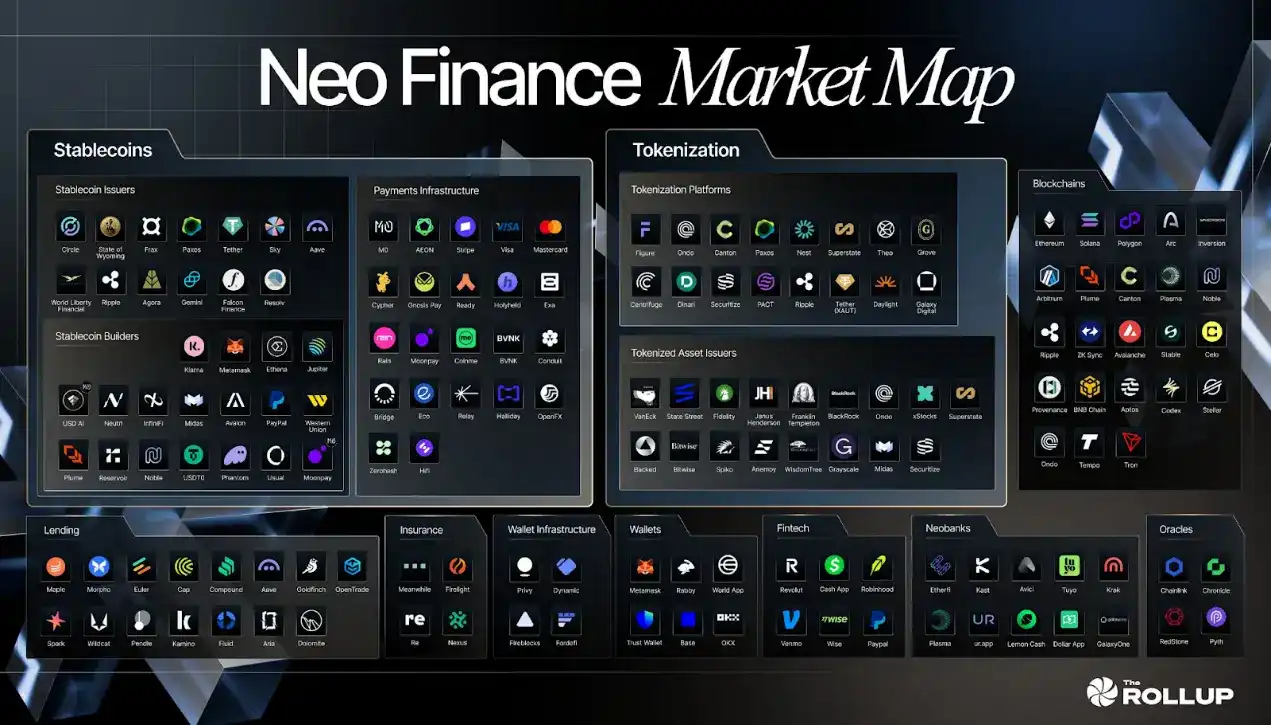
The combination of front-end consumer-grade user experience and back-end efficient DeFi infrastructure will provide users with a 'bank-like experience' that is both familiar and far superior to traditional banking.

Users' savings can be traded and transferred globally and are available 24/7. A simple example: a user's 'checking account' could earn a 5% annual interest rate, compared to 0.25% from a traditional bank.

Driven by teams focusing on different parts of the technology stack, the Neo Finance market has the potential to fundamentally change how the world interacts with money.

Let's take a look at some key areas in the market map.

Tokenization

Tokenization is the process of bringing real-world assets (such as treasury bonds, stocks, commodities, credit, money markets, etc.) on-chain.

The infrastructure and tokenization agent layer includes: Figure, Ondo Finance, Paxos, Centrifuge, Superstate Inc, Midas, Grove Finance, Nest, Dinari, Securitize, and other companies.
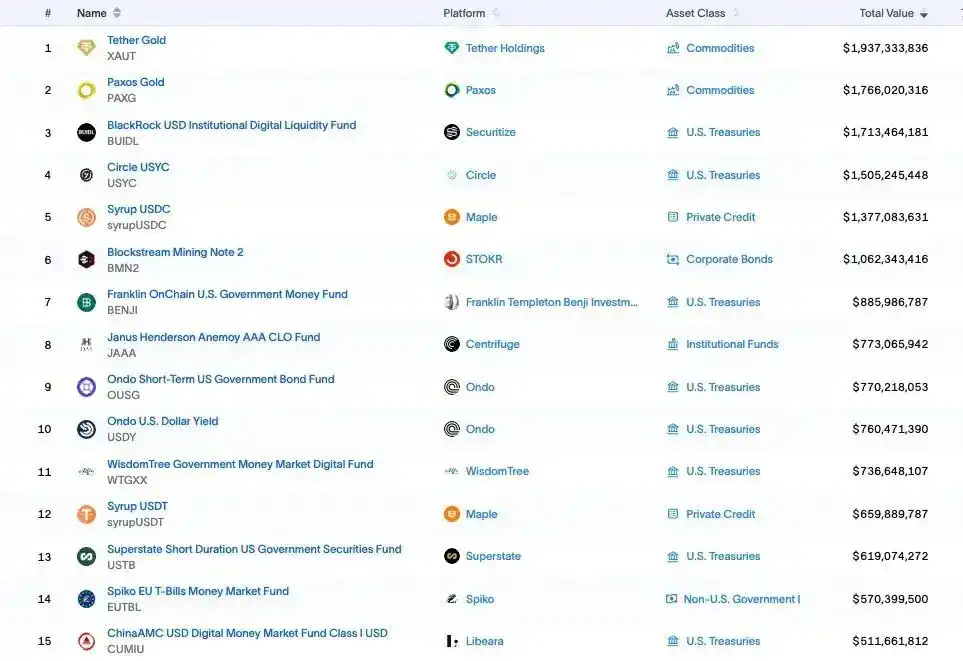
Tokenization has been discussed for years, but 2025 is the year it truly begins to scale.

Stablecoins

Stablecoins are by far the most successful crypto product, with 90% of new finance customers preferring stablecoins as their first point of contact with cryptocurrency.

The stablecoin issuer sector is booming, with numerous companies emerging, such as: Circle, Paxos, Tether, and Sky.

Meanwhile, yield-bearing stablecoins (or 'yield coins') like $sUSDS, $sUSDe, $BUIDL, $USYC, and $syrupUSDC have seen exponential growth over the past 18 months, with a supply exceeding $13 billion.
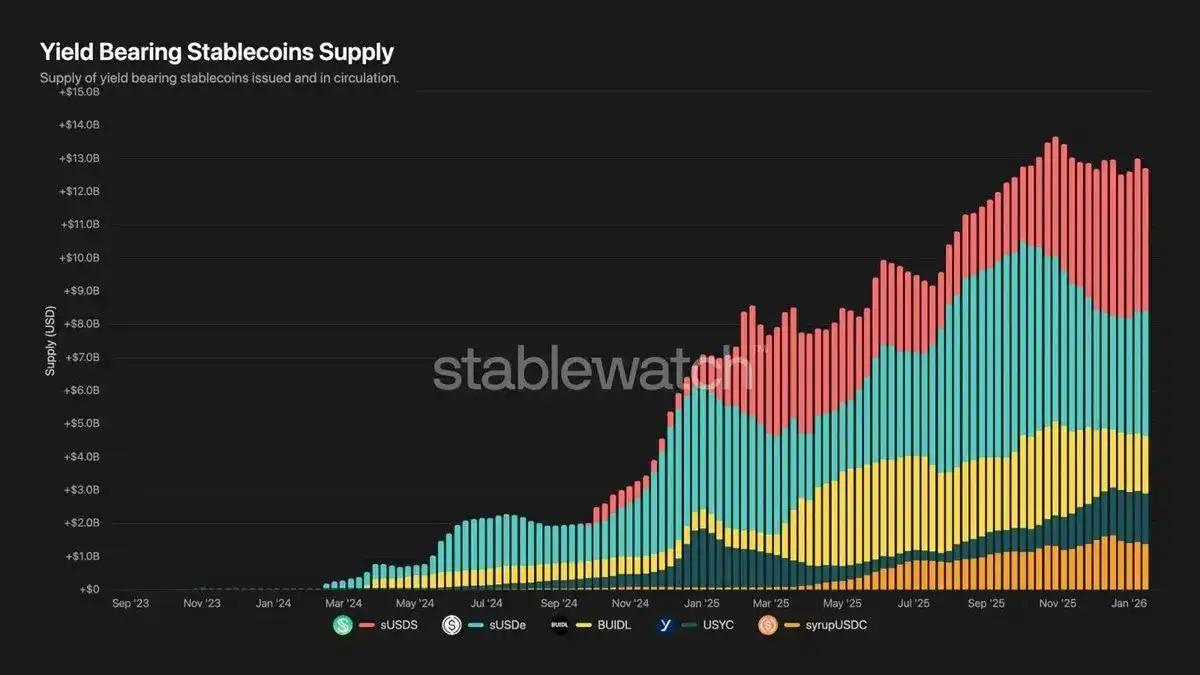
Users no longer have to choose between stability and yield as they did in the CeDeFi space during 2020-2022; now they can have both.

Neo-Banks

In the neo-bank sector, many teams are emerging, such as ether.fi, KAST, Tuyo, Galaxy, and others. These teams are leveraging DeFi backends to build consumer-facing 'bank-like' experiences from the ground up.
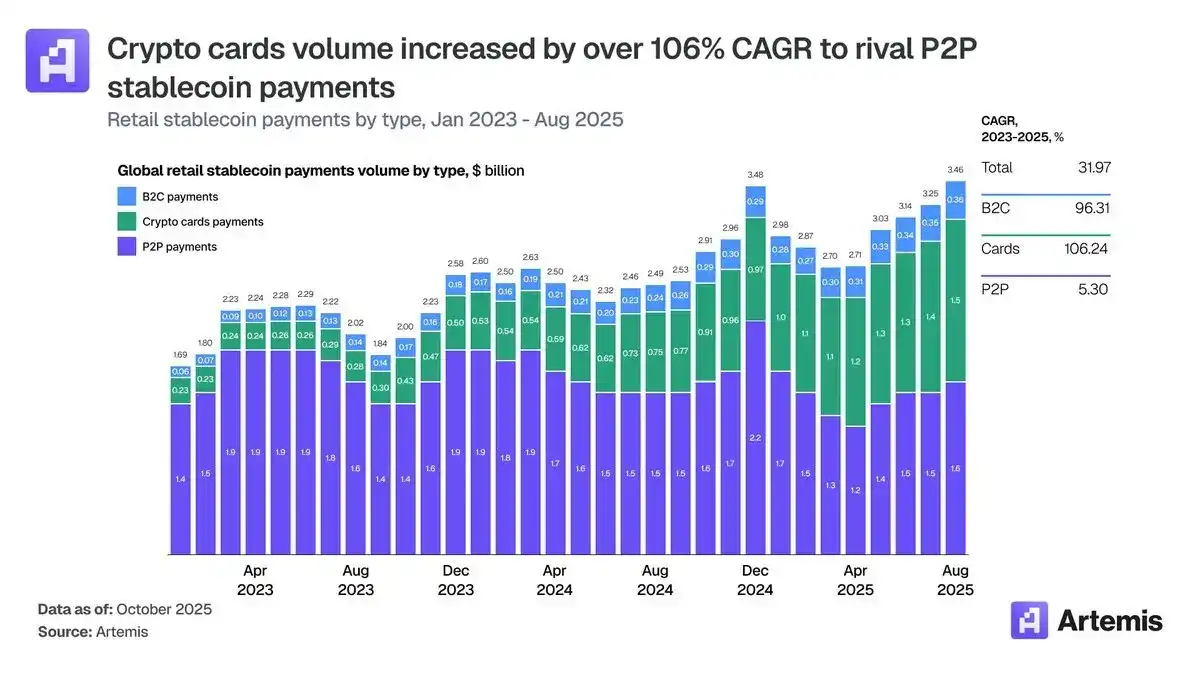
Remember the 'DeFi Mullet'? (PANews Note: Refers to a front-end with a TradFi user-friendly interface and a back-end powered by DeFi underlying technology) It's still here, and the data proves it.

Tokenization, stablecoins, and neo-banks are the three key areas of focus currently, expected to see the most significant growth in 2026 and beyond.

Beyond this, the crypto market is facing a harsh reality: old strategies are failing.

High FDV, low circulating supply launches aimed at dumping on retail; protocols lacking value accrual pathways; alt DEXs on 'ghost' chains; VC-backed projects where founders cash out hundreds of millions before achieving any PMF (Product-Market Fit).

All these plays are outdated, and this trend will continue.

In fact, I got into crypto after reading 'The Truth Machine' in 2017. Back then, I was almost certain this technology would reshape finance. Somehow, it feels like we veered off the original mission. Nine years later, we are closer than ever to that dream becoming a reality.

Everything is in place, the opportunity is here. Welcome to the era of Neo Finance.

Related reading: Nihilism and Vicious Cycles: Why Should We Oppose Over-Financialization?

Preguntas relacionadas

QWhat are the three main areas of focus in the Neo Finance ecosystem according to the article, and why are they significant?

AThe three main areas are tokenization, stablecoins, and neobanks. They are significant because they are expected to drive the most substantial growth in 2026 and beyond, combining consumer-friendly front-end experiences with efficient DeFi back-end infrastructure to revolutionize how the world interacts with money.

QHow does the article describe the current state and growth of 'yield stablecoins'?

AThe article states that yield stablecoins (or 'yield coins') like $sUSDS, $sUSDe, $BUIDL, $USYC, and $syrupUSDC have experienced exponential growth over the past 18 months, with their supply exceeding $13 billion.

QWhat is the 'DeFi Mullet' concept mentioned in the article, and what does it refer to?

AThe 'DeFi Mullet' refers to a business model where the front-end offers a user-friendly interface familiar to traditional finance (TradFi) users, while the back-end is powered by decentralized finance (DeFi) infrastructure.

QWhat outdated practices in the crypto market does the article claim are no longer effective?

AThe article claims that outdated practices include high Fully Diluted Valuation (FDV) with low circulating supply to sell to retail investors, protocols with no path to value accrual, alt-DEXs on 'ghost' chains, and venture-backed projects where founders cash out millions before achieving any Product-Market Fit (PMF).

QWhat major shift does the article suggest happened in 2025 regarding tokenization?

AThe article suggests that 2025 was the year when tokenization, the process of putting real-world assets like treasuries and stocks on-chain, truly began to scale and see mass adoption after being discussed for many years.

Lecturas Relacionadas

How Many Tokens Away Is Yang Zhilin from the 'Moon Chasing the Light'?

The article explores the intense competition between two leading Chinese AI companies, DeepSeek and Kimi (Moon Dark Side), and the mounting pressure on Yang Zhilin, the founder of Kimi. While DeepSeek re-emerged after 15 months of silence with its powerful V4 model—boasting 1.6 trillion parameters and low-cost, long-context capabilities—Kimi has been focusing on long-context processing and multi-agent systems with its K2.6 model. Yang faces a threefold challenge: technological rivalry, commercialization pressure, and investor expectations. Despite Kimi’s high valuation (reaching $18 billion), its revenue heavily relies on a single product with low paid conversion rates, while DeepSeek’s strategic silence and open-source influence have strengthened its market position and valuation prospects, now targeting over $20 billion. Both companies reflect broader trends in China’s AI ecosystem: Kimi aims for global influence through open-source contributions and agent-based advancements, while DeepSeek prioritizes foundational innovation and hardware independence, notably shifting to Huawei’s chips. Their competition is seen as vital for China’s AI progress, with the gap between top Chinese and U.S. models narrowing to just 2.7% on the Elo rating scale. Ultimately, the article argues that this rivalry, though anxiety-inducing for leaders like Zhilin, is essential for driving innovation and solidifying China’s role in the global AI landscape.

marsbitHace 4 hora(s)

How Many Tokens Away Is Yang Zhilin from the 'Moon Chasing the Light'?

marsbitHace 4 hora(s)

TechFlow Intelligence Bureau: ChatGPT Helps Amateur Mathematician Crack 60-Year-Old Problem, CFTC Sues New York Regulator Over Coinbase and Gemini

An amateur mathematician, with the assistance of ChatGPT, has solved a combinatorial mathematics puzzle originally proposed by Hungarian mathematician Paul Erdős in the 1960s. This marks another milestone in AI-aided mathematical research, demonstrating the evolving capabilities of large language models in formal reasoning. In other AI developments, OpenAI introduced a new privacy filter tool for enterprise API usage, automatically screening sensitive data. Meanwhile, the Qwen3.6-27B model achieved 100 tokens per second on a single RTX 5090 GPU using quantization, significantly lowering the cost barrier for local AI deployment. In crypto and Web3, the U.S. CFTC sued New York’s financial regulator, challenging its oversight of Coinbase and Gemini—a first-of-its-kind federal-state regulatory clash. Following a vulnerability, KelpDAO and major DeFi protocols established a recovery fund. Tether froze $344 million in assets linked to Iran’s central bank upon U.S. Treasury request, highlighting the centralized control risks in stablecoins. Separately, Litecoin underwent a 3-hour chain reorganization to undo a privacy-layer exploit. In the U.S., former President Trump invoked the Defense Production Act to address power grid bottlenecks affecting AI data centers and dismissed the entire National Science Board, raising concerns over research independence. A retail trader gained 250% on a $600k Intel options bet amid AI-related speculation. Xiaomi announced its first performance electric vehicle, targeting rivals like Tesla. Meanwhile, iPhone users reported devices automatically reinstalling a hidden app daily, suspected to be MDM-related. A Chinese securities report noted that A-share institutional crowding has reached its second-longest streak since 2007, signaling high valuations and potential style rotation. The day’s developments reflect a dual narrative: AI is enabling unprecedented individual breakthroughs, while centralized power structures—whether governmental or corporate—are becoming more assertive, underscoring that decentralization is as much a political-economic challenge as a technical one.

marsbitHace 4 hora(s)

TechFlow Intelligence Bureau: ChatGPT Helps Amateur Mathematician Crack 60-Year-Old Problem, CFTC Sues New York Regulator Over Coinbase and Gemini

marsbitHace 4 hora(s)

Trading

Spot
Futuros
活动图片





