Mapping FET’s path to $0.35 as supply tightens amid $2.3M outflows

ambcryptoPublicado a 2026-03-27Actualizado a 2026-03-27

Resumen

FET has recorded over $2.33 million in exchange outflows, signaling tightening supply and reduced immediate sell pressure. The price has rebounded strongly from a low of $0.1422, reclaiming the $0.20 support level and approaching the $0.26 resistance zone. A sustained break above $0.26 could pave the next major resistance near $0.35. DMI readings show strong buying pressure with +DI at 33.10 and -DI suppressed at 14.25, while ADX at 38.43 confirms trend strength. Continued negative netflows reflect accumulation behavior, supporting gradual upside expansion as fewer tokens remain available for sale. Market structure and indicators align in favor of further recovery.

Artificial Superintelligence Alliance [FET] has recorded over $2.33 million in exchange outflows as price reclaimed $0.20, at press time, signaling tightening supply amid strengthening trend structure. This movement has directly reduced the amount of FET available on exchanges, which typically limits immediate sell pressure.

As tokens leave trading platforms, liquidity on the sell side tightens, allowing price to stabilize more efficiently during recovery phases. Such behavior often aligns with accumulation, especially when large holders choose to hold rather than distribute.

As a result, the market structure begins to favor controlled upside movement instead of sharp downside volatility driven by sudden inflows.

FET presses $0.26 after reclaiming $0.20

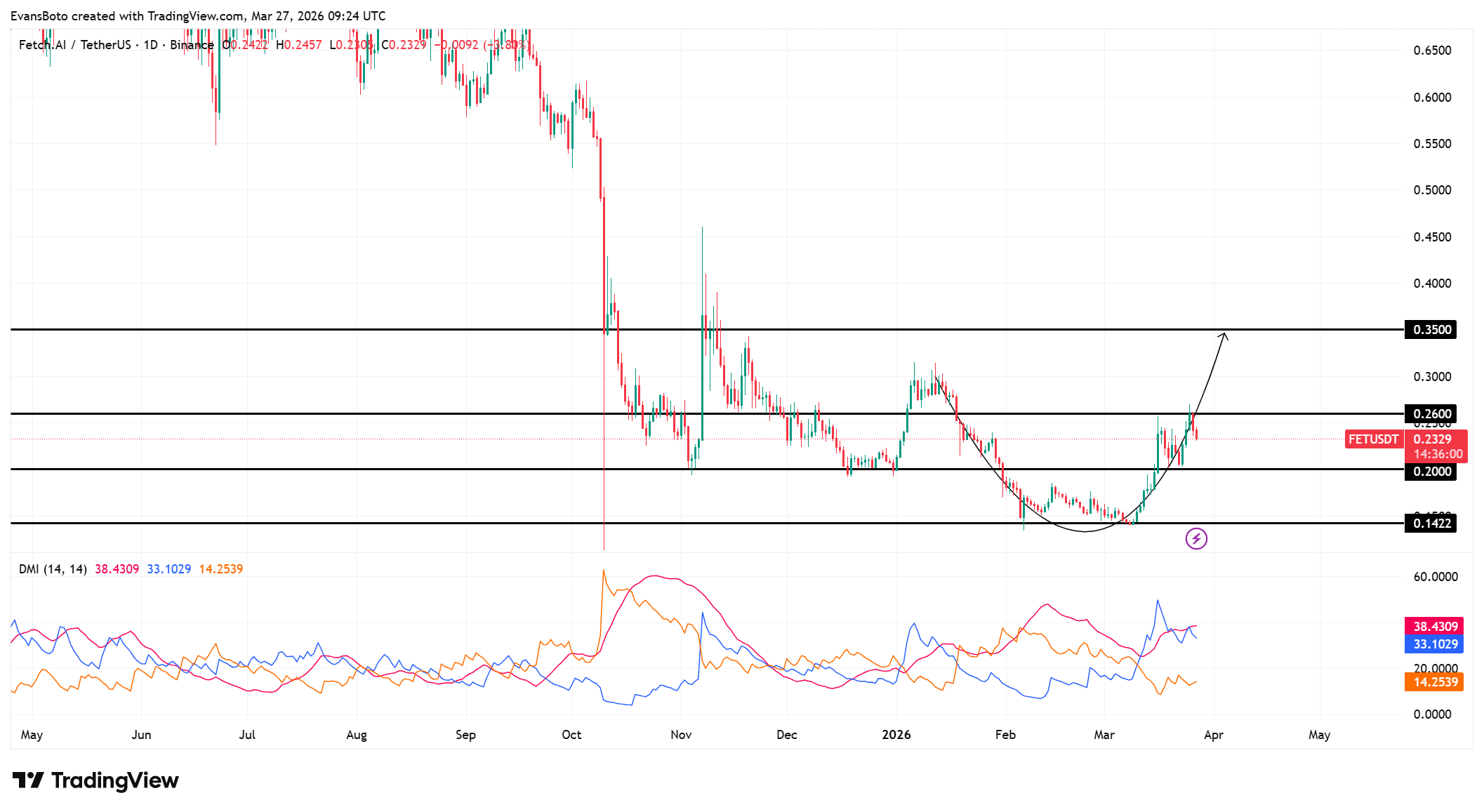
Price has rebounded strongly from the $0.1422 base and successfully reclaimed the $0.20 support level, marking a structural shift from prolonged downside pressure. After forming a rounded bottom, FET now trades near $0.2329 while pressing into the $0.26 resistance zone.

This level represents a critical barrier that previously capped recovery attempts. As price approaches this zone again, it reflects strengthening demand rather than weak relief rallies.

A sustained hold above $0.20 has already reinforced bullish intent, while a clean move through $0.26 would expose the next major level near $0.35, aligning with the broader recovery structure visible on the chart.

At press time, DMI readings have shifted decisively in favor of buyers, with +DI holding around 33.10 while -DI remained suppressed near 14.25. This spread clearly reflects dominant buying pressure rather than balanced conditions.

In addition, ADX has climbed to 38.43, confirming that the trend has strengthened rather than weakened.
Source: TradingView

Continued outflows reflect reduced sell pressure

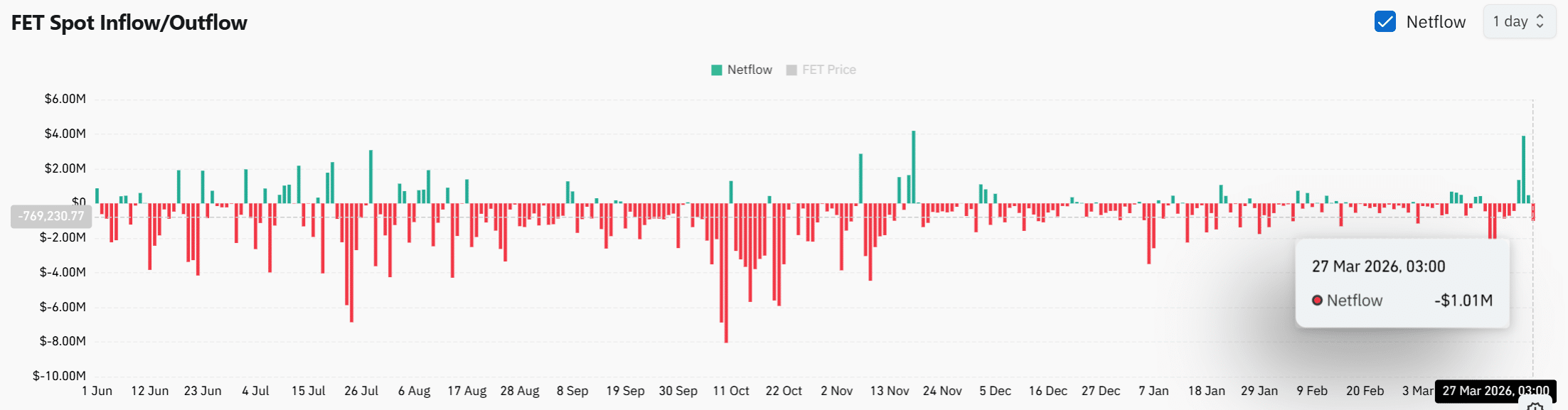
Spot Netflow data continues to print negative values, with the latest reading at approximately -$1.01 million. This consistent pattern of outflows indicates that more FET leaves exchanges than enters them, reinforcing the supply contraction already observed through whale withdrawals.

As this trend persists, fewer tokens remain available for immediate selling, which stabilizes price behavior during upward movements. Unlike inflow-driven markets that often signal distribution, sustained outflows suggest holders prefer retention over liquidation.

Such an environment supports gradual upside expansion, especially when paired with strengthening technical structure across price and indicators.
Source: CoinGlass

Can FET sustain this push toward $0.35?

FET now operates within a tightening supply environment while trend strength remains elevated and trader positioning favors continuation.

Price has already reclaimed key support and now challenges resistance with structural backing. As these conditions align, the market leans toward further upside progression rather than reversal.

A decisive move above $0.26 would likely extend the recovery toward $0.35, provided current dynamics persist without disruption.


Final Summary

  • FET structure reflects controlled strength as tightening supply and trend alignment continue favoring gradual upside expansion.
  • Price would likely extend higher if resistance breaks, as positioning and structural strength continue supporting directional conviction.


Preguntas relacionadas

QWhat is the significance of the $2.33 million in exchange outflows for FET?

AThe $2.33 million in exchange outflows signals a tightening of supply, as it directly reduces the amount of FET available on exchanges. This typically limits immediate sell pressure, stabilizes the price during recovery, and aligns with accumulation behavior where large holders choose to hold rather than sell.

QWhat key price level did FET reclaim, and what is the next major resistance target mentioned?

AFET successfully reclaimed the $0.20 support level. The next major resistance target mentioned is $0.35, which would be exposed if the price makes a clean move through the $0.26 resistance zone.

QHow do the DMI and ADX readings support the current market structure for FET?

AThe DMI readings show +DI at 33.10 and -DI suppressed near 14.25, reflecting dominant buying pressure. The ADX has climbed to 38.43, confirming that the trend has strengthened rather than weakened, supporting a bullish market structure.

QWhat does the consistent negative Spot Netflow data indicate about FET's market dynamics?

AThe consistent negative Spot Netflow data, with the latest reading at approximately -$1.01 million, indicates that more FET is leaving exchanges than entering them. This reinforces supply contraction, reduces immediate selling pressure, and suggests holders prefer retention over liquidation, supporting gradual upside expansion.

QWhat conditions are necessary for FET to sustain its push toward $0.35?

AFor FET to sustain its push toward $0.35, it needs a decisive move above the $0.26 resistance level, continued tightening supply, elevated trend strength, and trader positioning that favors continuation without disruption to the current dynamics.

Lecturas Relacionadas

From Banning Doubao to Embracing Honor: Why Did WeChat Suddenly 'Change Its Face'?

The article explores the sudden shift in WeChat's strategy towards AI assistants from mobile phone manufacturers, transitioning from strict opposition to active collaboration. For over a year, WeChat fiercely resisted attempts by phone AI assistants (like ByteDance's Doubao in late 2025) to control its features via GUI automation ("simulated clicking"), citing security and data control concerns. This stance created a significant barrier for system-level AI integration. Now, Tencent has initiated A2A (Agent-to-Agent) partnerships with major phone brands like Honor, Xiaomi, OPPO, and vivo. This model allows a phone's system AI (e.g., Honor's YOYO) to parse a user's voice command and send a structured request directly to WeChat's own internal AI agent via secure APIs. WeChat then executes the action (e.g., sending a message) and returns the result. The article attributes Tencent's "change of face" to strategic pressure. While leading in social app usage, Tencent trails rivals like ByteDance and Alibaba in standalone AI app popularity. WeChat, with its vast mini-program ecosystem, is Tencent's key asset for an AI comeback. The upcoming WeChat AI agent aims to handle tasks like booking and payments within the app. However, phone system assistants remain the primary AI entry point for most users. The A2A collaboration allows Tencent to extend WeChat's AI reach to this crucial system layer while maintaining control over its core functions and data. For phone manufacturers, embracing A2A is a pragmatic move. The GUI route proved unviable due to WeChat's blocks. A2A offers a compliant path to integrate a vital service, enhancing their AI assistants' usefulness. It allows them to focus on developing their own AI ecosystems for other services while cooperating on WeChat access. The collaboration is framed as a mutual, strategic necessity: Tencent gains a distribution channel, and manufacturers gain a key functionality. The partnership relies on a "dual authorization" mechanism for security, requiring both user and app consent for each action. While questions about long-term data privacy practices remain, experts note A2A is more secure and compliant than GUI automation. Ultimately, this cooperation is seen as a tentative, calculated truce. Tencent's long-term goal is to make WeChat an AI-powered "service OS." Phone manufacturers aim to make their system AI the central user interface. Their paths may converge or clash in the future, but for now, the A2A deal represents the opening chapter in the battle for the AI-era user入口, driven by necessity and strategic calculus on both sides.

marsbitHace 24 min(s)

From Banning Doubao to Embracing Honor: Why Did WeChat Suddenly 'Change Its Face'?

marsbitHace 24 min(s)

On-Chain Figures on the Eve of Kickoff: 1.6 Billion Traded Before the World Cup Even Begins

"On-Chain Numbers on the Eve of the World Cup: $1.6 Billion Traded Before Kick-off" Analysis of on-chain markets before the 2026 FIFA World Cup reveals significant crypto integration into football. The most striking figure is the approximately **$1.6 billion** in total trading volume on the single "World Cup Winner" contract on the Polymarket prediction market platform, accumulated before a single match was played. This represents explosive growth for a sector whose annual volume surged from ~$16B in 2024 to ~$64B in 2025. The ecosystem is maturing beyond speculation. Key developments include: 1) **Infrastructure upgrades** like Polymarket's migration to native, regulated USDC stablecoin for settlements; 2) **Reliable data oracles**, such as Chainlink, being used to resolve real-world match outcomes on-chain; and 3) **Official recognition**, with FIFA appointing its first-ever "Prediction Markets" partner. Over 100 contracts now cover everything from the outright winner to individual match results and even non-sporting risks like venue relocation. This evolution marks a fundamental shift. While crypto firms are absent from FIFA's top-tier sponsor list, the technology has deeply penetrated the tournament's financial and predictive infrastructure through regulated stablecoin settlements, decentralized oracles, and new official partnership categories. The regulatory landscape remains complex and varies by jurisdiction, but on-chain markets for the World Cup are already a multi-billion-dollar reality.

marsbitHace 1 hora(s)

On-Chain Figures on the Eve of Kickoff: 1.6 Billion Traded Before the World Cup Even Begins

marsbitHace 1 hora(s)

From SpaceX's IPO to the Future of Crypto: Which Crypto Sectors Will Host the Trillion-Dollar Narrative?

From the SpaceX IPO, which targets a $750 billion raise at a $1.77 trillion valuation, we can extrapolate capital flow trends relevant to crypto. The focus shifts from speculative narratives to foundational infrastructure and real-world asset (RWA) integration. Key crypto sectors poised to benefit include: 1. **AI Infrastructure**: The narrative is moving from consumer-facing AI applications to underlying, scarce resources like compute power and decentralized GPU networks (e.g., TAO, RENDER, AKT, IO). These protocols are positioning as the essential "picks and shovels" providers for the AI economy. 2. **Real-World Assets (RWA)**: Beyond tokenized treasury bonds, RWA's future lies in on-chain equity and pre-IPO assets like SpaceX. This could democratize access to high-growth assets and reshape global capital flows, benefiting infrastructure projects like ONDO, LINK, and Plume that facilitate issuance, data, and liquidity. 3. **Core Financial Infrastructure**: Stablecoins, payment networks, and DePIN (Decentralized Physical Infrastructure Networks) are critical for settling the future on-chain economy. Their role expands from internal trading tools to foundational layers for global finance, AI systems, and real-world asset networks, leading to potential value reassessment. In summary, the next cycle may prioritize long-term infrastructure value—AI compute, asset tokenization networks, and settlement layers—over short-lived application hype, mirroring the broader market's shift towards funding the foundational systems of the future.

marsbitHace 1 hora(s)

From SpaceX's IPO to the Future of Crypto: Which Crypto Sectors Will Host the Trillion-Dollar Narrative?

marsbitHace 1 hora(s)

Trading

Spot
Futuros

Artículos destacados

Cómo comprar FET

¡Bienvenido a HTX.com! Hemos hecho que comprar FETCH.ai (FET) sea simple y conveniente. Sigue nuestra guía paso a paso para iniciar tu viaje de criptos.Paso 1: crea tu cuenta HTXUtiliza tu correo electrónico o número de teléfono para registrarte y obtener una cuenta gratuita en HTX. Experimenta un proceso de registro sin complicaciones y desbloquea todas las funciones.Obtener mi cuentaPaso 2: ve a Comprar cripto y elige tu método de pagoTarjeta de crédito/débito: usa tu Visa o Mastercard para comprar FETCH.ai (FET) al instante.Saldo: utiliza fondos del saldo de tu cuenta HTX para tradear sin problemas.Terceros: hemos agregado métodos de pago populares como Google Pay y Apple Pay para mejorar la comodidad.P2P: tradear directamente con otros usuarios en HTX.Over-the-Counter (OTC): ofrecemos servicios personalizados y tipos de cambio competitivos para los traders.Paso 3: guarda tu FETCH.ai (FET)Después de comprar tu FETCH.ai (FET), guárdalo en tu cuenta HTX. Alternativamente, puedes enviarlo a otro lugar mediante transferencia blockchain o utilizarlo para tradear otras criptomonedas.Paso 4: tradear FETCH.ai (FET)Tradear fácilmente con FETCH.ai (FET) en HTX's mercado spot. Simplemente accede a tu cuenta, selecciona tu par de trading, ejecuta tus trades y monitorea en tiempo real. Ofrecemos una experiencia fácil de usar tanto para principiantes como para traders experimentados.

85 Vistas totalesPublicado en 2024.12.11Actualizado en 2026.06.02

Cómo comprar FET

Discusiones

Bienvenido a la comunidad de HTX. Aquí puedes mantenerte informado sobre los últimos desarrollos de la plataforma y acceder a análisis profesionales del mercado. A continuación se presentan las opiniones de los usuarios sobre el precio de FET (FET).

活动图片









