Manus Buyback Plan Emerges: Chinese Investors Plan to Repurchase Equity with $2 Billion, Path to Hong Kong IPO Becomes Clearer

marsbitPublicado a 2026-06-19Actualizado a 2026-06-19

Resumen

According to a report by The Information, early Chinese investors of Manus, including Tencent, Sequoia Capital China, and ZhenFund, are planning to repurchase the company from Meta for $2 billion—the same price Meta paid in its acquisition last December. This move is a direct response to the Chinese government's prohibition of the foreign acquisition in April. As part of the repurchase plan, Manus is considering establishing a Sino-foreign joint venture within China. This structure is seen as a way to ensure regulatory compliance for its Chinese investors and to pave the way for a future IPO in Hong Kong. Notably, U.S. investor Benchmark will not participate in the buyback, which will concentrate ownership even more among Chinese capital. Since its acquisition by Meta, Manus's business has grown rapidly, with its annualized revenue run rate reportedly increasing four-to-fivefold to $400-$500 million in roughly six months. This strong growth underpins the investors' willingness to repurchase at the original price. Financially, the forced unwinding of the deal may benefit the early investors, allowing them to regain equity at a cost far below the company's current implied valuation, with the added prospect of an independent future listing. However, specific terms of the repurchase, including funding proportions and the joint venture's equity structure, are still under negotiation. This "repurchase-joint venture-Hong Kong IPO" approach could serve as a reference model for oth...

By | 强调Next

According to a report by The Information on June 18, early Chinese investors of Manus plan to spend $2 billion, approximately 13.5 billion yuan, to buy back the company from Meta. The investors mentioned in the report include Tencent, Sequoia Capital China (formerly Sequoia Capital China Fund), and ZhenFund.

$2 billion was precisely the consideration Meta paid to acquire Manus in December last year. Liu Yuan, a partner at ZhenFund, publicly stated at the time that this was Meta's third-largest acquisition since its founding, only behind WhatsApp and Scale AI. Now history seems to be repeating itself, but with the roles of buyer and seller completely reversed.

1 · From Distributing Proceeds to Buyback

Insiders revealed that institutions such as Sequoia Capital China, ZhenFund, and Benchmark have already distributed the proceeds from the Meta acquisition to their respective limited partners. Tencent is also a party that has secured its gains.

After the acquisition was halted, Sequoia Capital China and ZhenFund did not ask LPs to return the already distributed profits. Instead, they intend to use newly raised funds to repurchase their respective Manus equity at Meta's original acquisition price. Tencent will also participate in this round of buyback.

It is worth noting that Benchmark will not participate in the buyback. An investor told The Information that this means Chinese investors will ultimately hold a larger proportion of Manus shares, and the company's equity structure will be more concentrated in Chinese capital than before the acquisition.

2 · Joint Venture Structure, Paving the Way for HK Listing

As part of the buyback plan, Manus is considering adjusting its corporate structure by establishing a Sino-foreign joint venture registered in mainland China. Foreign media analysis suggests this joint venture structure is designed to allow Chinese investors to continue holding the company's equity in compliance with regulations, while also preparing for a future Hong Kong IPO. The report states that Chinese investors plan to increase their capital in Manus in US dollars.

This buyback is widely interpreted as a direct response to the halt order issued in April this year. At that time, the Foreign Investment Security Review Office under the National Development and Reform Commission issued an announcement, prohibiting the "foreign acquisition of the Manus project" and requiring the parties involved to rescind the transaction and restore the original equity status.

Bloomberg previously reported two details. First, in May this year, Manus's three founders, Xiao Hong, Ji Yichao, and Zhang Tao, discussed raising about $1 billion from external investors to complete the buyback from Meta, with a valuation not less than the original $2 billion. The funding shortfall might be covered by the founding team with their own funds. Second, since June, Meta has severed the data connection between Manus and its internal systems, and notified employees to gradually migrate Manus-related projects to Meta's own systems, with no new Manus-related work to be initiated. The report by The Information is the most specific disclosure about the buyback plan to date.

3 · Business Data: Revenue Quadrupled or Quintupled in Half a Year

Insiders revealed that since being acquired by Meta, Manus's performance has been growing rapidly. Its current annualized revenue run rate has climbed to $400-500 million, approximately 2.7 to 3.4 billion yuan. At the time of the Meta acquisition, this figure was only $100 million, about 680 million yuan.

In other words, from its acquisition in December last year to now, Manus's revenue scale has increased four to fivefold in about half a year. This growth rate is also a key reason investors are willing to repurchase at the original price rather than trying to bargain for a lower price.

4 · Who Wins

From a financial perspective, the rescission of this acquisition might actually benefit Manus's early investors. Two insiders analyzed that the investors essentially get to reclaim the company's equity at a cost far below its current sale valuation. Furthermore, Manus has the opportunity to pursue an independent listing in the future, no longer needing to be part of the Meta ecosystem.

However, details are still being finalized. Both insiders emphasized that specific terms of the buyback transaction, including the funding ratio, equity design of the joint venture company, and the pace of capital increase, are still under negotiation.

Manus's financing journey has been quite legendary. In the Seed round in February 2023, ZhenFund invested about $3 million, resulting in a post-money valuation of $14 million; in the Angel round in August of the same year, the valuation rose to $50 million; in the Series A round in November 2024, Sequoia Capital China, Tencent, ZhenFund, and Wang Huiwen jointly invested, valuing the company at $85 million; in the Series B round in April 2025, led by Benchmark, the valuation approached $500 million. In just over two years, the valuation increased over a hundredfold, only to be acquired by Meta for $2 billion at the end of last year.
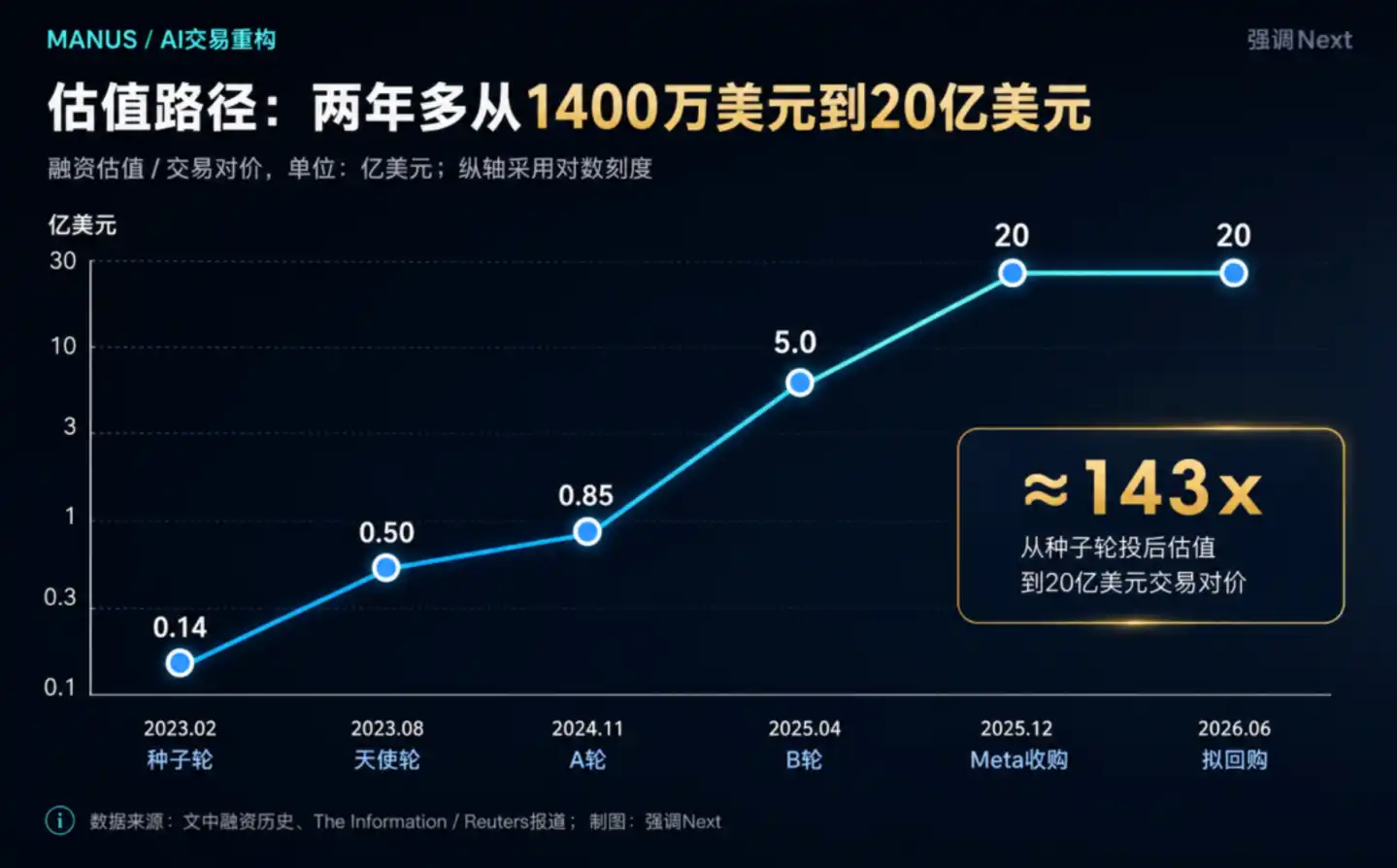
Now, this transaction is being rolled back. For Chinese AI startups, Manus's combination of "buyback + joint venture + Hong Kong IPO" might become a reference case for handling compliance issues in cross-border M&A going forward.


Preguntas relacionadas

QWhat is the reported plan of Manus' early Chinese investors regarding Meta's ownership, and what is the proposed amount?

AThe early Chinese investors, including Tencent, Sequoia Capital China (formerly Sequoia Capital China Fund), and ZhenFund, plan to repurchase Manus from Meta for $2 billion. This is the same amount Meta paid to acquire the company in December of last year.

QAccording to the article, what is the primary reason behind establishing a Sino-foreign joint venture as part of the repurchase plan?

AThe primary reason for considering a Sino-foreign joint venture structure is to allow the Chinese investment parties to compliantly hold equity in the company and, simultaneously, to pave the way for a future initial public offering (IPO) in Hong Kong.

QHow has Manus's business performance changed since its acquisition by Meta, according to the article?

ASince being acquired by Meta, Manus's business has grown rapidly. Its annualized revenue run rate has climbed to $400-$500 million, which is approximately four to five times the $100 million rate at the time of the Meta acquisition around six months prior.

QWhy does the article suggest the forced divestment might be financially beneficial for Manus's early investors?

AThe article suggests it might be a financial benefit because the investors can repurchase their equity at the original acquisition price of $2 billion, which is likely far lower than the company's current valuation given its rapid revenue growth. This allows them to regain ownership at a favorable cost, with the potential for an independent IPO in the future.

QWhich major early investor, mentioned in the article, has decided not to participate in the repurchase plan?

ABenchmark, a major early investor that led Manus's Series B funding round, has decided not to participate in the repurchase plan led by the Chinese investment consortium.

Lecturas Relacionadas

For the First Time Since 1955, S&P 500 Profits Exceed Long-Term Trend by 14%

For the first time since 1955, the S&P 500's earnings per share (EPS) have risen approximately 14% above their long-term historical trend channel, according to a recent report. This highlights a significant fundamental shift: strong corporate profits, not just AI narratives or liquidity, are now underpinning the market's high valuations. The strength of current earnings is evidenced on multiple fronts. Actual quarterly results are consistently beating analyst expectations, with the percentage of S&P 500 companies exceeding profit forecasts and the magnitude of sales surprises near multi-year highs. Furthermore, analysts are *raising* future EPS estimates instead of the typical post-quarter downgrades, with full-year 2026 growth expectations revised sharply upwards from ~13% to nearly 28%. This profit growth is broadening beyond the mega-cap "Magnificent Seven" tech stocks. While these giants remain the primary engine, the majority of S&P 500 sectors are contributing, with median company earnings growth around 13.8%. However, this exceptional strength creates a higher bar for future performance. With profit levels already so elevated, merely meeting elevated expectations may not suffice to push stocks higher. Any disappointment in revenue growth, profit margins, or forward guidance could trigger significant pressure on stretched valuations. Therefore, the sustainability of the earnings support will depend on continued sales expansion, stable margins, the payoff from massive AI investments, and, crucially, whether the positive trend of upward earnings revisions can persist.

marsbitHace 9 min(s)

For the First Time Since 1955, S&P 500 Profits Exceed Long-Term Trend by 14%

marsbitHace 9 min(s)

Once-Hot Web3 Enters Wave of Layoffs

"Once a hot sector, Web3 has entered a wave of layoffs, driven less by AI than by underlying financial pressures. The article details a severe and rapid downsizing across Web3 companies, particularly crypto exchanges, over the past year. It shares accounts from employees like Kevin and Richard, who experienced sudden terminations, often with system access cut off instantly and sometimes with minimal or no severance. Management frequently used pretexts like impossible performance targets or bogus tests to justify dismissals and avoid compensation. The layoffs have created a climate of fear and toxic workplace cultures for remaining employees, characterized by excessive surveillance, pointless meetings, and internal political battles. High-level power struggles and a focus on loyalty over competence further destabilize companies. The author argues the industry's core business model is collapsing. Exchanges, reliant on trading fees and high listing charges, are accused of exploiting projects and retail investors. This, combined with events like a major market crash in October 2025 that wiped out leveraged retail traders, has led to a severe liquidity drought. Venture capital funding has dried up, and many projects lack sustainable revenue. As a result, displaced workers struggle to find new roles. While many transition to the AI sector, they face stigma, with traditional finance and even some AI firms viewing Web3 experience negatively. The article concludes that this downturn is distinct: rather than a simple market cycle, it stems from predatory practices, a lack of innovation, and destructive internal competition that consumed the industry from within while the market shrank."

marsbitHace 24 min(s)

Once-Hot Web3 Enters Wave of Layoffs

marsbitHace 24 min(s)

Being at the Front Lines of the Coldcard Theft Case Made Me Realize Why the Impact is Far Greater Than the Numbers Suggest

Even 5 years after a vulnerability was discovered, no one expected it to fuel the largest Bitcoin theft of the year. On July 30, anomalies were detected: hundreds of Bitcoin were aggregated from numerous addresses in a short timeframe, followed by a rapid expansion of the attack. The perpetrator scanned thousands of addresses, stealing nearly 2,000 BTC worth over $100 million. The cause was quickly identified: a bug in the mnemonic generation process of the Coldcard hardware wallet, specifically a weak random number issue that made the entropy predictable. While initially less noticed in China due to Coldcard's smaller user base, the incident caused an uproar overseas, where Coldcard is highly respected among Bitcoin OGs and maximalists. Panic peaked by July 31, with small transactions (under 1 BTC) reaching a daily volume of 39,600 BTC, the highest since FTX's collapse in 2022. The attack is believed to have been discovered and executed by an AI model, similar to a prior incident that halved Zcash's value, but with potentially more severe psychological impact. The breach shook the core belief system of Bitcoin's most dedicated community. According to Yu Xian, founder of SlowMist, who is assisting some victims, the profound impact lies in undermining trust in a historically reputable, open-source, "perfect" hardware wallet. This erodes confidence in self-custody solutions, leading some users to reconsider the perceived safety of centralized exchanges with robust security measures. For ordinary users, Yu Xian recommends: always use a passphrase with your mnemonic seed; maintain a small amount in a non-passphrase wallet as a canary; and for non-technical users, relying on reputable centralized services might be a simpler option. General advice includes auditing your asset storage methods, staying calm to avoid phishing, and isolating questionable assets. The incident underscores a critical security asymmetry: attackers, unrestricted and highly motivated, can leverage AI far more aggressively than defenders, who face various constraints. This dynamic could lead to even larger-scale breaches in the future, potentially involving core protocols like Bitcoin itself. The industry's challenge is to continuously evolve and strengthen its defenses in this ongoing arms race.

marsbitHace 24 min(s)

Being at the Front Lines of the Coldcard Theft Case Made Me Realize Why the Impact is Far Greater Than the Numbers Suggest

marsbitHace 24 min(s)

Trading

Spot
活动图片