Making the Forbes Cover: Why Has It Become a Curse for Crypto Titans?

比推Publicado a 2026-02-06Actualizado a 2026-02-06

Resumen

The article explores the so-called "Forbes Cover Curse" in the cryptocurrency industry, where major figures featured on the magazine’s often coincide with market peaks followed by sharp downturns. It highlights three key examples: - Binance’s CZ appeared in February 2018 when Bitcoin was around $7,600. Soon after, BTC fell 58%. - FTX’s SBF was featured in October 2021 near Bitcoin’s then-all-time high. Thirteen months later, FTX collapsed and SBF was sentenced to prison. - MicroStrategy’s Michael Saylor graced the cover in January 2025 with BTC above $104,000. Within a year, the price dropped 40%, and his company faced billions in unrealized losses. The piece references the “magazine cover indicator” — a classic Wall Street concept suggesting that when a trend makes it to the cover of a major publication, it’s often near its end. The author argues that Forbes covers are not the cause of the decline but a symptom of market euphoria and overexposure. A notable exception was Justin Sun’s feature in March 2025, after which Bitcoin continued to rally. However, the frequency of crypto-related covers itself was seen as a signal of overheating optimism. The conclusion urges caution: when mainstream media celebrates crypto success and public excitement peaks, it may be time to consider reducing exposure — because “bull markets end on magazine covers.”

Author: Curry, Deep Tide TechFlow

Original Title: Forbes Editorial Department, the Most Accurate Short Signal in Crypto?

Bitcoin recently plunged to $60,000, marking its largest single-day drop since the FTX collapse.

Michael Saylor's company, Strategy (formerly MicroStrategy), holds 713,000 bitcoins with an average cost of $76,052. As of last night, the unrealized loss reached $6.5 billion. The stock price has fallen from a peak of $457 last year to $110, wiping out over three-quarters of its value.

However, a year ago, Saylor graced the cover of the renowned magazine Forbes. The headline read:

"The Bitcoin Alchemist." At that time, Bitcoin was priced at $104,000, and Saylor's net worth was $9.4 billion.

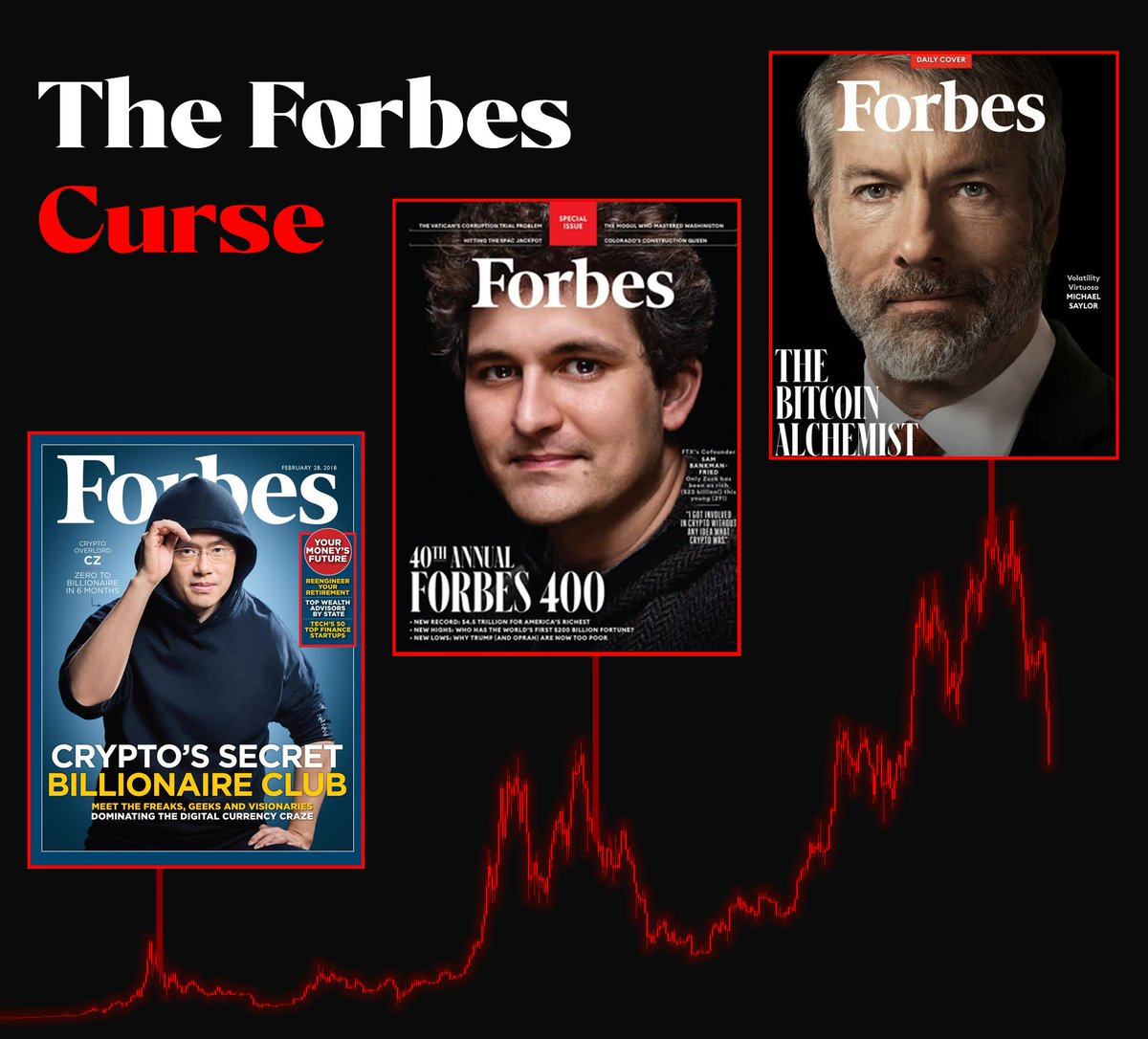
Now, a chart circulating on Twitter lines up three Forbes covers with Bitcoin's price chart below. Each cover perfectly marks the start of a sharp decline.

Of these three individuals, one has been to prison, one is currently in prison, and the third just lost $6.5 billion.

The Cover, Captured at the Peak of Hype

The first crypto figure to appear on Forbes' cover was CZ.

In February 2018, Forbes featured a cover titled "Crypto's Secret Billionaire Club," CZ stood in the center, hoodie up, exuding a rugged aura. The subtitle read:

From zero to billionaire in just 6 months.

At that time, Bitcoin had just fallen from nearly $20,000 at the end of 2017 to around $7,600. Forbes estimated CZ's net worth to be at least $1.1 billion. Binance, only six months old, was already the world's largest exchange by trading volume.

After the cover was released, Bitcoin briefly rebounded to $10,000. Then, it went nowhere but down.

By December 2018, Bitcoin had dropped to $3,156. From the day the cover was published, the decline was:

58%.

CZ's later story is well-known. On Forbes' 2025 global billionaires list, CZ's net worth was $62.9 billion, ranking first in the crypto industry.

But he hasn't been on the cover since.

The second crypto figure to appear on Forbes' cover was Sam Bankman-Fried.

In October 2021, Forbes released its 40th Forbes 400 Richest Americans list, featuring SBF on the cover. Under 30 years old, with a net worth of $26.5 billion, he was the 41st richest person in the U.S.

On the cover, he wore his signature gray T-shirt, with curly hair, looking like a college student who had just pulled an all-nighter playing League of Legends.

In hindsight, the magazine's tone was surreal. Forbes called him "the most powerful person in crypto," portraying him as a blend of Wall Street and Silicon Valley, building an exchange while donating to charity.

When the cover was released, Bitcoin was around $60,000, just a step away from its then-all-time high of $69,000.

Thirteen months later, FTX collapsed.

SBF had misappropriated over $8 billion in customer funds to cover losses at his other company, Alameda Research. In November 2022, users rushed to withdraw, and FTX couldn't meet the demand. Within a week, it went from the world's third-largest exchange to a bankrupt company. Bitcoin plummeted from $20,000 to $16,000.

Ultimately, SBF was arrested in his luxury apartment in the Bahamas.

Found guilty on all seven charges, he was sentenced to 25 years. Forbes later created a "30 Under 30 Hall of Shame," with SBF prominently featured.

From cover to handcuffs:

13 months.

The third was Michael Saylor.

On January 30, 2025, Forbes featured him on the cover with the title "The Bitcoin Alchemist." Bitcoin had just broken through $100,000, and Saylor's net worth surged from $1.9 billion the previous year to $9.4 billion, nearly quintupling. His company MicroStrategy's stock had risen 700% in a year and was newly included in the Nasdaq 100 index.

The Forbes piece included a detail:

On New Year's Eve, Saylor threw a 500-person party at his estate in Miami. Dancers waved orange Bitcoin glow balls, and outside waited a 154-foot yacht named Usher, ferrying institutional investors and crypto bigwigs to the event.

At the time, Saylor told Forbes:

"We've placed a crypto reactor in the middle of the company, sucking in capital and spinning it. Volatility drives everything." This statement was, of course, sincere. Saylor's alchemy boils down to one thing: issuing debt to buy Bitcoin.

When the Forbes cover was released, Bitcoin was at $104,000. One year and six days later, it's at $63,000. A decline of:

40%.

Saylor said on an earnings call that Strategy has built a "digital fortress."

The last crypto mogul to call his company a "fortress" was SBF. That was in June 2022. Five months later, FTX filed for bankruptcy.

The Cover: Both Praise and Curse

Wall Street has an old concept called the "magazine cover indicator":

When a trend makes it to the cover of a mainstream magazine, the trend is usually at its end.

The reasoning is simple. Forbes editors aren't prophets; like all retail investors, they only notice a story when it's at its most hyped.

The moment a magazine deems "someone in some industry worthy of a cover" is precisely the moment market frenzy peaks.

The cover isn't the cause of the curse; it's a symptom of the bubble.

However, there was one brief exception to this rule.

Last March, Justin Sun graced the Forbes cover with the title "The Crypto Billionaire Who Made the Trump Family $400 Million."

When the cover came out, Bitcoin was at $87,000. It didn't crash; instead, it rallied to an all-time high of $126,000 by October.

Did the curse fail?

Not entirely. When Sun appeared on the cover, it was only two months after Saylor's feature. One cover in January, another in March—the密集 appearance of crypto figures on mainstream magazine covers was itself a signal. It indicated the industry's narrative had become so hot that even Forbes editors felt one issue wasn't enough.

When covers start appearing in clusters, in hindsight, there might be a checklist of bull market top symptoms:

Forbes covers, taxi drivers discussing crypto, relatives asking how to open an account... If two out of three signals appear, it's time to reconsider your positions.

So, the real question isn't "Is the Forbes cover accurate?" but rather:

When everyone around you is telling the same story, when the story is so good even non-traders have heard of it, when mainstream media starts deifying figures in an industry...

Are you the one still buying, or the one already selling?

Bull markets don't end in panic. They end on the cover.

It's just that the cover stars may change, but the long bear market is always my bill to pay.


Twitter:https://twitter.com/BitpushNewsCN

Bitpush TG Group:https://t.me/BitPushCommunity

Bitpush TG Channel: https://t.me/bitpush

Original link:https://www.bitpush.news/articles/7609729

Criptos en tendencia

Preguntas relacionadas

QWhat is the 'magazine cover indicator' mentioned in the article, and how does it relate to the cryptocurrency market?

AThe 'magazine cover indicator' is an old Wall Street concept suggesting that when a trend makes the cover of a mainstream magazine, it has often reached its peak. In the context of the cryptocurrency market, it means that when a crypto figure like CZ, SBF, or Michael Saylor is featured on the Forbes cover, it signals the top of market euphoria and is often followed by a significant price decline.

QWhich three crypto figures were featured on Forbes covers, and what were the consequences for the market after their features?

AThe three crypto figures featured were CZ (2018), SBF (2021), and Michael Saylor (2025). After CZ's feature, Bitcoin fell 58%; after SBF's feature, FTX collapsed and Bitcoin dropped sharply; and after Saylor's feature, Bitcoin fell 40% from its high.

QWhy did the Forbes cover 'curse' seemingly not affect Justin Sun when he was featured in March?

AThe curse appeared not to affect Justin Sun immediately because his cover in March 2025 was followed by a continued bull run to a new all-time high of $126,000 in October. However, the article suggests that the high frequency of crypto covers (Saylor in January, Sun in March) was itself a symptom of peak market euphoria, a sign that the bull market was nearing its end.

QAccording to the article, what are some signals that might indicate the top of a bull market in cryptocurrency?

ASignals of a market top include a crypto figure being featured on the Forbes cover, taxi drivers talking about crypto, and relatives asking how to open a trading account. The article suggests that if two of these three signals appear, it might be time to reconsider one's investment position.

QWhat was the common outcome for the crypto billionaires who appeared on the Forbes cover, as described in the article?

AThe common outcome was a significant personal or professional downturn coinciding with a major market crash. CZ faced legal issues (though his wealth later grew), SBF was arrested and sentenced to 25 years in prison, and Michael Saylor's company faced massive paper losses on its Bitcoin holdings after the price declined.

Lecturas Relacionadas

As Consensus Accelerates, What Are Young Investors Betting On?

Title: As Consensus Forms Faster, What Are Young Investors Betting On? In the rapid evolution of tech investment, a new generation of young investors is navigating a landscape where AI, robotics, commercial aerospace, and quantum computing are advancing simultaneously. Traditional investment logic based on financial models is giving way to a need for deep technical understanding and the ability to act before industry consensus forms. An analysis of trends from the "WAIC FUTURE TECH" list of young investment leaders reveals key shifts in focus. The first major trend is the movement of AI from the digital screen into the physical world. Investment is shifting from large language models and chatbots towards embodied AI, robotics, AI hardware, and edge computing. While demonstrations generate excitement, the real challenge lies in achieving scalable, reliable, and cost-effective delivery in complex real-world environments like factories and logistics. Success depends not just on algorithms but on the integration of sensors, actuators, and control systems. Second, the competitive focus for large models is moving beyond raw capability toward building an "intelligence flywheel." The goal is to create self-reinforcing systems where user interaction generates data, improving the model, which in turn enhances the user experience and attracts more engagement. Companies that successfully embed AI into workflows to create these closed-loop systems can build lasting value that isn't easily erased by the next model upgrade. Third, facing a potential bottleneck in high-quality human-generated data, investors are looking at new underlying technologies. Reinforcement learning and self-play, as demonstrated by AlphaGo Zero, offer paths for AI to generate its own experience. Scientific foundation models, which aim to build general AI capabilities for fields like life sciences and materials discovery, represent a non-consensus direction that could unlock new frontiers of knowledge and data. Finally, in deep-tech areas like quantum computing, commercial aerospace, and space-based infrastructure, patient capital is essential. These fields have long, uncertain development and validation cycles involving complex engineering, supply chains, and regulations. Investment here requires a long-term view, focusing on foundational team capabilities and the eventual emergence of market demand, even if commercial returns are distant. Collectively, these trends illustrate how young investors are adapting to a new era. They are learning to make earlier, technically-informed judgments, balance hype with real-world viability, and provide the patient capital needed to build the deep-tech foundations of the future.

marsbitHace 16 min(s)

As Consensus Accelerates, What Are Young Investors Betting On?

marsbitHace 16 min(s)

Can Japan Buy Growth with AI? Will the Bond Market Believe It?

Japan's cabinet has introduced the 2026 Basic Policy on Economic and Fiscal Management and Reform, shifting its primary fiscal target. The new framework moves away from the traditional annual primary balance goal and instead prioritizes a stable reduction of the debt-to-GDP ratio. This change is tied to a strategy of increased "responsible proactive fiscal" spending, aiming to boost long-term growth through investments in strategic sectors like AI, semiconductors, energy, and robotics. The government estimates total public and private investment in 62 key technologies could exceed 370 trillion yen by 2040. The market reaction has been mixed and cautious. While equity markets may respond to policy signals, bond markets are focused on fiscal credibility. Concerns center on whether the weakening of the clear primary balance anchor could lead to looser fiscal discipline. If investors doubt that these strategic investments will generate sufficient productivity gains, tax revenue, and nominal growth to outpace rising interest costs, they may demand higher yields on Japanese Government Bonds (JGBs). Recent volatility in the yen and JGB yields, with the 10-year yield briefly reaching 2.9%, reflects this skepticism. The success of this new framework hinges on two factors: whether Japan can achieve a nominal growth rate consistently higher than its long-term interest rates, and whether future budgets demonstrate disciplined control over bond issuance. The government's narrative is that strategic investment is essential to break Japan's cycle of low growth, aging, and labor shortages. However, the bond market will continuously assess the credibility of this plan, pricing the risk that it may represent fiscal expansion rather than a viable growth strategy.

marsbitHace 54 min(s)

Can Japan Buy Growth with AI? Will the Bond Market Believe It?

marsbitHace 54 min(s)

Misjudged A-Shares: Resilience, Expectations, and Confidence

China's A-share market recently faced selling pressure, especially in tech sectors, initially triggered by a global tech sell-off that began in South Korea. However, the article argues this is a case of "mistaken injury" and highlights the market's underlying resilience. This resilience stems from three main pillars: **1) Tech Sector Fundamentals:** Unlike Korea's market dominated by a few memory chip stocks, China's tech sector is diversified across computing, communications, electronics, and semiconductors, supported by dual narratives of global AI supply chains and domestic substitution. Core areas like optical modules and fiber optics continue to show strong earnings growth. **2) "National Team" Support:** State-backed institutions and large corporations have made significant market purchases and announced buybacks, providing liquidity and signaling confidence. This is seen as a stabilizing policy signal, often associated with market bottoms. **3) Broader Market Pillars:** Other major sectors are showing endogenous recovery momentum. Consumer stocks benefit from stabilizing CPI and signs of sector recovery (e.g., liquor price hikes). Cyclical sectors like aluminum have high earnings, potential price increases due to tight supply, and low valuations. The financial sector offers stable dividends and low valuations. The conclusion is that the sell-off was driven by external contagion, not a collapse in fundamentals. With strong policy support and recovering momentum across key sectors, the A-share market possesses the toughness to regain stability.

marsbitHace 1 hora(s)

Misjudged A-Shares: Resilience, Expectations, and Confidence

marsbitHace 1 hora(s)

Trading

Spot

Artículos destacados

Cómo comprar T

¡Bienvenido a HTX.com! Hemos hecho que comprar Threshold Network Token (T) sea simple y conveniente. Sigue nuestra guía paso a paso para iniciar tu viaje de criptos.Paso 1: crea tu cuenta HTXUtiliza tu correo electrónico o número de teléfono para registrarte y obtener una cuenta gratuita en HTX. Experimenta un proceso de registro sin complicaciones y desbloquea todas las funciones.Obtener mi cuentaPaso 2: ve a Comprar cripto y elige tu método de pagoTarjeta de crédito/débito: usa tu Visa o Mastercard para comprar Threshold Network Token (T) al instante.Saldo: utiliza fondos del saldo de tu cuenta HTX para tradear sin problemas.Terceros: hemos agregado métodos de pago populares como Google Pay y Apple Pay para mejorar la comodidad.P2P: tradear directamente con otros usuarios en HTX.Over-the-Counter (OTC): ofrecemos servicios personalizados y tipos de cambio competitivos para los traders.Paso 3: guarda tu Threshold Network Token (T)Después de comprar tu Threshold Network Token (T), guárdalo en tu cuenta HTX. Alternativamente, puedes enviarlo a otro lugar mediante transferencia blockchain o utilizarlo para tradear otras criptomonedas.Paso 4: tradear Threshold Network Token (T)Tradear fácilmente con Threshold Network Token (T) en HTX's mercado spot. Simplemente accede a tu cuenta, selecciona tu par de trading, ejecuta tus trades y monitorea en tiempo real. Ofrecemos una experiencia fácil de usar tanto para principiantes como para traders experimentados.

650 Vistas totalesPublicado en 2024.12.10Actualizado en 2026.06.02

Cómo comprar T

Discusiones

Bienvenido a la comunidad de HTX. Aquí puedes mantenerte informado sobre los últimos desarrollos de la plataforma y acceder a análisis profesionales del mercado. A continuación se presentan las opiniones de los usuarios sobre el precio de T (T).

活动图片













