Loss Exceeding $26 Million: Analysis of Truebit Protocol Security Incident and Tracking of Stolen Funds Flow

marsbitPublicado a 2026-01-09Actualizado a 2026-01-09

Resumen

On January 9, the Truebit Protocol suffered an attack resulting in a loss of 8,535.36 ETH (approximately $26.4 million) due to an exploit in a five-year-old unaudited and unopen-sourced contract. The attack involved a suspected arithmetic logic flaw, possibly due to integer truncation, in an unverified function (0xa0296215). The attacker repeatedly called this function with a minimal msg.value to mint a large number of TRU tokens, which were then burned to withdraw ETH from the contract’s reserves. According to Beosin’s analysis, the stolen funds—totaling 8,535.36 ETH—were primarily transferred to two addresses: 0xd12f6e0fa7fbf4e3a1c7996e3f0dd26ab9031a60 (holding 4,267.09 ETH) and 0x273589ca3713e7becf42069f9fb3f0c164ce850a (holding 4,001 ETH). The attacker’s address (0x6c8ec8f14be7c01672d31cfa5f2cefeab2562b50) still retains 267.71 ETH. All related addresses have been flagged as high-risk by Beosin KYT. The incident underscores the importance of security audits, contract upgrades, and incorporating emergency pause mechanisms and modern Solidity safety features to mitigate risks in legacy smart contracts.

Author: Beosin

In the early hours of January 9, an unopen-sourced contract deployed by Truebit Protocol 5 years ago was attacked, resulting in a loss of 8,535.36 ETH (worth approximately $26.4 million). The Beosin security team conducted an analysis of the vulnerability and fund tracking for this security incident and shares the results as follows:

Attack Technique Analysis

For this incident, we take the most significant attack transaction as the analysis subject, with the transaction hash: 0xcd4755645595094a8ab984d0db7e3b4aabde72a5c87c4f176a030629c47fb014

1. The attacker calls getPurchasePrice() to obtain the price

2. Subsequently calls the flawed function 0xa0296215(), setting the msg.value extremely low
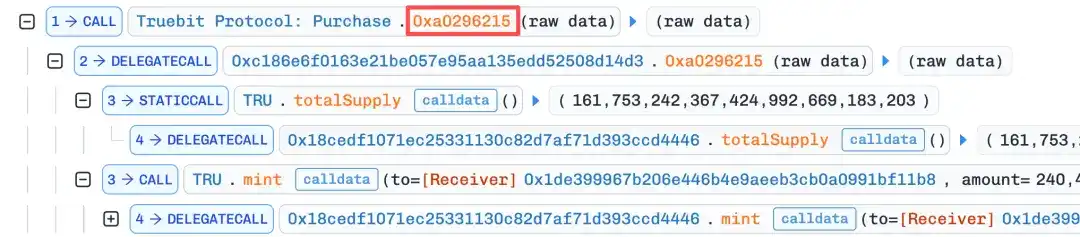
Since the contract is not open-source, it is inferred from the decompiled code that this function has an arithmetic logic vulnerability, such as integer truncation issues, allowing the attacker to successfully mint a large number of TRU tokens.

3. The attacker "sells back" the minted tokens to the contract through the burn function, extracting a large amount of ETH from the contract reserves.
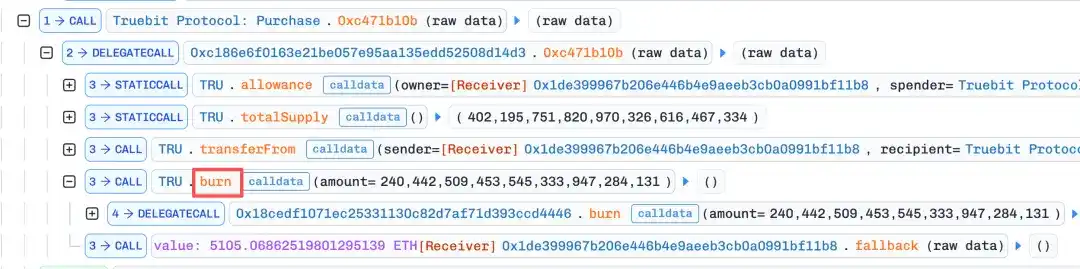
This process is repeated 4 more times, with the msg.value increasing each time, until almost all ETH in the contract is extracted.

Stolen Funds Tracking

Based on on-chain transaction data, Beosin conducted a detailed fund tracking through its blockchain on-chain investigation and tracking platform, BeosinTrace, and shares the results as follows:

Currently, the stolen 8,535.36 ETH, after transfers, are mostly held in 0xd12f6e0fa7fbf4e3a1c7996e3f0dd26ab9031a60 and 0x273589ca3713e7becf42069f9fb3f0c164ce850a.

Among them, address 0xd12f holds 4,267.09 ETH, and address 0x2735 holds 4,001 ETH. The address from which the attacker initiated the attack (0x6c8ec8f14be7c01672d31cfa5f2cefeab2562b50) still holds 267.71 ETH. There have been no further fund transfers from these three addresses yet.
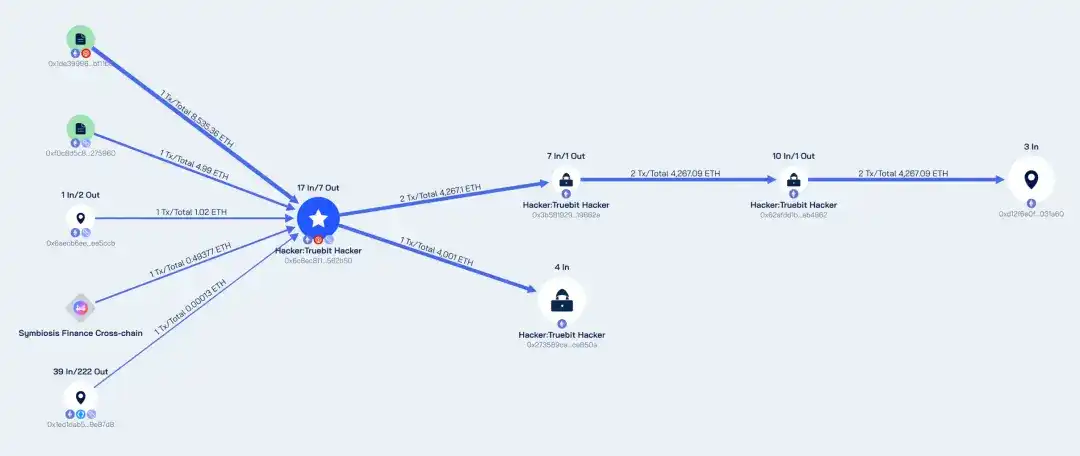
Stolen Funds Flow Analysis Diagram by Beosin Trace

The above addresses have been marked as high-risk addresses by Beosin KYT. Taking the attacker's address as an example:
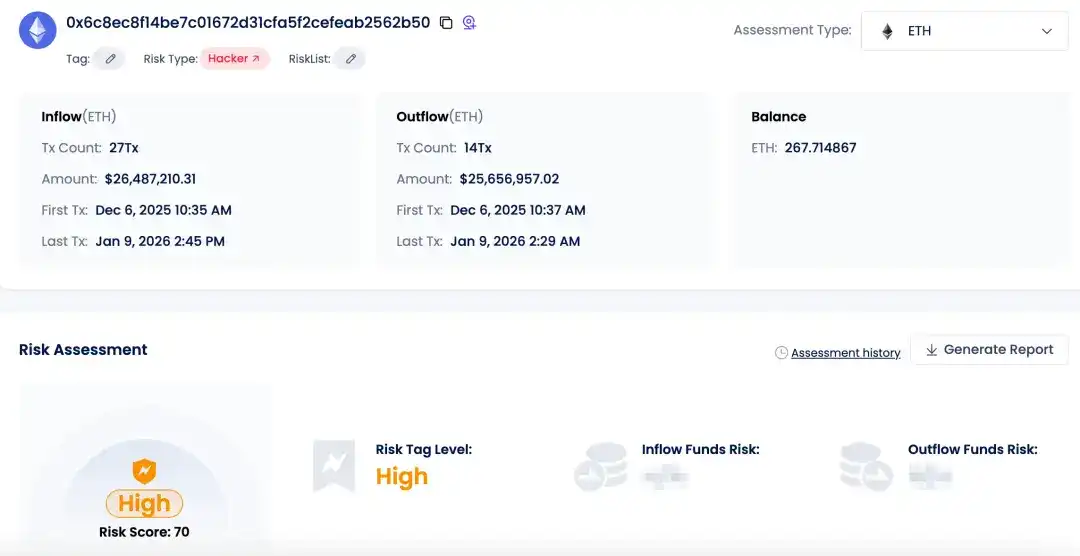
Beosin KYT

Conclusion

This stolen fund incident involves an unopen-sourced smart contract from 5 years ago. For such contracts, the project team should upgrade the contract, introduce emergency pause functions, parameter limitations, and new Solidity security features. Furthermore, security audits remain an essential step for contracts. Through security audits, Web3 enterprises can comprehensively detect smart contract code, identify and fix potential vulnerabilities, and enhance contract security.

*Beosin will provide a complete analysis report of all fund flows and address risks for this incident. Welcome to request it via the official email [email protected].


Preguntas relacionadas

QWhat was the total amount of ETH stolen in the Truebit Protocol security incident?

A8,535.36 ETH, valued at approximately $26.4 million.

QWhich function did the attacker call to exploit the vulnerability in the unopened contract?

AThe attacker called the function 0xa0296215() with a very small msg.value to exploit an arithmetic logic vulnerability, likely due to integer truncation issues.

QHow did the attacker convert the fraudulently minted TRU tokens into ETH?

AThe attacker used the burn function to 'sell back' the minted TRU tokens to the contract, extracting a large amount of ETH from the contract reserves.

QWhat are the two main addresses where the stolen ETH is currently held?

AThe majority of the stolen ETH is held in addresses 0xd12f6e0fa7fbf4e3a1c7996e3f0dd26ab9031a60 (4,267.09 ETH) and 0x273589ca3713e7becf42069f9fb3f0c164ce850a (4,001 ETH).

QWhat security measures does Beosin recommend to prevent such incidents?

ABeosin recommends upgrading the contract to include emergency pause functions, parameter limits, and new Solidity security features, as well as conducting thorough security audits to detect and fix potential vulnerabilities.

Lecturas Relacionadas

Must-Watch Events Next Week|CLARITY Act Could Face Senate Vote; SpaceX, Circle to Report Earnings (8.3-8.9)

**Summary: Key Events and Developments to Watch (August 3-9)** The upcoming week is marked by significant financial disclosures, key legislative deadlines, and notable product updates. **Major Financial Events:** Several companies are scheduled to release their Q2 2026 earnings. American Bitcoin (ABTC) will report on August 3, followed by SpaceX and Hut 8 Mining Corp. on August 4, and Circle on August 5. Notably, a significant portion of SpaceX shares (up to 12% of total shares) will be unlocked on August 6 following their earnings release. **Key Legislative Deadline:** The U.S. Senate faces an August 7 deadline to secure 60 votes for the CLARITY Act, a bipartisan bill aiming to establish a federal regulatory framework for cryptocurrencies. The Senate may hold a full vote on the bill during the week. **Economic Data:** The U.S. July Non-Farm Payrolls report will be released on August 7, providing crucial labor market data. **Technology & Product Updates:** * **Shutdowns:** DeFi portfolio tracker Zapper and wallet app Ctrl Wallet will cease operations on August 3. * **Upgrades:** LayerZero will deprecate its v1 relayers on August 3. XRP Ledger's new version 3.3.0, featuring five new functions, is expected next week. * **AI:** Elon Musk announced that the advanced Grok 4.6 AI model is set for release around August 7. * **Bitcoin:** The BIP-110 forced signaling for a potential Bitcoin network change is scheduled to begin around August 8. **Other Notable Events:** Chinese robotics firm Unitree Tech has set its preliminary price inquiry for its IPO for August 5. South Korean exchange Upbit will delist AQT and AERGO tokens on August 3.

marsbitHace 2 hora(s)

Must-Watch Events Next Week|CLARITY Act Could Face Senate Vote; SpaceX, Circle to Report Earnings (8.3-8.9)

marsbitHace 2 hora(s)

Stocks Are Plummeting More Sharply Than Cryptocurrencies. Where Has the Money Gone?

Stock Markets Plunge Deeper Than Cryptocurrencies: Where Did the Money Go? In late July, Seoul's Kospi index triggered circuit breakers for two consecutive days, plummeting over 40% from its June high. The collapse was led by heavyweight stocks like SK Hynix, whose record profits still disappointed investors, and devastating leveraged ETFs, with one major product losing over 83% of its value. This signaled a global, forced deleveraging targeting the most crowded trades. Interestingly, while stocks exhibited extreme volatility akin to crypto markets, Bitcoin rose nearly 15% in July after a prior steep drop. Analysis shows the money fleeing equities did not flow into Bitcoin. Instead, Bitcoin had already absorbed its sell-off in May-June, when U.S. spot Bitcoin ETFs saw historic outflows. The true safe-haven beneficiary was gold, whose price rose over 20% year-on-year, highlighting a decoupling between Bitcoin and gold as "digital gold." The sell-off was a targeted unwinding of leveraged positions in tech and semiconductors, accelerated by broker-dealer risk management and shifts in the AI narrative, including new competition from Chinese memory chipmakers. The retreat path was clear: from high-valuation tech stocks to cash and U.S. Treasuries, then to gold. For Bitcoin to attract sustained institutional inflows, conditions like eased global liquidity pressure, a "soft-landing" Fed rate cut, and U.S. regulatory clarity via legislation like the stalled CLARITY Act are needed. Currently, Bitcoin is not a safe haven but an already-cleared asset. Its low correlation with tech stocks, however, makes it a potential diversification play for institutional portfolios once the storm passes. The money isn't here yet, but the positioning is underway.

marsbitHace 2 hora(s)

Stocks Are Plummeting More Sharply Than Cryptocurrencies. Where Has the Money Gone?

marsbitHace 2 hora(s)

In Conversation with Ray Dalio: We Are Currently in an AI Bubble, with 1% of My Portfolio in Bitcoin

Ray Dalio, founder of Bridgewater Associates, warns in an interview that the current AI boom shows classic bubble characteristics, which could lead to significant economic downturns as seen in past cycles like 1929 or 2000. He explains that speculative enthusiasm, fueled by debt and overvaluation, often precedes a crash when rising rates or taxation force asset sales, causing widespread losses and recession. Dalio also outlines his "Big Cycle" theory, describing an approximate 80-year pattern where widening wealth gaps, massive government deficits, and shifting geopolitical power (like China's rise) create internal conflict and global instability. He emphasizes that we are in a late-cycle, transitional phase where traditional powers like the US and UK face decline. For personal wealth protection, Dalio advises diversification beyond cash into assets like stocks, bonds, real estate, and particularly gold, which he prefers over Bitcoin. While he holds about 1% of his portfolio in Bitcoin as a non-printable hard asset, he views gold as more secure from technological or governmental threats. Regarding AI's impact, Dalio believes it will disproportionately benefit capital owners, worsening inequality by replacing both physical and cognitive labor. He suggests that human intuition and emotional intelligence, combined with AI, will be key for future workers. On taxation, Dalio argues that wealth taxes are impractical and risk triggering asset sell-offs, reducing productive investment. He points to the UK as a cautionary example of debt, low productivity, and political strife. Geopolitically, Dalio foresees a more regionalized world, with the US showing weakness in prolonged conflicts like with Iran, akin to past imperial declines. The ideal outcome, he suggests, is coexisting powerful blocs (e.g., Americas, China-Asia Pacific) without major war.

marsbitHace 5 hora(s)

In Conversation with Ray Dalio: We Are Currently in an AI Bubble, with 1% of My Portfolio in Bitcoin

marsbitHace 5 hora(s)

Trading

Spot
活动图片




