Lighter TGE Imminent: Full Overview of Timeline, On-Chain Signals, and Market Pricing

Odaily星球日报Publicado a 2025-12-24Actualizado a 2025-12-24

Resumen

Lighter, a perpetual contract trading platform built on Ethereum L2, is expected to undergo its Token Generation Event (TGE) soon, with market speculation pointing to a window between December 24 and January 1. Key signals include its recent addition to Coinbase's listing roadmap, a Binance perpetual futures pre-market listing, and on-chain movements of 250 million LIT tokens (25% of total supply) suspected to be for airdrop distribution. Data from DeFiLlama shows Lighter leading the Perp DEX sector with $232.3B in trading volume over the past 30 days and a TVL exceeding $1.4B. The project distinguishes itself by leveraging Ethereum's ecosystem rather than building an independent L1, aiming to combine CEX efficiency with DEX security. Pre-market trading on Binance values LIT at around $3.2, implying a fully diluted valuation (FDV) of approximately $3.2B. Market analysts project a range of potential valuations: a bear case of $1.5B FDV ($1.5 per token), a base case of $3B–$4.2B FDV, and a bullish scenario of $7.5B–$12.5B FDV. Users are advised to monitor official announcements closely, as the team is currently reviewing Sybil and wash-trading activities before final airdrop distribution.

Original | Odaily Planet Daily (@OdailyChina)

Author | Asher (@Asher_ 0210)
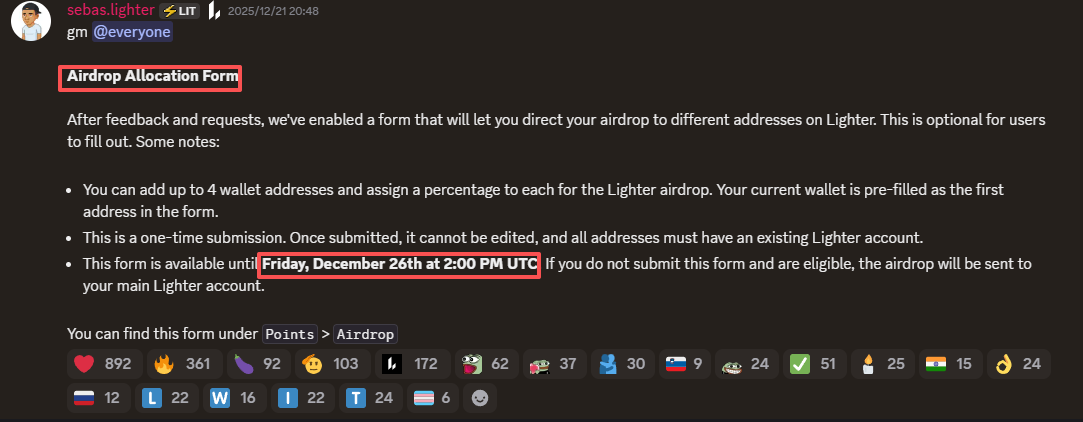
On December 13, Coinbase Markets announced on platform X that Lighter had been added to its listing roadmap; On December 21, Lighter officially announced on Discord, requiring users to complete airdrop address registration by December 26; On December 23, Binance launched Lighter (LIT) perpetual contract pre-market trading. With multiple key milestones landing in quick succession, market expectations for Lighter's imminent Token Generation Event (TGE) have rapidly heated up.
On-chain data further confirms this judgment. On December 20, the Lighter token contract transferred 250 million LIT to a new address (0x98e7769167194A8Cf272B649319676bE84052b5f); This morning, this address has already distributed varying amounts of tokens to 20 addresses, with the highest single transaction being approximately 3.1 million tokens and the lowest about 9,820 tokens. It currently still holds about 230 million LIT. Although the official use of this batch of tokens has not been disclosed, the community widely speculates it may be for airdrop-related distribution.

It is worth noting that 250 million LIT恰好 exactly accounts for 25% of the total token supply,高度 consistent with the community's previous猜测猜测 about "25% allocated for airdrops," further strengthening the market's judgment that Lighter is about to complete its TGE.

Lighter token contract transfers 250 million LIT to a new address

Regarding the timeline expectation, feedback from participants of the previous Lighter Japan AMA suggests the TGE might occur in the window from December 24 to January 1 next year; On the prediction event "When will Lighter conduct its TGE?" on Polymarket, December 29 has the highest probability, currently around 75%.
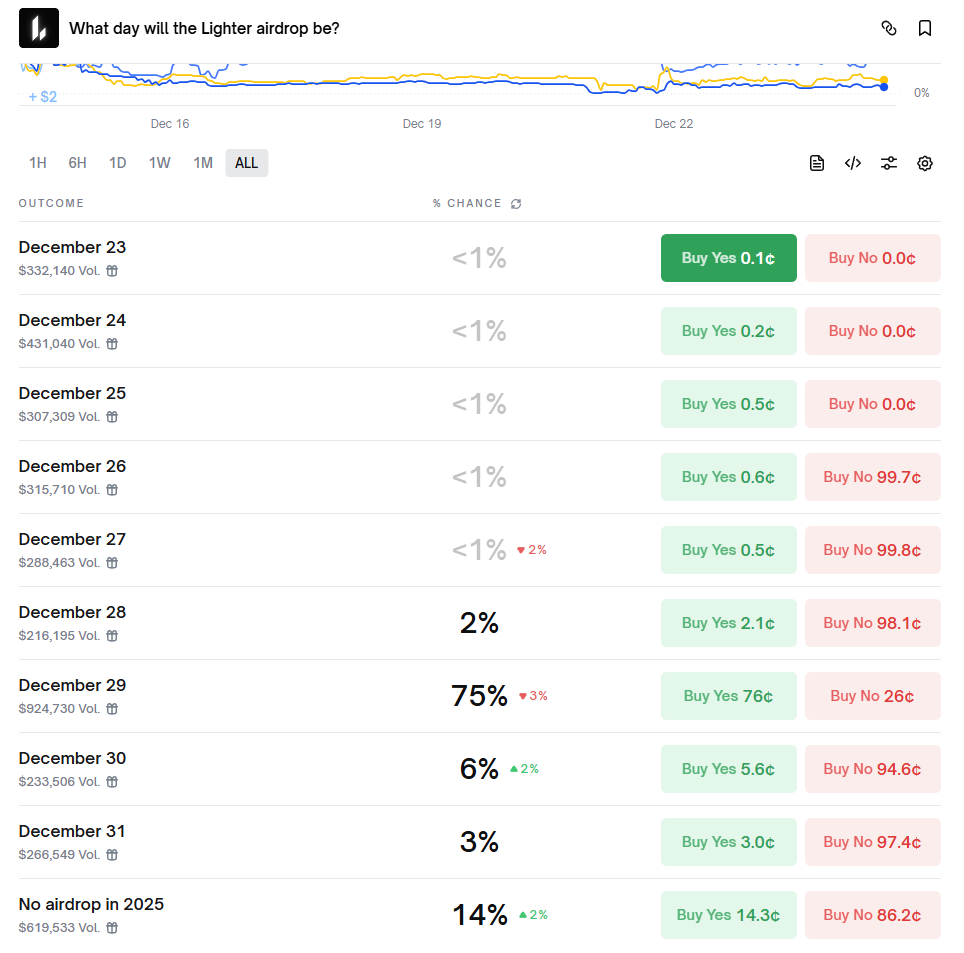
Polymarket prediction event: "On which day will Lighter conduct its TGE?"

Lighter Ranks First in Perp Dex Sector by Perpetual Contract Volume Over Past 30 Days

Lighter is a perpetual contract trading platform built on Ethereum Layer 2 (L2), aiming to combine the speed and liquidity of centralized exchanges (CEX) with the security and transparency of decentralized exchanges (DEX).

According to DeFiLlama data, over the past 30 days, Lighter led the Perp Dex sector with approximately $232.3 billion in perpetual contract trading volume, ahead of Aster ($195.5 billion) and Hyperliquid ($182 billion).

Perp Dex sector perpetual contract trading volume ranking

Furthermore, Lighter's TVL has continued to rise in recent months, currently surpassing $1.4 billion, exceeding Aster's ($1.27 billion).
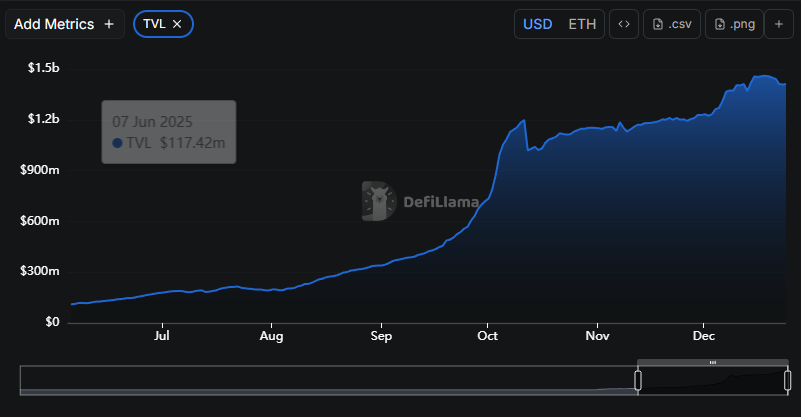
Lighter TVL Data

If Aster's backer is Binance, then Lighter's backer is Ethereum. As Lighter CEO Vladimir Novakovski previously commented on platform X, “Being an L1 is a bug, not a feature.”
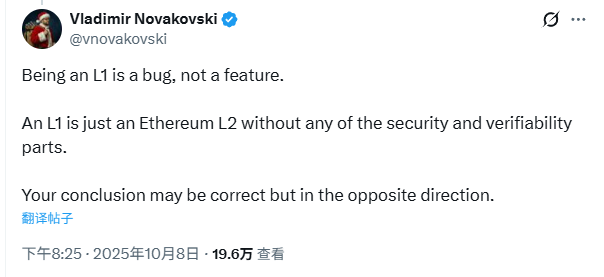
Lighter CEO comments on Lighter's choice of a modular L2 route

Instead of choosing a closed architecture like HyperLiquid's self-built L1, Lighter adopts a core route of "Ethereum-native composability": LLP Tokens can circulate on the mainnet and synergize with DeFi protocols like Aave, thus enjoying a low-cost, low-latency, verifiable execution environment within an open ecosystem. In other words, Lighter's goal is to allow any protocol to reuse its matching engine and capital system. Lighter is not meant to replace Ethereum, but to evolve with Ethereum, becoming the underlying engine for high-performance on-chain finance.

Lighter Valuation and Pre-Market Pricing

Based on Binance's perpetual contract pre-market trading, the LIT price has slowly declined from an initial $3.9 to a current quote of $3.2. At the current price, Lighter's Fully Diluted Valuation (FDV) is approximately $3.2 billion.

If 25% of the total token supply is entirely used for future airdrops, and given a total of 12 million points, then each point corresponds to approximately 20.8 LIT. Estimated at the current pre-market price, each point is worth about $66.

Market Participants' Valuation Range Estimates

Crypto KOL ingalvarez.sol (@ingalvarezsol) predicted Lighter's valuation by combining factors from Polymarket, OTC point prices, and the pre-market LIT token price:

  • $1.5 billion Minimum valuation under pessimistic conditions, corresponding to a token price of ~$1.5;
  • $3–4.2 billion: Bear market benchmark range, corresponding to a token price of ~$3 to $4;
  • $7.5–12.5 billion: Optimistic scenario, corresponding to a token price of ~$7.5 to $12.5;

Another early Lighter user, Chuk (@chuk_xyz), also made predictions based on Lighter's TVL, trading volume, revenue, and other data:

  • Bear Market Range ($1.5B–$4.2B FDV): If the price operates within this range post-TGE, it can be seen as an opportunity zone. The psychological pressure on airdrop holders is lowest, and the risk-reward ratio is clearest.
  • Benchmark Range ($4.2B–$7.5B FDV): If Lighter can stabilize its TVL and maintain a top-tier operational scale, this range can be considered fair value. After the price enters this range, it is suitable to take staged profits to break even while retaining some position.
  • Bull Market Range ($7.5B–$12.5B+ FDV): This range意味着 core catalysts have been fully priced in by the market, including strengthened RWA momentum and consensus formed around the distribution narrative (fintech/broker alignment). This stage is more suitable for continuously reducing positions during the upward trend.

On the Polymarket prediction event "Lighter FDV one day after opening," the probability of exceeding $1 billion FDV is as high as 88%, and the probability of exceeding $2 billion FDV is also 83%.
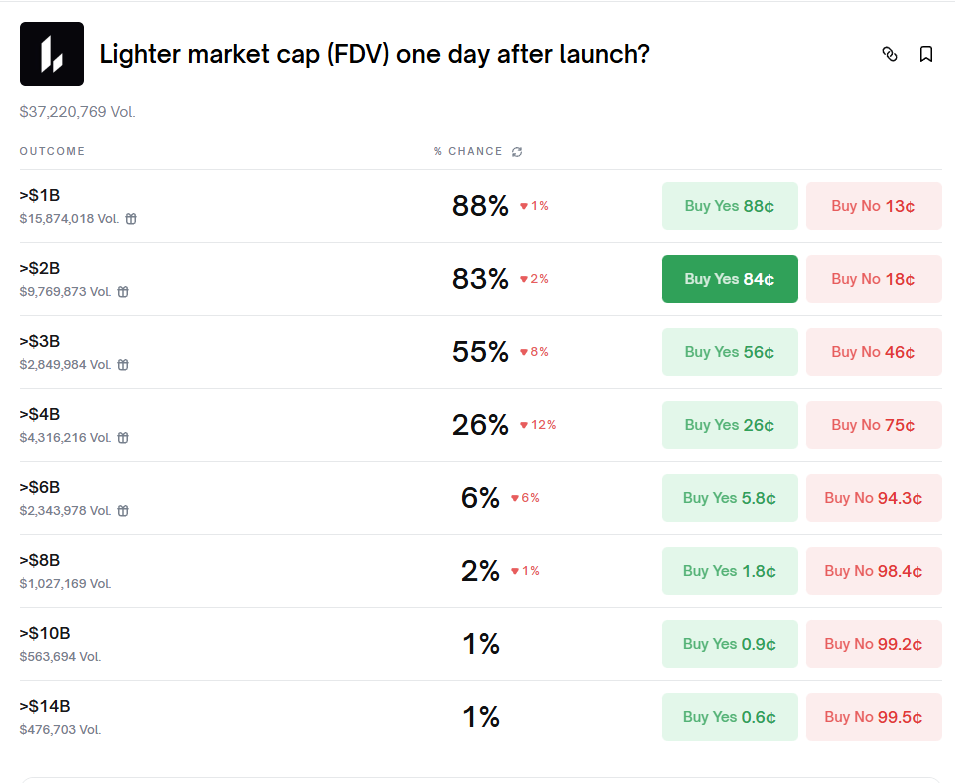
Polymarket event: "Lighter FDV one day after opening"

In summary, the market's minimum expectation for Lighter's opening valuation is an FDV of $1.5 billion, corresponding to a token price of $1.5. Therefore, if the opening price pulls back, $1.5 is an ideal short-term entry price.

Do Not "Celebrate at Halftime," Closely Monitor Official Announcements

Early participants in Lighter interactions must not "celebrate at halftime"; points cannot be considered profit until they are converted into actual LIT tokens. According to the latest announcement from Lighter on their official Discord, "We have entered the final stage of the second season points event. Data analysis is currently underway to remove points obtained by sybil addresses, self-trading, and wash trading. All slashed points (including portions already removed) will be redistributed to the community."

Latest announcement from Lighter on official Discord


Preguntas relacionadas

QWhat is the expected TGE (Token Generation Event) date for Lighter based on market predictions?

ABased on Polymarket predictions, the highest probability (around 75%) is for the TGE to occur on December 29th. Other community feedback suggests a window between December 24th and January 1st.

QWhat is the significance of the 250 million LIT tokens transferred to a new address on December 20th?

AThe transfer of 250 million LIT tokens, which is 25% of the total supply, is widely speculated by the community to be for airdrop distribution, aligning with previous rumors about the airdrop allocation.

QHow does Lighter's trading volume rank in the Perp DEX sector over the past 30 days?

AAccording to DeFiLlama data, Lighter ranked first in the Perp DEX sector for perpetual contract trading volume over the past 30 days, with approximately $232.3 billion, ahead of Aster and Hyperliquid.

QWhat is the current pre-market price of LIT on Binance and what is the corresponding Fully Diluted Valuation (FDV)?

AThe pre-market price of LIT on Binance is currently around $3.2, which corresponds to a Fully Diluted Valuation (FDV) of approximately $3.2 billion.

QWhat is the core architectural philosophy behind Lighter, as stated by its CEO?

ALighter's CEO, Vladimir Novakovski, stated that 'Being an L1 is a bug, not a feature.' Lighter is built as a modular Layer 2 on Ethereum, aiming to combine CEX-like speed and liquidity with DEX-like security and transparency, and to integrate natively with the Ethereum ecosystem.

Lecturas Relacionadas

Near Returns to the AI Stage: Transformation into a Public Chain Due to 'Payroll Difficulties,' Agent and Privacy Emerge as New Growth Narratives

NEAR Returns to AI Origins: From Payroll Struggles to Blockchain, Now Focusing on AI Agents and Privacy NEAR Protocol's journey began not with grand blockchain ambitions, but from a practical hurdle: its AI startup founders, including Transformer paper co-author Illia Polosukhin, couldn't efficiently pay international developers in 2017. This led them to pivot and build a high-performance, scalable blockchain. After years navigating various crypto narratives like sharding and cross-chain interoperability, NEAR is now leveraging its AI roots to re-enter the AI arena. A key driver is its "NEAR Intents" layer, which abstracts complex cross-chain transactions. Users simply state their goal (e.g., swap BTC for ETH), and a solver network finds the optimal route. This system has processed over $20B in cross-chain volume, generating significant fee revenue. A major growth area is private transactions via "Confidential Intents/Swaps," which hide trade details until settlement to protect against MEV and front-running. Remarkably, private swaps recently accounted for over 40% of NEAR's transaction volume, highlighting strong demand but also potential regulatory scrutiny. With its AI-founder pedigree, NEAR is positioning itself at the intersection of blockchain, AI agents, and privacy, aiming to become infrastructure for the emerging agent economy while navigating the challenges of its rapid adoption.

marsbitHace 50 min(s)

Near Returns to the AI Stage: Transformation into a Public Chain Due to 'Payroll Difficulties,' Agent and Privacy Emerge as New Growth Narratives

marsbitHace 50 min(s)

From Ethereum to AI's 'CROPS': What Exactly is This Set of 'Slow Variables' That Vitalik Repeatedly Emphasizes?

In recent discussions, Vitalik Buterin has frequently emphasized the concept of "CROPS," a framework defining core values for Ethereum's development. CROPS stands for Censorship Resistance, Capture Resistance, Open Source, Privacy, and Security. Initially outlined in the Ethereum Foundation's "EF Mandate," it represents a commitment to user sovereignty, ensuring that the network resists external control, remains open, protects privacy, and prioritizes security. The relevance of CROPS extends beyond Ethereum's foundational principles, becoming crucial in the context of AI integration. As AI agents begin handling wallet operations and automated transactions, the risk increases that users may cede control over their digital assets, privacy, and intentions to centralized AI service providers. A "CROPS AI" would therefore emphasize local execution where possible, privacy-preserving remote model calls (e.g., using zero-knowledge proofs), and transparent, verifiable processes to maintain user agency. Vitalik highlights a significant convergence between "CROPS Ethereum access layer" and "CROPS AI." Both address the same fundamental challenge: how users can access powerful services—be it blockchain data via RPCs or AI models—without exposing sensitive information or relinquishing ultimate control. This intersection points toward a future digital entry point that is more private, secure, and user-controlled. Ultimately, CROPS is not merely an abstract ideal but a practical guidepost. It steers development—from protocol resilience and wallet design to AI agent safety—towards a future where users retain self-sovereignty even as digital systems grow more complex and powerful. In an era of accelerating AI adoption, these "slow variables" of censorship resistance, openness, privacy, and security may define Ethereum's enduring value.

marsbitHace 1 hora(s)

From Ethereum to AI's 'CROPS': What Exactly is This Set of 'Slow Variables' That Vitalik Repeatedly Emphasizes?

marsbitHace 1 hora(s)

Silicon Valley 'Startup Guru' Steve Hoffman: Web3 + AI Could Be a Trap

Silicon Valley investor and "Godfather of Startups" Steve Hoffman warns that combining Web3 with AI is likely a trap, not a promising venture. In an interview, Hoffman argues that while AI is a foundational technology touching all industries, Web3 adds complexity, friction, and regulatory risk without solving mainstream consumer or business needs. He advises founders to focus on deep, specialized applications where startups can out-iterate giants, rather than on generic features easily replicated by large tech companies. Hoffman observes that Silicon Valley will lead foundational AI research, while China excels at rapid, large-scale application and commercialization, particularly in robotics. He stresses that AI-driven autonomous agents capable of collaborative, multi-step tasks are 2-4 years away, which will cause significant job displacement. The solution is not to slow AI but to redesign business models around human-AI collaboration and reform social systems like education and retraining. For startups, Hoffman recommends focusing on vertical, expertise-heavy domains to build defensibility. He sees major opportunities in AI fraud detection and cybersecurity. Key founder mindsets include systemic thinking over feature-focus, relentless customer centricity, building adaptive teams, and deeply understanding AI's capabilities and limits. Hoffman is also leading a non-profit initiative to establish university centers aimed at training future leaders in responsible, human-value-aligned AI innovation.

marsbitHace 2 hora(s)

Silicon Valley 'Startup Guru' Steve Hoffman: Web3 + AI Could Be a Trap

marsbitHace 2 hora(s)

Token Inefficient, Economy Tokenless

The article "Tokens Aren't Economical, Economics Aren't Tokenized" analyzes a pivotal shift in the AI industry from a technology-driven narrative to one dominated by capital efficiency. It highlights two concurrent trends: a severe capital shortage due to the exorbitant and recurring costs of compute (e.g., OpenAI's high burn rate) and a wave of corporate spin-offs where major tech companies are separating their AI units (like Kuaishou's Kling and Baidu's Kunlunxin). The core argument is that AI's "anti-internet" business model, where user growth increases costs rather than profits, has created a disconnect between high valuations and actual cash flow. Spin-offs address this by allowing AI assets to be valued independently. Within a parent company, they are seen as cost centers, but as standalone entities, they are priced based on their growth potential and scarcity in the primary market, leading to massive valuation premiums (e.g., Kling's estimated value tripling post-spin-off). The industry is at an inflection point, moving from "model worship" to "value realization." The competition is evolving from a pure compute (GPU) race to a broader focus on systemic efficiency and full-stack engineering (involving CPUs and orchestration) to achieve viable commercialization. The year 2026 is framed as a critical moment where the industry must definitively answer how to economically translate AI capability into tangible business value, reshaping the sector's future power structure.

marsbitHace 2 hora(s)

Token Inefficient, Economy Tokenless

marsbitHace 2 hora(s)

Trading

Spot
Futuros
活动图片




