Let Funds Flow at Internet Speed

链捕手Publicado a 2026-07-13Actualizado a 2026-07-13

Resumen

Tokenization bridges the distinct worlds of always-on, permissionless DeFi and traditional funds with scheduled, permissioned settlements, unlocking significant value for those who can manage this integration. The tokenized Real World Asset (RWA) market exceeds $33 billion, with U.S. Treasuries comprising nearly half. It offers corporate treasurers options from low-risk, liquid Treasury funds to higher-yield, programmable investments, all benefiting from the same audit standards as traditional bonds. The core advantage is *composability*: tokenized funds can combine yield, liquidity, and transferability simultaneously, unlike traditional finance which forces a trade-off. However, achieving this requires sophisticated coordination. Tokenized funds remain legally bound to daily net asset value (NAV) updates, KYC-verified holder lists, and redemption cut-offs based on traditional settlement infrastructure (e.g., 5 PM ET). Key challenges in this hybrid model are: 1) **Price**: Determining token value between NAV updates to prevent manipulation; 2) **Compliance**: Embedding KYC/whitelisting (e.g., within a vault) to allow free circulation of receipt tokens in DeFi; and 3) **Cross-chain Consistency**: Maintaining a single source of truth for ownership and value across multiple blockchains. Projects like Centrifuge (with its deRWA framework and V3 architecture) and LayerZero address these by using a hub-and-spoke model. A central "hub" chain manages NAV, accounting, and complianc...

Article Compiled by: Block unicorn

Tokenization stitches together two very different worlds: the always-on, permissionless DeFi protocol, where prices fluctuate every few seconds, and the traditional fund, whose settlements follow the administrative timeframes of a group of permitted holders.

Merging the two requires masterful orchestration, but for those who can pull it off, there is immense value. In today's article, I explore who is behind the curtain, operating the bridges that connect these worlds, and who is capturing the value.

The size of tokenized real-world asset (RWA) pools exceeds $33 billion, with tokenized U.S. Treasuries accounting for about $15 billion. But notably, its share has slipped from 55% to less than 45% in just one year. Meanwhile, other tokenized funds have grown, including institutional credit funds (e.g., Apollo's ACRED) and private credit funds (e.g., Janus Henderson's JAAA).

The maturation of tokenization offers a range of choices for treasurers or CFOs managing corporate cash, across varying risk appetites. Those seeking low risk, low returns but high liquidity can opt for Treasury funds, while those pursuing higher yields and stronger programmability can choose riskier investment options. The safety of yields is no longer the concern it once was. These instruments backed by Treasury funds are audited by the same auditing institutions that audit traditional bonds.
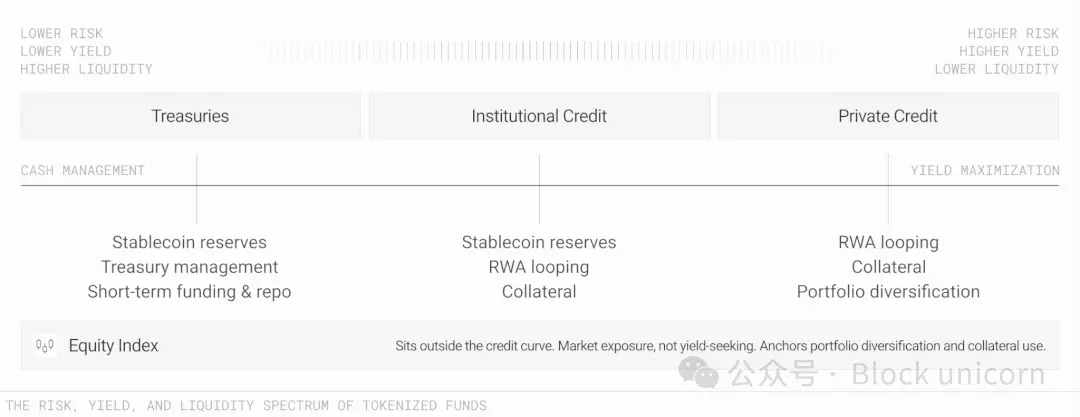
This is the strongest argument that real-world asset tokenization is on the verge of a boom among institutional investors.

If someone asks me what the difference is between off-chain and on-chain money, I'd say it's composability. It is composability that allows one dollar to serve a greater purpose across multiple channels, achieving higher compound growth. The ability to cash out instantly and to put your money to more efficient work makes them seem like funds on steroids.

Traditional finance makes us choose between yield, liquidity, and transferability. Tokenized funds, if managed well, can give us all three at once.

But "managed well" is no simple task. The composability of funds involves an engineering problem.

Stitching Together Two Very Different Worlds

Blockchain brings speed, cost-effectiveness, and rapid settlement to tokenized risk-weighted assets (RWAs). But a tokenized money market fund is still a fund, not a stablecoin. It still needs its net asset value updated once every business day, following the fund manager's schedule. It still needs to maintain a KYC'd holder group. For example, BlackRock's BUIDL has a $5 million minimum investment threshold, while Circle's USYC is restricted to non-U.S. persons. It still needs to adhere to redemption cutoffs because its underlying Treasury settlement relies on off-chain infrastructure with a settlement cutoff at 5 p.m. ET.

This is the legal essence of the product. Remove daily NAV settlements, and it's no longer a money market fund. Remove the whitelist, and the SEC will come knocking.

So how can a fund maintain its set timeline, holder setup, and redemption window while also having the token representing its shares flow at internet speed? The fund needs specially built infrastructure to maintain NAV at period-end, support epoch-based settlement, and adhere to strict legal boundaries when moving assets across blockchains. It's a tricky co-existence puzzle.

A recent report jointly published by LayerZero and Centrifuge describes how they solved this.

Resolving the Conflict Points

Three conflict points determine whether this coexistence model can succeed. If the orchestration layer gets these right, the fund can run at internet speed without breaching legal boundaries.

The first is price.

What is the token worth between two NAV settlement cycles? Some issuers freeze the token price at yesterday's level and accept the stagnation. A frozen price is easily manipulated when rates move during the day. A continuously moving price is harder to manipulate, but also harder to reconcile with the fund's actual books.

The second is the compliance factor.

Where does the whitelist verification layer run? If it runs on every transfer, the token cannot touch open DeFi and can only move between approved wallets. If that layer is wrapped inside a vault, the vault holds the regulated shares and issues a freely transferable receipt token to holders who have passed KYC once. That receipt can be composed through DeFi, with compliance embedded in the vault, not checked on every transfer. Centrifuge's deRWA framework is a good example.

The third conflict arises when moving assets across chains.

When a tokenized fund is deployed on nine chains, you need a single source of truth for ownership and value. While on-chain infrastructure can update in real time, discrepancies still need to be updated and reconciled across nine chains. The more failure points, the more chances for error.

LayerZero and Centrifuge solved this by building a hub-and-spoke model. In this model, one authoritative chain manages NAV, accounting, and compliance. A messaging layer (orchestrated by LayerZero in this case) pushes these updates to the spoke chains where tokens are actually used.
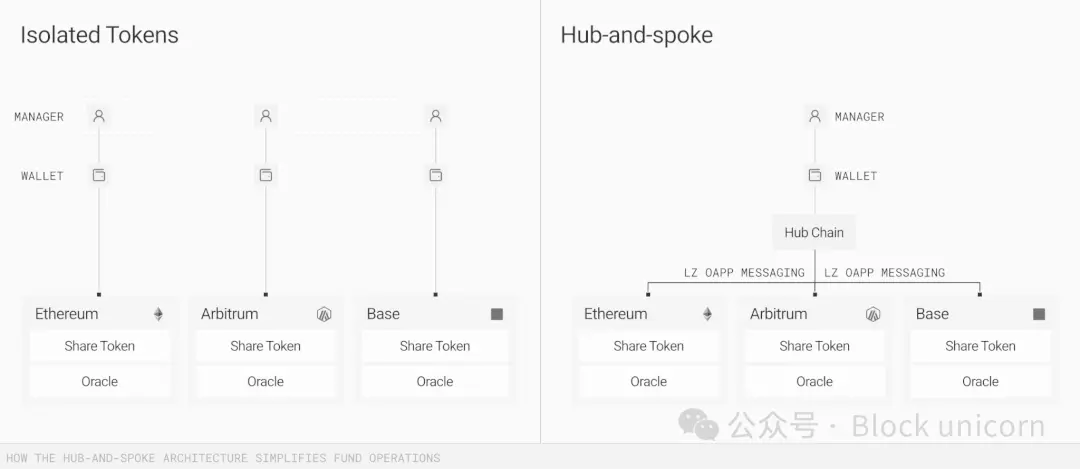
Centrifuge's V3 architecture is built exactly on this, where each pool chooses a hub chain as its source of truth, branch chains as distribution terminals for deposits, and enabling DeFi composability. LayerZero transmits operational data between the chains to keep NAV updates, compliance instructions, and cross-chain balance states in sync.

This is the coveted yet essential orchestration I mentioned earlier, which delivers value to those who can execute it. Whoever can maintain a fund's authoritative state consistently across chains becomes very hard to replace. While fund managers still own time, and blockchains still own composability, someone in the middle must enable both.

The most fragile part of asset movement is accounting for assets in transit.

When an asset is in transit between chains, it can temporarily disappear from the fund's visible balance sheet. Centrifuge V3 issues tokenized confirmations for assets in transit, so the fund's balance sheet remains continuous even while the underlying token is still moving. This is the on-chain equivalent of trade-date accounting. Tedious, but crucial.

Why should institutional investors consider tokenized funds despite these conflicts?

One of the best ways to optimize idle cash via tokenization is round-tripping. A treasurer can deposit tokenized Treasury funds and borrow stablecoins against them as collateral. If the borrowing rate is lower than the fund's yield, holding the fund earns a profit. The treasurer can then redeploy the stablecoin proceeds into other yield sources and repeat the cycle.
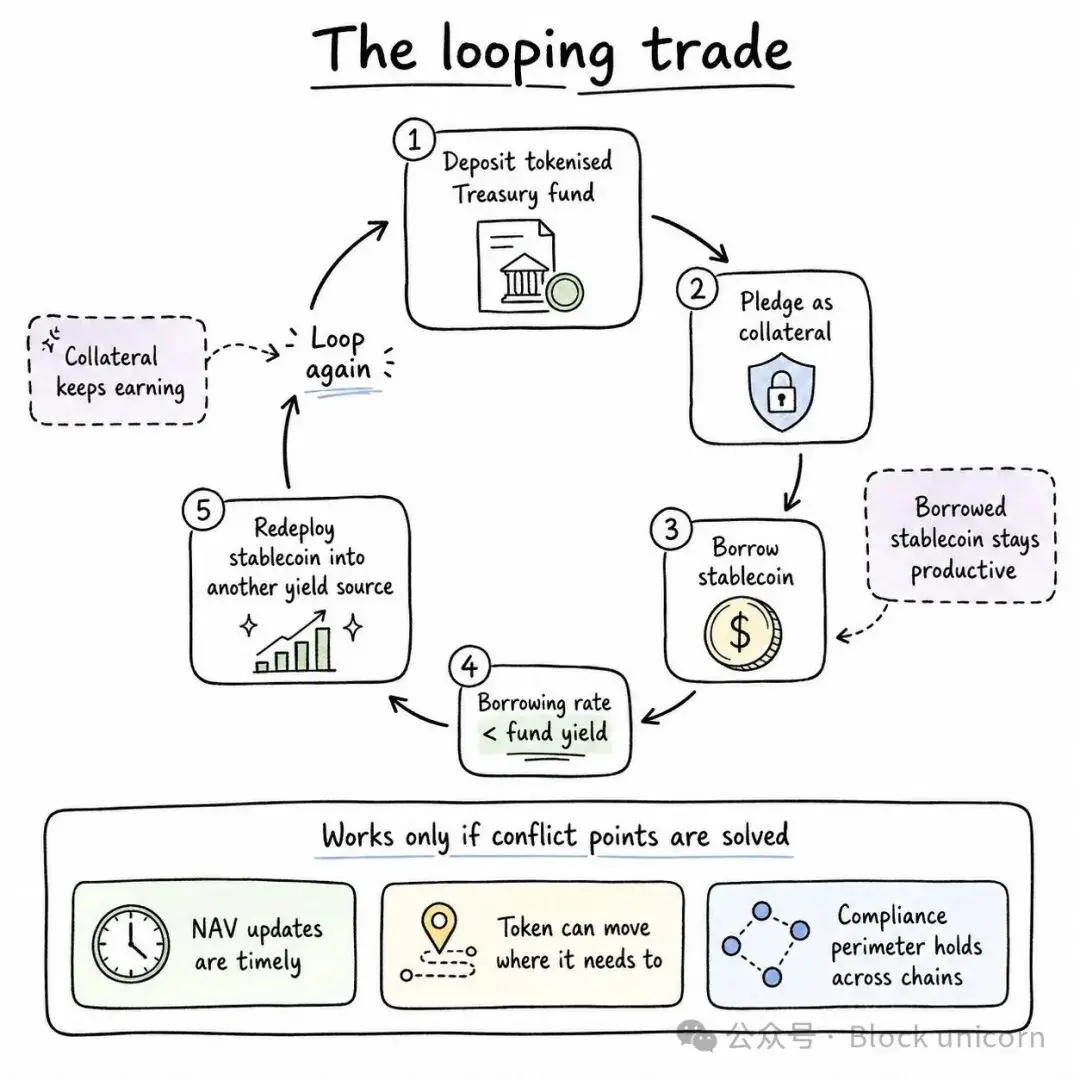
The entire round-trip only works if the above conflict points are resolved. This is the next challenge for those building tokenization infrastructure. These conflict points have been exploited in the past. For instance, if the on-chain NAV price for a smaller tokenized product stays constant for two to four hours and lags the underlying asset price, it creates an arbitrage opportunity until the next NAV price spikes.

A redemption gate conflict can occur when off-chain NAV triggers liquidity limits, if independent on-chain smart contracts try to process token redemptions instantly. This leads to smart contracts holding "orphaned" or unexecuted token transactions that keep trying to execute simultaneously against the off-chain caps.

Large private credit funds and business development companies (BDCs) are facing this right now. Three weeks ago, Apollo Global's $26 billion private credit fund, the Apollo Debt Solutions fund (ADS), had to cap redemptions at 5% after investors tried to redeem about 16.8% of the fund. If something similar happened to a fund that also trades a tokenized version, it would be hard to rule out a redemption gate conflict. In Q2, investors redeemed $15.6 billion from broadly held private credit funds, up from about $13.9 billion in the previous quarter.

Faults can occur in cross-chain message delivery, leaving positions not fully settled. Only by monitoring every failure mode, with credentialed people accountable, can institutional trust be won.

If tokenization is to live up to its apparent potential, it must navigate the following challenges. It is not just about putting U.S. Treasuries on-chain or creating a new asset class. Those building the infrastructure must break the old rules that force investors to choose between yield, liquidity, and transferability. If tokenization can make a dollar do multiple jobs at once without compromising the credibility brought by existing safeguards, institutions sitting on billions in cash will certainly take note.

I've written before that SWIFT, as the orchestration layer of today, has more value and influence than any party on either side of the network it serves. Visa is also worth more than all the banks it serves globally, except JPMorgan.

That is the incentive for being the orchestration layer in an evolving financial world. It can secure a seat at the table in capital markets for the next decade. Centrifuge is defining the role on the fund side, while LayerZero is building the bridges that connect the pieces.

That's all for today. See you in the next article.

Preguntas relacionadas

QWhat is the core advantage of tokenized funds over traditional finance according to the article?

AThe core advantage is composability. Tokenized funds allow money to achieve higher compound growth by being programmatically used across multiple channels simultaneously. Unlike traditional finance, which forces a trade-off between yield, liquidity, and transferability, properly managed tokenized funds can potentially offer all three.

QWhat are the three main conflict points that need to be resolved for tokenized real-world asset (RWA) funds to function effectively?

AThe three main conflict points are: 1) **Price**: Determining the token's value between Net Asset Value (NAV) calculation cycles. 2) **Compliance**: Integrating whitelist/KYC verification without sacrificing DeFi composability. 3) **Cross-Chain Transfers**: Maintaining a unified source of truth for ownership and value when assets are deployed across multiple blockchains.

QHow do LayerZero and Centrifuge propose to solve the cross-chain conflict point for tokenized funds?

AThey propose a hub-and-spoke model. One authoritative chain (the hub) manages the NAV, accounting, and compliance. A messaging layer (e.g., LayerZero) coordinates and pushes these updates to multiple spoke chains where the tokens are actually used for DeFi composability. This ensures synchronization of the fund's authoritative state across all chains.

QWhat specific DeFi strategy does the article mention as a benefit of tokenized treasury funds for corporate treasurers?

AThe article mentions a rehypothecation or 'loop trade' strategy. A treasurer can deposit tokenized treasury funds, use them as collateral to borrow stablecoins, and then redeploy the stablecoin capital into other yield-generating opportunities. This creates a loop that enhances returns if the borrowing rate is lower than the fund's yield.

QWhat historical financial entities does the article compare the new 'coordination layer' in tokenized finance to, and why?

AThe article compares the coordination layer to SWIFT and Visa. It argues that the entity which successfully coordinates between the traditional fund world (with its legal timelines) and the blockchain world (with its speed and composability) will capture immense value, similar to how SWIFT's and Visa's coordination roles made them more valuable than most of the individual networks or banks they serve.

Lecturas Relacionadas

DistributeX Unveils DX Coin Ecosystem Roadmap, Advancing Preparations for Its On-Chain Launch

DistributeX has unveiled the DX Coin Ecosystem Roadmap, detailing its preparations for the upcoming on-chain launch of DX Coin. The roadmap outlines key phases focusing on community governance, technical readiness, blockchain deployment, and ecosystem growth. Current efforts are centered on building community consensus and completing technical groundwork. This includes launching community votes to select the official DX Coin logo and decide on the preferred blockchain network for integration. The platform will also implement features like on-chain wallet binding and contribution tracking to prepare for future data synchronization and rewards. Before the official launch, DistributeX will publish a Tokenomics White Paper detailing the token's issuance, governance, and long-term strategy, and will take a snapshot of eligible community accounts for future asset allocation. The subsequent deployment phase will involve smart contract deployment, security audits, community airdrops, and developing liquidity on decentralized exchanges. Looking further ahead, planned utilities for DX Coin encompass cross-chain interoperability, decentralized governance, digital rights, staking, and other Web3 applications. This roadmap aims to provide the community with clear visibility into the platform's plans, as DistributeX works to establish a solid foundation for DX Coin's on-chain ecosystem and long-term expansion.

TheNewsCryptoHace 37 min(s)

DistributeX Unveils DX Coin Ecosystem Roadmap, Advancing Preparations for Its On-Chain Launch

TheNewsCryptoHace 37 min(s)

AI at a Crossroads: Why Wall Street is Saying "No" to ChatGPT and Claude?

The article "AI at a Crossroads: Why Wall Street Says 'No' to ChatGPT and Claude" explores the growing tension between the adoption of powerful, closed-source AI models and the imperative for data privacy and intellectual property (IP) protection in enterprises, particularly in high-stakes sectors like finance. It details how the fundamental architecture of services like OpenAI and Anthropic involves sending user data in plaintext to the vendors' servers, creating risks of IP leakage ("alpha transfer"). While enterprise contracts with "zero-data-retention" clauses offer some assurance, they rely on trust. A significant problem is "shadow AI," where employees use personal accounts, bypassing corporate policies and leading to data breaches. For consumers, the article highlights that AI conversations lack legal protections like attorney-client privilege and can be subpoenaed in legal cases, a fact many users are unaware of. The core of the piece analyzes the technical spectrum of privacy solutions, contrasting **protocol-level privacy** (contracts, anonymous proxies) with more robust **structural-level privacy**. The latter includes: * **TEEs (Trusted Execution Environments) / Confidential Computing:** Running models in hardware-sealed enclaves with remote attestation. * **End-to-End Encryption (E2EE):** Encrypting prompts so only the target enclave can read them. * **Fully Homomorphic Encryption (FHE):** Performing computations on encrypted data without decryption (currently very slow). * **Local Inference:** Running models entirely on-premise, the most private but costly and limited to less powerful models. The article argues that verifiable privacy (via attestation) is only possible with **open-source models**, as closed-source vendors cannot reveal their serving code without losing competitive advantage. While the performance and cost gap between open and closed models is narrowing, a key dilemma remains: sacrifice some model capability for privacy or risk data exposure for a competitive edge. A case study from Bridgewater and Thinking Machines demonstrates that a finely-tuned open-source model (Qwen) can outperform leading closed models in specific, expert financial tasks, both in accuracy and lower cost. However, the training process itself often isn't private. The discussion extends to the **"harness layer"**—the tools and data sources surrounding an AI agent. Here, privacy becomes even more complex, as each external API call can expose data. Current solutions are mostly at the protocol level (gateways, PII masking), with true encrypted search for open-ended queries still in the research phase. In conclusion, the demand for private AI is growing, with services like Venice AI and Proton gaining users. While privacy-enabling infrastructure (like enclaves) is becoming more affordable and performant, the article posits that the most defensible value lies in solving the remaining hard problems: private training cycles, fully private tool calls, and practical encrypted search. For enterprises, the path forward is to use their proprietary "alpha" (expert knowledge) to fine-tune open-source models within a verifiably private environment, securing their most valuable strategic insights.

链捕手Hace 44 min(s)

AI at a Crossroads: Why Wall Street is Saying "No" to ChatGPT and Claude?

链捕手Hace 44 min(s)

On the Eve of the US Stock Inflation Test, Wall Street Faces the Most Severe 'Data Deception' in History

On the eve of the crucial US June CPI release, a significant credibility gap is emerging between official inflation data and consumer sentiment. While May CPI and PCE figures suggested a "concerning but not critical" picture, the University of Michigan Consumer Sentiment Index plummeted to its lowest level in nearly 50 years. This contradiction is prompting economists to question the reliability of key macroeconomic indicators. The core issue, as highlighted by labor economist Kathryn Anne Edwards, lies in a systemic flaw within the current inflation measurement framework. The Consumer Price Index (CPI) averages prices across a "market basket" meant for a "typical consumer," thereby masking vastly different inflation experiences across demographic groups. For instance, Bureau of Labor Statistics (BLS) research indicates that from 2006 to 2023, the lowest income quintile faced a cumulative inflation rate 7.7 percentage points higher than the highest quintile—a disparity largely invisible in the headline CPI number. This averaging effect means investors and policymakers relying on aggregate CPI may be basing decisions on a statistically smoothed figure that fails to capture the true distribution of economic pressure. Edwards argues that expanding this measurement framework is technically feasible, requiring primarily political will rather than new data collection. The BLS already tracks 100,000 items monthly; creating more granular indices for different family types, income levels, and housing statuses would mainly involve re-weighting existing data. The BLS has produced such experimental series before. A more nuanced data picture is crucial for accurate policy and market forecasting. Ultimately, improving measurement cannot solve underlying economic stresses. Edwards notes concurrent pressures like slowing hiring, stagnant wage growth, persistently high prices, rising credit card debt, a subdued housing market due to high rates, and AI's potential disruption to jobs. These factors collectively explain the deep chasm between official statistics and consumer pessimism. The key takeaway for markets is the need to look beyond a single headline CPI number. Understanding the divergence in inflation experiences across the population is critical for accurately assessing the real pressure within the economy, the path of Federal Reserve policy, and risks on the consumer side.

marsbitHace 1 hora(s)

On the Eve of the US Stock Inflation Test, Wall Street Faces the Most Severe 'Data Deception' in History

marsbitHace 1 hora(s)

Trading

Spot
活动图片