Ledger implant tests Bitcoin ETFs as safer custodial solutions than hardware wallets

cointelegraphPublished on 2026-10-12Last updated on 2026-10-12

Abstract

A newly discovered hardware implant exploit affecting Ledger wallets has sparked debate about the safety of self-custody via hardware wallets compared to holding Bitcoin through ETFs. Analyst PlanB stated he had "zero regrets" about moving his BTC to ETFs in 2025, citing recent exploits as validation. Industry figures note a long-standing trend of large holders shifting to ETFs for "enhanced security," a phenomenon now entering public discourse following the Ledger incident, which may have caused over $86 million in losses. While experts like Blockstream's Adam Back assert hardware wallets can remain secure with improved threat modeling, others highlight the risks of user error. 21Shares co-founder Ophelia Snyder argued that without proper technical setup, self-custody is less secure than relying on specialized custodial firms. Bitcoin researcher Jameson Lopp cautioned against a panicked mass migration to ETFs, warning it could create new central points of failure. The discussion underscores a tension between the ideals of self-custody and the practical security offered by institutional solutions like Bitcoin ETFs.

The newly discovered Ledger exploit has stirred broad industry debate over the safety of hardware wallets compared to effectively custodying Bitcoin holdings through exchange-traded funds (ETFs).

Bitcoin analyst Plan B said his then-controversial decision to move his Bitcoin (BTC) holdings to ETFs in 2025 was the right call in light of the recent Coldcard and Ledger exploits. “Zero regrets” about my ETF decision, wrote the analyst in a Monday X post.

Large holders have been converting self-custodied assets to ETFs for “enhanced security” for years, which is one of the main “selling points” for ETFs, 21Shares co-founder Ophelia Snyder told Cointelegraph in an email on Monday, adding that the recent exploits made this phenomenon part of the “public discourse.”

The remarks follow the discovery of a compromised Ledger wallet that contained an unauthorized hardware implant. Some blockchain investigators estimated that losses from these implants could top $86 million, raising questions about the security of self-custodial cold wallets.

Related: Standard Chartered plans institutional crypto custody in Singapore

Hardware wallets are still safe, but providers need better threat modelling: Adam Back

To be sure, hardware wallets can still be secure custodial options, but providers need a better understanding of the emerging threat landscape, according to Blockstream CEO and Hashcash inventor Adam Back.

“Surprisingly few manufacturers understood the generic attacks, or so it seemed from their marketing and design choices, for the last decade. Time to catch up with threat-modelling,” wrote Back in a Saturday X post.
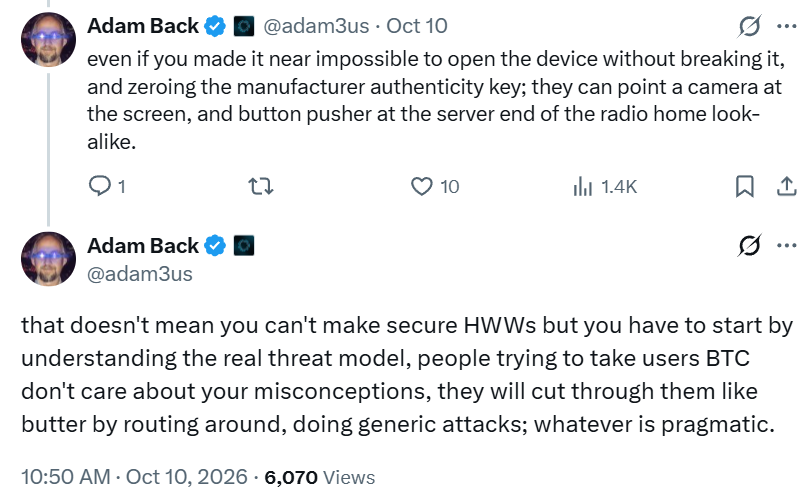
Source: Adam Back

However, Snyder said the main issue with self-custodial wallets is that their security depends on investors’ technical expertise and individual setup. She said:

“Without taking the time and rigor to set up properly, self-custody will always be less secure than handing over the assets to a specialist firm whose job it is to manage those protocols for you.”

Bitcoin security researcher and cypherpunk Jameson Lopp also said that self-custodial wallets can be a robust option, but urged investors to avoid mass migration to create new central points of failure during rushed transactions.

Magazine: Bitcoiners turn to dice throws as self-custody setups are re-evaluated

Related Questions

QAccording to the article, why did analyst Plan B say he had 'zero regrets' about his decision to move Bitcoin to ETFs in 2025?

AAnalyst Plan B said he had 'zero regrets' because he believed his decision was the right call in light of the recent Coldcard and Ledger hardware wallet exploits, implying ETFs offered a safer custodial solution compared to those compromised self-custody options.

QWhat is one of the main selling points for Bitcoin ETFs mentioned by 21Shares co-founder Ophelia Snyder?

AOphelia Snyder stated that one of the main selling points for Bitcoin ETFs is 'enhanced security,' as large holders have been converting self-custodied assets to ETFs for this reason for years.

QWhat recent security incident raised questions about the safety of self-custodial cold wallets?

AThe discovery of a compromised Ledger wallet containing an unauthorized hardware implant raised these questions. Some investigators estimated losses from such implants could exceed $86 million.

QAccording to Blockstream CEO Adam Back, what do hardware wallet providers need to improve regarding security?

AAdam Back stated that hardware wallet providers need a better understanding of the emerging threat landscape and need to 'catch up with threat-modelling,' as surprisingly few manufacturers seemed to understand generic attacks based on their marketing and design choices in the past decade.

QWhat key vulnerability of self-custodial wallets does Ophelia Snyder highlight?

AOphelia Snyder highlights that the security of self-custodial wallets depends heavily on the investor's technical expertise and individual setup. Without proper time and rigor in setup, self-custody can be less secure than using a specialist firm.

Related Reads

Tech Veteran: Anthropic IPO Will Be the Peak of the US AI Rally, Will "Go Big on China AI" If Conditions Allow

Veteran tech investor Jack Selby, head of Copper Sky and managing partner of Peter Thiel's family office, warns that Anthropic's planned IPO—aiming to raise up to $100 billion—could mark the peak of the AI market rally. He cautions that if the highly anticipated IPO prices well below expectations, the expiry of lock-up periods could trigger significant selling pressure and a large-scale AI market correction. Selby names SoftBank and Oracle as "canaries in the coal mine," flagging Oracle's higher debt ratio as a bigger risk, and suggests investors needing AI exposure consider Google instead. Selby also questions Anthropic's fundamentals: over 80% of its revenue is non-recurring and vulnerable to competitors closing the technology gap within six to nine months. He notes the business is extremely capital-intensive—requiring costly data, energy, data centers, and chips—and that with interest rates no longer near zero, calling it a trillion-dollar company seems far-fetched. He further highlights Chinese competition, saying DeepSeek and other Chinese AI models trail Anthropic by only about six months, posing a direct threat. Selby says he would "aggressively go long on Chinese AI" if conditions allow, arguing that Anthropic cannot claim all its business must rely on U.S. models, since most AI use cases resemble basic tool applications, leaving room for Chinese alternatives.

marsbit7h ago

Tech Veteran: Anthropic IPO Will Be the Peak of the US AI Rally, Will "Go Big on China AI" If Conditions Allow

marsbit7h ago

Trading

Spot
活动图片