Leaving OpenAI, How Much Has Their Net Worth Increased?

marsbitPublicado a 2026-05-13Actualizado a 2026-05-13

Resumen

Former OpenAI employees have collectively accrued near-trillion dollar valuations through ventures and investments, charting AI's future. The article highlights two main paths: founding high-value companies like Anthropic and Perplexity, or applying insider insights as investors. Leopold Aschenbrenner exemplifies the investor path. After being fired from OpenAI, he leveraged firsthand knowledge of AI's massive energy demands to make hugely successful public market bets on nuclear and fuel cell companies, practicing "cross-industry cognitive arbitrage." Other alumni, like the Zero Shot VC fund founders, use their technical foresight for early-stage investing. Their key advantage lies not just in picking winners, but in knowing which technical approaches are likely dead ends—a "veto list" derived from internal OpenAI experience. Angel investing within the network, as seen with Mira Murati and Sam Altman, operates on deep, pre-existing understanding of a founder's capabilities, reducing due diligence to near zero. This creates an ecosystem bound by a shared belief in AGI's imminent arrival, differing from networks like the "PayPal Mafia" which were built on shared past struggles. The shift of these builders to investors signals a profound conviction: their situational awareness of the AI landscape is now so clear that deploying capital based on that judgment is more efficient than building themselves. They are allocating bets on the future they helped shape from the inside.

There is only one way to use a true information advantage: place your bet before others price it.

Over the past two years, everyone has been anxious, trying to find the answer to the same question: What will be the next AI sector to rise?

Storage, optical modules, compute stocks, energy stocks... the narrative changes every few months. Each time, some miss the boat, and each time, some say "next time for sure."

Few ask another question: What are the people who understand AI best betting on?

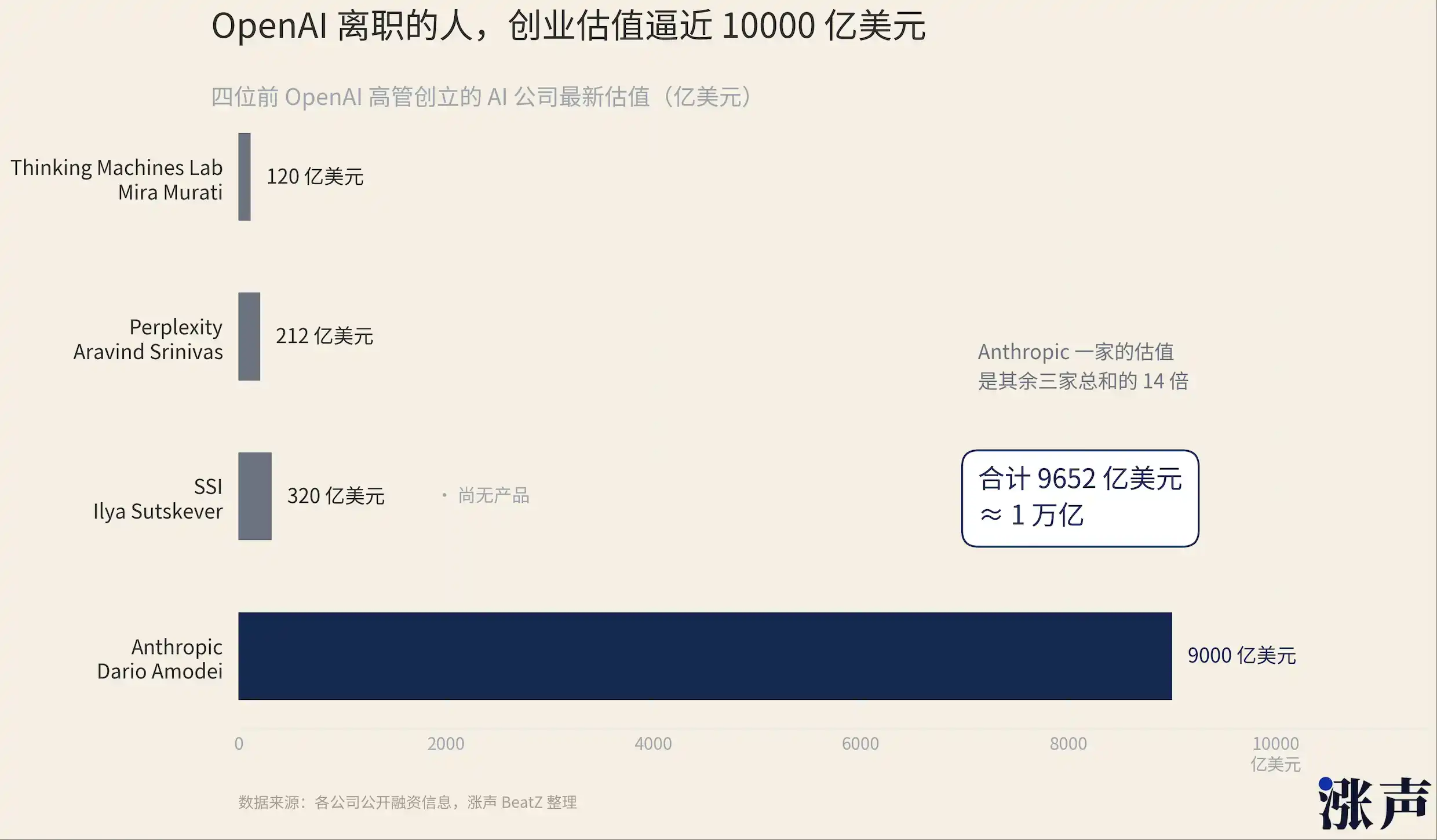
The combined net worth of those who left OpenAI has now approached $1 trillion. And their ventures and investments are at the start of AI's next era.

Dario Amodei founded Anthropic, potential valuation $900 billion. Ilya Sutskever's SSI has no product, valuation $32 billion. Aravind Srinivas built Perplexity, valuation $21.2 billion. Mira Murati's Thinking Machines Lab, valuation $12 billion.
Therefore, OpenAI's most important output in recent years might not be GPT-4, but these departing employees it has exported to society.

Among them, the youngest person fired by OpenAI, Leopold Aschenbrenner, has become one of the most frequently cited names in capital markets over the past two years.

The legendary record has been chewed over repeatedly by the media: fired by OpenAI at age 23, wrote a 165-page report titled "Situational Awareness," raised a hedge fund from $225 million to $5.5 billion within a year, heavily invested in nuclear power and fuel cells—and got it all right.

The story is too perfect, the contrast too sharp, the outcome too successful. Today, whenever discussing investment logic in the AI era, he is almost an unavoidable figure.

But Leopold is merely the first of this group to be seen.

Those who left OpenAI have broadly taken two paths.

One is the path of Ilya, Mira, Aravind: starting companies, raising massive funds, rushing toward the next disruptive product—exactly like every other Silicon Valley genius exodus.

The other is much quieter: a group chose to place bets, leaving execution to others, specializing in judgment.

Leopold took the extreme form of this second path.

He went to public markets, used an operator's perspective from the AI industry, found assets in traditional energy stocks that were mispriced, and bought heavily. He doesn't understand energy, but he knows how much electricity AI will burn. That's enough. This kind of insight cannot be replicated by reading reports or attending industry conferences; it can only be accumulated by being in that position.

Beyond this path, there's another group doing things with the same logic but in a different form: smaller funds, completing due diligence in hours that others take months, where the list of rejections is more valuable than the investment list. They constitute the most easily overlooked, yet most worth examining, layer of this great exodus.

Most people leave a company taking their resume. Those leaving OpenAI take with them a set of answers others don't yet know they need.

I. There Is No Second Leopold

Leopold heavily invested in the nuclear power company Vistra and the fuel cell company Bloom Energy.

After both bets succeeded, he gradually adjusted his portfolio in late 2025, sold Vistra, and further concentrated funds on Bloom Energy and data center infrastructure.

Traditional energy analysts looking at these two stocks would pull up grid expansion plans, compare carbon tax policies, build demand growth models. Leopold's approach is completely different.
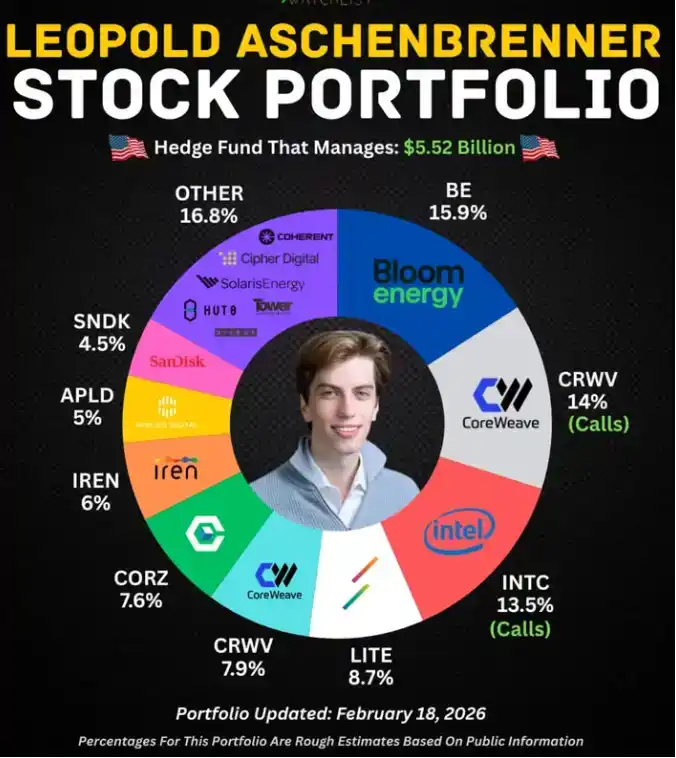
At OpenAI, he saw the scale of server rooms, saw the electricity bill for training a flagship model, heard engineers discuss why the next generation of data centers must be located next to nuclear power plants. These details are not in any financial report or analyst report, but they form a conclusion about energy demand more real than any model.

This playbook is called "cross-industry cognitive arbitrage" in investing: translating insider information from one industry into undervalued assets in another.

In the past, this was the domain of top macro hedge funds, relying on a global macroeconomic perspective.

Leopold did something more precise: he used the operator's perspective from the AI industry to find pricing lag vulnerabilities in traditional energy public markets.

This path is hard to replicate.

II. Zero Shot: The Most Valuable Thing Is the Rejection List

Evan Morikawa, founder of Zero Shot Fund, also came from OpenAI, with a similarly solid technical background. He went into VC.

Alumni, completely different paths.

Leopold's judgment comes from his concrete experience in AI's most core roles—a firsthand sense of model training costs, data center planning, energy demand. It can only be accumulated by being in that seat; there's no fast-forward button. Within OpenAI's core positions, very few are truly qualified to answer this question.

In April this year, a new fund sized at $100 million quietly surfaced, named Zero Shot.

This is a term from AI training, referring to a model answering directly without having seen any examples.

The three co-founders are from OpenAI: former DALL-E and ChatGPT application engineering lead Evan Morikawa, OpenAI's original prompt engineer Andrew Mayne, and former researcher and engineer Shawn Jain.

They have already invested in three companies: AI enterprise workflow company Worktrace, AI-enhanced factory robotics company Foundry Robotics, and another project still in stealth.

$100 million, in today's AI funds that often raise tens of billions, is a small number.

But talking about which sectors they refuse to invest in speaks volumes.

Mayne publicly stated he is bearish on most "vibes programming" tools—that category of products that help you write code with natural language.

The reason is straightforward: he knows what OpenAI has accumulated internally in the programming direction and knows how quickly the moats of such tools will be eroded directly by foundation models. Morikawa, meanwhile, keeps his distance from many "human-centric video data companies" in the robotics sector. Those enterprises specifically collecting human motion data to train robots—in his view, this technical path will hit a wall.

These two judgments, ordinary VCs can't make.

They haven't been at the source of information, haven't seen those internal discussions, so they have no way to judge which path is a dead end.

Zero Shot's advantage lies hidden in the rejection list. In a market where everyone is shouting about AI startups, knowing where the pitfalls are is more valuable than knowing who to bet on. Those who have already mined, a list of landmines is more useful than a treasure map.

They deliberately keep the size at $100 million, for specific reasons.

They know clearly in which stage their advantage is most valuable: the early stage when the technical path hasn't converged. At that stage, those with insider knowledge can distinguish at a glance which path is viable.

Once a project reaches Series C or D, financial data and public information will cover up the information advantage, and this card is played out.

The larger the scale, the more one needs to chase "certain big tracks," the more one is fighting using others' playbooks.

$100 million is their honest assessment of the boundary of their advantage.

III. Being an Angel Investor Is Another Business

Both Mira Murati and Zero Shot Fund invested in former OpenAI colleague Angela Jiang's Worktrace, a company using AI to optimize enterprise workflows.

But the investment logic is more solid than "good relationships."

Mira saw Angela's decision-making style under OpenAI's high-pressure environment, saw her judgment on AI product boundaries, saw her execution within real constraints. These things can't be faked in a two-hour founder pitch, nor fully reconstructed by the most meticulous due diligence.

Angela didn't need to convince Mira to believe in her, because Mira had already formed her judgment. The information cost for angel investment approaches zero, but the information quality far exceeds the market average.

A bigger flywheel is with Sam Altman.

Reportedly, Altman decides whether to follow-on invest within hours of hearing about a former employee starting a company, then adds capital from the OpenAI Startup Fund and substantial API resources.

He personally holds no OpenAI equity, but every alumnus's success expands OpenAI's data inlets, distribution channels, and policy influence. He is using capital to maintain an ecosystem that doesn't belong to him but continuously rewards him. This is an invisible form of equity, but it compounds in a very real way.

This ecosystem leads many to mistakenly think it's old colleagues helping each other out.

Comparing it with the PayPal Mafia clarifies the difference.

The PayPal Mafia's cohesion came from shared hardship: surviving the payment wars together, experiencing the eBay acquisition together, forming trench camaraderie during those near-death years. That trust was real, but their judgments about the future were individual. Thiel did venture capital, Musk built rockets, Hoffman built social networks—their paths diverged.

What binds the OpenAI alumni together is a shared bet on the future: AGI will come, the window is limited, now is a once-in-a-millennium opportunity to position. The driving force of belief is more lasting than camaraderie because it directly connects to interests. Once anyone's bet direction proves correct, the entire network benefits.

This also makes the entry threshold for this circle微妙 subtle.

If your product is good enough, raising money from this group isn't a problem. But if you harbor doubts about AI's future, or if your startup logic is premised on "AGI is still far away," even with an excellent product, it's hard to get a check from these people.

Differences in worldview end the conversation before the handshake.

IV. From Builders to Investors

The destinations of OpenAI alumni can be grouped into three categories.

Ilya, Aravind, Mira all chose entrepreneurship.

But even within entrepreneurship, they are doing completely different things. Aravind is in a fiercely competitive consumer business, Mira is building a tool platform, Ilya's SSI doesn't even have a product, got a $32 billion valuation, betting on the word "safety" itself.

Leopold and Zero Shot chose investing.

Leopold went to public markets, Zero Shot does early-stage VC. Both are paths externalizing judgment into capital, not personally executing. This is the minority among OpenAI alumni, but this minority deserves a separate look: when someone is willing to bet but not personally build, it usually means their judgment of the outcome is clear enough that they don't need action to explore.

People usually think the highest expression of genius is creation. But this group offers another answer: when judgment is clear enough, dispersing cognition by betting on multiple directions and letting those with execution capabilities build is a more efficient choice.

Leopold's report is titled "Situational Awareness," a military term referring to a pilot's real-time perception of the entire battlefield.

A pilot's situational awareness determines his actions two seconds later; losing it means death. What this group brought out from OpenAI is precisely situational awareness of this AI battlefield. They know the battle's direction, know where the high ground is, know which trench leads to a dead end.

What they are doing now is deploying accordingly.

The era's smartest people starting to choose ALL IN indicates that, in their view, the answer is already clear enough—clear enough that they no longer need to verify it by getting their hands dirty.


Preguntas relacionadas

QWhat is the key advantage that former OpenAI employees hold when they leave, according to the article?

AThey possess unique 'situational awareness'—first-hand, internal knowledge about AI's trajectory, costs (like energy consumption for model training), and technological dead ends, which they can use to identify undervalued opportunities in other sectors or make superior investment decisions.

QWhat are the two main career paths taken by people who left OpenAI, as described in the article?

A1. Founding companies to build the next disruptive AI product (like Ilya Sutskever, Mira Murati). 2. Becoming investors, using their insider knowledge to make strategic bets in public markets or venture capital (like Leopold Aschenbrenner and the Zero Shot fund).

QHow does Leopold Aschenbrenner's investment strategy differ from that of a traditional energy analyst?

ATraditional analysts rely on public data, reports, and models. Leopold used his firsthand experience from OpenAI (e.g., seeing data center scales and power bills) to understand future AI-driven energy demand. This 'cross-industry cognitive arbitrage' allowed him to identify mispriced assets like nuclear and fuel cell companies before the market corrected.

QWhat is the unique value of the Zero Shot investment fund's 'rejection list'?

ATheir 'rejection list'—knowing which AI ideas or technical paths are likely dead ends—is more valuable than knowing what to invest in. This insight comes from their internal OpenAI experience, allowing them to avoid pitfalls (like certain 'vibes coding' tools or robotics approaches) that outside investors might not foresee, saving capital and time.

QHow does the 'OpenAI alumni' network differ from historical networks like the 'PayPal Mafia'?

AThe PayPal Mafia was bonded by shared past hardships and camaraderie. The OpenAI network is united by a shared future bet—a strong belief in the imminent arrival of AGI (Artificial General Intelligence). This shared worldview and strategic alignment on the AI opportunity drive their collaboration and investments more than personal history alone.

Lecturas Relacionadas

Blocked Its Own Treasure, WeChat AI Steps Up

Tencent's stock surged over 10% on June 2nd amid reports that WeChat, with 1.43 billion monthly users, is finalizing tests for a native AI Agent. The reported feature, accessible by swiping right from the main interface, allows users to issue commands in natural language. The AI then decomposes tasks and automatically calls upon relevant Mini Programs within WeChat to complete actions like ordering food, booking tickets, or making payments, creating a closed-loop service execution system. This strategic shift follows the internal conflict and subsequent "blocking" of Tencent's standalone AI app, Yuanbao, by WeChat for violating sharing rules during a 2026 Spring Festival promotion. The incident highlighted a lack of internal consensus and exposed the weakness of competing in the standalone AI assistant arena against rivals like ByteDance's Doubao (345M MAU) and Alibaba's Qianwen. The new WeChat AI Agent aims to leverage WeChat's unique assets—its massive user base, standardized Mini Program APIs, WeChat Pay, and identity system—to move from simple content generation to actual task execution. Analysts note this changes the competitive landscape from model benchmarks to which AI can connect to more real-world services. However, success depends on key variables: the capability of Tencent's underlying Hunyuan model, managing massive inference costs, and redesigning incentives for Mini Program developers whose traffic might be bypassed. The move is seen as an attempt to keep user service intent within WeChat's ecosystem as AI begins to redefine how users access services.

marsbitHace 14 min(s)

Blocked Its Own Treasure, WeChat AI Steps Up

marsbitHace 14 min(s)

ByteDance Adopts Arm CPUs, Jensen Huang: So Sad I Didn't Buy Arm

**Summary:** At Computex 2026, Arm CEO Rene Haas announced that ByteDance and Oracle have adopted Arm's self-designed Arm AGI data center CPU. The company expects significant revenue growth from this product, projecting $20 billion in demand for the 2027/2028 fiscal years. Haas noted that restricting AI-capable CPUs from the US to China is nearly impossible due to their widespread applications. Arm's stock has surged dramatically this year, notably rising 16% after NVIDIA's Arm-based Vera CPU and RTX Spark announcements. A highlight was the informal, humorous on-stage conversation between Haas and NVIDIA CEO Jensen Huang. Huang joked about NVIDIA's failed attempt to acquire Arm and playfully lamented selling his Arm shares. Both executives showed a clear sense of camaraderie and shared regret over the missed merger. Key technical topics were discussed: 1. **AI PC Design:** Huang explained NVIDIA's RTX Spark superchip (with a 20-core Arm CPU) is designed for future AI agents that will autonomously run and use tools on PCs, blending local and cloud processing. 2. **Agent vs. OS:** Huang emphasized the operating system remains crucial, as AI agents rely on its APIs and tools to function. 3. **Growth Constraints:** He identified the shift to "useful AI" that generates profitable tokens as a primary driver for immense, almost limitless, computational demand. Haas outlined Arm's strategy across PC and data centers. For PCs, Arm collaborates with partners like NVIDIA and MediaTek, offering its compute subsystem (CSS) for custom SoCs. In data centers, its Arm AGI CPU (built on TSMC's 3nm process) has gained major partners including OpenAI, Meta, and now ByteDance and Oracle. Arm presented a multi-year roadmap for its in-house CPU line. The article concludes that while GPUs dominated the AI training race, the explosion of AI agents is shifting significant focus to CPUs for inference, state management, and tool orchestration. The industry is trending towards vertical integration, with companies like cloud providers designing chips and chip/IP firms offering full solutions, all competing to deliver more efficient computing per watt.

marsbitHace 34 min(s)

ByteDance Adopts Arm CPUs, Jensen Huang: So Sad I Didn't Buy Arm

marsbitHace 34 min(s)

New Wall Street Play: Yen Shorts Still Adding, But Japan Stocks Don't Rely on Carry Trade Unwinding

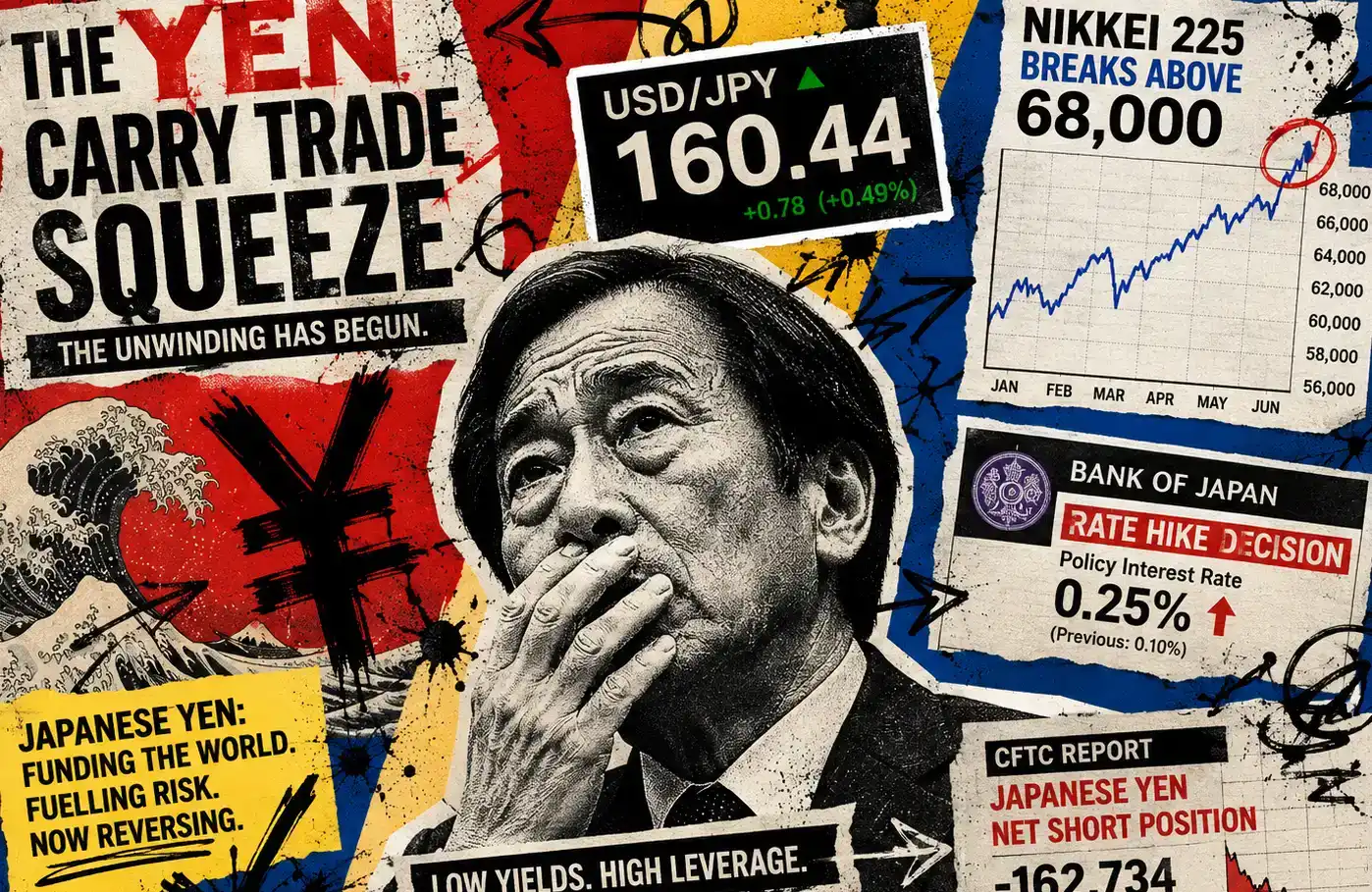
On June 3rd, USD/JPY hit 160.44, its highest level since July 2024, while the Nikkei 225 surged past 68,000 points. Contrary to popular narratives of an imminent "carry trade unwind" akin to August 2024, data reveals a more complex picture. Speculative net short positions in yen futures have actually increased, reaching -114,667 contracts by late May, suggesting traders are doubling down rather than retreating. Meanwhile, Japan's Finance Ministry conducted its largest-ever single-round FX intervention (11.73 trillion yen) in April-May but failed to hold the 160 yen line. The Nikkei's rally is not driven by carry trade dynamics. Foreign investors are aggressively buying Japanese stocks, with net purchases in 2026 running nearly 16 times higher than 2025 levels. This inflow is concentrated in AI and semiconductor-related stocks like SoftBank and Socionext, fueled by positive sector outlooks, rather than being a flight from unwinding yen shorts. Furthermore, the Nikkei has continued climbing despite the Bank of Japan's (BOJ) rate hikes to 0.75%. This disconnect exists because the current equity boom is fueled by AI-driven foreign investment, not reliant on cheap yen funding. However, this relationship remains fragile. Should the BOJ hike rates further (e.g., to 1.0%) while dollar weakness increases carry trade costs, the trajectories of the yen and Japanese stocks could reconverge, potentially triggering volatility.

marsbitHace 39 min(s)

New Wall Street Play: Yen Shorts Still Adding, But Japan Stocks Don't Rely on Carry Trade Unwinding

marsbitHace 39 min(s)

Broadcom's Q3 Guidance Misses Expectations by $12 Billion, After-Hours Trading Plummets Over 13%, AI Narrative "Cooling"?

On June 3, Broadcom released record Q2 FY26 results with revenue of $22.19B, up 48% YoY, and AI chip sales of $10.8B, up 143%. Adjusted EPS of $2.44 beat estimates. However, its Q3 AI semiconductor revenue guidance of $16B, while up over 200% YoY, fell roughly $1.2B (7%) short of analyst consensus expectations of $17.2B. This miss, coupled with slightly weaker-than-expected software revenue, triggered a severe market reaction. CEO Hock Tan maintained the FY26 AI revenue outlook of over $100B but did not raise it, disappointing investors who had priced in more robust growth. The stock plummeted over 13% in after-hours trading, erasing roughly $270B in market cap. The sell-off extended to peers like Marvell. A key concern for markets, particularly for Chinese optical module suppliers, was Tan's comment that the contribution of AI networking (e.g., Ethernet switches, optical interconnect chips) to AI revenue, currently near 40%, is expected to normalize to around 30% over time, signaling a potential peak in growth for that segment. Despite the guidance shortfall, Tan reiterated that AI demand remains "insatiable" and reaffirmed the long-term target of exceeding $100B in AI revenue by FY27. The reaction highlights the heightened sensitivity and premium valuation placed on AI-exposed stocks, where anything less than stellar guidance can prompt significant profit-taking. The broader question is whether this represents a cooling AI narrative or a correction in overstretched valuations.

marsbitHace 39 min(s)

Broadcom's Q3 Guidance Misses Expectations by $12 Billion, After-Hours Trading Plummets Over 13%, AI Narrative "Cooling"?

marsbitHace 39 min(s)

Trading

Spot
Futuros

Artículos destacados

Cómo comprar ONE

¡Bienvenido a HTX.com! Hemos hecho que comprar Harmony (ONE) sea simple y conveniente. Sigue nuestra guía paso a paso para iniciar tu viaje de criptos.Paso 1: crea tu cuenta HTXUtiliza tu correo electrónico o número de teléfono para registrarte y obtener una cuenta gratuita en HTX. Experimenta un proceso de registro sin complicaciones y desbloquea todas las funciones.Obtener mi cuentaPaso 2: ve a Comprar cripto y elige tu método de pagoTarjeta de crédito/débito: usa tu Visa o Mastercard para comprar Harmony (ONE) al instante.Saldo: utiliza fondos del saldo de tu cuenta HTX para tradear sin problemas.Terceros: hemos agregado métodos de pago populares como Google Pay y Apple Pay para mejorar la comodidad.P2P: tradear directamente con otros usuarios en HTX.Over-the-Counter (OTC): ofrecemos servicios personalizados y tipos de cambio competitivos para los traders.Paso 3: guarda tu Harmony (ONE)Después de comprar tu Harmony (ONE), guárdalo en tu cuenta HTX. Alternativamente, puedes enviarlo a otro lugar mediante transferencia blockchain o utilizarlo para tradear otras criptomonedas.Paso 4: tradear Harmony (ONE)Tradear fácilmente con Harmony (ONE) en HTX's mercado spot. Simplemente accede a tu cuenta, selecciona tu par de trading, ejecuta tus trades y monitorea en tiempo real. Ofrecemos una experiencia fácil de usar tanto para principiantes como para traders experimentados.

251 Vistas totalesPublicado en 2024.12.12Actualizado en 2026.06.02

Cómo comprar ONE

Discusiones

Bienvenido a la comunidad de HTX. Aquí puedes mantenerte informado sobre los últimos desarrollos de la plataforma y acceder a análisis profesionales del mercado. A continuación se presentan las opiniones de los usuarios sobre el precio de ONE (ONE).

活动图片