LayerZero drops after $15mln Alameda dump – More pain ahead for ZRO?

ambcryptoPublicado a 2026-04-01Actualizado a 2026-04-01

Resumen

LayerZero (ZRO) has faced significant selling pressure, dropping 8.42% to $1.83, with its market cap falling to $575 million. The decline intensified after Alameda Research dumped 7.93 million ZRO tokens worth $15.3 million, signaling a lack of confidence and accelerating downward momentum. ZRO broke below key support levels, including the 50 and 100-day EMAs, and its RSI fell deeper into bearish territory. If selling continues, ZRO could fall further to $1.4. However, sustained negative exchange netflows indicate continued buyer interest, which may provide support and potentially lead to a rebound toward $2.2 if selling pressure eases.

Layerzero has experienced significant downward pressure since it was rejected at $2.2 a week ago. The altcoin has closed at lower lows over the said period, touching a low of $1.8.

At press time, LayerZero [ZRO] traded at $1.83, down 8.42% on the daily charts. Over the same period, the altcoin’s market cap plunged 7% to $575 million.

Despite the market weakness, institutional players have continued to dump ZRO, further straining the market.

Alameda Research dumps 7.93 million ZRO

After 2 months of dormancy, Alameda Research resumed its LayerZero selling spree. According to Lookonchain, Alameda Research deposited 7.93 million ZRO worth $15.3 million to Wintermute.

With the recent sale, the team wallet has offloaded its entire LayerZero holdings. Usually, when the team offloads during a downtrend, it signals a lack of confidence in the market.

Any impact on ZRO?

Notably, Alameda Research has sold ZRO several times before, and almost every time, it has sold near a local top.

For example, the last time the Alameda team sold these tokens, ZRO crashed from $2.10 to $1.50. This time, however, it seems the team sold later into the dip.

Following the latest sale, the token reacted aggressively, dropping over 6%. In fact, the selling pressure accelerated the altcoin’s downward momentum.

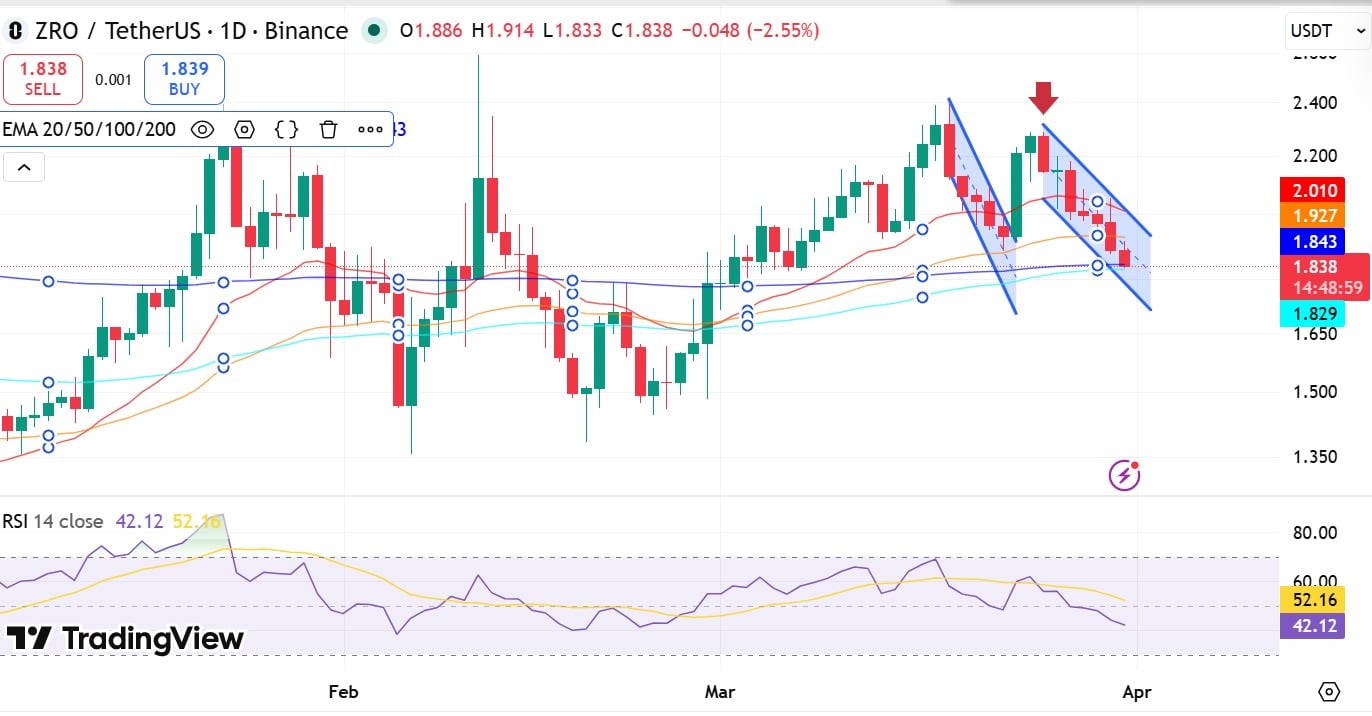
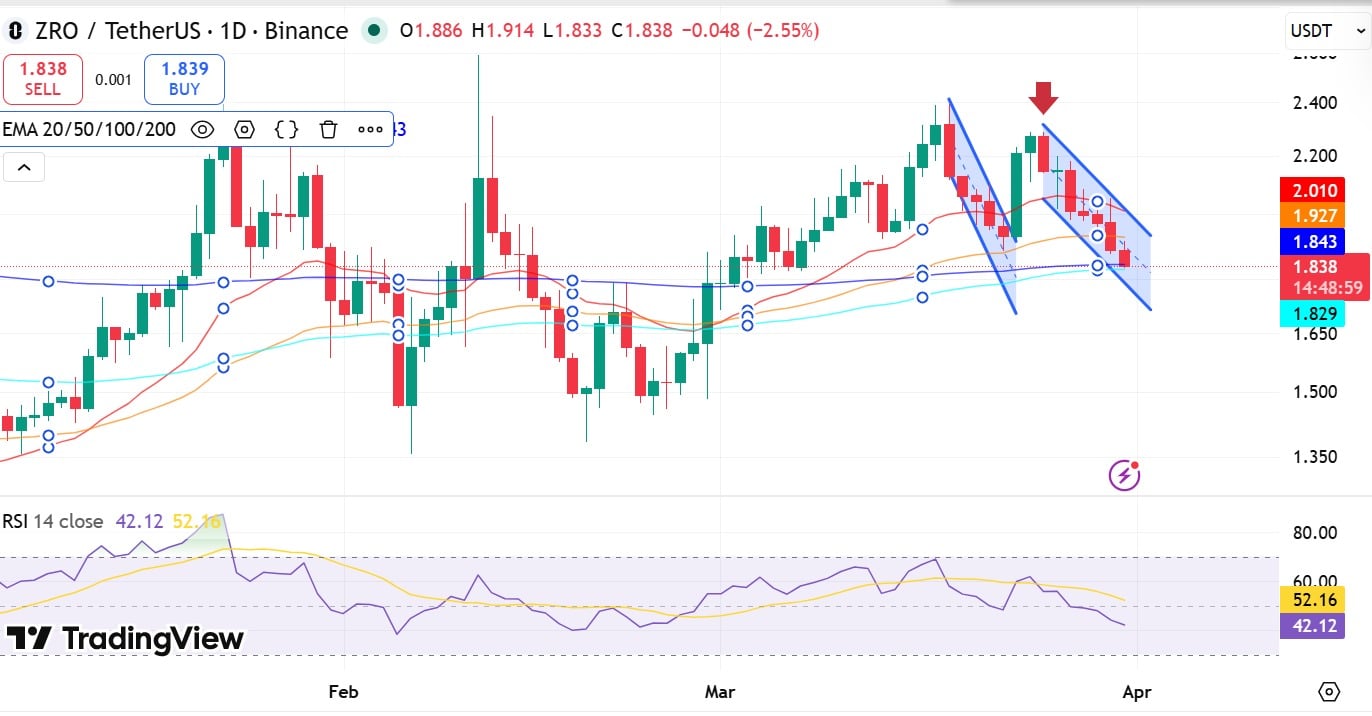
As such, the altcoin’s Relative Strength Index (RSI) dropped from 47 to 41, further stretching deeper into the bearish zone.
Source: TradingView

At the same time, ZRO fell below its 50 and 100-day EMAs, further confirming the trend’s strength. Therefore, if the selling pressure, especially from large entities, persists, the downtrend is likely to strengthen.

Currently, ZRO is testing $1.8 support; if pressure intensifies and it fails to hold, the altcoin could slide towards $1.4.

LayerZero Buyers still remain active in the market

Although LayerZero has continued to decline, buyers have remained largely active during this period. Exchange activity further echoed this market demand.

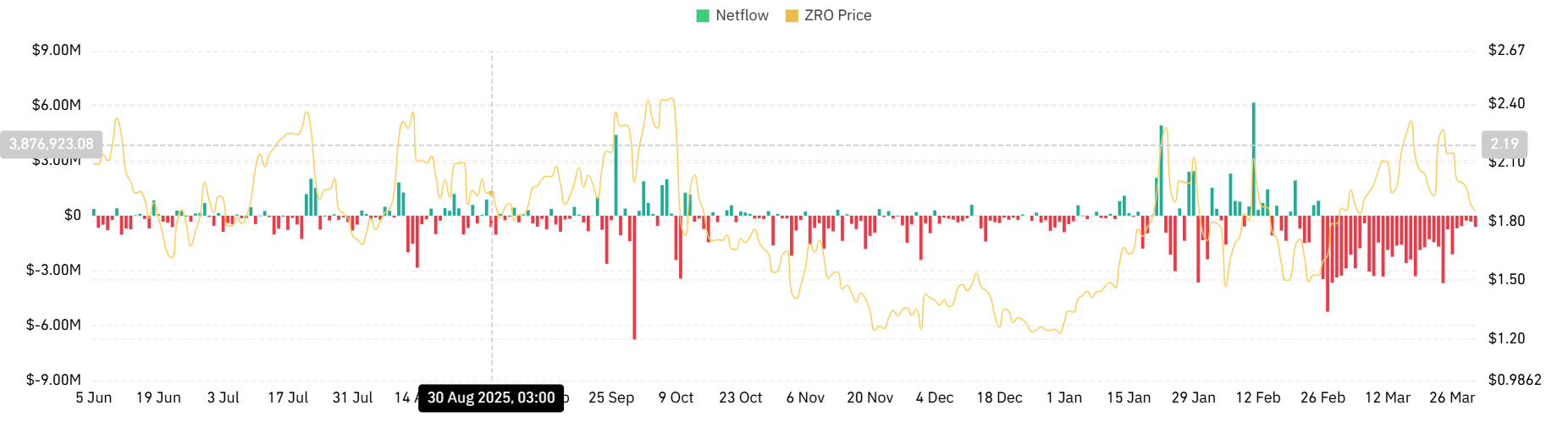
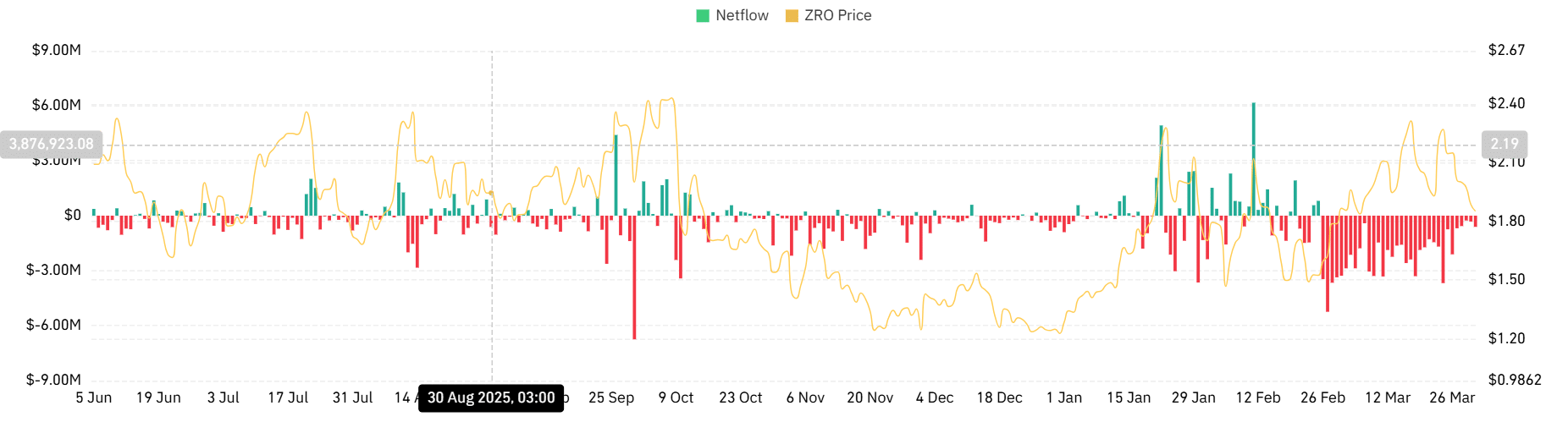
Coinglass data showed that Spot Netflow has remained negative for over 30 consecutive days. At press time, the altcoin’s Netflow was -$609k.
Source: CoinGlass

A sustained negative netflow suggested that buyers have outpaced sellers on exchanges. Traditionally, higher buyer presence has reduced supply, increasing scarcity and thus helping to stabilize prices.

Although the demand so far has failed to absorb the pressure, it gives the altcoin a lifeline and could offer significant support. If the market finally feels this demand and sellers are exhausted below $2, ZRO could rebound, reclaim $2, and target $2.2.


Final Summary

  • Alameda Research returned after two months of dormancy and dumped 7.93 million ZRO worth $15.3 million.
  • LayerZero [ZRO] dropped 8.42%, breaching $2 support, and touching a low of $1.83 amid rising selling pressure.


Preguntas relacionadas

QWhat was the immediate impact of Alameda Research's recent 7.93 million ZRO dump on the market?

AThe immediate impact was a sharp price decline of over 6%, with the token's price dropping to $1.83 and its market cap falling by 7% to $575 million.

QAccording to the article, what is the significance of a team offloading its holdings during a downtrend?

AIt typically signals a lack of confidence in the market, which can further strain the asset's price and accelerate downward momentum.

QWhat key technical indicators suggest a strengthening bearish trend for ZRO?

AThe Relative Strength Index (RSI) dropped from 47 to 41, stretching deeper into the bearish zone, and the price fell below its 50 and 100-day Exponential Moving Averages (EMAs).

QDespite the selling pressure, what on-chain metric suggests that buyers are still active for LayerZero?

AThe Spot Netflow has remained negative for over 30 consecutive days, indicating that more tokens are being withdrawn from exchanges than deposited, which suggests buyer demand is outpacing selling pressure.

QWhat are the potential price targets for ZRO if the current $1.8 support level fails to hold?

AIf the selling pressure intensifies and the $1.8 support level is broken, the altcoin could slide further down towards $1.4.

Lecturas Relacionadas

Worried about AI's Self-Evolution, Anthropic Intends to Stop Training?

In early 2026, Anthropic signaled a significant shift in its public narrative regarding AI development timelines and safety. In June, its Anthropic Institute published a detailed article, "When AI builds itself," presenting internal data suggesting accelerating AI self-improvement. Key figures included over 80% of merged code being written by Claude and a 52x speedup in certain optimization tasks. The article outlined three future scenarios, with the most speculative being full recursive self-improvement (RSI), where AI autonomously builds better successors. Anthropic stated RSI is "possible" and may arrive faster than most institutions are prepared for. This narrative pivot followed a series of strategic moves. In January, CEO Dario Amodei wrote about a powerful self-improvement feedback loop. In February, Anthropic revised its Responsible Scaling Policy, removing a core commitment to pause training if capabilities outstripped safety controls, citing the risk of falling behind competitors. This change coincided with reported pressure from the US Department of Defense. By May, Anthropic's valuation had soared to $965 billion. Anthropic's stance was mirrored by other industry leaders. DeepMind CEO Demis Hassabis adjusted his AGI timeline to "by 2029" and admitted to using provocative language like "foothills of the singularity" to create urgency. OpenAI also released a model claiming a key role in its own creation process. The article's carefully calibrated tone—presenting dramatic data alongside qualifying footnotes—exemplifies a balancing act between signaling technological acceleration and managing commercial, regulatory, and safety imperatives. External experts offered contrasting interpretations of the same data, from warnings of catastrophic risk akin to Chernobyl to skepticism that current automation merely handles "grunt work," not genius. The coordinated narrative shift among top labs highlights the complex interplay between perceived technical inflection points and strategic communication aimed at investors, regulators, and the public.

marsbitHace 2 min(s)

Worried about AI's Self-Evolution, Anthropic Intends to Stop Training?

marsbitHace 2 min(s)

The Macroeconomic Underpinnings of Africa's Payment Market Landscape

The African payments market, characterized by the world's highest mobile money penetration and fastest-growing cryptocurrency adoption, is not a coincidence but a macroeconomic necessity driven by deep structural factors. Two key drivers create this landscape: (1) Africa's heavy reliance on commodity exports, trade, and remittances, generating massive cross-border settlement and remittance demand; and (2) chronically underdeveloped financial infrastructure, exacerbated by international bank de-risking, foreign exchange mismanagement, and persistent inflation. This vacuum has allowed mobile money and crypto to thrive. Mobile money platforms replace banks for domestic payments, while cryptocurrencies serve as a store of value against local currency depreciation and a low-cost medium for cross-border exchange. A crucial division lies along the Sahara Desert. North Africa is integrated into the oil-anchored MENA framework, while Sub-Saharan Africa (SSA), plagued by dollar shortages and fragmented currencies, has become a natural, massive market for mobile money and crypto. Nigeria, Kenya, and South Africa are global leaders in adoption. The SSA economy is deeply dollarized due to currency instability, yet suffers from a severe "dollar shortage" caused by trade deficits and limited export capacity. This creates parallel forex markets and high remittance costs. Cryptocurrencies, particularly stablecoins, fill this gap by providing access to dollar liquidity, cheaper cross-border transfers, and an inflation-resistant store of value, primarily driven by retail users for small-value transactions. While regional initiatives like PAPSS aim to reduce dollar dependence, the fundamental constraints of commodity reliance, trade imbalances, and shallow financial markets persist. Therefore, mobile money and cryptocurrencies are not niche trends but essential financial infrastructure filling a structural void, and they are likely to remain central to Africa's economic landscape for the foreseeable future.

链捕手Hace 11 min(s)

The Macroeconomic Underpinnings of Africa's Payment Market Landscape

链捕手Hace 11 min(s)

Is the Sharp Decline Over? Let the Data Speak

**Has the Sharp Decline Ended? Let Data Speak** Bitcoin's recent significant drop has placed short sellers in a precarious position. Three concurrent pressures—sustained outflows from ETFs, miners offloading coins to exchanges, and short-term holders capitulating—pushed the price near $63k. The asset fell 13% this week and 21% this month, roughly halving from its all-time high. A critical data point is the extremely crowded short positioning, with a short-to-long ratio reaching 8:1, representing nearly $100 billion in short interest overhead. This creates conditions for a potential short squeeze if selling pressure merely pauses, similar to the event in November 2022 which triggered a 24% rally. The selling pressures are real: spot Bitcoin ETFs have seen a record $5.4 billion outflow over 20 days. Short-term holders moved 53k loss-held BTC to exchanges in a day, and miners sent 24k BTC to Binance, a six-month high. Capital is also rotating towards AI and tech stocks like SpaceX, with $400 billion invested in AI infrastructure recently. However, on-chain data shows accumulation by long-term holders, who added 200k BTC in a month, and institutions/miners have absorbed 1.24 million BTC since 2023. This indicates strong buying beneath the surface. Key levels to watch are the $67k-$70k zone (2021 high & 2024 breakout point). A swift recovery above it suggests a leverage washout; failure could test $60k-$55k. The direction also hinges on ETF flow reversal. Currently, the S&P 500 hits new highs driven by AI, while Bitcoin and DeFi (TVL down from $173b to $73.9b) lag. The most probable path is a grinding basing process between $60k-$58k with continued ETF outflows. A less likely but explosive scenario involves a sudden flow reversal, a surge above $70k triggering a short squeeze, and a rally back above $76k. The immediate trigger depends on when the relentless selling pauses. A final cautionary note questions Bitcoin's correlation: if the high-flying U.S. stock market corrects, will Bitcoin once again miss the rally but not the decline?

foresightnews_apiHace 26 min(s)

Is the Sharp Decline Over? Let the Data Speak

foresightnews_apiHace 26 min(s)

Trading

Spot
Futuros

Artículos destacados

Cómo comprar ZRO

¡Bienvenido a HTX.com! Hemos hecho que comprar LayerZero (ZRO) sea simple y conveniente. Sigue nuestra guía paso a paso para iniciar tu viaje de criptos.Paso 1: crea tu cuenta HTXUtiliza tu correo electrónico o número de teléfono para registrarte y obtener una cuenta gratuita en HTX. Experimenta un proceso de registro sin complicaciones y desbloquea todas las funciones.Obtener mi cuentaPaso 2: ve a Comprar cripto y elige tu método de pagoTarjeta de crédito/débito: usa tu Visa o Mastercard para comprar LayerZero (ZRO) al instante.Saldo: utiliza fondos del saldo de tu cuenta HTX para tradear sin problemas.Terceros: hemos agregado métodos de pago populares como Google Pay y Apple Pay para mejorar la comodidad.P2P: tradear directamente con otros usuarios en HTX.Over-the-Counter (OTC): ofrecemos servicios personalizados y tipos de cambio competitivos para los traders.Paso 3: guarda tu LayerZero (ZRO)Después de comprar tu LayerZero (ZRO), guárdalo en tu cuenta HTX. Alternativamente, puedes enviarlo a otro lugar mediante transferencia blockchain o utilizarlo para tradear otras criptomonedas.Paso 4: tradear LayerZero (ZRO)Tradear fácilmente con LayerZero (ZRO) en HTX's mercado spot. Simplemente accede a tu cuenta, selecciona tu par de trading, ejecuta tus trades y monitorea en tiempo real. Ofrecemos una experiencia fácil de usar tanto para principiantes como para traders experimentados.

208 Vistas totalesPublicado en 2024.12.10Actualizado en 2026.06.02

Cómo comprar ZRO

Discusiones

Bienvenido a la comunidad de HTX. Aquí puedes mantenerte informado sobre los últimos desarrollos de la plataforma y acceder a análisis profesionales del mercado. A continuación se presentan las opiniones de los usuarios sobre el precio de ZRO (ZRO).

活动图片