Law Firm Behind FTX Legal Work Now Facing $525M Suit

bitcoinistPublicado a 2026-05-15Actualizado a 2026-05-15

Resumen

A federal lawsuit seeks $525 million from Silicon Valley law firm Fenwick & West for its alleged central role in facilitating FTX's fraud. A bankruptcy examiner found the firm "deeply intertwined" in FTX's wrongdoing, creating shell companies like North Dimension to funnel over $3 billion, drafting backdated agreements, and implementing FTX's auto-delete messaging policy on Signal. The suit, filed by 20 international victims, claims Fenwick's involvement lent FTX false legitimacy, preventing investors from withdrawing savings. It cites former FTX engineer Nishad Singh, who testified he directly told Fenwick attorneys about misuse of customer funds, after which the firm allegedly advised on concealment. The complaint includes claims of malpractice and fraud, targeting both the firm and two individual partners. This follows the recent rejection of Sam Bankman-Fried's bid for a new trial.

A court-appointed bankruptcy examiner found that Fenwick & West was “deeply intertwined in nearly every aspect of FTX Group’s wrongdoing” — and now that finding sits at the heart of a $525 million federal lawsuit filed against the Silicon Valley law firm.

Shell Companies And Deleted Messages

Twenty victims of the FTX collapse, coming from five countries, filed the complaint Wednesday in the US District Court for the District of Columbia.

They say they lost their life savings when the exchange went under in November 2022, and that Fenwick’s involvement gave FTX a false sense of legitimacy that kept them from pulling their money out in time. Six individual defendants are named alongside the firm.

The examiner’s conclusions came after a review of more than 200,000 documents in the federal bankruptcy proceedings.

According to the lawsuit, the examiner found that Fenwick created corporate structures for both FTX and its sister trading firm Alameda Research, formed shell entities to hide money movements, and drafted backdated agreements to cover up illicit transfers.
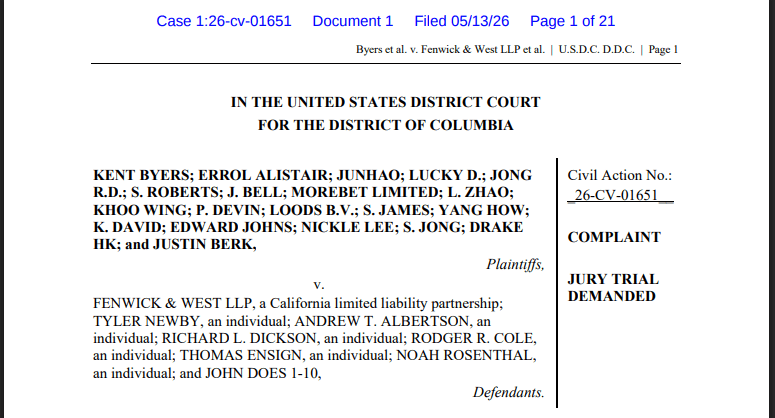
Source: Court Listener

Two specific acts are described in detail. Reports indicate Fenwick attorneys set up North Dimension Inc., a Delaware shell company that posed as an electronics retailer while allegedly funneling over $3 billion in stolen customer funds.

The firm also reportedly put in place FTX’s auto-delete messaging policy on the Signal app — the same system federal prosecutors say helped the fraud go undetected.

A Witness From Inside FTX

Nishad Singh, FTX’s former Director of Engineering, adds another layer to the case. Singh pleaded guilty to fraud charges and testified against Sam Bankman-Fried at his criminal trial.

According to the lawsuit, Singh told Fenwick attorneys directly that customer funds were being misused. Rather than walking away, the firm allegedly advised on how to conceal it.

BTCUSD now trading at $79,806. Chart: TradingView

After FTX filed for bankruptcy, Fenwick quietly scrubbed all references to the exchange from its website. The firm also retained defense lawyers from Gibson Dunn before any civil lawsuit had been filed against it.

Damages And Individual Defendants

The plaintiffs are bringing seven claims, including malpractice, fraud, and gross negligence. They are seeking compensatory damages above $525 million, a return of all legal fees Fenwick collected from FTX, and punitive damages against two named partners — Tyler Newby and Daniel Friedberg — for what the complaint calls deliberate and reckless individual professional conduct.

Meanwhile, Bankman-Fried’s own legal efforts have stalled. A federal judge last month rejected his bid for a new trial, dismissing his claims of new evidence as baseless.

Judge Lewis Kaplan, who sentenced Bankman-Fried to 25 years in prison in 2024, said his arguments were “wildly conspiratorial and entirely contradicted by the record.”

Featured image from WealthBuilders, chart from TradingView

Preguntas relacionadas

QAccording to the lawsuit, what specific actions did the court-appointed bankruptcy examiner find Fenwick & West to be involved in with FTX?

AThe examiner found that Fenwick & West was 'deeply intertwined in nearly every aspect of FTX Group’s wrongdoing,' including creating corporate structures for FTX and Alameda Research, forming shell entities to hide money movements, and drafting backdated agreements to cover up illicit transfers.

QWho is named as a key witness from inside FTX in the lawsuit against Fenwick & West, and what is the significance of his testimony?

ANishad Singh, FTX's former Director of Engineering, is named. He pleaded guilty to fraud and testified that he directly told Fenwick attorneys customer funds were being misused. The lawsuit alleges the firm then advised on how to conceal it rather than withdrawing.

QWhat are the plaintiffs in the lawsuit seeking from Fenwick & West and the named individual partners?

AThe plaintiffs are seeking compensatory damages above $525 million, a return of all legal fees Fenwick collected from FTX, and punitive damages against two named partners, Tyler Newby and Daniel Friedberg, for alleged deliberate and reckless professional conduct.

QWhat were two specific acts allegedly performed by Fenwick attorneys detailed in the complaint?

AFirst, they set up the Delaware shell company North Dimension Inc., which allegedly funneled over $3 billion in stolen customer funds while posing as an electronics retailer. Second, they reportedly implemented FTX’s auto-delete messaging policy on Signal, which helped conceal the fraud.

QWhat recent development is mentioned regarding Sam Bankman-Fried's legal situation?

AA federal judge, Lewis Kaplan, last month rejected Sam Bankman-Fried's bid for a new trial, dismissing his claims of new evidence as 'wildly conspiratorial and entirely contradicted by the record.' Judge Kaplan had sentenced him to 25 years in prison in 2024.

Lecturas Relacionadas

STRC Breaks Below $95: Why Does It Continue to Depeg? Is There Default Risk?

"STRC Falls Below $95: Why the Persistent Depegging and Is There Default Risk?" The article discusses the recent decline in the price of STRC, a perpetual preferred stock issued by Strategy (MSTR) designed to trade around a $100 par value. As of publication, STRC traded at $94.65, raising market concerns. STRC is described as a high-yield cash flow product, offering an 11.50% annual dividend paid monthly. Its "preferred" status grants it priority over common stock for dividends and in liquidation. Key reasons cited for the price depegging include: 1. **Bitcoin's Price Drop:** MSTR's assets are heavily tied to Bitcoin (BTC), which fell over 21% from its recent high, pressuring all Strategy-related products. 2. **Competitive Pressure:** Rival Strive Asset Management's similar product, SATA, offers daily dividends and has maintained its $100 par value with a ~13% yield. In response, Strategy has proposed changing STRC's dividend frequency from monthly to bi-weekly, pending shareholder vote. 3. **Technical Selling:** A break below $100 may have triggered algorithmic selling and stop-losses, exacerbating the decline. Regarding default risk, the analysis suggests it is currently low. Strategy founder Michael Saylor confirmed the June 2026 dividend rate remains at 11.50% with no cuts or suspensions. The company's massive reserve of 843,706 BTC provides a significant backstop for its obligations. Industry opinions are mixed. Some analysts view the BTC holdings as reliable support for dividends, while critics like Peter Schiff warn of potential dividend cuts leading to price crashes and lawsuits. Others highlight inflation risk and the company's ability to reduce dividends without a formal default. In summary, STRC's drop is attributed to BTC volatility, competition, and technical factors. While immediate default risk appears contained, the product faces challenges from market conditions and competitive dynamics.

marsbitHace 1 hora(s)

STRC Breaks Below $95: Why Does It Continue to Depeg? Is There Default Risk?

marsbitHace 1 hora(s)

AI Trading Cools, South Korean Stocks Plunge 1.8%, Spot Gold Rises 1%, Bitcoin Dives

A sell-off in AI-related stocks, triggered by Broadcom's disappointing earnings forecast, sent shockwaves through global markets. South Korea's KOSPI led Asia's decline, plunging 1.8% as the risks from concentrated chip stock gains and surging leveraged investments came to the fore. The tech-heavy Nasdaq 100 futures fell 0.5% following Broadcom's 14% after-hours plunge, which signaled a slower-than-expected transition to AI clients. This pullback extended Wall Street's weakness, halting the S&P 500's nine-day rally amid hawkish Fed signals and renewed Middle East tensions. South Korean authorities convened an emergency meeting, pledging "immediate measures" against market volatility and warning of record-high stock margin debt. The adjustment rippled across assets: Bitcoin fell to around $64,000, its lowest since February, while safe-haven gold rose 1% on bargain hunting. Oil prices dipped on Middle East ceasefire news. Market analysts noted the sell-off was driven by profit-taking after massive gains, particularly in chip stocks like Samsung and SK Hynix, which now dominate the KOSPI. Wall Street banks are divided on Korea's outlook, with Goldman Sachs raising its target while Citigroup and others warn of overvaluation and a potential bubble. Bridgewater's Ray Dalio noted that great technological shifts often create bubbles. Meanwhile, Fed officials' hints at potential future rate hikes added to the cautious mood ahead of key U.S. jobs data.

华尔街日报Hace 1 hora(s)

AI Trading Cools, South Korean Stocks Plunge 1.8%, Spot Gold Rises 1%, Bitcoin Dives

华尔街日报Hace 1 hora(s)

Trading

Spot
Futuros
活动图片