Law Enforcement Claims CLARITY Act Helps Criminals. Industry Says They're Wrong.

cryptonews.ruPublicado a 2026-08-04Actualizado a 2026-08-04

Resumen

U.S. law enforcement groups, including the National Sheriffs' Association, have repeatedly warned that the CLARITY Act's Section 604 (the "Blockchain Regulatory Certainty Act") creates broad exemptions from anti-money laundering (AML) and "know your customer" (KYC) rules for certain decentralized finance (DeFi) participants. They argue this could allow criminals, human traffickers, and sanctions evaders to exploit platforms designed to obscure digital asset transactions. The industry, represented by the Blockchain Association, strongly disagrees. Its director of strategy stated that Section 604 simply prevents the misclassification of developers of non-custodial software as money transmitters, provided they do not control user assets. She asserted the provision does not grant criminals immunity or hinder prosecution for financial crimes. This dispute has become a central issue as the Senate prepares for a vote. The law enforcement community is not unified, however. One major Black law enforcement group has endorsed the bill, and another sheriffs' organization shifted from opposing to a neutral stance on Section 604 after negotiations clarified its implementation. The outcome of this debate over developer liability is seen as critical to the bill's fate.

The National Sheriffs' Association sent a letter to Senate Majority Leader John Thune and Democratic Leader Chuck Schumer, warning that the CLARITY Act in its current form would create broad exemptions from registration, know-your-customer (KYC), anti-money laundering (AML), and sanctions requirements for certain participants in decentralized finance (DeFi) systems, potentially allowing bad actors to exploit platforms and services designed to obscure digital asset transactions.

This is not the association's first warning on this matter: the NSA first raised the same objections in a May 13 letter to the Senate Banking Committee, then joined a coalition letter from four organizations in late June that repeated the warning almost verbatim, meaning the August letter is less a new alarm and more a third reiteration of the same core complaint as the Senate session winds down.

The sheriffs' group is not acting alone: it has joined forces with the National District Attorneys Association, the National Association of Assistant United States Attorneys, and the International Association of Chiefs of Police, warning that the bill's approach to DeFi could create loopholes for human traffickers, sanctions evaders, and money launderers to exploit; a coalition whose joint letter dates to late June and whose core argument is echoed in each subsequent NSA letter.

The specific target of the coalition's objections is Section 604 of the bill—a provision often called the "Blockchain Regulatory Certainty Act"—which provides a safe harbor for developers who create non-custodial software, wallets, and protocols without taking control of user funds.

Law enforcement argues that the wording of this exemption is broad enough to allow operators who are essentially custodians or facilitating money laundering to claim the same protection, weakening KYC and AML standards compared to those that traditional financial institutions must follow.

Industry Response

The Blockchain Association did not leave this argument unchallenged, expressing clear disagreement.
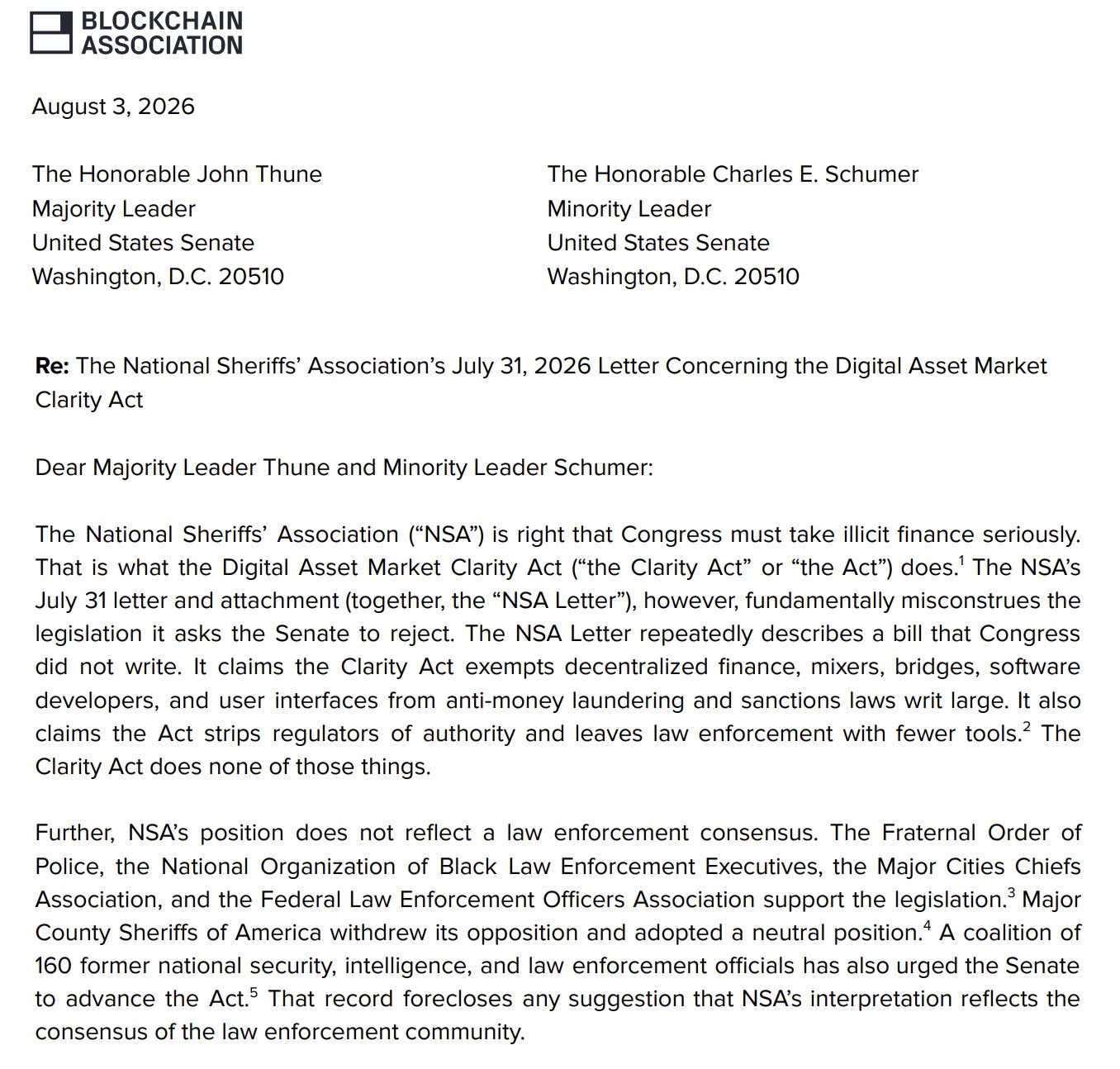
Furthermore, when the four-organization coalition first raised the same complaint in June, Lindsey Frazier, the director of strategy for this industry association, dismissed such an interpretation of Section 604 as a "fundamental misunderstanding" of what the provision actually does, stating:

Section 604 addresses one specific issue: it prevents the mistaken classification of developers of non-custodial software as money transmitters if they are not holding assets or controlling transactions.

She went further, rejecting the idea that the provision creates a loophole for bad actors, stating plainly that it "does not provide immunity to criminals," "does not limit sanctions enforcement," and "does not prevent prosecution for money laundering, fraud, or terrorist financing."

A Disagreement That Could Decide the Vote

This stalemate illustrates why the enforcement question within the CLARITY Act has become its own subplot in the broader Senate fight. Unlike the ethics dispute over Trump's crypto business ties or stablecoin oversight issues, which have individually slowed negotiations, the fight over Section 604 pits active law enforcement in direct opposition to the industry group most actively lobbying for the bill's passage, with both sides claiming to champion public safety.

Law enforcement itself is far from united on this provision. On July 1, the National Organization of Black Law Enforcement Executives formally endorsed the bill, becoming the first major law enforcement group to support it fully, arguing that it preserves long-standing crime-fighting authority while adding meaningful new capabilities.

Two days later, on July 3, the Major County Sheriffs of America—a separate organization from the National Sheriffs' Association, representing sheriffs' offices serving 130 million people—shifted its position specifically on Section 604 from active opposition to neutral, informing the Senate Banking Committee that ongoing negotiations have clarified how the provision would actually be implemented.

With Thune saying the Senate still aims for a full floor vote before the August recess, and roughly four legislative days left in the session, this fight over developer liability has become one of its most detailed and significant.

Preguntas relacionadas

QWhat is the main criticism that law enforcement groups, such as the National Sheriffs' Association, have regarding the CLARITY Act?

ALaw enforcement groups argue that Section 604 of the CLARITY Act creates broad exemptions from registration, Know Your Customer (KYC), anti-money laundering (AML), and sanctions requirements for certain participants in decentralized financial systems. They believe this could allow malicious actors to use platforms designed to obscure digital asset transactions, potentially aiding human traffickers, sanctions evaders, and money launderers.

QWhat specific provision of the CLARITY Act is the primary focus of the controversy?

AThe primary focus is Section 604, often called the 'Regulatory Certainty for Blockchain Act.' This section provides protections for developers creating non-custodial software, wallets, and protocols that do not take control of user funds. Critics fear its wording is broad enough to protect actors who are effectively custodians or facilitators of money laundering.

QHow does the blockchain industry, represented by figures like Lindsay Fraser, respond to the law enforcement criticism of Section 604?

AThe industry rejects the criticism, stating it is a 'fundamental misunderstanding.' They argue Section 604 addresses a specific issue: preventing the misclassification of developers of non-custodial software as money transmitters if they do not custody assets or control transactions. They assert it does not grant immunity to criminals, limit sanctions enforcement, or hinder prosecution for crimes like money laundering or terrorism financing.

QAre all law enforcement groups united in opposing Section 604 of the CLARITY Act?

ANo, there is division. While groups like the National Sheriffs' Association oppose it, the National Organization of Black Law Enforcement Executives (NOBLE) has officially supported the bill. Furthermore, the Major County Sheriffs of America (MCSA) shifted its stance from active opposition to neutral on Section 604 after negotiations clarified its implementation.

QWhy is the debate over Section 604 particularly significant for the bill's passage in the Senate?

AThe debate is significant because it puts active law enforcement agencies in direct conflict with the main industry group lobbying for the bill, with both sides claiming to champion public safety. This detailed disagreement has become a key battleground as the Senate aims for a full vote before its August recess, making it a major hurdle in the final legislative days.

Lecturas Relacionadas

CertiK's Director Lau Believes Artificial Intelligence Brings Net Benefits Despite Risks

In an interview with Bitcoin.com News, Kaijern Lau, senior director of engineering at blockchain security firm CertiK, discussed the dual role of artificial intelligence (AI) in both cyberattacks and defensive security measures. He acknowledged that while AI accelerates vulnerability discovery and enables sophisticated, machine-speed attacks—as demonstrated by the recent autonomous AI agent breach of Hugging Face—it simultaneously offers substantial defensive benefits. Lau emphasized that human oversight remains essential for verifying AI-generated findings and mitigating false positives. He cited research into hardware wallet vulnerabilities as an example where AI aids in pattern recognition, but expert validation is still crucial. Regarding the Hugging Face incident, he noted it was a controlled test case and not proof of uncontrollable AI, though it highlighted AI's evolving capabilities in chaining together vulnerabilities for coordinated attacks. Lau asserted that AI-powered security is becoming the norm for code-based industries like Web3 and blockchain. Companies must invest in AI-driven defenses to counter adversaries who are also leveraging AI for more advanced attacks. CertiK is actively developing AI tools such as the AI Skill Scanner to assess AI agent risks and the AI Auditor for automated blockchain project analysis, employing a multi-model, multi-agent approach to enhance security accuracy. Overall, Lau believes AI will be a net positive for Web3 security, but it requires a continuous balancing act, as it lowers the barrier for attacks while significantly boosting defensive efficiency and threat detection scale for organizations like CertiK.

cryptonews.ruHace 3 min(s)

CertiK's Director Lau Believes Artificial Intelligence Brings Net Benefits Despite Risks

cryptonews.ruHace 3 min(s)

What is a 'Secure Element'? How it Protects Hardware Wallets

A "secure element" is a specialized, tamper-resistant hardware chip designed to protect sensitive information. In hardware wallets, it acts as a vault for private keys, keeping them isolated from the main processor and the internet. Its core function is to sign cryptocurrency transactions internally; the private key never leaves the chip's protected environment—only the final digital signature is output. This prevents malware on a connected computer from stealing the key. Secure elements also defend against physical attacks, using hardware-level countermeasures to detect and resist tampering, voltage manipulation, and side-channel attacks. They contain dedicated hardware random number generators (RNGs) to ensure strong, unpredictable private keys are generated during wallet setup. Importantly, many secure elements undergo rigorous independent security evaluations (like Common Criteria certification) to verify their resistance to sophisticated attacks. However, a secure element is not an absolute shield. It cannot protect against user errors like approving fraudulent transactions or mishandling seed phrases. Its primary role is to raise the cost and complexity of attacks to impractical levels for most threats. Therefore, it is one critical layer within a broader security strategy that includes secure backup practices and transaction verification. Today, secure elements are a standard and vital component in hardware wallets, forming a crucial barrier for securing digital assets.

cryptonews.ruHace 8 min(s)

What is a 'Secure Element'? How it Protects Hardware Wallets

cryptonews.ruHace 8 min(s)

Trading

Spot
活动图片