LATEST NEWS: Federal Reserve Consumer Price Index (PCE) Data, Used to Measure Inflation, Released! Here's Bitcoin's (BTC) First Reaction!

cryptonews.ruPublicado a 2026-08-26Actualizado a 2026-08-26

Resumen

Bitcoin maintained high levels ahead of the U.S. inflation data release, the Personal Consumption Expenditures (PCE) Price Index, a key metric for the Federal Reserve. BTC recently surged from around $62,000 to over $80,000, briefly surpassing $81,000 for a three-month high before a slight pullback. Market focus was intensely on the PCE report, as lower-than-expected figures could strengthen the case for looser Fed monetary policy, while higher figures could dampen rate cut expectations and pressure Bitcoin. The July PCE data was released as follows: Core PCE (YoY) at 3.3% (matching expectations), Core PCE (MoM) at 0.2% (matching expectations), Headline PCE (YoY) at 3.7% (slightly above 3.6% expected), and Headline PCE (MoM) at 0.2% (above the 0.1% expected).

The leading cryptocurrency, Bitcoin, is maintaining its high levels ahead of today's release of U.S. inflation data for Personal Consumption Expenditures (PCE).

As is known, Bitcoin rose from approximately $62,000 to over $80,000 in a very short period. Yesterday, $BTC even surpassed the $81,000 mark, reaching its highest level in the last three months.

Although the market subsequently retreated somewhat, its attention is now focused on the Consumer Price Index (PCE) data, one of the most closely watched inflation indicators by the Fed, as well as on expectations regarding the Fed's monetary policy.

A PCE report lower than expected could reinforce the perception of easing inflationary pressures, supporting expectations that the Fed may pursue a softer monetary policy. Conversely, a PCE report higher than expected could weaken expectations for interest rate cuts, creating short-term selling pressure on Bitcoin.

Thus, the U.S. consumer spending data is critically important for both interest rates and $BTC, and the July consumer spending data, considered a leading indicator of inflation, has been released.

Thus, the data for Personal Consumption Expenditures in July were as follows:

Core Personal Consumption Expenditures Price Index (annual) released: 3.3% – Expected: 3.3% – Previous: 3.3%

Core Personal Consumption Expenditures Price Index (monthly) released: 0.2% – Expected: 0.2% – Previous: 0.1%

Personal Consumption Expenditures Price Index (annual) announced: 3.7% – Expected: 3.6% – Previous: 3.7%

Personal Consumption Expenditures Price Index (monthly) announced: 0.2% – Expected: 0.1% – Previous: -0.1%

*This is not investment advice.

end-content

Criptos en tendencia

Preguntas relacionadas

QWhat is the key inflation index the Bitcoin (BTC) market is focused on, according to the article?

AAccording to the article, the Bitcoin market is intensely focused on the U.S. Personal Consumption Expenditures (PCE) index data, which is one of the inflation indicators most closely monitored by the Federal Reserve.

QHow might a PCE report lower than expectations potentially affect the U.S. Federal Reserve's monetary policy and Bitcoin?

AA PCE report lower than expectations could strengthen the perception of easing inflationary pressure, supporting expectations that the Fed could adopt a more accommodative monetary policy, which would likely be positive for Bitcoin.

QWhat were the announced monthly and annual core PCE index values for July?

AFor July, the announced core PCE index was 0.2% on a monthly basis and 3.3% on an annual basis.

QHow did the headline (overall) PCE price index for July compare to expectations?

AThe announced headline PCE price index for July was 3.7% on an annual basis, slightly higher than the expected 3.6%.

QWhat recent price milestone did Bitcoin (BTC) achieve according to the article?

AAccording to the article, Bitcoin recently surpassed $81,000, reaching its highest level in the last three months.

Lecturas Relacionadas

$120 Million Vanishes Overnight! Crypto's 'Steadiest Giant' Stumbles in South America

Summary: Tether's $120 million Bitcoin mining venture in Uruguay, initiated in May 2023, was abruptly shut down in July 2025 when the national power utility UTE cut off electricity. The project, developed in partnership with local firm Microfin in Florida province, was touted as a model for leveraging the country's nearly 98% renewable energy grid. The collapse stemmed from a fundamental contract dispute over electricity supply. Tether interpreted the agreed power volume as a "minimum guaranteed supply," expecting to request more as the mining operation expanded. UTE, however, viewed it as a "strict maximum cap." This disagreement led to frequent power curtailments for the 24/7 mining facility, causing significant revenue loss from lost computing power. Following the 2025 election of left-wing President Yamandú Orsi and a management change at UTE, negotiations broke down. Microfin stopped paying electricity bills in May 2025, formally notified UTE of contract termination in June, and did not attend a final meeting where UTE presented a revised contract. By the July 25 power cut, Microfin's debt approached $5 million. The operation ceased, laying off 30 of its 38 local staff, with all outstanding debts settled by December 2025. The failure highlights key risks for heavy-asset overseas investments: Uruguay's green energy proved not to be cheap energy, especially after the 2024 Bitcoin halving squeezed industry profits. Furthermore, political changes can swiftly alter utility company policies, undermining the long-term regulatory stability critical for such projects. While financially absorbable for Tether, the incident underscores that operational success depends on unambiguous contracts and genuine cost advantages, not just technological scale.

marsbitHace 16 min(s)

$120 Million Vanishes Overnight! Crypto's 'Steadiest Giant' Stumbles in South America

marsbitHace 16 min(s)

Is Bitcoin Price Lagging? Record Global M2 Money Supply Could Be a Springboard for BTC's Rise

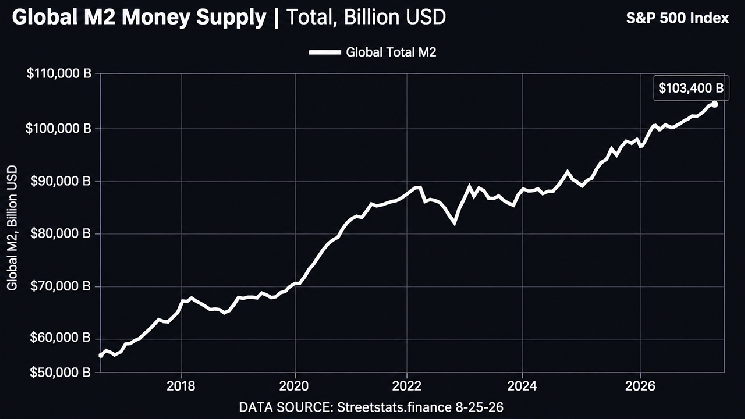
Bitcoin Price Lagging? Record Global Money Supply M2 Could Springboard BTC Growth The global money supply (M2) is expanding rapidly, similar to global debt. The US M2, representing all money circulating in its economy, has reached a record $23.16 trillion. Combined with figures from major economies like the Eurozone, China, and Japan, the global M2 is approximately $103 trillion. Some estimates, however, place it closer to $195 trillion. This surge in liquidity is significant because excess capital often seeks higher returns in assets like precious metals, stocks, and cryptocurrencies. Bitcoin's recent price surge above $81,000 has brought the global M2 metric back into focus. Following a sharp rise in early August after a US Treasury bond buyback announcement, BTC still trades about 37% below its October 2025 all-time high exceeding $126,000. This gap presents a potential "catch-up" trade thesis. Bitcoin's fixed supply of 21 million contrasts with governments' ability to print fiat currency, making scarce assets like BTC attractive if monetary expansion continues. Historically, Bitcoin's bull cycles in 2017-2018 and 2020-2021 coincided with M2 expansion and increased liquidity. Over the past year, the correlation seemed broken as M2 grew while Bitcoin's price fell sharply from its peak. Observers believe fresh dollars may have remained locked in cash-favorable investments. Some, like Ash Crypto, now suggest a long-awaited alignment between Bitcoin and M2 may be starting, especially as a weakening US Dollar Index this month has seen assets like gold and Bitcoin surge. A softer dollar pressures cash havens and prompts holders to act. While record M2 doesn't guarantee higher Bitcoin prices, a sustained influx of liquidity, a weak dollar, and capital flowing into alternative assets could trigger a catch-up rally sooner than expected. However, changes in these conditions could lead to the opposite outcome.

cryptonews.ruHace 41 min(s)

Is Bitcoin Price Lagging? Record Global M2 Money Supply Could Be a Springboard for BTC's Rise

cryptonews.ruHace 41 min(s)

Blockchain Capital Partner: Tokenization Will Reshape the Underlying Structure of Capital Markets

"Blockchain Capital partner Aleks Larsen argues that tokenization will fundamentally restructure capital markets by solving a costly 'packaging' problem in finance. Currently, assets like mortgages, private equity, and stocks exist in fragmented, incompatible systems, creating huge friction and slowing capital flow. Tokenization introduces a standardized, machine-readable interface for assets—akin to shipping containers for finance. Just as containerization standardized global trade, enabling massive efficiency gains and economic growth, tokens standardize financial rights. This allows platforms, lenders, and custodians to interact with assets directly on a shared network without rebuilding infrastructure for each one. Stablecoins demonstrate this potential, processing volumes rivaling Visa with far lower cost and faster settlement. Beyond payments, tokenization is expanding to assets like U.S. Treasuries, commodities, and private credit, now totaling nearly $400 billion on-chain. This shift changes financial service access: instead of depending on relationships with institutions, services become accessible based on the asset's tokenized properties themselves. DeFi protocols like Aave exemplify this, where assets meeting criteria can be used as collateral programmatically. Ultimately, tokenization will reorganize capital markets around open networks of specialized services, lowering barriers to entry and reducing costs. This could unlock global capital for currently underserved assets—small receivables, regional infrastructure, emerging market credit—integrating them into a seamless, programmable financial system. Combined with AI, tokenization promises to make capital allocation more efficient, transparent, and globally accessible, reshaping how economic value is created and distributed."

marsbitHace 45 min(s)

Blockchain Capital Partner: Tokenization Will Reshape the Underlying Structure of Capital Markets

marsbitHace 45 min(s)

Trading

Spot

Artículos destacados

Cómo comprar DATA

¡Bienvenido a HTX.com! Hemos hecho que comprar DATA Network (DATA) sea simple y conveniente. Sigue nuestra guía paso a paso para iniciar tu viaje de criptos.Paso 1: crea tu cuenta HTXUtiliza tu correo electrónico o número de teléfono para registrarte y obtener una cuenta gratuita en HTX. Experimenta un proceso de registro sin complicaciones y desbloquea todas las funciones.Obtener mi cuentaPaso 2: ve a Comprar cripto y elige tu método de pagoTarjeta de crédito/débito: usa tu Visa o Mastercard para comprar DATA Network (DATA) al instante.Saldo: utiliza fondos del saldo de tu cuenta HTX para tradear sin problemas.Terceros: hemos agregado métodos de pago populares como Google Pay y Apple Pay para mejorar la comodidad.P2P: tradear directamente con otros usuarios en HTX.Over-the-Counter (OTC): ofrecemos servicios personalizados y tipos de cambio competitivos para los traders.Paso 3: guarda tu DATA Network (DATA)Después de comprar tu DATA Network (DATA), guárdalo en tu cuenta HTX. Alternativamente, puedes enviarlo a otro lugar mediante transferencia blockchain o utilizarlo para tradear otras criptomonedas.Paso 4: tradear DATA Network (DATA)Tradear fácilmente con DATA Network (DATA) en HTX's mercado spot. Simplemente accede a tu cuenta, selecciona tu par de trading, ejecuta tus trades y monitorea en tiempo real. Ofrecemos una experiencia fácil de usar tanto para principiantes como para traders experimentados.

557 Vistas totalesPublicado en 2026.07.01Actualizado en 2026.07.01

Cómo comprar DATA

Discusiones

Bienvenido a la comunidad de HTX. Aquí puedes mantenerte informado sobre los últimos desarrollos de la plataforma y acceder a análisis profesionales del mercado. A continuación se presentan las opiniones de los usuarios sobre el precio de DATA (DATA).

活动图片