Lagarde Says ECB Needs Tokenised Money, Not Crypto Stablecoins

bitcoinistPublicado a 2026-05-08Actualizado a 2026-05-08

Resumen

ECB President Christine Lagarde argues Europe should not respond to dominant US dollar stablecoins by creating its own euro-denominated versions. Instead, she advocates for building tokenised financial infrastructure based on central bank money. Lagarde acknowledges stablecoins' growth and role in crypto settlement and cross-border payments, but identifies key risks: financial stability vulnerabilities, as shown by USDC's depegging during the Silicon Valley Bank collapse, and potential disruption to monetary policy transmission in the euro area. She contends that promoting private euro stablecoins under MiCAR would offer limited benefits for the euro's international role while introducing material trade-offs. A more effective path to strengthening the euro involves deeper capital market integration and developing a safe asset base. Lagarde is constructive on the transformative potential of DLT-based market infrastructure for Europe's fragmented financial system. The ECB's strategy focuses on public solutions like the Pontes project for wholesale settlement in central bank money and the Appia roadmap for an interoperable tokenised ecosystem by 2028. The goal is to harness innovation's benefits without replicating fragile instruments from elsewhere.

ECB President Christine Lagarde has pushed back against the idea that Europe should answer dollar crypto stablecoin dominance by promoting euro-denominated stablecoins of its own, arguing instead that the region should build tokenised financial infrastructure anchored in central bank money.

In a speech at the Banco de España LatAm Economic Forum in Roda de Bará, Spain, Lagarde framed stablecoins as one of the fastest-moving policy questions in global finance. The market, she said, has grown from less than $10 billion six years ago to more than $300 billion today, with close to 98% of stablecoins denominated in US dollars and nearly 90% controlled by Tether and Circle.

Lagarde: ECB Must Not Copy US Crypto Stablecoin Model

That concentration has turned crypto stablecoins into more than a crypto-market instrument. In Lagarde’s view, they now sit at the intersection of monetary power, financial stability and tokenised-market infrastructure.

“The growing argument is that to remain relevant, Europe must respond by promoting euro-denominated stablecoins of its own,” Lagarde said. “Otherwise, it faces a future of digital dollaritation and a loss of monetary sovereignty.”

But she argued that this framing misses the central issue. Stablecoins, according to Lagarde, perform two separate functions that are often conflated: a monetary function, by extending the reach of a currency, and a technological function, by acting as the cash leg for settlement on distributed ledger infrastructure.

“The argument I want to develop today is that once we disentangle those two functions, the case for promoting euro-denominated stablecoins is far weaker than it appears,” she said. “And a more fundamental question comes into view: do we actually need stablecoins to obtain the benefits they are said to provide? Or are we mistaking the instrument for the outcome?”

Lagarde acknowledged that stablecoins have become central to crypto settlement and increasingly relevant for cross-border payments, particularly in regions where access to stable currencies is limited. She also noted that dollar-backed stablecoins can reinforce demand for US Treasuries, especially if they become yield-bearing instruments.

That dynamic is now openly part of US policy. Lagarde pointed to the GENIUS Act, which the US administration has described not only as a consumer protection and financial stability measure, but also as a tool to support “the continued global dominance of the U.S. dollar” and strengthen demand for Treasuries.

For Europe, however, Lagarde said the monetary case for euro stablecoins is weak once risks are included. Under MiCAR, euro-denominated stablecoins could create additional demand for euro-area safe assets and marginally extend the euro’s international reach. Yet she argued that the trade-offs would be material.

The first is financial stability. Lagarde cited Circle’s USDC depeg during the Silicon Valley Bank collapse in March 2023, when Circle disclosed that $3.3 billion of USDC reserves were held at the failed bank and the token briefly fell to $0.877.
“The promise of par redemption depends on the very market confidence that can vanish when financial stability deteriorates,” she said. “And a mass redemption can accelerate that deterioration.”

The second risk is monetary policy transmission. If retail deposits migrate into non-bank stablecoins and return to banks as wholesale funding, the ECB’s rate decisions may transmit less effectively through the banking system. Lagarde said this matters particularly in the euro area, where banks remain the dominant source of credit to the real economy.

Her conclusion was blunt: stablecoins are not an efficient way to strengthen the euro’s international role. The better route, she said, is deeper capital-market integration through Europe’s savings and investments union, alongside a safe asset base that matches the euro’s global ambitions.

Where Lagarde was more constructive was on tokenisation itself. She described DLT-based market infrastructure as genuinely transformative, especially for Europe’s fragmented financial system. In 2023, the EU had 295 trading venues, 14 central clearing counterparties and 32 central securities depositories, compared with two clearing houses and one central securities depository in the US.

Stablecoins currently fill the settlement gap in tokenized markets because they provide an on-chain unit of value for atomic settlement. But Lagarde argued that private stablecoins are fragile and fragmented foundations for that role.

The ECB’s answer is public infrastructure. From September, the Eurosystem plans to offer wholesale settlement through the Pontes project, linking DLT platforms to TARGET so transactions can settle in central bank money. Lagarde also pointed to the Appia roadmap, published in March, which aims to support a fully interoperable European tokenised financial ecosystem by 2028.

“Europe knows which port it is sailing to,” Lagarde concluded. “Our task is not to replicate instruments developed elsewhere, but to build the foundations and the infrastructure that serve our own objectives, so that we can harness the benefits of innovation without importing the fragilities.”

At press time, the total crypto market cap stood at $2.64 trillion.
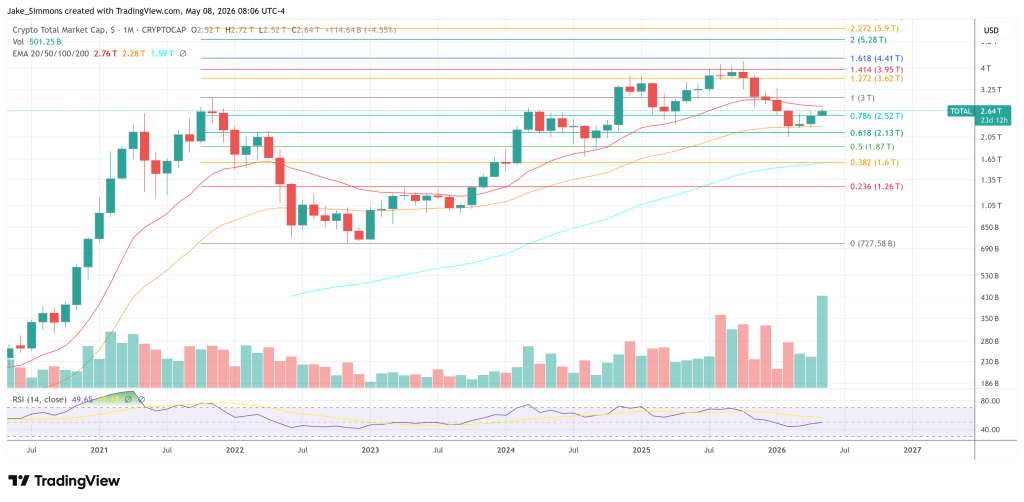
Total crypto market cap faces the 20-month EMA, 1-week chart | Source: TOTAL on TradingView.com

Preguntas relacionadas

QWhat is Christine Lagarde's main argument against promoting euro-denominated stablecoins?

AShe argues that the monetary case for euro stablecoins is weak once financial stability and monetary policy transmission risks are considered, and that Europe should instead build tokenized financial infrastructure anchored in central bank money.

QAccording to Lagarde, what two functions do stablecoins perform that are often conflated?

AStablecoins perform a monetary function, by extending the reach of a currency, and a technological function, by acting as the cash leg for settlement on distributed ledger infrastructure.

QWhat are the two main risks Lagarde associates with private stablecoins?

AThe two main risks are financial stability (as demonstrated by the USDC depeg during the Silicon Valley Bank collapse) and the impairment of monetary policy transmission if retail deposits migrate into stablecoins.

QWhat European public infrastructure projects does Lagarde mention as alternatives to stablecoins for tokenized markets?

AShe mentions the Pontes project (starting in September) to offer wholesale settlement in central bank money, and the Appia roadmap, which aims to support a fully interoperable European tokenized financial ecosystem by 2028.

QHow does Lagarde describe the current dominance of US dollar stablecoins in the market?

AShe states that close to 98% of stablecoins are denominated in US dollars, with nearly 90% of the market controlled by Tether and Circle.

Lecturas Relacionadas

GitHub, Transfixed by AI

On the night of February 9th, GitHub suffered a major outage caused by a simple configuration change—reducing a cache refresh interval from 12 to 2 hours—that triggered a cascade of failures. This was not an isolated event, but part of a broader pattern. In early 2026, GitHub experienced at least 8 major incidents, failing to meet its promised 99.9% availability. These outages stemmed from structural issues: explosive growth in load, tight service coupling, and insufficient protection against abnormal traffic. This unprecedented load is driven by AI Agents. In 2025, GitHub handled ~1 billion commits. By 2026, weekly commits reached 275 million, projecting to ~14 billion for the year—a 14x increase. AI tools like Claude Code now contribute 4.5% of all public repository commits, with weekly submissions surging 25x in just three months. AI-generated pull requests jumped from 4 million to 17 million per month in half a year. Unlike human developers, AI Agents work continuously, generating commits at a scale that overwhelms infrastructure designed for human rhythms. The surge also shattered GitHub's business model. Copilot's flat-rate pricing, based on assisting human developers, became unsustainable as Agentic AI sessions consumed resources worth hundreds of dollars for a few dollars in fees. In response, GitHub imposed usage limits and, by June 1st, shifted to a pay-per-use "AI Credits" system. Facing this new reality, GitHub realized a 10x scaling plan was insufficient. It announced a need to *redesign* its architecture for 30x current scale—decoupling services, adding fault isolation, and improving change management to prevent cascading failures. Other platforms like Stripe and AWS are facing similar challenges with AI Agents. Fundamentally, GitHub is transitioning from a human collaboration platform to an "exhaust pipe" for automated AI workflows. Its detailed post-mortem reports aim to maintain trust during this turbulent rebuild. The February outage was not just a technical glitch, but a signal of the software industry's entry into a new, AI-driven era.

marsbitHace 13 min(s)

GitHub, Transfixed by AI

marsbitHace 13 min(s)

Both Suffer Massive Losses Exceeding $90 Billion, Which Is in Greater Peril: Strategy or Bitmine?

Facing massive paper losses exceeding $90 billion each amidst a sharp market downturn, "Digital Asset Treasury" (DAT) giants Strategy and Bitmine find themselves in a precarious position, but with different underlying risks. Strategy, heavily invested in Bitcoin (BTC), faces significant financial strain. Its strategy relies heavily on debt, including convertible notes and preferred stock (STRC) requiring substantial dividend payments. With its cash reserves dwindling and BTC offering no staking yield for cash flow, Strategy's high leverage makes it vulnerable. A continued price decline could force asset sales to meet obligations, potentially creating a negative feedback loop. Its market value has already fallen sharply. In contrast, Bitmine, an Ethereum (ETH) holder, appears on firmer financial ground. It primarily funds its purchases through equity offerings (like ATM programs), avoiding debt pressure. It also generates income by staking a large portion of its ETH holdings. While not immune to market drops and shareholder dilution concerns, Bitmine maintains more flexibility, recently announcing a new preferred share offering to raise further capital. The core divergence lies in their financing: Bitmine uses equity (investor money), while Strategy uses debt (borrowed money). Consequently, Bitmine currently faces less immediate liquidity pressure than Strategy, which must navigate the dual challenge of servicing debt/dividends and a declining core asset (BTC) price.

marsbitHace 21 min(s)

Both Suffer Massive Losses Exceeding $90 Billion, Which Is in Greater Peril: Strategy or Bitmine?

marsbitHace 21 min(s)

Where the AI Bubble Really Is: Which Layer of Players Are Naked

AI Bubble: Where It Really Is and Who's Swimming Naked This analysis dissects the AI industry not as a single entity but as a five-layer pyramid, arguing that bubbles are concentrated in specific tiers, not uniformly distributed. **Key Distinction from the 2000 Dot-com Bubble:** Unlike 2000, where companies had stock prices before revenue, today's leading AI players have massive, contract-backed revenue driving their valuations. Core infrastructure demand is real, with every GPU running at full capacity for paying customers. **The Five-Layer Pyramid & Bubble Assessment:** * **L0 (Fab/Manufacturing) & Top L4 (Leading AI Apps): NO BUBBLE.** Companies like TSMC, NVIDIA, major cloud providers (Microsoft, Google, Meta, Amazon), and top AI labs have real revenues and orders. Supply is tightly constrained by TSMC's disciplined capacity control and physical limits like power/land for data centers, preventing a supply glut. * **L1 (Memory): BATTLEGROUND.** Sky-high HBM margins could signal a new structural cycle or a classic "boom before bust." The oligopoly of three major players may enforce supply discipline, making this a high-stakes bet. * **L2 (Interconnect/Optical Modules): BUBBLE TERRITORY.** Companies like Lumentum and AAOI have seen stock surges (4-10x) far outpacing revenue growth. This hardware segment has lower physical barriers to expansion than fabs, allowing speculation. It mirrors the 2000 bubble's epicenter—optics. * **L3 (Infrastructure/"GPU Landlords"): VULNERABLE.** GPU leasing companies profit from the current compute shortage but own no long-term moat. Their business model relies on a temporary bottleneck that will ease as big tech expands and new tech (e.g., potential space-based data centers) emerges. * **L4 Long Tail (VC-backed Startups): STRONG BUBBLE SIGNALS.** VC funding concentration in AI is twice that of the 1999 peak. Many startups with little revenue use the valuation logic of successful giants to justify their own, creating high risk of a "valuation crunch" when funding dries up. **Critical Risks to Monitor:** 1. **GPU Depreciation & Accounting:** Companies extending the assumed useful life of GPUs artificially boost profits. The true economic life depends on future generational leaps from NVIDIA. 2. **"GPU Credit" & Off-Balance-Sheet Leverage:** Emerging structures where shell companies borrow to buy GPUs and lease them out (with chipmakers sometimes investing) move debt off major balance sheets. This echoes the "vendor financing" of 2000 and the securitization risks of 2008, though currently small-scale. 3. **TSMC Abandoning Caution:** If the primary supply bottleneck (TSMC's conservative capacity planning) breaks, runaway supply could trigger a bust. 4. **Algorithmic Efficiency Breakthrough:** A major leap in software efficiency could drastically reduce the need for raw compute hardware, undermining the investment thesis. **Conclusion:** The AI boom is expensive and has frothy areas, but its core is underpinned by real demand and physical supply constraints. The bubble risk is layered: most present in optical components, GPU leasing, and the long-tail startup ecosystem, while the foundational chip manufacturing and leading application layers remain relatively solid—for now.

marsbitHace 33 min(s)

Where the AI Bubble Really Is: Which Layer of Players Are Naked

marsbitHace 33 min(s)

Trading

Spot
Futuros
活动图片





