Lagarde Says ECB Needs Tokenised Money, Not Crypto Stablecoins

bitcoinistPublicado a 2026-05-08Actualizado a 2026-05-08

Resumen

ECB President Christine Lagarde argues Europe should not respond to dominant US dollar stablecoins by creating its own euro-denominated versions. Instead, she advocates for building tokenised financial infrastructure based on central bank money. Lagarde acknowledges stablecoins' growth and role in crypto settlement and cross-border payments, but identifies key risks: financial stability vulnerabilities, as shown by USDC's depegging during the Silicon Valley Bank collapse, and potential disruption to monetary policy transmission in the euro area. She contends that promoting private euro stablecoins under MiCAR would offer limited benefits for the euro's international role while introducing material trade-offs. A more effective path to strengthening the euro involves deeper capital market integration and developing a safe asset base. Lagarde is constructive on the transformative potential of DLT-based market infrastructure for Europe's fragmented financial system. The ECB's strategy focuses on public solutions like the Pontes project for wholesale settlement in central bank money and the Appia roadmap for an interoperable tokenised ecosystem by 2028. The goal is to harness innovation's benefits without replicating fragile instruments from elsewhere.

ECB President Christine Lagarde has pushed back against the idea that Europe should answer dollar crypto stablecoin dominance by promoting euro-denominated stablecoins of its own, arguing instead that the region should build tokenised financial infrastructure anchored in central bank money.

In a speech at the Banco de España LatAm Economic Forum in Roda de Bará, Spain, Lagarde framed stablecoins as one of the fastest-moving policy questions in global finance. The market, she said, has grown from less than $10 billion six years ago to more than $300 billion today, with close to 98% of stablecoins denominated in US dollars and nearly 90% controlled by Tether and Circle.

Lagarde: ECB Must Not Copy US Crypto Stablecoin Model

That concentration has turned crypto stablecoins into more than a crypto-market instrument. In Lagarde’s view, they now sit at the intersection of monetary power, financial stability and tokenised-market infrastructure.

“The growing argument is that to remain relevant, Europe must respond by promoting euro-denominated stablecoins of its own,” Lagarde said. “Otherwise, it faces a future of digital dollaritation and a loss of monetary sovereignty.”

But she argued that this framing misses the central issue. Stablecoins, according to Lagarde, perform two separate functions that are often conflated: a monetary function, by extending the reach of a currency, and a technological function, by acting as the cash leg for settlement on distributed ledger infrastructure.

“The argument I want to develop today is that once we disentangle those two functions, the case for promoting euro-denominated stablecoins is far weaker than it appears,” she said. “And a more fundamental question comes into view: do we actually need stablecoins to obtain the benefits they are said to provide? Or are we mistaking the instrument for the outcome?”

Lagarde acknowledged that stablecoins have become central to crypto settlement and increasingly relevant for cross-border payments, particularly in regions where access to stable currencies is limited. She also noted that dollar-backed stablecoins can reinforce demand for US Treasuries, especially if they become yield-bearing instruments.

That dynamic is now openly part of US policy. Lagarde pointed to the GENIUS Act, which the US administration has described not only as a consumer protection and financial stability measure, but also as a tool to support “the continued global dominance of the U.S. dollar” and strengthen demand for Treasuries.

For Europe, however, Lagarde said the monetary case for euro stablecoins is weak once risks are included. Under MiCAR, euro-denominated stablecoins could create additional demand for euro-area safe assets and marginally extend the euro’s international reach. Yet she argued that the trade-offs would be material.

The first is financial stability. Lagarde cited Circle’s USDC depeg during the Silicon Valley Bank collapse in March 2023, when Circle disclosed that $3.3 billion of USDC reserves were held at the failed bank and the token briefly fell to $0.877.
“The promise of par redemption depends on the very market confidence that can vanish when financial stability deteriorates,” she said. “And a mass redemption can accelerate that deterioration.”

The second risk is monetary policy transmission. If retail deposits migrate into non-bank stablecoins and return to banks as wholesale funding, the ECB’s rate decisions may transmit less effectively through the banking system. Lagarde said this matters particularly in the euro area, where banks remain the dominant source of credit to the real economy.

Her conclusion was blunt: stablecoins are not an efficient way to strengthen the euro’s international role. The better route, she said, is deeper capital-market integration through Europe’s savings and investments union, alongside a safe asset base that matches the euro’s global ambitions.

Where Lagarde was more constructive was on tokenisation itself. She described DLT-based market infrastructure as genuinely transformative, especially for Europe’s fragmented financial system. In 2023, the EU had 295 trading venues, 14 central clearing counterparties and 32 central securities depositories, compared with two clearing houses and one central securities depository in the US.

Stablecoins currently fill the settlement gap in tokenized markets because they provide an on-chain unit of value for atomic settlement. But Lagarde argued that private stablecoins are fragile and fragmented foundations for that role.

The ECB’s answer is public infrastructure. From September, the Eurosystem plans to offer wholesale settlement through the Pontes project, linking DLT platforms to TARGET so transactions can settle in central bank money. Lagarde also pointed to the Appia roadmap, published in March, which aims to support a fully interoperable European tokenised financial ecosystem by 2028.

“Europe knows which port it is sailing to,” Lagarde concluded. “Our task is not to replicate instruments developed elsewhere, but to build the foundations and the infrastructure that serve our own objectives, so that we can harness the benefits of innovation without importing the fragilities.”

At press time, the total crypto market cap stood at $2.64 trillion.
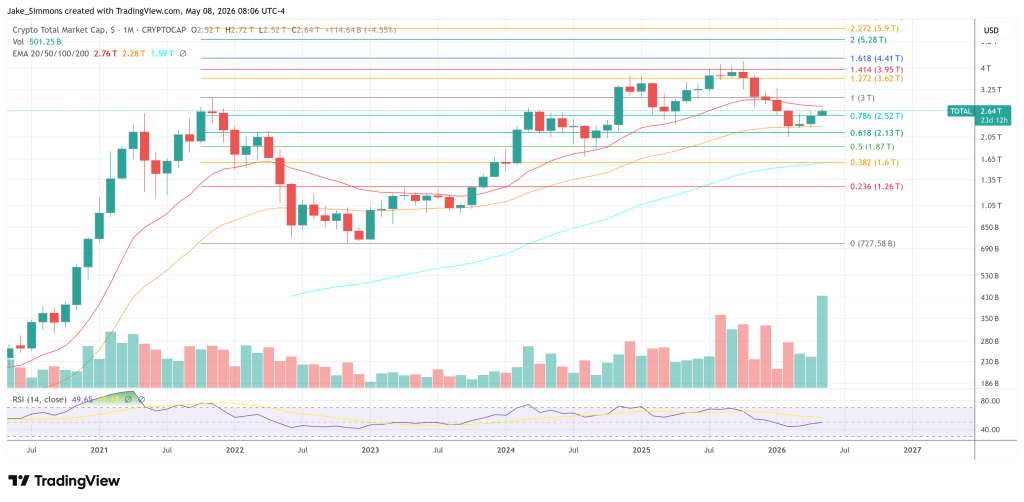
Total crypto market cap faces the 20-month EMA, 1-week chart | Source: TOTAL on TradingView.com

Preguntas relacionadas

QWhat is Christine Lagarde's main argument against promoting euro-denominated stablecoins?

AShe argues that the monetary case for euro stablecoins is weak once financial stability and monetary policy transmission risks are considered, and that Europe should instead build tokenized financial infrastructure anchored in central bank money.

QAccording to Lagarde, what two functions do stablecoins perform that are often conflated?

AStablecoins perform a monetary function, by extending the reach of a currency, and a technological function, by acting as the cash leg for settlement on distributed ledger infrastructure.

QWhat are the two main risks Lagarde associates with private stablecoins?

AThe two main risks are financial stability (as demonstrated by the USDC depeg during the Silicon Valley Bank collapse) and the impairment of monetary policy transmission if retail deposits migrate into stablecoins.

QWhat European public infrastructure projects does Lagarde mention as alternatives to stablecoins for tokenized markets?

AShe mentions the Pontes project (starting in September) to offer wholesale settlement in central bank money, and the Appia roadmap, which aims to support a fully interoperable European tokenized financial ecosystem by 2028.

QHow does Lagarde describe the current dominance of US dollar stablecoins in the market?

AShe states that close to 98% of stablecoins are denominated in US dollars, with nearly 90% of the market controlled by Tether and Circle.

Lecturas Relacionadas

Within Strategy's Framework, STRC's Dividend Yield Remains at 12% as Share Price Stays Below Par Value

Michael Saylor, Executive Chairman of Strategy (MSTR), confirmed that the dividend rate for its STRC perpetual preferred shares will remain at 12.00% through August 2026. The rate has increased from 9% at its July 2025 launch to the current high via a "ratchet" mechanism, which permanently raises the rate by 0.5% whenever the share price falls below $95. This mechanism is intended to push the price back toward its $100 par value and support Strategy's "at-the-market" (ATM) program for issuing new shares to fund Bitcoin purchases. However, the mechanism has not worked as intended. STRC shares closed at $89.46 on July 31, remaining about 10-11% below par value despite the record-high dividend. Competition from rival Strive's higher-yielding SATA securities has pressured demand. The persistent discount has forced Strategy to suspend new STRC issuances via its ATM program, limiting this funding channel for Bitcoin acquisitions. STRC's struggles reflect Bitcoin's own volatility, as the preferred shares historically move in tandem. Analysts have warned the ratchet structure carries long-term, one-way risk. A law firm is investigating Strategy's ability to maintain dividend payments if Bitcoin's price stays low. Retail investors own roughly 83% of outstanding STRC shares, a group seen as prone to panic selling during downturns. In response, Strategy has established financial reserves, including a liquidity cushion covering about 26 months of dividend/interest obligations, and a $2 billion share buyback program alongside a Bitcoin monetization framework, though the company emphasized it is not obligated to sell any Bitcoin.

cryptonews.ruHace 11 min(s)

Within Strategy's Framework, STRC's Dividend Yield Remains at 12% as Share Price Stays Below Par Value

cryptonews.ruHace 11 min(s)

Analyst: Bitcoin's Price Will Drop to $60k in August, Then Rebound to $70k

Financial analyst Andrey Poroshin has provided a new forecast for Bitcoin's price dynamics in August. Poroshin, an analyst at the Bitbanker exchange, expects the cryptocurrency market to experience a downturn this month, with prices retesting the $60,000 level due to a lack of supportive macroeconomic catalysts. He noted that the recent US Federal Reserve decision to hold interest rates did not significantly impact the market, while inflation remains above the 2% target. Poroshin stated that Bitcoin is ending July under pressure from moderate volatility and a lack of new macroeconomic stimuli, leading to continued market caution. According to his base scenario, Bitcoin will drop to a range of $60,000 to $62,000 before recovering to $70,000. He pointed out that even $70,000 remains below the cost of mining in the US, which has prompted some miners to shift towards AI data center operations. Poroshin cited the winding down of BitMEX's operations as a potential catalyst for a price rebound, suggesting the exit of weaker players often coincides with market reversals and reduced short-term selling pressure. He believes Bitcoin is currently less susceptible to geopolitical shocks, such as the Iran-US conflict, and does not expect significant market changes in August related to the pending CLARITY Act. Looking ahead, Poroshin forecasts that September will bring more active price fluctuations driven by potential Fed rate decisions and possible discussions or approval of the CLARITY Act.

cryptonews.ruHace 11 min(s)

Analyst: Bitcoin's Price Will Drop to $60k in August, Then Rebound to $70k

cryptonews.ruHace 11 min(s)

Trading

Spot
活动图片





