L2's 'Card Swipe' Era: When the Scaling Narrative Ends, Payments Become the Lifeline

marsbitPublicado a 2026-01-22Actualizado a 2026-01-22

Resumen

The article discusses the growing "payment card" trend among Layer-2 (L2) networks as a strategy to survive a severe user activity and transaction crisis. It begins with Solana's criticism of Starknet's low usage (allegedly only 8 daily active users and 10 transactions) despite its high valuation, highlighting a broader issue of low traffic across many L2s, as evidenced by data from L2BEAT and DefiLlama. Key examples include Zero Network, which stopped producing blocks for weeks with minimal impact, and networks like Linea, Starknet, Scroll, and ZKsync exhibiting very low Transactions Per Second (TPS). With Base and Arbitrum dominating 80% of the Total Value Locked (TVL), other L2s face a significant valuation-to-usage disparity. Facing a lack of killer dApps, L2s are turning to cryptocurrency payment cards to generate consistent on-chain activity. Unlike custodial cards from exchanges (which use chains like Tron or Solana for batch settlement), L2s are leveraging non-custodial cards that require on-chain settlement for each transaction. Examples include: - **Scroll**: Partnered with Etherfi for gasless transactions and cashback subsidies. - **Gnosis**: Its Gnosis Pay card converts user assets to stablecoins for euro payments. - **Linea**: Used as a primary settlement layer for the MetaMask card. This shift provides a high-frequency, sustainable use case, driving transaction volume. Even Polygon is pivoting to payments, citing significant non-USD stablecoin transfer volume...

Original Author: Eric, Foresight News

Recently, Solana made a joke about Starknet, mocking an L2 with only 8 daily active users and 10 transactions per day that still has a $15 billion FDV.
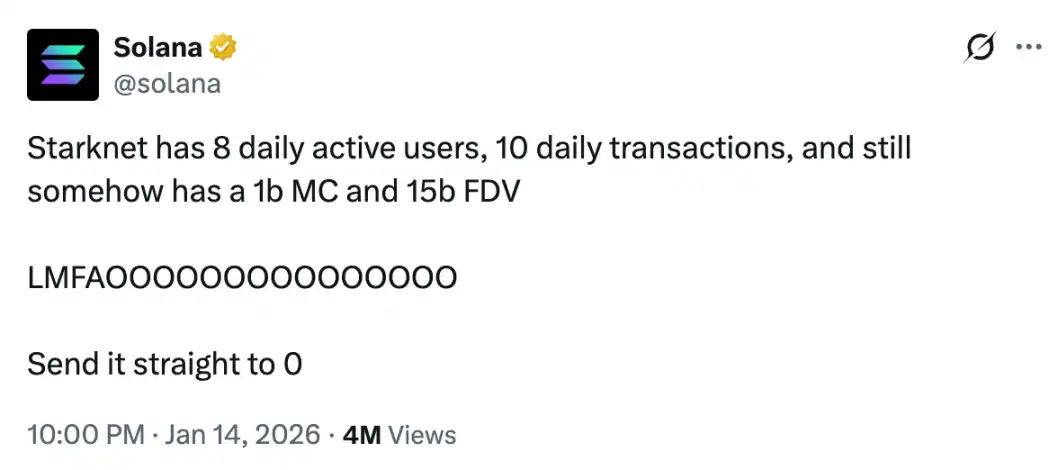
Although, in hindsight, this salt-in-the-wound joke was meant to attract attention and introduce the news of Starknet's token STRK launching on Solana via NEAR Intents. But Solana's criticism is not without reason; the L2s that have sprung up like mushrooms in the past two years are indeed facing a traffic crisis.

The most convincing recent example is on January 8th, when Zero Network, an L2 network incubated by Web3 wallet company Zerion, was exposed to have stopped producing blocks for over 3 weeks, but it seemed to have no impact. The official reaction was even more subtle; Zero Network stopped producing blocks on December 19, 2025, but the official statement on fixing the issue only came on December 23. The last original content posted by Zero Network's official Twitter was in May of the same year.

Despite this, the claim of only 8 users executing 10 transactions per day is an exaggeration. According to data from L2BEAT, Starknet's TPS yesterday was 2.64, meaning there were over 200,000 transactions on the network in a day. But this number is still extremely low; even the Ethereum mainnet's daily transaction volume is 10 times that of Starknet.
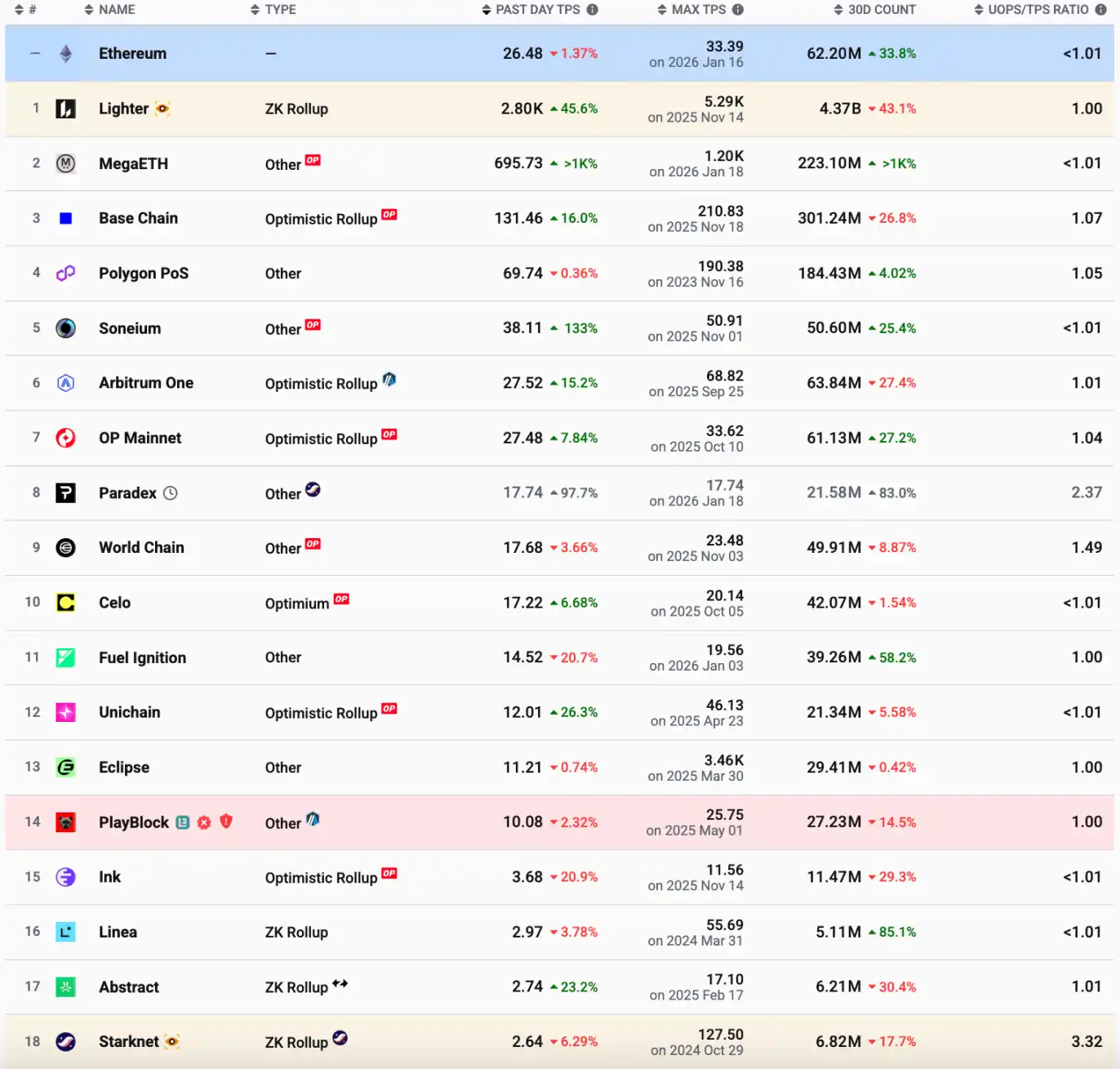
Data shows that among general-purpose L2s, aside from Base and Polygon, even Arbitrum and OP Mainnet's TPS are not significantly higher than Ethereum's. Linea and Starknet have a TPS of less than 3. The parts not shown in the screenshot include Scroll with a TPS slightly over 1, and ZKsync, Blast, etc., with less than 1.
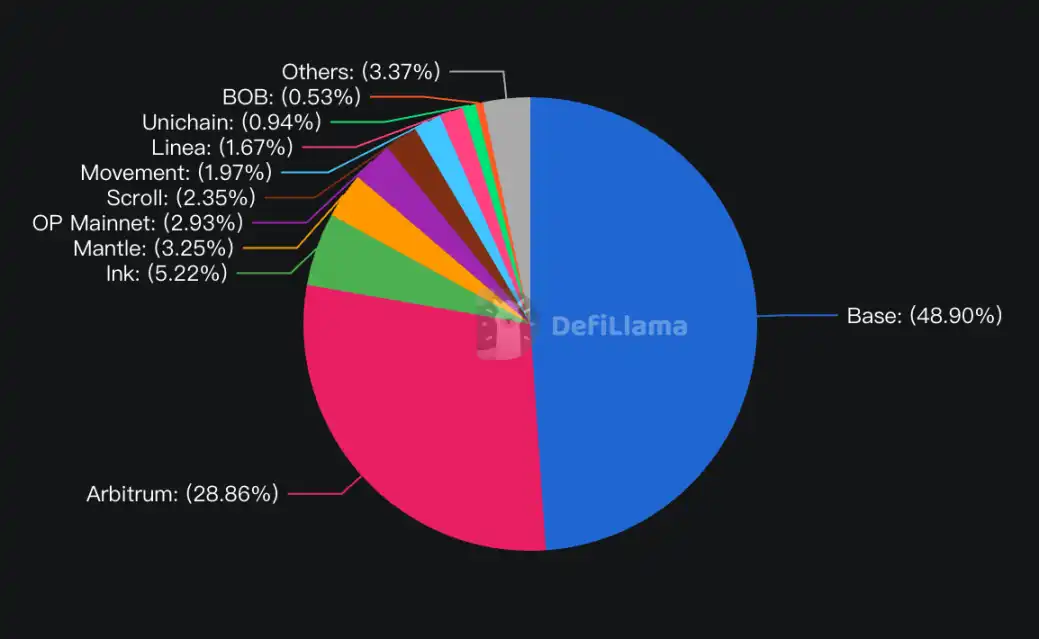
Looking at the TVL data from DefiLlama, Base and Arbitrum together account for nearly 80% of all L2 TVL. The remaining L2s, not in the "Others" category, had a combined valuation conservatively estimated at nearly $10 billion during their private funding rounds, but their combined TVL is less than $2 billion.
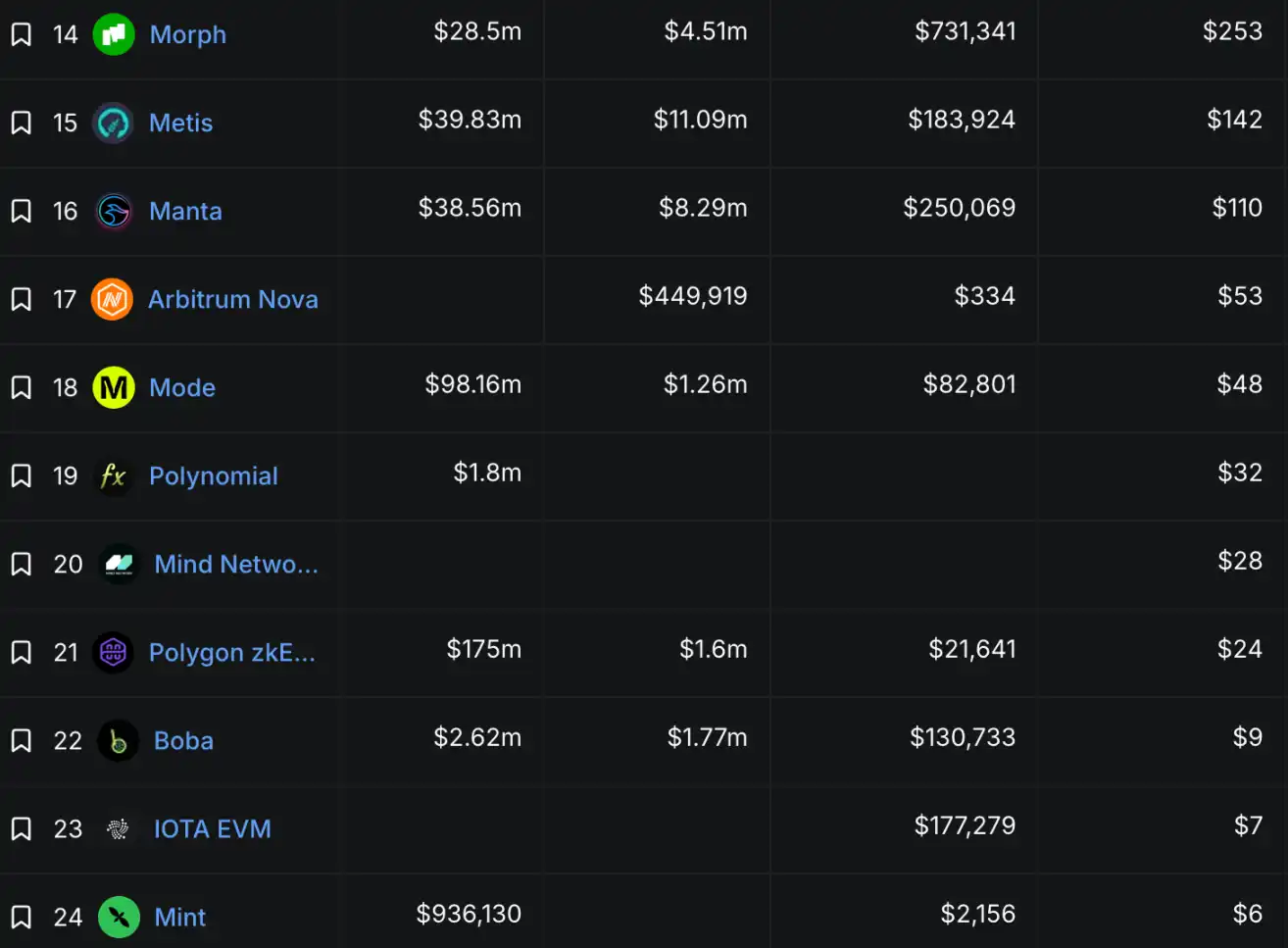
In terms of protocol revenue, only the top 7 protocols had revenues above $1,000 in the past 24 hours. Daily protocol revenues in the three-digit or even two-digit range might not even compare to the interest some large holders earn daily from placing assets in exchange wealth management.

This data very直观地展示了 (intuitively shows) the current predicament of L2s: against the backdrop of a lack of application narratives, hoping for a killer app that doesn't operate as an appchain and willingly runs on a general-purpose L2 has become a pipe dream. On the question of finding an application scenario that can provide stable transaction data, L2s have found the same answer: cryptocurrency cards.

Pavel Paramonov, founder of cryptocurrency research institution Hazeflow, once criticized that cryptocurrency cards are essentially not "cryptocurrency payments" but still fiat payments, not truly promoting cryptocurrency adoption. But he also mentioned that many projects or public chains launching crypto cards are doing so out of necessity, with the goal merely being to keep users within their ecosystem.

Many cryptocurrency cards launched by exchanges currently are a form of "custodial" card. User assets are held in exchange or institutional custody accounts, and upon consumption, settlement is handled by the exchange, off-ramp companies, and the card issuer. The settlement chains for such cards are usually Tron, Solana, or even the slightly higher-cost Ethereum. On one hand, the存量 (存量 - inventory/supply) of stablecoin assets on these chains is sufficient; on the other hand, some cards reduce costs through batch settlement rather than per-transaction settlement. For institutions, liquidity and stability might be more important than the low cost of L2s.

The crypto cards that L2s are eyeing are various forms of "non-custodial cards." Before using such a card for payment, assets reside in the user's own wallet, and each payment is settled individually, which can effectively increase on-chain activity. Typical examples include Scroll (Etherfi card settlement layer), Gnosis, and Linea (MetaMask card settlement layer).

In September 2024, Etherfi announced that its payment card would use Scroll as the settlement layer. Scroll can help Etherfi achieve "gasless transactions" and provide a higher cashback percentage subsidized by the SCR token. Besides the traditional method of directly spending assets on Scroll, the Etherfi card has a special mechanism: users can borrow fiat currency using yield-bearing assets on Scroll as collateral for payments. Supported assets include eETH, weETH, wETH, eBTC, etc.

Gnosis, as a sidechain that has long lacked presence, has successfully made a comeback with its payment card. Its card, Gnosis Pay, primarily operates in Europe. Users can connect non-custodial wallets like MetaMask and Gnosis Safe in the Gnosis Pay App. During spending, Gnosis Pay converts the user's wallet's supported assets (certain Euro, Pound, and Dollar stablecoins) into EURe, a Euro stablecoin issued by Monerium, which is then converted 1:1 into Euros for payment.

The crypto card issued by MetaMask uses ConsenSys's L2 Linea as the primary settlement network, additionally supporting Solana and Base. Users need to deposit supported payment assets (various USD or Euro stablecoins) into their MetaMask wallet before spending. During payment, user assets are transferred to the off-ramp service provider, converted into fiat currency, and then paid to the merchant.
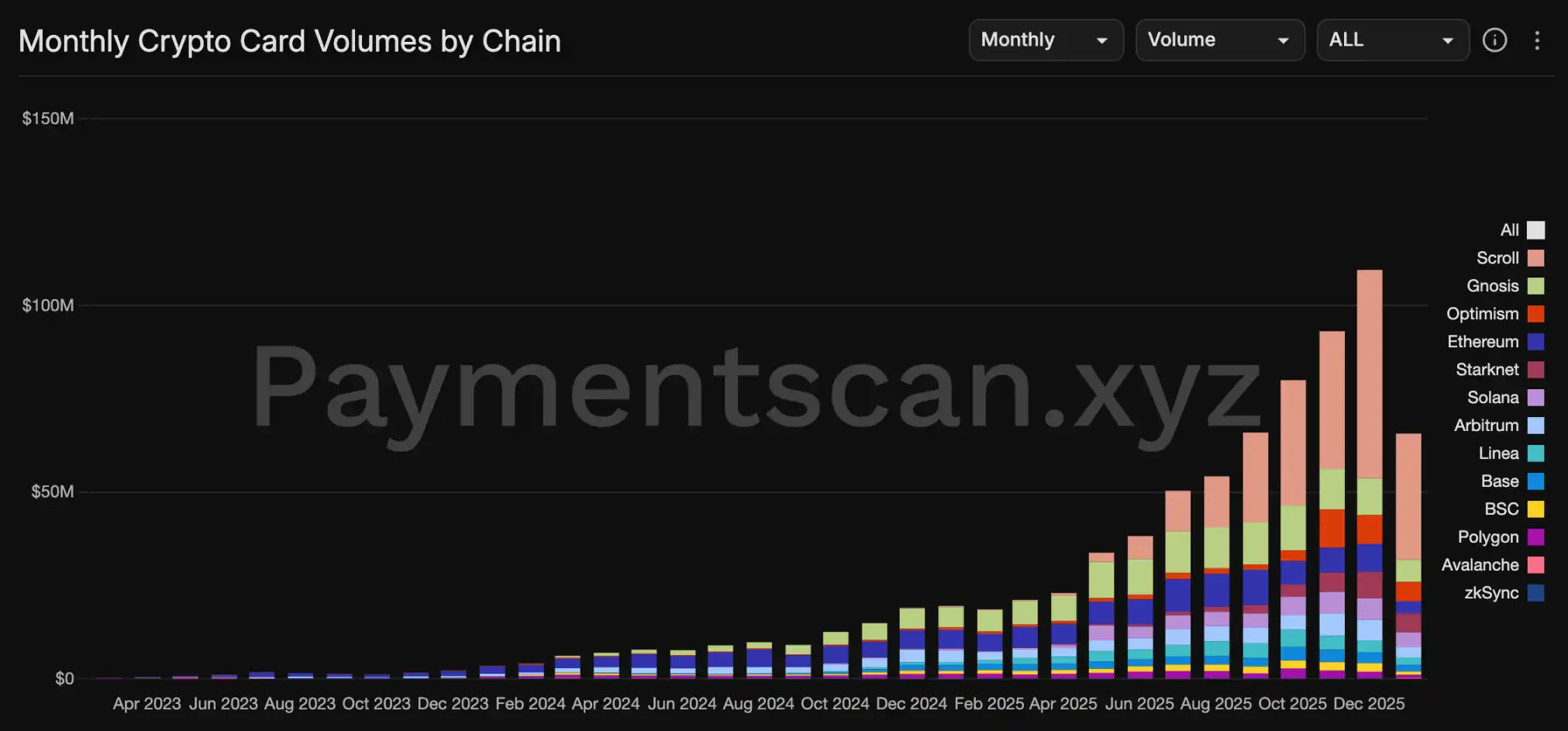
Due to the per-transaction settlement nature of non-custodial cards, each user消费 (消费 - consumption/spending) corresponds to a contract call to verify the remaining asset balance and the on-chain asset transfer. Thus, L2s can rely on payments, an absolutely high-frequency and sustainable scenario, to ensure a certain level of on-chain activity. According to Paymentscan data, Scroll, through its partnership with Etherfi and SCR subsidies, has captured a significant market share in card payments. However, this data is not entirely accurate, as many card payments might not involve on-chain transfers but are settled internally by institutions. Regardless, it's an indisputable fact that L2s have found a practical application scenario through payments.

It's not just emerging L2s that are anxious; Polygon, which cannot be strictly classified as an L2, also recently shifted its strategic focus to payments. By the end of 2025, the transfer volume of non-USD stablecoins on Polygon exceeded $11.1 billion, with the new stablecoin XSGD reaching $2.24 billion in trading volume and the Australian Dollar stablecoin AUDF reaching $2.46 billion. Additionally, Polygon has become one of the main chains used for Stripe's stablecoin payments; its announcement on January 13th to acquire cryptocurrency payment infrastructure Coinme and blockchain development platform Sequence for a consideration of $250 million更是将 (更是将 - further writes) "all in on payments" plainly on its face.

After experiencing the bombardment of various concepts, L2s have come to recognize reality. While they still await novel applications, the urgent task at hand is to utilize their low-cost, high-efficiency characteristics and survive first through payments.


Criptos en tendencia

Preguntas relacionadas

QWhat is the main issue facing Layer 2 (L2) networks according to the article?

AThe main issue facing L2 networks is a severe lack of user activity and transaction volume, leading to a 'traffic crisis' where many L2s have extremely low TPS and TVL, making it difficult to sustain themselves without finding practical, high-frequency use cases.

QWhat specific example does the article use to illustrate the inactivity of some L2 networks?

AThe article cites Zero Network, an L2 incubated by Web3 wallet company Zerion, which stopped producing blocks for over three weeks without any noticeable impact, and whose official Twitter account had not posted original content since May of the same year.

QWhat solution have many L2 networks turned to generate consistent on-chain activity?

AMany L2 networks have turned to cryptocurrency payment cards, specifically non-custodial cards, as a solution. Each payment with these cards requires an on-chain settlement, creating a high-frequency and sustainable source of transactions.

QWhich L2 networks are mentioned as having partnered with specific crypto cards to increase transactions?

AThe article mentions Scroll (partnering with Etherfi card), Gnosis (with its Gnosis Pay card), and Linea (used as a settlement layer for the MetaMask card) as examples of L2s leveraging payment cards to boost on-chain activity.

QWhy does the article state that Polygon is also shifting its strategic focus?

APolygon is shifting its strategic focus to payment solutions because it has seen significant transaction volume from non-USD stablecoins and has made major acquisitions, such as buying cryptocurrency payment infrastructure company Coinme and blockchain development platform Sequence, effectively going 'all in on payments'.

Lecturas Relacionadas

Has Bitcoin Bottomed, or Is a 'Shakeout' Approaching? What's the Situation with XRP?

Cryptocurrency analytics platform Santiment shared key insights on Bitcoin and altcoin markets, highlighting significant signals from on-chain data. Analysis shows Bitcoin's 365-day MVRV ratio has fallen to -26%, indicating substantial losses for long-term holders, a level historically associated with market bottom formations and long-term buying opportunities. While short-term MVRV is near breakeven, suggesting no clear directional signal, the annual perspective points to a bottom before bullish cycles. On-chain data reveals divergent behavior: large wallets (10-10,000 BTC) have been accumulating, adding ~18,500 BTC in 10 days, while smaller retail investors continue buying dips. Analysts caution that high retail demand can sometimes create a risk of a final market shakeout or correction. The altcoin market shows a mixed picture. Ethereum's 365-day MVRV is around -33%, but recent monthly gains combined with overly optimistic social sentiment pose a short-term correction risk. XRP is in oversold territory with 30-day and 365-day MVRVs at -57.5% and -45.5% respectively, signaling potential for a strong mid-to-long term rebound. Social activity and optimism are rising for Solana, while investor sentiment remains calmer towards Cardano. Future direction for Bitcoin and altcoins depends not only on on-chain metrics but also on macroeconomic and regulatory developments. The Federal Reserve's interest rate decision and upcoming policy rulings are increasing market volatility expectations, while uncertainty around the U.S. Congressional clarity process continues to pressure pricing. *This is not investment advice.

cryptonews.ruHace 1 hora(s)

Has Bitcoin Bottomed, or Is a 'Shakeout' Approaching? What's the Situation with XRP?

cryptonews.ruHace 1 hora(s)

Bank of Korea Reveals Results of Tokenized Deposit Testing

The Bank of Korea has announced the results of its pilot test for tokenized deposits. Involving 28 central banks and international financial organizations, the project saw participation from major South Korean banks including KB Kookmin Bank, NH NongHyup Bank, Shinhan Bank, Woori Bank, and Hana Bank. Transactions, from payment orders to final settlement, were completed in real time, averaging just 80 seconds. The test involved 30 transactions across 17 different scenarios—such as corporate and interbank transfers—and was conducted in six currencies, including the Korean won, US dollar, and euro, with a total transaction value reaching approximately $995,000. The central bank reported that the platform operated stably throughout, despite being only partially connected to the existing banking infrastructure. Settlements using tokenized deposits were executed seamlessly, quickly, and transparently. An internal transfer of 20 million won (about $13,890) between NH NongHyup Bank and Shinhan Bank was also successfully processed via the Project Agora platform, which involved connecting to the Bank of Korea's CBDC test platform, Project Hangang. Additionally, KB Kookmin Bank and Japan's MUFG Bank tested cross-border payments using these deposit tokens—digital certificates issued by commercial banks within the pilot, not directly by the central bank. The Bank of Korea plans to continue testing payments with tokenized deposits. This follows last year's pledge by South Korean authorities to tighten regulations for won-based stablecoins, which will require approval from both the central bank and the Financial Services Commission.

cryptonews.ruHace 3 hora(s)

Bank of Korea Reveals Results of Tokenized Deposit Testing

cryptonews.ruHace 3 hora(s)

Trading

Spot

Artículos destacados

Cómo comprar ERA

¡Bienvenido a HTX.com! Hemos hecho que comprar Caldera (ERA) sea simple y conveniente. Sigue nuestra guía paso a paso para iniciar tu viaje de criptos.Paso 1: crea tu cuenta HTXUtiliza tu correo electrónico o número de teléfono para registrarte y obtener una cuenta gratuita en HTX. Experimenta un proceso de registro sin complicaciones y desbloquea todas las funciones.Obtener mi cuentaPaso 2: ve a Comprar cripto y elige tu método de pagoTarjeta de crédito/débito: usa tu Visa o Mastercard para comprar Caldera (ERA) al instante.Saldo: utiliza fondos del saldo de tu cuenta HTX para tradear sin problemas.Terceros: hemos agregado métodos de pago populares como Google Pay y Apple Pay para mejorar la comodidad.P2P: tradear directamente con otros usuarios en HTX.Over-the-Counter (OTC): ofrecemos servicios personalizados y tipos de cambio competitivos para los traders.Paso 3: guarda tu Caldera (ERA)Después de comprar tu Caldera (ERA), guárdalo en tu cuenta HTX. Alternativamente, puedes enviarlo a otro lugar mediante transferencia blockchain o utilizarlo para tradear otras criptomonedas.Paso 4: tradear Caldera (ERA)Tradear fácilmente con Caldera (ERA) en HTX's mercado spot. Simplemente accede a tu cuenta, selecciona tu par de trading, ejecuta tus trades y monitorea en tiempo real. Ofrecemos una experiencia fácil de usar tanto para principiantes como para traders experimentados.

459 Vistas totalesPublicado en 2025.07.17Actualizado en 2026.06.02

Cómo comprar ERA

Discusiones

Bienvenido a la comunidad de HTX. Aquí puedes mantenerte informado sobre los últimos desarrollos de la plataforma y acceder a análisis profesionales del mercado. A continuación se presentan las opiniones de los usuarios sobre el precio de ERA (ERA).

活动图片












