KuCoin taps Tomorrowland festivals as MiCA-era on-ramp for European fans

cointelegraphPublicado a 2025-12-17Actualizado a 2025-12-17

Resumen

KuCoin has signed an exclusive multi-year partnership with Tomorrowland music festivals from 2026 to 2028, becoming the event's official crypto and payments partner. This follows KuCoin’s recent acquisition of a MiCA-regulated license in the EU, allowing it to operate as a fully compliant crypto service provider. The collaboration aims to integrate cryptocurrency seamlessly into festival operations—including ticketing, merchandise, and concessions—without disrupting the user experience. Emphasizing security and regulatory compliance, KuCoin seeks to position crypto as a mainstream financial tool, learning from past failed Web3 partnerships like FTX’s with Tomorrowland. The goal is a smooth, invisible integration of digital assets into live events.

KuCoin announced an exclusive multiyear deal with Tomorrowland Winter and Tomorrowland Belgium from 2026 to 2028, making the exchange the music festival’s exclusive crypto and payments partner.

The move comes just weeks after KuCoin secured a Markets in Crypto-Assets Regulation (MiCA) service provider license in the European Union.

KuCoin’s MiCA play goes mass‐market

KuCoin EU Exchange recently obtained a crypto asset service provider license in Austria under the EU’s MiCA regime, giving it a fully regulated foothold in the bloc as Brussels’ new rulebook for exchanges, custody and stablecoins comes into force.

The Tomorrowland deal signals how KuCoin plans to use that status, not just to run a compliant trading venue, but to plug crypto rails directly into mainstream culture.
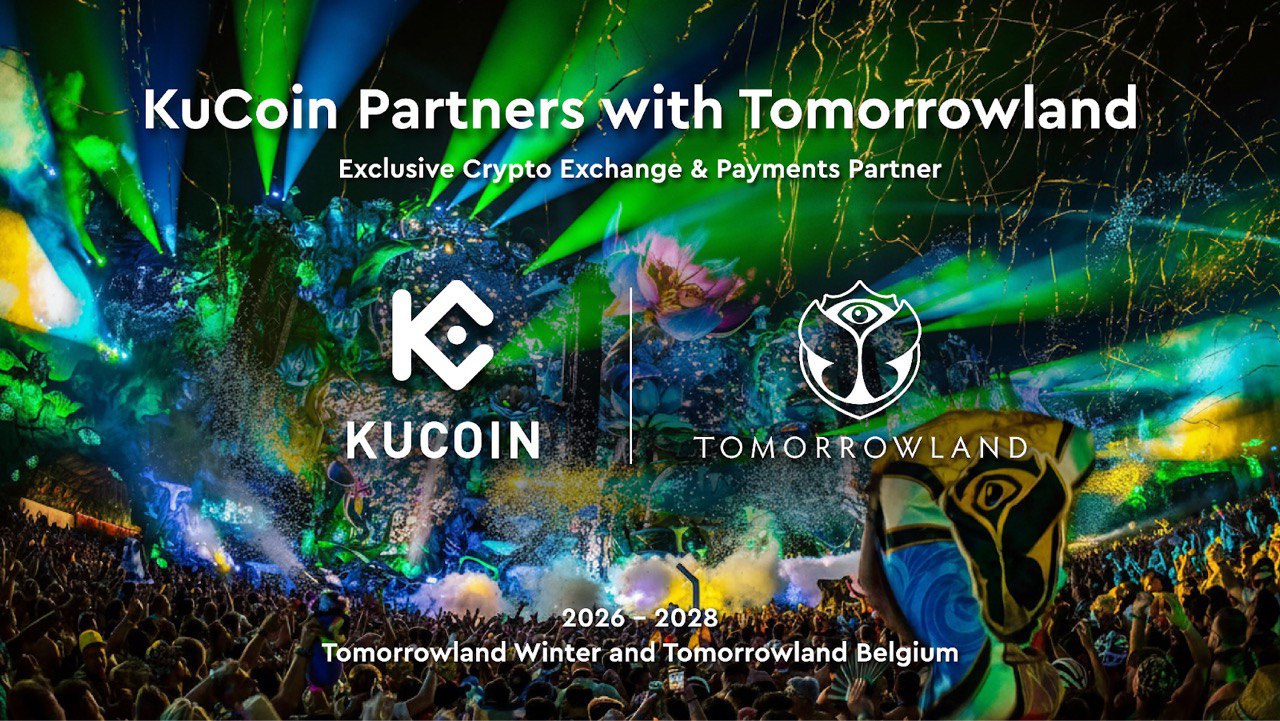
KuCoin joins forces with Tomorrowland. Source: KuCoin

KuCoin said the Tomorrowland deal will cover Tomorrowland Winter 2026 in Alpe d’Huez, France, and Tomorrowland Belgium 2026 in Boom, Belgium, with the same arrangement continuing through 2028.

Related: Burning Man-inspired festival in Bali goes full Web3: Here’s how

From sponsorship to payment rails

KuCoin insists this is not just a logo play. A spokesperson at KuCoin told Cointelegraph that as an exclusive payments partner, the exchange is working with Tomorrowland to weave crypto into the festival’s existing payments stack so that “financial tools” sit behind the scenes of ticketing, merch and food and drink.

The stated goal is to keep the rails “intuitive and invisible,” rather than forcing festivalgoers through clunky wallets or unfamiliar flows, with KuCoin positioning itself as facilitating the secure and efficient movement of value while fans focus on the music.

The company declined to spell out exactly which assets and rails will be supported on‐site, or whether every purchase will run natively onchain, but said that KuCoin’s “Trust First. Trade Next.” mantra runs through its messaging.

The spokesperson stressed advanced security, multi‐layer protection and adherence to EU standards as the foundation for taking crypto beyond the trading screen and into live events.

Related: What is Markets in Crypto-Assets (MiCA)?

Learning from FTX’s Tomorrowland flop

Tomorrowland’s organizers have been here before. In 2022, the festival announced a Web3 partnership with FTX Europe that promised NFTs and “the future of music festivals” before collapsing along with the exchange itself months later.

That experience makes the choice of a MiCA‐licensed partner, and the emphasis on user protection, more than cosmetic; it is a second attempt at bridging culture and crypto (this time with regulatory scaffolding and clearer guardrails).

Rather than setting public hard targets for user numbers or payment volumes by 2028, KuCoin is pitching success as “seamless integration” of crypto into the festival experience:

“We aim to demonstrate that digital assets can be a core component of global digital finance, moving from a niche technology to a mainstream utility. “

Related: Spain’s regulator sets out MiCA transition rules for crypto platforms

Criptos en tendencia

Lecturas Relacionadas

Must-Watch Events Next Week|CLARITY Act Could Face Senate Vote; SpaceX, Circle to Report Earnings (8.3-8.9)

**Summary: Key Events and Developments to Watch (August 3-9)** The upcoming week is marked by significant financial disclosures, key legislative deadlines, and notable product updates. **Major Financial Events:** Several companies are scheduled to release their Q2 2026 earnings. American Bitcoin (ABTC) will report on August 3, followed by SpaceX and Hut 8 Mining Corp. on August 4, and Circle on August 5. Notably, a significant portion of SpaceX shares (up to 12% of total shares) will be unlocked on August 6 following their earnings release. **Key Legislative Deadline:** The U.S. Senate faces an August 7 deadline to secure 60 votes for the CLARITY Act, a bipartisan bill aiming to establish a federal regulatory framework for cryptocurrencies. The Senate may hold a full vote on the bill during the week. **Economic Data:** The U.S. July Non-Farm Payrolls report will be released on August 7, providing crucial labor market data. **Technology & Product Updates:** * **Shutdowns:** DeFi portfolio tracker Zapper and wallet app Ctrl Wallet will cease operations on August 3. * **Upgrades:** LayerZero will deprecate its v1 relayers on August 3. XRP Ledger's new version 3.3.0, featuring five new functions, is expected next week. * **AI:** Elon Musk announced that the advanced Grok 4.6 AI model is set for release around August 7. * **Bitcoin:** The BIP-110 forced signaling for a potential Bitcoin network change is scheduled to begin around August 8. **Other Notable Events:** Chinese robotics firm Unitree Tech has set its preliminary price inquiry for its IPO for August 5. South Korean exchange Upbit will delist AQT and AERGO tokens on August 3.

marsbitHace 1 hora(s)

Must-Watch Events Next Week|CLARITY Act Could Face Senate Vote; SpaceX, Circle to Report Earnings (8.3-8.9)

marsbitHace 1 hora(s)

Stocks Are Plummeting More Sharply Than Cryptocurrencies. Where Has the Money Gone?

Stock Markets Plunge Deeper Than Cryptocurrencies: Where Did the Money Go? In late July, Seoul's Kospi index triggered circuit breakers for two consecutive days, plummeting over 40% from its June high. The collapse was led by heavyweight stocks like SK Hynix, whose record profits still disappointed investors, and devastating leveraged ETFs, with one major product losing over 83% of its value. This signaled a global, forced deleveraging targeting the most crowded trades. Interestingly, while stocks exhibited extreme volatility akin to crypto markets, Bitcoin rose nearly 15% in July after a prior steep drop. Analysis shows the money fleeing equities did not flow into Bitcoin. Instead, Bitcoin had already absorbed its sell-off in May-June, when U.S. spot Bitcoin ETFs saw historic outflows. The true safe-haven beneficiary was gold, whose price rose over 20% year-on-year, highlighting a decoupling between Bitcoin and gold as "digital gold." The sell-off was a targeted unwinding of leveraged positions in tech and semiconductors, accelerated by broker-dealer risk management and shifts in the AI narrative, including new competition from Chinese memory chipmakers. The retreat path was clear: from high-valuation tech stocks to cash and U.S. Treasuries, then to gold. For Bitcoin to attract sustained institutional inflows, conditions like eased global liquidity pressure, a "soft-landing" Fed rate cut, and U.S. regulatory clarity via legislation like the stalled CLARITY Act are needed. Currently, Bitcoin is not a safe haven but an already-cleared asset. Its low correlation with tech stocks, however, makes it a potential diversification play for institutional portfolios once the storm passes. The money isn't here yet, but the positioning is underway.

marsbitHace 1 hora(s)

Stocks Are Plummeting More Sharply Than Cryptocurrencies. Where Has the Money Gone?

marsbitHace 1 hora(s)

In Conversation with Ray Dalio: We Are Currently in an AI Bubble, with 1% of My Portfolio in Bitcoin

Ray Dalio, founder of Bridgewater Associates, warns in an interview that the current AI boom shows classic bubble characteristics, which could lead to significant economic downturns as seen in past cycles like 1929 or 2000. He explains that speculative enthusiasm, fueled by debt and overvaluation, often precedes a crash when rising rates or taxation force asset sales, causing widespread losses and recession. Dalio also outlines his "Big Cycle" theory, describing an approximate 80-year pattern where widening wealth gaps, massive government deficits, and shifting geopolitical power (like China's rise) create internal conflict and global instability. He emphasizes that we are in a late-cycle, transitional phase where traditional powers like the US and UK face decline. For personal wealth protection, Dalio advises diversification beyond cash into assets like stocks, bonds, real estate, and particularly gold, which he prefers over Bitcoin. While he holds about 1% of his portfolio in Bitcoin as a non-printable hard asset, he views gold as more secure from technological or governmental threats. Regarding AI's impact, Dalio believes it will disproportionately benefit capital owners, worsening inequality by replacing both physical and cognitive labor. He suggests that human intuition and emotional intelligence, combined with AI, will be key for future workers. On taxation, Dalio argues that wealth taxes are impractical and risk triggering asset sell-offs, reducing productive investment. He points to the UK as a cautionary example of debt, low productivity, and political strife. Geopolitically, Dalio foresees a more regionalized world, with the US showing weakness in prolonged conflicts like with Iran, akin to past imperial declines. The ideal outcome, he suggests, is coexisting powerful blocs (e.g., Americas, China-Asia Pacific) without major war.

marsbitHace 5 hora(s)

In Conversation with Ray Dalio: We Are Currently in an AI Bubble, with 1% of My Portfolio in Bitcoin

marsbitHace 5 hora(s)

Trading

Spot

Artículos destacados

Cómo comprar ERA

¡Bienvenido a HTX.com! Hemos hecho que comprar Caldera (ERA) sea simple y conveniente. Sigue nuestra guía paso a paso para iniciar tu viaje de criptos.Paso 1: crea tu cuenta HTXUtiliza tu correo electrónico o número de teléfono para registrarte y obtener una cuenta gratuita en HTX. Experimenta un proceso de registro sin complicaciones y desbloquea todas las funciones.Obtener mi cuentaPaso 2: ve a Comprar cripto y elige tu método de pagoTarjeta de crédito/débito: usa tu Visa o Mastercard para comprar Caldera (ERA) al instante.Saldo: utiliza fondos del saldo de tu cuenta HTX para tradear sin problemas.Terceros: hemos agregado métodos de pago populares como Google Pay y Apple Pay para mejorar la comodidad.P2P: tradear directamente con otros usuarios en HTX.Over-the-Counter (OTC): ofrecemos servicios personalizados y tipos de cambio competitivos para los traders.Paso 3: guarda tu Caldera (ERA)Después de comprar tu Caldera (ERA), guárdalo en tu cuenta HTX. Alternativamente, puedes enviarlo a otro lugar mediante transferencia blockchain o utilizarlo para tradear otras criptomonedas.Paso 4: tradear Caldera (ERA)Tradear fácilmente con Caldera (ERA) en HTX's mercado spot. Simplemente accede a tu cuenta, selecciona tu par de trading, ejecuta tus trades y monitorea en tiempo real. Ofrecemos una experiencia fácil de usar tanto para principiantes como para traders experimentados.

467 Vistas totalesPublicado en 2025.07.17Actualizado en 2026.06.02

Cómo comprar ERA

Discusiones

Bienvenido a la comunidad de HTX. Aquí puedes mantenerte informado sobre los últimos desarrollos de la plataforma y acceder a análisis profesionales del mercado. A continuación se presentan las opiniones de los usuarios sobre el precio de ERA (ERA).

活动图片













