Kraken Partners With Nasdaq In New Tokenized Stocks Move

bitcoinistPublicado a 2026-03-10Actualizado a 2026-03-10

Resumen

Kraken's parent company Payward has partnered with Nasdaq to develop an "equities transformation gateway," a new infrastructure layer connecting regulated tokenized equity markets with permissionless blockchain networks. The collaboration centers on Kraken's xStocks product, which has surpassed $25 billion in transaction volume with over $4 billion settled on-chain. Scheduled to become operational in H1 2027, Nasdaq's equity token design will use xStocks as its permissionless infrastructure layer, maintaining issuer control and regulatory compliance while enabling interoperability with DeFi environments. The gateway will allow seamless movement of tokenized equities between traditional markets and blockchain networks, with Kraken handling KYC/AML requirements. Payward's co-CEO Arjun Sethi emphasized that tokenization transforms equities into programmable instruments capable of serving as cross-platform collateral for trading, margin, derivatives, and lending—significantly enhancing capital efficiency beyond traditional brokerage limitations.

Kraken parent Payward has partnered with Nasdaq to build what the companies describe as an “equities transformation gateway,” a new infrastructure layer designed to connect regulated tokenized equity markets with permissionless blockchain networks. For crypto markets, the significance is clear: one of the largest traditional market operators is now working directly with a crypto-native tokenization framework to move equities between institutional rails and DeFi environments.

The partnership centers on xStocks, Kraken’s tokenized equities product, which Payward said has surpassed $25 billion in total transaction volume less than a year after launch. More than $4 billion of that volume has been settled on-chain, and the framework now counts over 85,000 unique holders across supported networks, giving Kraken a sizable footprint as tokenized stocks move from concept toward market structure.

Nasdaq And Kraken Join Forces

Under the proposed setup, xStocks will power the permissionless infrastructure layer for Nasdaq’s upcoming issuer-sponsored equity token design. That design, which Nasdaq expects to become operational starting in the first half of 2027, is meant to preserve issuer control, existing regulatory frameworks, and the rights attached to the underlying shares while still allowing those assets to interact with blockchain-based financial systems.

In practical terms, the gateway is supposed to let eligible users swap tokenized equities between a regulated, permissioned market environment and open on-chain ecosystems. Payward said this would allow assets to move “fluidly” between institutional trading infrastructure and decentralized financial networks, while Payward Services handles KYC and AML onboarding for participants accessing the bridge through Kraken.

Arjun Sethi, co-CEO of Payward and Kraken, framed the effort as a structural change to how equities can be used once they are placed on programmable rails. “Tokenization upgrades market infrastructure at the asset layer by allowing equities to exist as programmable financial instruments that can operate across both regulated capital markets and open blockchain networks,” he said. “Today most equities sit inside brokerage systems where their utility is largely limited to directional exposure and, in some cases, broker-specific margin arrangements.”

He argued that the current model leaves capital trapped inside siloed venues. “That structure fragments liquidity across venues and leaves a meaningful amount of capital static relative to its potential utility,” Sethi said. “With xStocks, our goal is to make equities natively interoperable across trading venues, financial applications and blockchain networks while preserving issuer rights, regulatory protections and price integrity.”

Sethi went further, tying tokenized equities to a broader capital-efficiency thesis that will be familiar to crypto derivatives traders. “Bringing equities onto programmable infrastructure expands how they can function within a portfolio,” he said. “Instead of simply representing exposure to a company, tokenized equities can operate as collateral within unified trading systems that support spot markets, cross-margin trading, derivatives, perpetual futures, and financing environments.”

That point sits at the heart of the announcement. Payward is not pitching tokenized stocks merely as wrappers for traditional shares, but as collateral that can move across trading, lending and hedging systems under a unified margin framework. In jurisdictions where xStocks are already available, Payward will also serve for an initial period as the primary settlement layer for transactions tied to Nasdaq’s equity token design.

At press time, the total crypto market cap stood at $2.32 trillion.
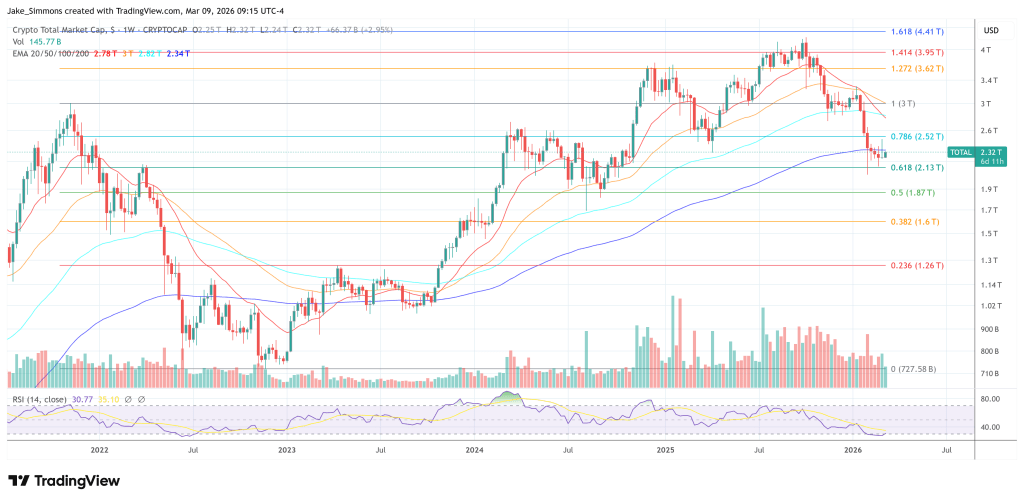
Total crypto market cap, 1-week chart | Source: TOTAL on TradingView.com

Preguntas relacionadas

QWhat is the main purpose of the partnership between Kraken's parent company Payward and Nasdaq?

AThe partnership aims to build an 'equities transformation gateway,' a new infrastructure layer designed to connect regulated tokenized equity markets with permissionless blockchain networks, allowing equities to move between institutional rails and DeFi environments.

QWhat is xStocks and what milestone has it achieved according to the article?

AxStocks is Kraken's tokenized equities product, which has surpassed $25 billion in total transaction volume less than a year after launch, with over $4 billion settled on-chain and more than 85,000 unique holders.

QWhen does Nasdaq expect its issuer-sponsored equity token design to become operational?

ANasdaq expects its issuer-sponsored equity token design to become operational starting in the first half of 2027.

QHow does Arjun Sethi describe the current limitation of traditional equities in brokerage systems?

AArjun Sethi states that in traditional brokerage systems, equities' utility is largely limited to directional exposure and some broker-specific margin arrangements, which fragments liquidity and leaves capital trapped in siloed venues.

QWhat broader function does Payward envision for tokenized equities beyond being wrappers for traditional shares?

APayward envisions tokenized equities functioning as collateral within unified trading systems that support spot markets, cross-margin trading, derivatives, perpetual futures, and financing environments, enhancing capital efficiency and interoperability.

Lecturas Relacionadas

Polymarket's "2028 Presidential Election" Volume King Is... LeBron James???

An article from Odaily Planet Daily, authored by Azuma, discusses a peculiar phenomenon observed on the prediction market platform Polymarket regarding the "2028 US Presidential Election" event. Despite having a real-time probability of less than 1%, unlikely candidates such as NBA star LeBron James (with $48.41 million in trading volume), celebrity Kim Kardashian ($33.84 million), and even ineligible figures like Elon Musk ($23.14 million) and New York City Mayor Zohran Mamdani ($18.39 million) account for approximately 70% of the total trading volume. In contrast, high-probability candidates like Vice President JD Vance ($10.58 million), California Governor Gavin Newsom ($15.71 million), and Secretary of State Marco Rubio ($9.32 million) have significantly lower trading activity. The article explains that this counterintuitive trend is not driven by irrational speculation but by rational strategies. Polymarket offers a 4% annualized holding reward for certain markets, including the 2028 election, to maintain long-term pricing accuracy. This yield exceeds the current 5-year US Treasury rate (3.98%), attracting large investors ("whales") to hold "NO" shares on low-probability candidates for risk-free returns. Additionally, some users utilize a platform feature that allows converting a set of "NO" shares into corresponding "YES" shares for better liquidity or pricing efficiency, rather than directly buying "YES" shares for their preferred candidates. Thus, the seemingly absurd trading activity is strategically motivated.

marsbitHace 17 min(s)

Polymarket's "2028 Presidential Election" Volume King Is... LeBron James???

marsbitHace 17 min(s)

Dialogue with ViaBTC CEO Yang Haipo: Is the Essence of Blockchain a Libertarian Experiment?

"ViaBTC CEO Yang Haipo: Blockchain as a Hardcore Libertarian Experiment" In a deep-dive interview, ViaBTC CEO Yang Haipo reframes the essence of blockchain, arguing it is not merely a new technology or infrastructure but a hardcore libertarian experiment. This experiment, born from the 2008 financial crisis and decades of cypherpunk ideology, tests a fundamental question: to what extent can freedom and self-organization exist without centralized trust? The discussion highlights the experiment's verified outcomes. On one hand, it has proven its core value of censorship resistance, providing critical financial lifelines for entities like WikiLeaks and individuals in hyperinflationary or sanctioned countries via tools like stablecoins. However, Yang points out a key paradox: the most successful product, USDT, is itself a centralized compromise, showing users prioritize a less-controlled pipeline over pure decentralization. On the other hand, the experiment has exposed the severe costs of this freedom—a "dark forest" without safeguards. Events like the collapses of LUNA, Celsius, and FTX, resulting in massive wealth destruction and prison sentences for founders, underscore the system's fragility and the inherent risks of an unregulated environment. Yang observes that despite decentralized protocols, human nature inevitably recreates centralized power structures, speculative frenzies, and narrative-driven cycles (from ICOs to Meme coins), where emotion and belonging often trump technological substance. Looking forward, he believes blockchain's future is significant but niche. Its real value lies in serving specific, real-world needs for financial sovereignty and bypassing traditional controls, not as a universal infrastructure replacing all centralized systems. For the average participant, Yang's crucial advice is to cultivate independent judgment. True freedom is not holding a crypto wallet, but possessing a mind resilient to groupthink and narrative hype in a high-risk, often irrational market.

marsbitHace 31 min(s)

Dialogue with ViaBTC CEO Yang Haipo: Is the Essence of Blockchain a Libertarian Experiment?

marsbitHace 31 min(s)

Trading

Spot
Futuros
活动图片