Kraken-backed xStocks launches on TON Wallet in ‘nearly all markets’

cointelegraphPublicado a 2025-12-18Actualizado a 2025-12-18

Resumen

Kraken-backed tokenized securities platform xStocks has launched on TON Wallet, a self-custodial wallet integrated with Telegram. The rollout makes tokenized U.S. equities available on The Open Network (TON) for the first time, offering assets like Circle, Coinbase, Robinhood, and TON Strategy. While the service is accessible in nearly all markets where TON Wallet operates, it excludes the U.S., EU, and Australia at launch due to regulatory constraints. xStocks aims to target users in developing markets initially, prioritizing global accessibility through digital platforms. In contrast, other firms like Securitize remain focused on the U.S., citing a clear regulatory pathway for tokenized securities there.

Kraken-backed tokenized securities platform xStocks is launching on TON Wallet, a self-custodial wallet on the Telegram messenger.

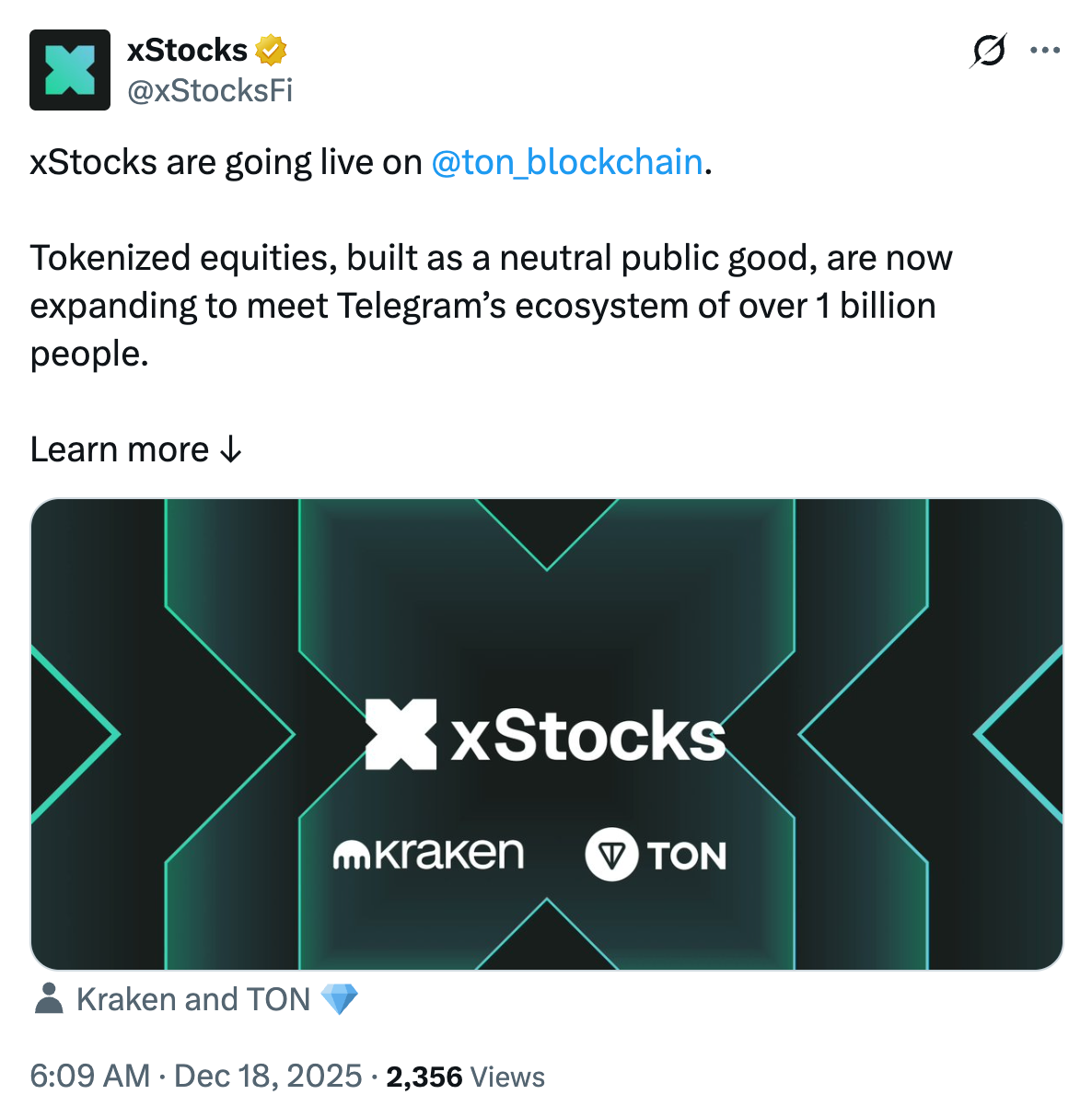
Following an initial rollout on Wallet in Telegram, xStocks is now live on TON Wallet, marking the offering’s official launch on Telegram-linked blockchain, The Open Network (TON), Kraken announced Thursday.

“Launching xStocks on TON brings tokenized equities onto truly open infrastructure,” Kraken co-CEO Arjun Sethi said in the announcement, adding that the launch marks the first time for Telegram users to access tokenized US equities onchain.

Wallet in Telegram’s previous integration of xStocks featured 35 tokenized stocks, including Circle (CRCLX), Coinbase (COINX), Robinhood (HOODX) and TON Strategy (TONx).

The offering is not available in the US, EU and Australia

“Stocks and ETFs will be accessible in nearly all markets where TON Wallet is currently available,” Egor Danilov, chief product officer at The Open Platform (TOP) and Wallet in Telegram, told Cointelegraph.

However, the offering will not be available at launch in key markets, including the US, the European Union, and Australia, he said, noting that the rollout aligns with regulatory requirements and xStocks’ existing framework.
Source: xStocks

“Access will expand gradually as regulatory guidance allows,” Danilov said, emphasizing that xStocks are not available in the US nor to US persons. “Distribution will continue to respect regional rules and licensing requirements,” he added.

US market still in focus for some tokenization firms

XStocks’ limited geographic rollout on TON reflects the company’s view that tokenized US equities should initially be targeted at customers in developing markets rather than in advanced economies.

“Bringing xStocks onto TON is part of that shift — real financial products becoming available to people globally through familiar digital tools, rather than only through financial institutions in developed markets,” Danilov told Cointelegraph.

Related: Coinbase adds stock trading, prediction markets in ‘everything app’ push

By contrast, some major tokenization providers have taken a more optimistic view of the US market. Securitize, one of the largest firms in the sector, has said it sees a viable regulatory pathway for tokenized securities in the United States, and that its tokenized stocks are already available to US investors.

On Dec. 9, Securitize CEO Carlos Domingo told Cointelegraph that the company’s experience shows there is a “clear regulatory path for issuers to natively tokenize assets for US investors.”



Preguntas relacionadas

QWhat is xStocks and on which platform is it launching?

AxStocks is a Kraken-backed tokenized securities platform. It is launching on TON Wallet, a self-custodial wallet on the Telegram messenger.

QAccording to the announcement, what is significant about xStocks launching on TON for Telegram users?

AThe launch marks the first time Telegram users can access tokenized US equities onchain.

QIn which major markets will the xStocks offering NOT be available at launch?

AThe offering will not be available at launch in the US, the European Union, and Australia.

QHow does xStocks' geographic rollout strategy for tokenized US equities differ from a firm like Securitize?

AxStocks is initially targeting customers in developing markets, while Securitize has taken a more optimistic view of the US market, stating there is a clear regulatory path and that its tokenized stocks are already available to US investors.

QWho is Egor Danilov and what did he say about the future availability of xStocks?

AEgor Danilov is the chief product officer at The Open Platform (TOP) and Wallet in Telegram. He stated that access to xStocks will expand gradually as regulatory guidance allows and that distribution will continue to respect regional rules and licensing requirements.

Lecturas Relacionadas

The "Impossible Triad" Is Fundamentally a Pseudo-Problem

The article argues that blockchain's fundamental limitation is not the scalability trilemma (decentralization, scalability, security), which has been largely solved, but the lack of **privacy** and, until recently, clear **legitimacy**. Blockchain is described as a slow, expensive, globally shared computer whose core value is censorship resistance and verifiability. While ideal for native digital assets like money (e.g., stablecoins), its default transparency acts as a **tax**, exposing all transactions and enabling MEV extraction, which deters serious institutional capital. Simultaneously, its permissionless nature created regulatory ambiguity. The piece contends that **privacy** is the missing critical feature. It rejects the false choice between total transparency and complete anonymity. Modern cryptography (like zero-knowledge proofs) enables **compliant privacy**: users can prove facts (solvency, KYC status, compliance) without revealing the underlying sensitive data (specific holdings, identities). This preserves auditability for regulators and eliminates the leak of financial information. With recent regulatory progress (e.g., the GENIUS Act) addressing legitimacy, adding default, provably compliant privacy becomes a pure upgrade. It transforms blockchain from a costly, public ledger into a confidential settlement layer, finally bridging the gap to mainstream institutional and individual adoption of on-chain finance.

链捕手Hace 11 hora(s)

The "Impossible Triad" Is Fundamentally a Pseudo-Problem

链捕手Hace 11 hora(s)

Optical Chips: Collective Capacity Expansion

The global optical chip industry is experiencing a massive wave of expansion driven by surging AI data center demand. Major players across the US, Japan, Europe, and China are aggressively investing to ramp up production capacity. In the US, Coherent is expanding its 6-inch Indium Phosphide (InP) semiconductor fab in Texas, supported by CHIPS Act funding and a $2 billion strategic investment from NVIDIA. Lumentum is building a new factory for InP optical devices, and Nokia is scaling its advanced photonic chip packaging and testing capabilities. NVIDIA's investments aim to secure future supply of critical lasers and optical interconnect products for AI infrastructure. Japan's JX Advanced Metals, a leading InP substrate supplier, plans a multi-billion yen investment to increase its capacity 7-10 times, strengthening its grip on the crucial upstream materials market. In Europe, IQE and Tower Semiconductor settled a patent dispute and signed a multi-year InP epitaxial wafer supply agreement, highlighting that next-generation silicon photonics platforms will integrate high-performance InP components. STMicroelectronics and Sivers Semiconductors are also expanding silicon photonics production and partnerships. China is rapidly building out its domestic supply chain. Dongshan Precision's subsidiary, Source Photonics, announced a $12 billion project to expand optical chip and module production. Companies like Sanan Optoelectronics and Yunnan Germanium are scaling up InP chip manufacturing and substrate production, moving towards vertical integration from materials to modules. While debate continues around the exact future architecture—whether CPO (Co-Packaged Optics), NPO, or pluggables will dominate—analysts like Morgan Stanley argue the underlying driver is unchangeable: the explosive growth in bandwidth demand. This will inevitably increase the volume of optical engines, lasers, and related content per GPU, regardless of the final technical path. The competition for "more light" in the AI era has intensified into a global, full-chain capacity race.

marsbitHace 14 hora(s)

Optical Chips: Collective Capacity Expansion

marsbitHace 14 hora(s)

Trading

Spot
Futuros
活动图片