KITE under pressure: 1.8B supply meets falling demand and rising shorts

ambcryptoPublicado a 2026-03-27Actualizado a 2026-03-27

Resumen

KITE remains in a bearish phase with weakening fundamentals and negative market sentiment. The number of holders has declined from 105,420 to 104,780 since March 24, while market capitalization dropped by $57 million. Despite a high circulating supply of 1.8 billion tokens, demand is shrinking. The price fell 11% in 24 hours, with rising volume indicating strong bearish momentum. Perpetual traders are increasing short exposure, pushing the funding rate to a deeply negative -1.2420%, similar to levels preceding a previous sharp decline. Liquidity analysis suggests a potential drop toward $0.175, with further downside risk likely due to persistent selling pressure and dominant short positioning.

Kite [KITE] remains in a bearish phase as market sentiment continues to weaken. The recent decline reflects underlying structural shifts that could push prices lower in the near term.

Perpetual traders are capitalizing on this trend, increasing short exposure in ways that may exert additional downward pressure in upcoming trading sessions.

KITE fundamentals weaken as holder count drops

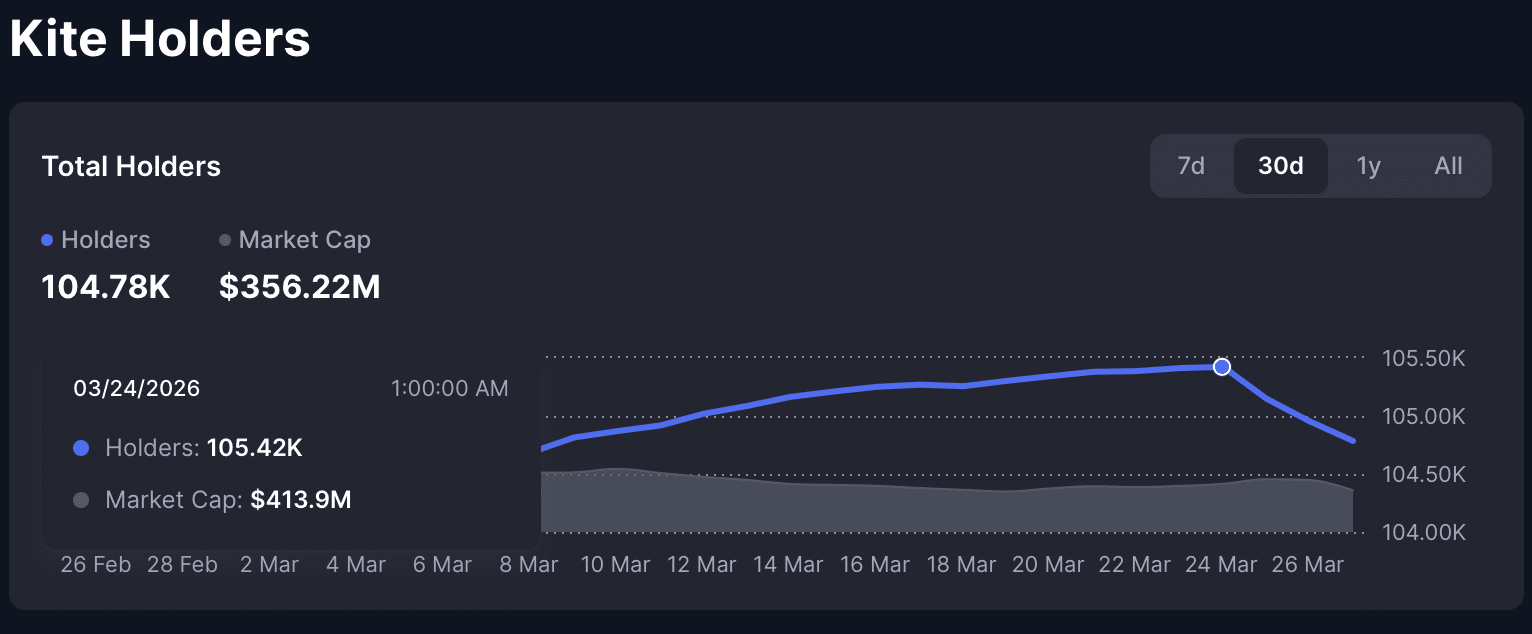
A key driver behind KITE’s recent decline lies in deteriorating fundamentals. The number of holders has dropped sharply after peaking at 105,420 on the 24th of March, when market capitalization reached $413.9 million.

At press time, the holder count has fallen to 104,780, while market capitalization has declined by $57 million, according to CoinMarketCap.
Source: CoinMarketCap

Despite the drop in participation, KITE’s circulating supply remains elevated at 1.8 billion tokens. This imbalance between supply and shrinking holder demand continues to weigh on sentiment.

At the same time, price action has weakened, with KITE posting a double-digit loss of 11% over the past 24 hours as of writing. Trading volume, however, has increased. Historically, rising volume alongside falling prices signals strong bearish momentum, suggesting the downtrend may extend.

Perpetual market signals growing short dominance

The perpetual futures market adds further downside risk.

Short traders have increased their dominance across KITE contracts. Over the past 24 hours, the Open Interest Weighted Funding Rate, which measures whether longs or shorts control the market, has turned sharply negative, at press time, reinforcing bearish sentiment.

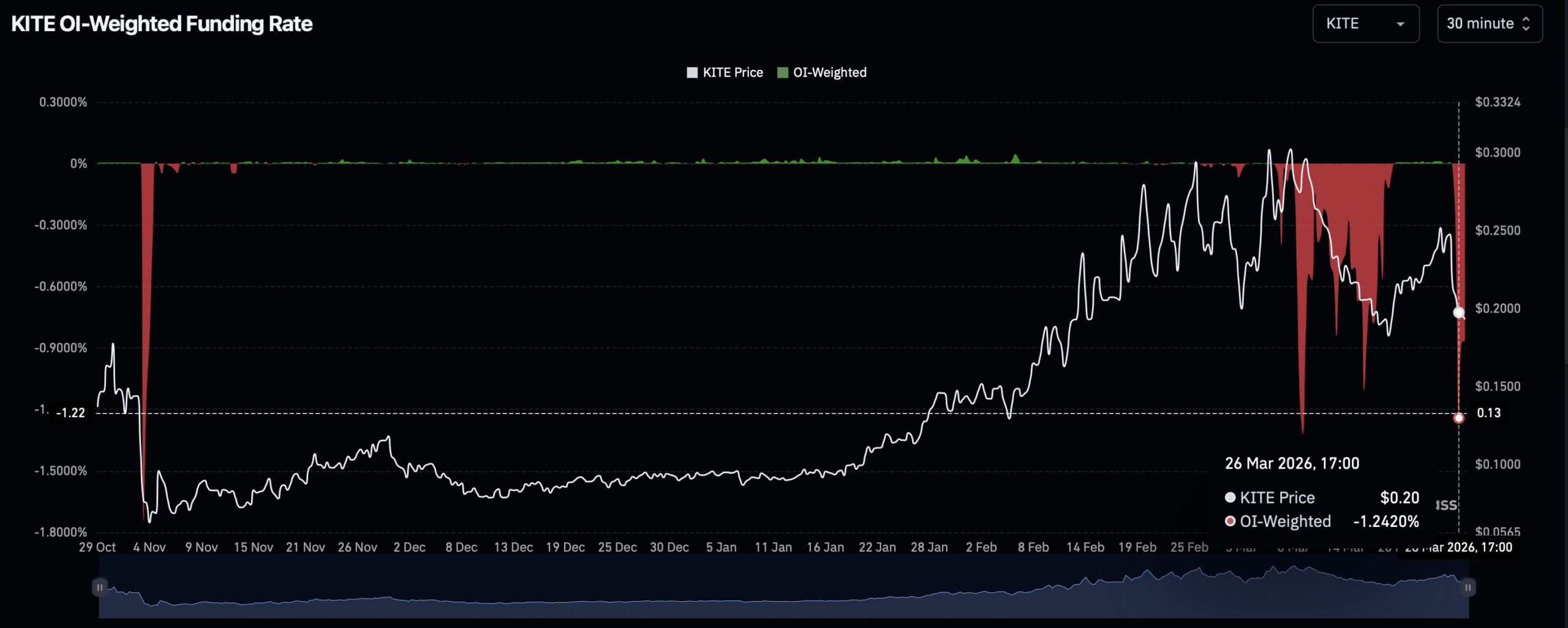
The Funding Rate dropped to -1.2420%, the steepest drop since the 9th of March. On the 19th of March, a similar decline occurred, resulting in a sharp price drop from $0.29 to $0.18, indicating potential downside pressure.
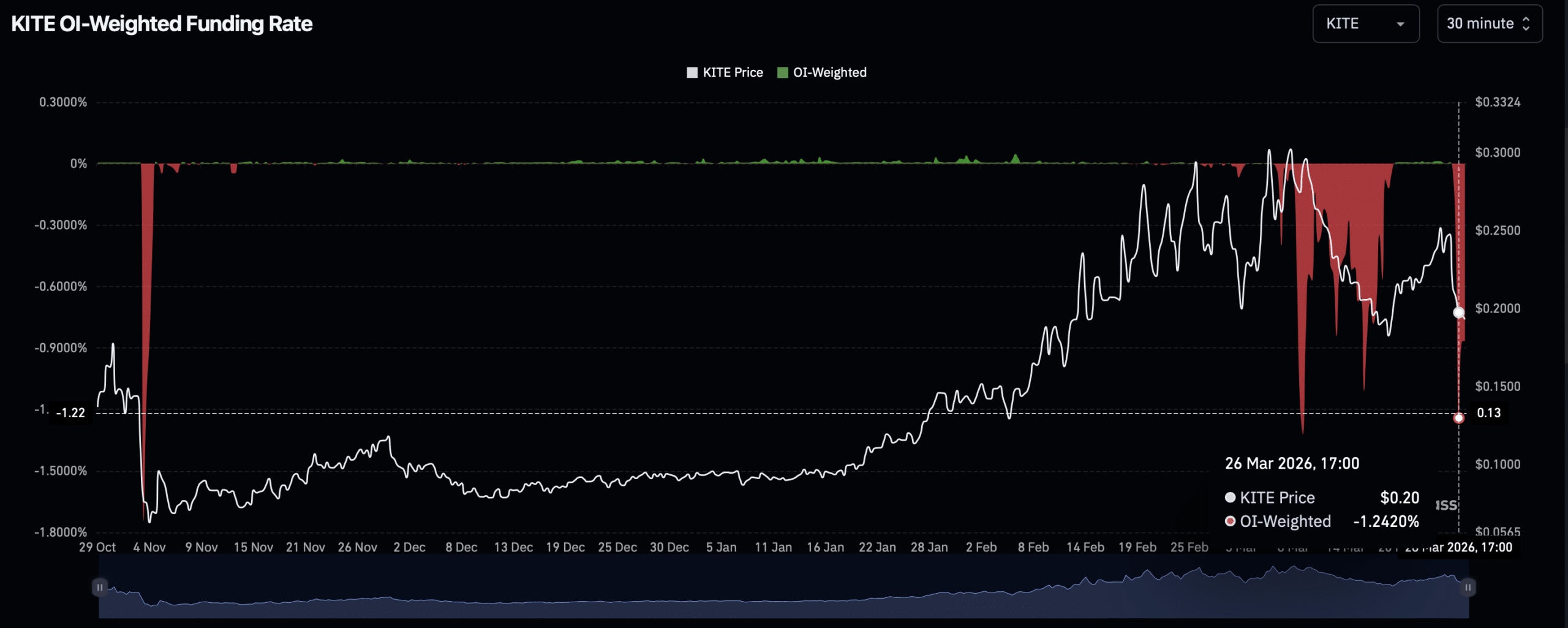
Source: CoinGlass

Notably, capital inflows into the perpetual market have risen even as short positioning intensifies. Open Interest has increased by nearly 1% to $50.54 million, suggesting that traders are adding liquidity primarily to build short exposure.

Liquidity points to further downside risk

Liquidity data indicates that KITE may still have room to decline.

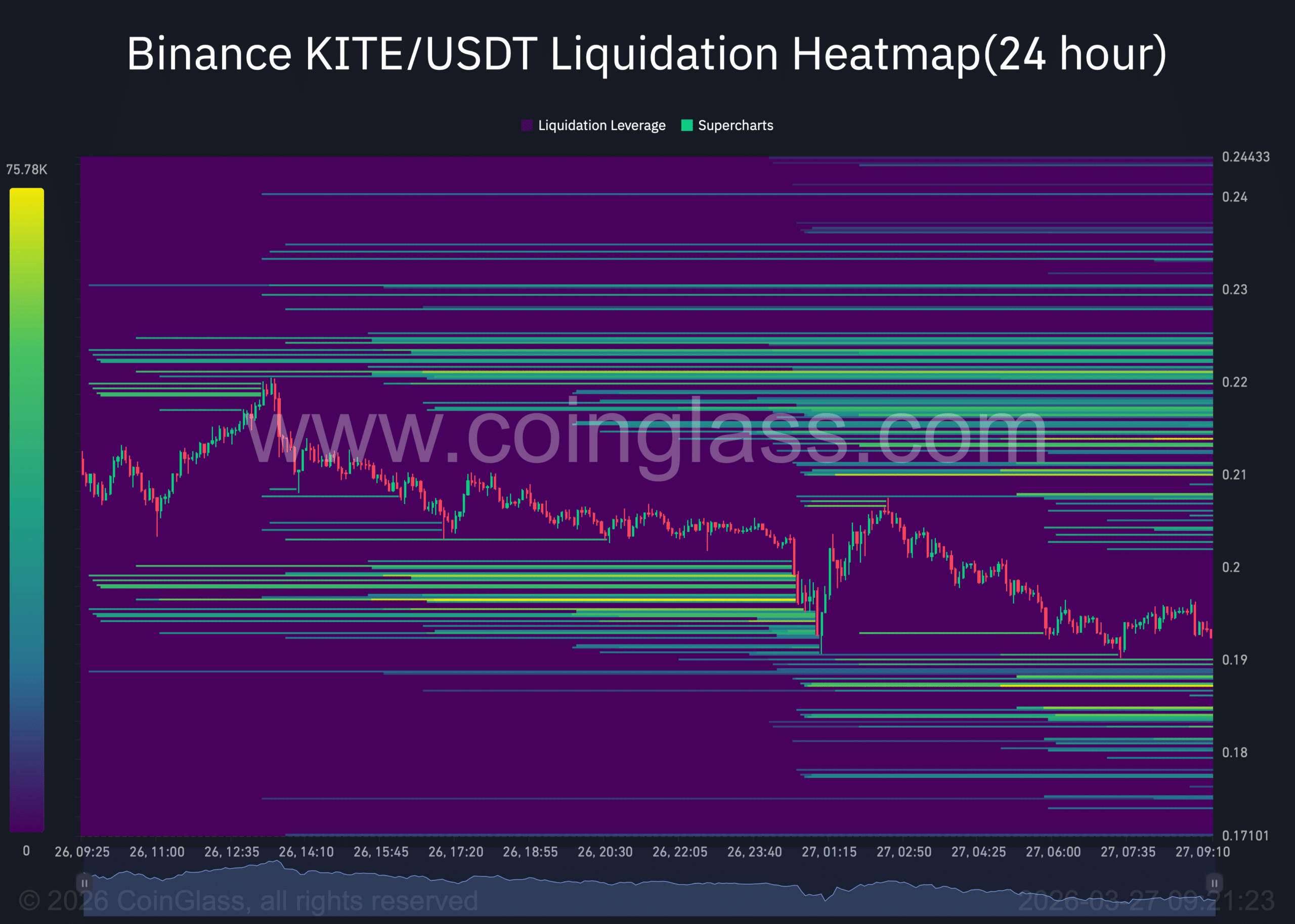
Current liquidity clusters indicate a potential move toward $0.175, where a concentration of unfilled orders exists. With minimal liquidity below this level, price may gravitate toward this zone in the short term.
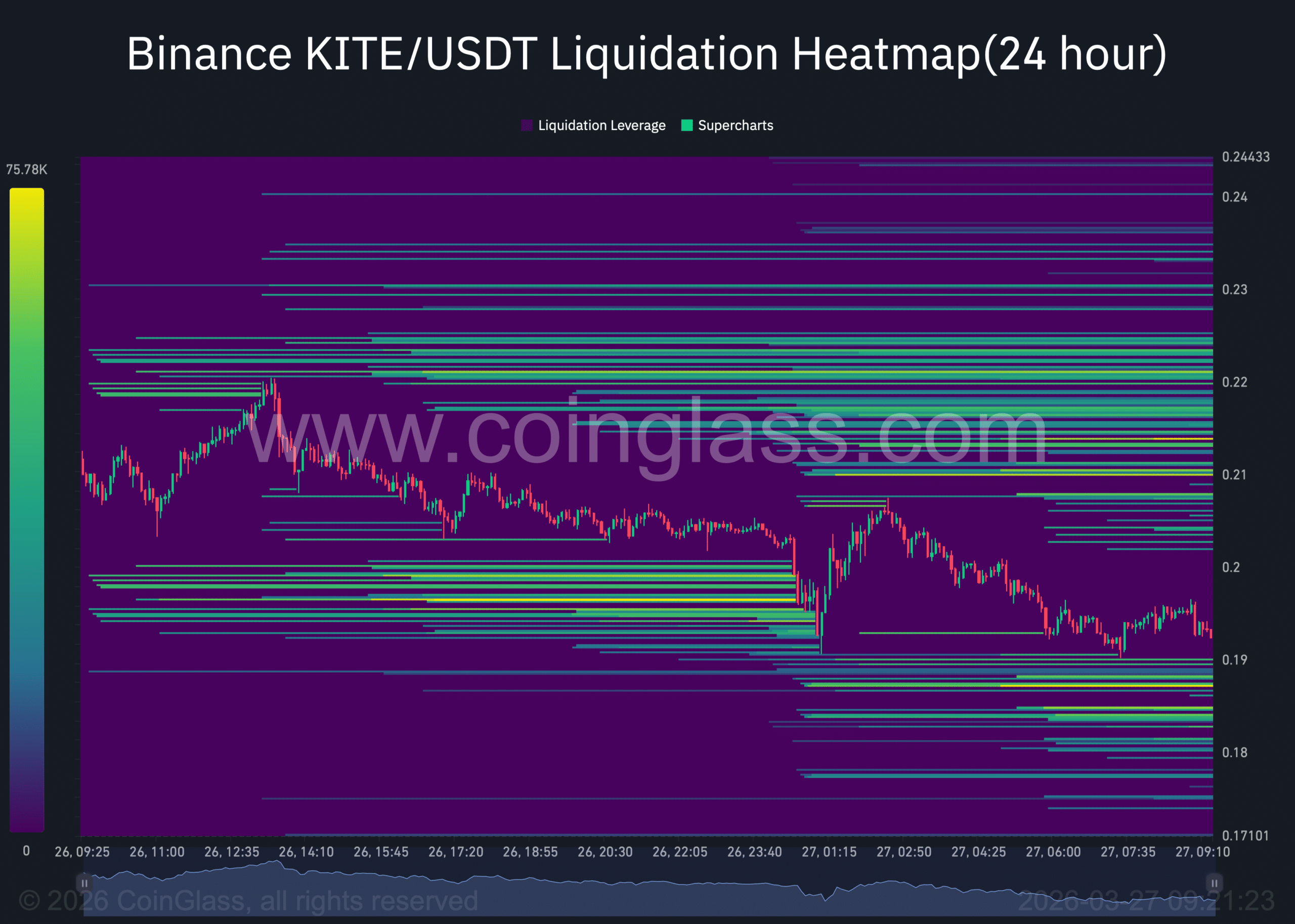
Source: CoinGlass

If KITE stabilizes and rebounds from this region, it could target a recovery toward the $0.23–$0.24 range. However, given the prevailing bearish momentum and increasing short pressure, the probability of further downside remains higher for now.


Final Summary

  • KITE’s holder count continues to decline after reaching an all-time high on March 24, coinciding with a $57 million drop in market capitalization.
  • Perpetual traders are reinforcing the downtrend, with short contracts rising to levels last seen weeks ago.


Preguntas relacionadas

QWhat is the main reason behind KITE's recent price decline according to the article?

AThe main reason is deteriorating fundamentals, including a sharp drop in holder count and an imbalance between the elevated circulating supply of 1.8 billion tokens and shrinking holder demand.

QHow has the number of KITE holders changed since its peak on March 24th?

AThe holder count has dropped from a peak of 105,420 on March 24th to 104,780 at the time of writing.

QWhat does the negative Open Interest Weighted Funding Rate indicate for the perpetual futures market?

AA sharply negative funding rate of -1.2420% indicates that short traders are dominant and paying long traders, reinforcing bearish sentiment in the market.

QWhat price level does liquidity data suggest KITE gravitate towards in the short term?

ALiquidity data suggests a potential move toward $0.175, where a concentration of unfilled orders exists.

QWhat was the percentage loss in KITE's price over the 24 hours preceding the article?

AKITE posted a double-digit loss of 11% over the past 24 hours as of writing.

Lecturas Relacionadas

China's First Embodied Data Compliance Outbound: How Does Paxini Become a Game-Changer for Industry Development?

"Embodied Intelligence Data Compliance Goes Global: A Breakthrough Moment. At the 2026 World Intelligent Industry Expo, Paxini, the sole Chinese company authorized for cross-border embodied data transfer, launched a pioneering project in Tianjin. This marks the first officially approved case of its kind in China, resolving a major industry bottleneck for compliant international data flow. As the ultimate direction of AI evolution, embodied intelligence relies on vast, multi-modal physical world interaction data. Despite booming global demand, stringent compliance had previously trapped the domestic industry. Paxini's breakthrough establishes a formal compliance framework, setting a benchmark for standardized development. The core of Paxini's success lies in its industry-leading data infrastructure and compliant security architecture, aligning with national data strategy. It operates a large-scale 'data collection factory' for high-quality, multi-modal data and has established a full-chain compliant pathway from 'collection-processing-certification-outbound transfer'. This dual advantage in data scale/quality and compliance secures its leadership. Beyond immediate commercial impact, the project signifies long-term strategic value: international market validation from top-tier financial institutions and the compounding benefits of ecosystem building. High-quality physical world data possesses enduring value. By solving fundamental infrastructure and compliance challenges, Paxini not only contributes a 'Chinese model' to the global embodied intelligence industry but also solidifies a key competitive moat for the long haul. This enables safe, efficient global flow of China's quality embodied data, amplifying its influence in the intelligent manufacturing landscape."

marsbitHace 3 min(s)

China's First Embodied Data Compliance Outbound: How Does Paxini Become a Game-Changer for Industry Development?

marsbitHace 3 min(s)

Macroeconomic Origins of the African Payments Market Structure

Africa’s payment landscape exhibits the world’s highest mobile money penetration and fastest cryptocurrency adoption. This is not a market anomaly but a macroeconomic inevitability driven by deep structural factors: a vast, young population, heavy reliance on commodity exports and remittances generating massive cross‑border payment needs, and a chronically underdeveloped formal banking system plagued by de‑risking, high inflation, and currency instability. This vacuum has allowed mobile money (e.g., M‑Pesa) to become the primary payment channel domestically, while cryptocurrencies—particularly stablecoins—serve as a store of value against local‑currency depreciation and a lower‑cost cross‑border medium. The key divide is the Sahara: North Africa integrates with the MENA oil‑centric financial system, while Sub‑Saharan Africa, facing acute dollar shortages and fragmented currencies, is the epicenter of this fintech surge. Structural reliance on dollars, driven by trade deficits and weak local currency credibility, creates persistent dollar scarcity, which crypto and mobile payments effectively address. Efforts like the Pan‑African Payment and Settlement System (PAPSS) aim at de‑dollarization, but these alternatives will remain essential as long as underlying economic constraints—commodity dependence, limited industrialization, and financial exclusion—persist.

marsbitHace 15 min(s)

Macroeconomic Origins of the African Payments Market Structure

marsbitHace 15 min(s)

AAOI Defies Trend with Over 10% Surge, 'New Stock God' Serenity Predicts Potential to Double Again

On June 4th, despite a significant sell-off in the broader AI and semiconductor sector triggered by Broadcom's disappointing guidance, Applied Optoelectronics (AAOI) surged over 11%, showcasing a sharp divergence in market sentiment. Broadcom's warning about potential supply chain diversification by key customer Google and a weaker-than-expected outlook punctured the high-flying AI valuation narrative. This led to heavy selling in names like Broadcom (-12.6%) and Micron (-7%), with funds rotating into traditional industrial stocks. AAOI defied this trend. The stock has experienced high volatility recently, driven by bullish analyst coverage, notably from Rosenblatt which raised its price target to $220. Key catalysts include initial 800G optical module revenue from Amazon, potential certification from Oracle, and strong demand across its product portfolio. The company has reported cumulative orders for 800G/1.6T modules exceeding $324 million and is aggressively expanding manufacturing capacity in Texas, targeting an annualized run-rate of $1.4 billion for its module business by Q3 2027. However, AAOI's fundamentals present a mixed picture. Its Q1 2026 results missed expectations, showing a GAAP net loss, and Q2 guidance points to merely breakeven adjusted EPS. Risks include a delayed 800G production ramp to the second half of the year and high dependence on a few key cloud customers. Recent stock sales by company executives near price highs also noted. The article suggests AAOI's rally reflects a market beginning to differentiate within the AI ecosystem. While Broadcom's issues prompted a reassessment of custom ASIC and customer concentration risks, funds flowing into AAOI indicate a belief that the "physical bottleneck" narrative for optical connectivity—where supply remains tight—remains intact and is somewhat decoupled from the current sector weakness. The sustainability of AAOI's premium valuation now hinges on the successful execution of its production plans and upcoming quarterly results.

marsbitHace 22 min(s)

AAOI Defies Trend with Over 10% Surge, 'New Stock God' Serenity Predicts Potential to Double Again

marsbitHace 22 min(s)

Trading

Spot
Futuros
活动图片