Keel shuts US Bitcoin mining operations as Q2 revenue falls 50%

cointelegraphPublicado a 2026-08-11Actualizado a 2026-08-11

Resumen

Keel Infrastructure has decommissioned all of its U.S. Bitcoin mining operations as it pivots to high-performance computing (HPC), according to its Q2 report. The company's revenue fell 50% year-over-year to $30 million, citing lower Bitcoin prices and the shutdown of its Moses Lake mining site. It reported an operating loss of $141 million, including significant non-cash depreciation. As part of winding down its Bitcoin holdings, Keel sold 1,085 BTC for $75 million since April, holding 1,861 BTC as of last week. The company joins others like Bit Digital and Crusoe in exiting mining for AI and HPC infrastructure. Its stock price dropped 12% on Monday.

Keel Infrastructure said it has decommissioned all US Bitcoin mining operations in preparation for high-performance computing (HPC) site construction, according to its second-quarter report published on Monday.

The digital infrastructure company reported $30 million in revenue, down 50% year-over-year. The decrease was largely attributed to a decline in the average Bitcoin (BTC) price and the shutdown of its Moses Lake crypto mining operations in April 2026.

The company also reported a $141 million operating loss, compared with operating income of $11 million in the same period last year. The loss included $84 million in non-cash depreciation.

Multiple Bitcoin miners have expanded into AI infrastructure, but Keel is among the few to fully exit US Bitcoin mining as it shifts toward HPC. Other companies that halted mining operations to pivot to AI include Bit Digital and Crusoe.

Keel held 1,861 BTC as of Friday after selling 1,085 BTC for $75 million since April 1 as part of its ongoing wind-down of its Bitcoin holdings. The company also reported about $819 million in liquidity, including $698 million in unrestricted cash.

Keel’s stock price fell 12% on Monday, according to Yahoo Finance.

Magazine: How Bitcoin mining heat is being tested to warm Canadian greenhouses

Preguntas relacionadas

QWhy did Keel Infrastructure shut down its US Bitcoin mining operations?

AKeel decommissioned its US Bitcoin mining operations in preparation for the construction of high-performance computing (HPC) sites, as it shifts its business focus away from cryptocurrency mining.

QWhat was the main reason for the 50% year-over-year decline in Keel's Q2 revenue?

AThe 50% year-over-year revenue decline was largely attributed to a decrease in the average Bitcoin price and the shutdown of its Moses Lake crypto mining operations in April 2026.

QHow much Bitcoin (BTC) did Keel sell as part of winding down its holdings, and for what total amount?

AKeel sold 1,085 BTC for $75 million since April 1 as part of its ongoing wind-down of its Bitcoin holdings.

QBesides Keel, which other companies have halted Bitcoin mining operations to pivot to AI?

AOther companies that have halted Bitcoin mining operations to pivot to AI include Bit Digital and Crusoe.

QWhat was Keel's reported liquidity at the end of the period, and what constituted most of it?

AKeel reported about $819 million in liquidity, which included $698 million in unrestricted cash.

Lecturas Relacionadas

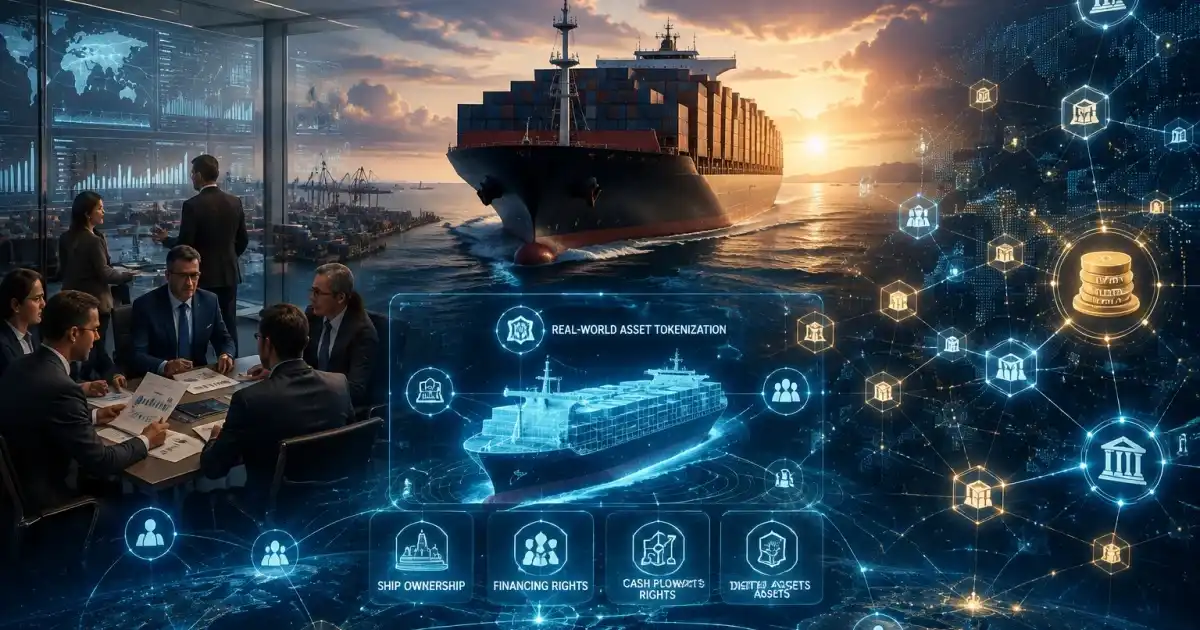
680 Billion Dollars in Ship Financing Goes On-Chain, Can RWA Open a New Entrance to Shipping Finance?

$680 Billion in Ship Financing Moves On-Chain: Can RWA Open a New Gateway for Maritime Finance? The global shipping industry, reliant on roughly $680 billion in traditional bank loans and leases, faces accessibility and liquidity challenges. This article explores how blockchain-based Real World Asset (RWA) tokenization could transform this market. It highlights the collaboration between ADI Chain and Shipfinex, which aims to digitize maritime assets, making them more transparent and accessible to a broader range of institutional investors. Shipping assets, characterized by high value and relatively predictable cash flows, are seen as a prime target for RWA innovation. Tokenization could unlock new funding sources for companies and new investment avenues, potentially improving market efficiency. However, the path is complex. Significant hurdles include navigating diverse cross-border regulations, designing legally sound digital structures that mirror real-world rights and risks, and fostering acceptance within a traditionally conservative industry. The article concludes that while the technological potential is clear, the long-term success of RWA in sectors like maritime finance will depend more on regulatory progress, mature business models, and genuine industry adoption than on the technology alone. This move represents a broader shift of blockchain from crypto-native applications toward integrating with core traditional economic assets.

marsbitHace 2 min(s)

680 Billion Dollars in Ship Financing Goes On-Chain, Can RWA Open a New Entrance to Shipping Finance?

marsbitHace 2 min(s)

This Cycle, Stop Paying for Stories

Based on discussions with experienced on-chain participants, there is a consensus that the current market cycle demands a shift in strategy: from buying into narratives and expectations to focusing on verifiable fundamentals and cash flow. Key takeaways include: 1) Prioritize assets with real value capture. In a bear market, protocols that generate consistent fees and directly reward token holders through mechanisms like buybacks, burns, or dividends become essential. Examples cited are launchpad-related tokens and notable buyback tokens. 2) Select projects with proven Product-Market Fit (PMF) and a complete operational loop. The next cycle will likely focus on utility and real-world validation, particularly in narratives like asset tokenization and the Agentic Economy. Projects without genuine users, transaction loops, or revenue will be filtered out. Metrics such as Assets Under Management (AUM), trading volume, and fee generation are critical for evaluation. 3) Opt for assets with strong, organically grown "consensus." This refers to enduring community belief that survives market cycles, not manufactured hype. Examples include veteran meme coins and established sector leaders that maintain liquidity and community vitality over time. 4) Avoid purely VC-backed tokens. These often suffer from high Fully Diluted Valuation (FDV), low circulating supply, and continuous, large unlocks. Without inherent value capture, they typically rely on pre-launch airdrop hype and face significant sell-pressure upon unlocks, posing substantial risk to retail investors. (Note: The mentioned tokens are for illustrative purposes only and do not constitute investment advice.)

marsbitHace 3 min(s)

This Cycle, Stop Paying for Stories

marsbitHace 3 min(s)

The Harsh Truth About Crypto Infrastructure and M&A Deals

The brutal truth about crypto infrastructure and M&A deals The crypto industry faces a fundamental crisis: an overabundance of capital and technology, but a critical shortage of scalable consumer distribution channels. In their desperation to prove viability to investors, crypto startups have fallen into a costly trap—subsidizing paid pilot projects and partnerships with Web2 corporations and traditional financial institutions. However, 95% of these pilots never reach full-scale deployment. Web2 corporations are not interested in being long-term SaaS clients; they will simply acquire successful infrastructure outright when it proves valuable, as seen with Stripe/Bridge and Robinhood/Bitstamp. This marks the start of an aggressive consolidation cycle. Well-capitalized players and top-tier protocols will achieve inorganic growth by acquiring battle-tested infrastructure, licenses, and distribution channels at realistic valuations, while underfunded projects chasing pilots will fail. The coming consumer expansion will follow an 80/20 market split: 1. 80% will be controlled by a handful of regulated Web2/fintech giants (e.g., Visa, Stripe, PayPal) who provide the regulatory guardrails and user-friendly interfaces for mass adoption. 2. 20% will remain a permissionless DeFi "sandbox" for developers to build and test new on-chain primitives. Therefore, the path for Web3 startups is reversed. Founders must first prove product-market fit in the 20% DeFi sandbox. Scaling will not come from building a standalone B2C brand, but from being integrated into or acquired by one of the few Web2 gateways controlling the 80% distribution layer. The future winners are infrastructure teams building institutional-grade "rails" designed to plug directly into Web2's distribution channels.

cryptonews.ruHace 7 min(s)

The Harsh Truth About Crypto Infrastructure and M&A Deals

cryptonews.ruHace 7 min(s)

Trading

Spot
活动图片