KBank Signals Major Crypto Push With Stablecoin Wallet Trademarks as $SUBBD Reshapes Creator Economy

bitcoinistPublicado a 2026-02-03Actualizado a 2026-02-03

Resumen

Thailand's Kasikornbank (KBank) is strengthening its digital asset infrastructure by filing trademarks for digital wallets and stablecoin solutions, signaling a major institutional push into blockchain. This move aims to modernize payments and capture digital capital flows in Southeast Asia. Simultaneously, the $85 billion creator economy is shifting toward decentralization. SUBBD Token ($SUBBD) is highlighted as an AI-powered platform built on Ethereum that reduces fees and gives creators more control. It integrates AI tools for content generation and community management, alongside a staking system offering 20% APY to incentivize holders. The project has raised over $1.4 million in its presale, reflecting strong demand for utility-driven Web3 applications.

Thailand’s second-largest lender, Kasikornbank (KBank), is quietly fortifying its digital asset infrastructure.

The banking giant isn’t just tinkering; trademark filings show they are securing IP rights for digital wallets and stablecoin solutions right before the anticipated IPO of their asset management arm. This isn’t just a technical upgrade; it’s a signal that institutional banking is finally getting serious about integrating blockchain rails.

KBank seems to be prepping for a future where crypto is a daily medium of exchange, not just a speculative toy. By locking down these trademarks now, the bank is effectively hedging against the slow death of legacy SWIFT systems to capture digital capital flows across Southeast Asia.

Why does that matter? Simple: institutional validation usually precedes mass utility. When banks build the wallet infrastructure, they’re essentially rolling out the red carpet for the applications built on top of it.

But while banks focus on the ‘rails’, the actual movement of money, the real innovation is happening at the application layer. Specifically, where AI meets decentralized finance. The $85B content creation industry is undergoing a similar overhaul.

Just as KBank wants to bypass legacy payment friction, new ecosystems are cutting out the restrictive fee structures of Web2 platforms. This shift from centralized control to decentralized utility is bridging the gap between institutional adoption and retail use. That’s why investors are looking closely at AI-powered challengers like SUBBD Token ($SUBBD).

AI-Driven Platforms Decentralize The $85B Creator Economy

While giants like KBank modernize the back end, the front-end user experience is shifting toward creator sovereignty. Frankly, the current model looks predatory. Legacy platforms often extract fees ranging from 20% to 70% of a creator’s earnings while retaining the right to de-platform users on a whim. The inefficiency is glaring: intermediaries are extracting massive value without contributing proportional utility.

SUBBD Token ($SUBBD) tackles this by merging the Ethereum blockchain with advanced AI tools. The goal?

Return control to the creators. By using an ERC-20 token for transactions, the ecosystem cuts out high banking fees and payment processor delays—the very friction points KBank’s stablecoin initiatives aim to solve institutionally.

But SUBBD goes beyond payments. It integrates proprietary AI models for content generation (think AI Voice Cloning and AI Influencer Creation), allowing creators to scale their output without exploding their labor costs.

The addition of an AI Personal Assistant for automated interactions signals a major shift in how influencers manage community engagement. Instead of manual replies, AI tools handle the grunt work, optimizing revenue streams through subscriptions, pay-per-view (PPV), and NFT sales. (For creators, this means transforming a passive audience into an active, token-gated economy.)

Governance rights further distinguish this model. Token holders vote on feature rollouts and community events, ensuring the platform evolves based on user needs rather than shareholder mandates.

LEARN MORE ABOUT $SUBBD WITH OUR ‘WHAT IS SUBBD TOKEN?’ GUIDE.

$SUBBD Presale Momentum Highlights Demand For Yield-Bearing Web3 Utilities

The market’s appetite for utility-driven AI projects is obvious in recent capital inflows. Smart money is watching early-stage valuations closely, hunting for assets that offer both technological innovation and incentives for long-term holding. SUBBD has already secured over $1.4M in its ongoing presale, a figure that suggests robust confidence in the roadmap, even with broader market volatility.

Currently priced at $0.05749, the token offers an entry point that contrasts sharply with the saturated valuations of established AI cryptos. The project’s economic model is built for retention.

To mitigate the volatility often seen with new utility tokens, SUBBD offers a staking protocol with a fixed 20% APY for the first year. This high-yield structure does double duty: it rewards early adopters for locking liquidity and stabilizes the token’s circulating supply during the critical initial growth phase.
Source: SUBBD Token

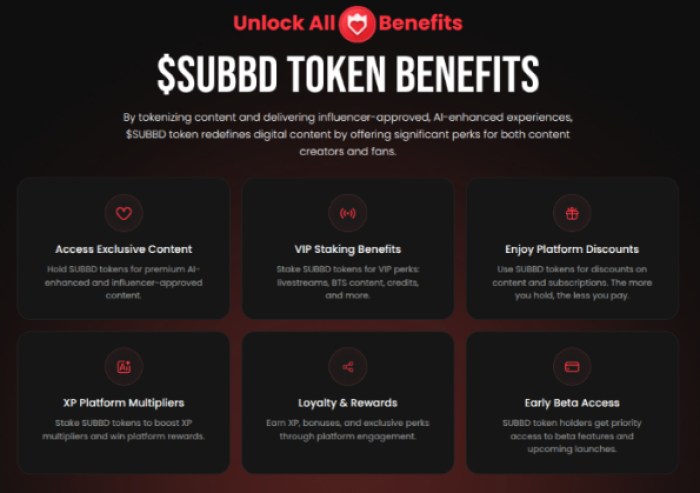
But it’s not just about yield. For fans, staking unlocks tiered platform benefits, including access to exclusive livestreams and ‘HoneyHive’ membership. This gamification of finance, where holding a token grants both interest and experiential access, is fast becoming the standard for successful Web3 launches.

As institutional giants like KBank build the stablecoin highways, projects like SUBBD are building the high-speed vehicles that give users a reason to drive on them.

VISIT THE OFFICIAL $SUBBD PRESALE SITE.

This article is not financial advice. Cryptocurrency investments, including presales and AI tokens, carry inherent risks. Always conduct independent research before making investment decisions.


Criptos en tendencia

Preguntas relacionadas

QWhat is Kasikornbank (KBank) doing to strengthen its position in the digital asset space according to the article?

AKasikornbank (KBank) is fortifying its digital asset infrastructure by filing trademarks for digital wallets and stablecoin solutions, signaling a serious institutional push to integrate blockchain technology and capture digital capital flows in Southeast Asia.

QHow does the SUBBD Token ($SUBBD) aim to benefit content creators?

ASUBBD Token ($SUBBD) aims to return control to creators by using an ERC-20 token to cut out high banking fees and payment processor delays. It also integrates AI tools for content generation and community management, and allows token holders to participate in governance.

QWhat specific AI tools does the SUBBD ecosystem integrate for creators?

AThe SUBBD ecosystem integrates proprietary AI models for AI Voice Cloning and AI Influencer Creation, as well as an AI Personal Assistant for automated interactions to help creators scale their output and manage community engagement.

QWhat financial incentive does SUBBD offer to early token holders?

ASUBBD offers a staking protocol with a fixed 20% APY for the first year to reward early adopters, lock liquidity, and stabilize the token's circulating supply during its initial growth phase.

QHow much funding has SUBBD secured in its ongoing presale, and what does this indicate?

ASUBBD has secured over $1.4 million in its ongoing presale, indicating robust market confidence in its roadmap and demand for utility-driven AI projects despite broader market volatility.

Lecturas Relacionadas

Annual Salary of Millions Competing for Electricians, Meta Rushes to Open Its Own Technical School

The AI boom is facing an unexpected bottleneck: a severe shortage of skilled construction workers and electricians. As tech giants like Meta, OpenAI, and Alphabet race to build massive data centers—such as OpenAI's $16 billion "Stargate" project—they are hitting a critical labor wall. The U.S. needs an estimated 130,000 more electricians, 240,000 construction workers, and 150,000 supervisors by 2030 for AI infrastructure alone, but tens of thousands of electrician jobs go unfilled each year. While AI companies offer high premiums, with electricians earning up to $280,000 annually, worker scarcity still causes massive losses—delays on a single project can cost $14.2 million per month. The complexity of building AI data centers, which require immense power (equivalent to powering hundreds of thousands of homes), sophisticated electrical systems, and advanced liquid cooling solutions, demands highly skilled technicians who are in short supply. To combat this, companies are investing heavily in training. Meta has committed $115 million to a free training school offering tuition, housing, and stipends, targeting 5,000 new workers. OpenAI is partnering with unions to secure skilled labor. These efforts are paying off, with a significant rise in Gen Z interest in trade schools over college. However, the power demands are staggering. AI data centers are driving a rapid surge in electricity consumption, projected to account for up to 12% of U.S. power use by 2028 and raising costs for consumers. Furthermore, the construction boom is project-based, leading to a potential future glut of trained workers once building peaks, which could depress wages industry-wide. The race for AI supremacy now depends as much on skilled hands as on advanced chips.

marsbitHace 1 hora(s)

Annual Salary of Millions Competing for Electricians, Meta Rushes to Open Its Own Technical School

marsbitHace 1 hora(s)

OpenAI No Longer Sells Its Most Expensive Model for Profit

OpenAI is shifting its business strategy away from promoting its most expensive, flagship models for every task. Recent price cuts—80% for GPT-5.6 Luna and 20% for Terra—signal a deeper change: the company now actively advises users that many tasks don't require the most powerful model. Instead, OpenAI recommends a tiered approach: use the high-end GPT-5.6 Sol for complex planning and analysis, then delegate execution to cheaper models like Luna. This mirrors moves by Anthropic, which recently launched Claude Opus 5 at half the price of its top model, Fable 5. Both companies are de-emphasizing flagship models as primary revenue drivers, using them instead for brand prestige and technological showcases. The industry is entering a "mass-market" phase, similar to automotive, where high-volume, cost-effective models handle daily operations and drive scale. OpenAI's price reductions are partly enabled by AI models themselves optimizing underlying code and infrastructure, creating a self-reinforcing cycle of efficiency gains and cost reduction. Competition is shifting from "who is smartest" to "who offers the best value." The goal is no longer selling individual models but fostering widespread API adoption and ecosystem lock-in. By making AI calls cheap and ubiquitous, companies like OpenAI aim to become the indispensable, utility-like infrastructure powering automated workflows—the "water and electricity" of software, quietly embedded everywhere.

marsbitHace 1 hora(s)

OpenAI No Longer Sells Its Most Expensive Model for Profit

marsbitHace 1 hora(s)

Trading

Spot

Artículos destacados

Cómo comprar PUSH

¡Bienvenido a HTX.com! Hemos hecho que comprar Push Protocol (PUSH) sea simple y conveniente. Sigue nuestra guía paso a paso para iniciar tu viaje de criptos.Paso 1: crea tu cuenta HTXUtiliza tu correo electrónico o número de teléfono para registrarte y obtener una cuenta gratuita en HTX. Experimenta un proceso de registro sin complicaciones y desbloquea todas las funciones.Obtener mi cuentaPaso 2: ve a Comprar cripto y elige tu método de pagoTarjeta de crédito/débito: usa tu Visa o Mastercard para comprar Push Protocol (PUSH) al instante.Saldo: utiliza fondos del saldo de tu cuenta HTX para tradear sin problemas.Terceros: hemos agregado métodos de pago populares como Google Pay y Apple Pay para mejorar la comodidad.P2P: tradear directamente con otros usuarios en HTX.Over-the-Counter (OTC): ofrecemos servicios personalizados y tipos de cambio competitivos para los traders.Paso 3: guarda tu Push Protocol (PUSH)Después de comprar tu Push Protocol (PUSH), guárdalo en tu cuenta HTX. Alternativamente, puedes enviarlo a otro lugar mediante transferencia blockchain o utilizarlo para tradear otras criptomonedas.Paso 4: tradear Push Protocol (PUSH)Tradear fácilmente con Push Protocol (PUSH) en HTX's mercado spot. Simplemente accede a tu cuenta, selecciona tu par de trading, ejecuta tus trades y monitorea en tiempo real. Ofrecemos una experiencia fácil de usar tanto para principiantes como para traders experimentados.

251 Vistas totalesPublicado en 2024.12.13Actualizado en 2026.06.02

Cómo comprar PUSH

Discusiones

Bienvenido a la comunidad de HTX. Aquí puedes mantenerte informado sobre los últimos desarrollos de la plataforma y acceder a análisis profesionales del mercado. A continuación se presentan las opiniones de los usuarios sobre el precio de PUSH (PUSH).

活动图片












