KBank Signals Major Crypto Push With Stablecoin Wallet Trademarks as $SUBBD Reshapes Creator Economy

bitcoinistPublicado a 2026-02-03Actualizado a 2026-02-03

Resumen

Thailand's Kasikornbank (KBank) is strengthening its digital asset infrastructure by filing trademarks for digital wallets and stablecoin solutions, signaling a major institutional push into blockchain. This move aims to modernize payments and capture digital capital flows in Southeast Asia. Simultaneously, the $85 billion creator economy is shifting toward decentralization. SUBBD Token ($SUBBD) is highlighted as an AI-powered platform built on Ethereum that reduces fees and gives creators more control. It integrates AI tools for content generation and community management, alongside a staking system offering 20% APY to incentivize holders. The project has raised over $1.4 million in its presale, reflecting strong demand for utility-driven Web3 applications.

Thailand’s second-largest lender, Kasikornbank (KBank), is quietly fortifying its digital asset infrastructure.

The banking giant isn’t just tinkering; trademark filings show they are securing IP rights for digital wallets and stablecoin solutions right before the anticipated IPO of their asset management arm. This isn’t just a technical upgrade; it’s a signal that institutional banking is finally getting serious about integrating blockchain rails.

KBank seems to be prepping for a future where crypto is a daily medium of exchange, not just a speculative toy. By locking down these trademarks now, the bank is effectively hedging against the slow death of legacy SWIFT systems to capture digital capital flows across Southeast Asia.

Why does that matter? Simple: institutional validation usually precedes mass utility. When banks build the wallet infrastructure, they’re essentially rolling out the red carpet for the applications built on top of it.

But while banks focus on the ‘rails’, the actual movement of money, the real innovation is happening at the application layer. Specifically, where AI meets decentralized finance. The $85B content creation industry is undergoing a similar overhaul.

Just as KBank wants to bypass legacy payment friction, new ecosystems are cutting out the restrictive fee structures of Web2 platforms. This shift from centralized control to decentralized utility is bridging the gap between institutional adoption and retail use. That’s why investors are looking closely at AI-powered challengers like SUBBD Token ($SUBBD).

AI-Driven Platforms Decentralize The $85B Creator Economy

While giants like KBank modernize the back end, the front-end user experience is shifting toward creator sovereignty. Frankly, the current model looks predatory. Legacy platforms often extract fees ranging from 20% to 70% of a creator’s earnings while retaining the right to de-platform users on a whim. The inefficiency is glaring: intermediaries are extracting massive value without contributing proportional utility.

SUBBD Token ($SUBBD) tackles this by merging the Ethereum blockchain with advanced AI tools. The goal?

Return control to the creators. By using an ERC-20 token for transactions, the ecosystem cuts out high banking fees and payment processor delays—the very friction points KBank’s stablecoin initiatives aim to solve institutionally.

But SUBBD goes beyond payments. It integrates proprietary AI models for content generation (think AI Voice Cloning and AI Influencer Creation), allowing creators to scale their output without exploding their labor costs.

The addition of an AI Personal Assistant for automated interactions signals a major shift in how influencers manage community engagement. Instead of manual replies, AI tools handle the grunt work, optimizing revenue streams through subscriptions, pay-per-view (PPV), and NFT sales. (For creators, this means transforming a passive audience into an active, token-gated economy.)

Governance rights further distinguish this model. Token holders vote on feature rollouts and community events, ensuring the platform evolves based on user needs rather than shareholder mandates.

LEARN MORE ABOUT $SUBBD WITH OUR ‘WHAT IS SUBBD TOKEN?’ GUIDE.

$SUBBD Presale Momentum Highlights Demand For Yield-Bearing Web3 Utilities

The market’s appetite for utility-driven AI projects is obvious in recent capital inflows. Smart money is watching early-stage valuations closely, hunting for assets that offer both technological innovation and incentives for long-term holding. SUBBD has already secured over $1.4M in its ongoing presale, a figure that suggests robust confidence in the roadmap, even with broader market volatility.

Currently priced at $0.05749, the token offers an entry point that contrasts sharply with the saturated valuations of established AI cryptos. The project’s economic model is built for retention.

To mitigate the volatility often seen with new utility tokens, SUBBD offers a staking protocol with a fixed 20% APY for the first year. This high-yield structure does double duty: it rewards early adopters for locking liquidity and stabilizes the token’s circulating supply during the critical initial growth phase.
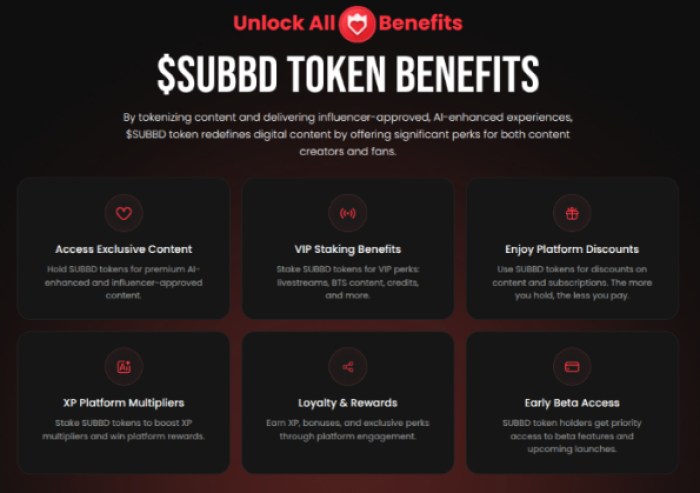
Source: SUBBD Token

But it’s not just about yield. For fans, staking unlocks tiered platform benefits, including access to exclusive livestreams and ‘HoneyHive’ membership. This gamification of finance, where holding a token grants both interest and experiential access, is fast becoming the standard for successful Web3 launches.

As institutional giants like KBank build the stablecoin highways, projects like SUBBD are building the high-speed vehicles that give users a reason to drive on them.

VISIT THE OFFICIAL $SUBBD PRESALE SITE.

This article is not financial advice. Cryptocurrency investments, including presales and AI tokens, carry inherent risks. Always conduct independent research before making investment decisions.


Preguntas relacionadas

QWhat is Kasikornbank (KBank) doing to strengthen its position in the digital asset space according to the article?

AKasikornbank (KBank) is fortifying its digital asset infrastructure by filing trademarks for digital wallets and stablecoin solutions, signaling a serious institutional push to integrate blockchain technology and capture digital capital flows in Southeast Asia.

QHow does the SUBBD Token ($SUBBD) aim to benefit content creators?

ASUBBD Token ($SUBBD) aims to return control to creators by using an ERC-20 token to cut out high banking fees and payment processor delays. It also integrates AI tools for content generation and community management, and allows token holders to participate in governance.

QWhat specific AI tools does the SUBBD ecosystem integrate for creators?

AThe SUBBD ecosystem integrates proprietary AI models for AI Voice Cloning and AI Influencer Creation, as well as an AI Personal Assistant for automated interactions to help creators scale their output and manage community engagement.

QWhat financial incentive does SUBBD offer to early token holders?

ASUBBD offers a staking protocol with a fixed 20% APY for the first year to reward early adopters, lock liquidity, and stabilize the token's circulating supply during its initial growth phase.

QHow much funding has SUBBD secured in its ongoing presale, and what does this indicate?

ASUBBD has secured over $1.4 million in its ongoing presale, indicating robust market confidence in its roadmap and demand for utility-driven AI projects despite broader market volatility.

Lecturas Relacionadas

RWA First Stock's Major Acquisition: Why Buy a 'Traditional' Mortgage Company?

On June 10th, Figure Technology Solutions (Nasdaq: FIGR), a blockchain-native capital markets firm, announced a $717 million acquisition of Kiavi, a leading non-bank lender for residential real estate investors. The deal involves Figure acquiring Kiavi's technology and operations for approximately $538 million, while forming a joint venture with alternative asset manager Sixth Street to purchase Kiavi's existing loan portfolio. Sixth Street also provided a $3 billion forward purchase commitment. This acquisition marks a strategic shift for Figure, known as the "RWA (Real World Asset) first stock," allowing it to expand significantly into the larger market of first-lien mortgages. Kiavi specializes in non-qualified mortgage (Non-QM) loans, such as short-term fix-and-flip (RTL) and rental property (DSCR) loans—a segment traditionally underserved by major banks. The move is expected to increase Figure's first-lien loan origination to over $7 billion annually, aiming for these to constitute about 40% of its business by 2027. Both companies leverage AI for underwriting: Kiavi uses proprietary models to value renovated properties and automate document processing, dominating the fix-and-flip lending space. Figure plans to integrate these assets onto its blockchain platform, Provenance, using its new 'Adaptor' product to standardize and tokenize the loans for institutional investors on its Democratized Prime marketplace. While the integration poses challenges—including merging different asset types, interest rate sensitivity of Kiavi's loans, and post-IPO execution risks—Figure projects the deal to be accretive to earnings with a cash payback period under four years. The transaction is seen as a major step in scaling blockchain-based capital markets, moving RWA tokenization from concept validation toward large-scale operation.

Foresight NewsHace 3 min(s)

RWA First Stock's Major Acquisition: Why Buy a 'Traditional' Mortgage Company?

Foresight NewsHace 3 min(s)

Trend in US Stocks: A Post Triggers a 930-Point Rebound, Tonight Belongs to SpaceX

On Thursday (June 11, U.S. Eastern Time), Wall Street staged a textbook V-shaped reversal. The Dow Jones surged 929.97 points (+1.86%) to close above 50,000, while the Nasdaq and S&P 500 rose 2.54% and 1.75%, respectively. The rally occurred despite the hottest PPI report in years, with May data showing a 6.5% year-on-year surge, the highest since 2022. The market ignored the inflation data, focusing instead on reports that former President Trump called off a planned strike on Iran, hinting at a potential multi-party peace agreement draft. This sparked a sharp drop in oil prices, fueling hopes that inflation may have peaked. Sector rotations were stark: previously battered AI hardware and cyclical stocks led the gains, while defensive sectors that hit record highs the prior day were sold off. Chip stocks like Micron and Intel saw sharp rebounds. In contrast, software giant Oracle plunged nearly 10% despite beating earnings, with concerns over cloud revenue and cash flow. Adobe also fell after hours despite raising guidance, as its CFO announced departure. The rally's sustainability is questioned, driven largely by social media posts about unconfirmed geopolitical developments. Inflation risks remain, with pipeline pressures still high. Meanwhile, the market's risk appetite faces a major test with SpaceX's historic IPO. Priced at $135 per share, it aims to raise ~$75 billion with a $1.75 trillion valuation, becoming the largest U.S. IPO ever. It will join the Nasdaq 100 in 15 days, triggering massive index fund buying. However, critics cite extreme valuation (88x sales) and market liquidity concerns.

marsbitHace 26 min(s)

Trend in US Stocks: A Post Triggers a 930-Point Rebound, Tonight Belongs to SpaceX

marsbitHace 26 min(s)

The Trillion-Dollar Valuation Test: Are the Three Super IPOs a Tech Stock Frenzy or a Crypto Market Nightmare?

Trillion-Dollar Valuation Test: Are the Three Mega IPOs a Tech Stock Frenzy or a Crypto Market Nightmare? The capital market in 2026 is witnessing a highly anticipated wave of tech IPOs, centered on SpaceX, OpenAI, and Anthropic. Collectively valued at over $3.5 trillion, their potential listing represents one of the largest such waves in recent years. This raises concerns about market liquidity, valuation bubbles, and potential capital outflows from other assets like crypto. SpaceX's valuation narrative has shifted from rocket launches to becoming a global infrastructure play via its Starlink satellite network, which now drives most revenue. Despite ongoing losses, investors focus on its long-term growth potential. OpenAI and Anthropic represent the core productivity engines of generative AI. Their public listings would offer the first direct investment opportunity in large foundation model companies, potentially triggering a repricing within the AI sector. Market fears of a massive "capital drain" from these IPOs are likely overstated. Historical precedents like Alibaba and Saudi Aramco show that mega-listings primarily cause capital reallocation, not destruction, within the vast equities market. Systemic risk is rarely triggered by IPOs alone. For stock markets, short-term volatility and sector repricing are expected, especially for AI concept stocks. Long-term, these listings could reinforce the tech sector's importance. For crypto, direct competition for speculative capital exists, particularly affecting AI-themed tokens. However, crypto's trajectory remains more tied to its own cycles, macro liquidity, and Bitcoin ETF flows rather than a single IPO event. The real risk lies not in the listings themselves but in the sky-high growth expectations embedded in these valuations. If future revenue, profitability, or commercialization progress disappoints, significant valuation resets could follow, impacting high-growth tech stocks. Ultimately, the market's direction hinges on macroeconomic conditions and whether these companies can deliver on their ambitious promises.

链捕手Hace 42 min(s)

The Trillion-Dollar Valuation Test: Are the Three Super IPOs a Tech Stock Frenzy or a Crypto Market Nightmare?

链捕手Hace 42 min(s)

Trillion-Dollar Valuation Test: Are the Three Super IPOs a Tech Stock Frenzy or a Crypto Market Nightmare?

Title: Trillion-Dollar Valuations at Stake: Super IPOs of SpaceX, OpenAI, Anthropic – Tech Boom or Crypto Nightmare? TL;DR: A wave of mega-tech IPOs is approaching, featuring SpaceX (targeting a $1.75 trillion valuation), OpenAI (~$852B), and Anthropic (~$965B), with a combined potential valuation exceeding $3.5 trillion. This tests the market's pricing of innovation and sparks debate on liquidity impact. * **SpaceX**'s valuation is now driven more by its Starlink global communications infrastructure than its core rocket business. * **OpenAI & Anthropic** offer the first major public investment opportunities in foundational AI models, potentially repricing the entire AI sector. * Concerns about a market-wide "liquidity drain" are likely overblown; history shows large IPOs mainly cause fund reallocation, not disappearance, and rarely trigger systemic risk. * Crypto markets, especially some AI-themed tokens, may face short-term fund competition, but their long-term trajectory depends more on macro liquidity, regulation, and Bitcoin cycles. * The real risk lies not in the IPOs themselves, but in whether these companies can justify their sky-high valuations with future revenue growth and profitability. Unmet expectations could lead to significant repricing pressure. Ultimately, these IPOs represent a massive market pricing of next-gen tech infrastructure, not a prelude to a market crash. The broader market direction will be determined by macro conditions, corporate earnings, and risk appetite.

marsbitHace 42 min(s)

Trillion-Dollar Valuation Test: Are the Three Super IPOs a Tech Stock Frenzy or a Crypto Market Nightmare?

marsbitHace 42 min(s)

Trading

Spot
Futuros

Artículos destacados

Cómo comprar PUSH

¡Bienvenido a HTX.com! Hemos hecho que comprar Push Protocol (PUSH) sea simple y conveniente. Sigue nuestra guía paso a paso para iniciar tu viaje de criptos.Paso 1: crea tu cuenta HTXUtiliza tu correo electrónico o número de teléfono para registrarte y obtener una cuenta gratuita en HTX. Experimenta un proceso de registro sin complicaciones y desbloquea todas las funciones.Obtener mi cuentaPaso 2: ve a Comprar cripto y elige tu método de pagoTarjeta de crédito/débito: usa tu Visa o Mastercard para comprar Push Protocol (PUSH) al instante.Saldo: utiliza fondos del saldo de tu cuenta HTX para tradear sin problemas.Terceros: hemos agregado métodos de pago populares como Google Pay y Apple Pay para mejorar la comodidad.P2P: tradear directamente con otros usuarios en HTX.Over-the-Counter (OTC): ofrecemos servicios personalizados y tipos de cambio competitivos para los traders.Paso 3: guarda tu Push Protocol (PUSH)Después de comprar tu Push Protocol (PUSH), guárdalo en tu cuenta HTX. Alternativamente, puedes enviarlo a otro lugar mediante transferencia blockchain o utilizarlo para tradear otras criptomonedas.Paso 4: tradear Push Protocol (PUSH)Tradear fácilmente con Push Protocol (PUSH) en HTX's mercado spot. Simplemente accede a tu cuenta, selecciona tu par de trading, ejecuta tus trades y monitorea en tiempo real. Ofrecemos una experiencia fácil de usar tanto para principiantes como para traders experimentados.

216 Vistas totalesPublicado en 2024.12.13Actualizado en 2026.06.02

Cómo comprar PUSH

Discusiones

Bienvenido a la comunidad de HTX. Aquí puedes mantenerte informado sobre los últimos desarrollos de la plataforma y acceder a análisis profesionales del mercado. A continuación se presentan las opiniones de los usuarios sobre el precio de PUSH (PUSH).

活动图片












