Kalshi and Coinbase Receive CFTC Approval, Ushering in the Most Regulation-Friendly Era for the Crypto Industry?

marsbitPublicado a 2026-05-30Actualizado a 2026-05-30

Resumen

The U.S. Commodity Futures Trading Commission (CFTC) took two landmark actions on May 29. It approved Kalshi's application to list a Bitcoin perpetual futures contract and issued a no-action letter to Coinbase Financial Markets. This allows Coinbase to offer certain perpetual futures products to U.S. customers through a subsidiary, with digital assets permitted as collateral. These moves, coupled with a new CFTC policy statement, provide a clearer regulatory pathway for perpetual contracts in the U.S., moving them from a regulatory gray area. CFTC Chair Mike Selig stated this is a key step for U.S. crypto leadership but noted the policy is not yet permanent. The article explains that CFTC's previous reluctance stemmed from legal ambiguities, as perpetual contracts lack an expiration date. However, such contracts dominate global crypto derivatives, accounting for ~78% of centralized exchange volume in 2025, forcing U.S. regulators to adapt to competition from offshore platforms like Hyperliquid. The approvals offer two compliance paths: Kalshi's direct listing and Coinbase's model using foreign futures. This is expected to attract institutional capital back to regulated U.S. venues, stimulate the launch of more products like ETH perpetuals, and enhance U.S. competitiveness in the global crypto derivatives market. The author suggests this may signal a "regulatorily friendly" era for crypto.

Author: Ma He, Foresight News

On May 29th, the U.S. Commodity Futures Trading Commission (CFTC) announced two landmark actions on the same day: it formally approved the Bitcoin perpetual contract submitted by KalshiEX, LLC (Kalshi). Additionally, the CFTC issued a no-action letter to Coinbase, allowing Coinbase to offer certain perpetual futures products to U.S. customers through its subsidiary.

The CFTC also released a "Policy Statement on the Listing of Perpetual Contracts," providing a clear guidance framework for the listing of perpetual products on regulated markets. This combination of actions signifies a crucial step away from the longstanding regulatory gray area for U.S. crypto derivatives, moving toward a compliant path for genuine perpetual contracts.

Kalshi and Coinbase Both Receive Regulatory Approval

The CFTC's review determined that Kalshi's Bitcoin perpetual contract complies with the core principles of the Commodity Exchange Act and Designated Contract Market (DCM) regulations, including the depth and liquidity of the underlying Bitcoin spot market, contract design, and risk management capabilities. The approval order requires Kalshi to maintain ongoing compliance and clarifies that the perpetual contract design "may not be suitable for all asset classes," encouraging other market participants to engage with regulators and submit formal applications for perpetual products based on different underlying assets.

Furthermore, the CFTC's Division of Market Participants issued an interpretive letter and a no-action letter to the registered futures commission merchant Coinbase Financial Markets (CFM), permitting it to offer crypto options and perpetual contracts listed on Deribit to U.S. users. The letter confirms that these perpetual contracts can be classified as foreign futures under CFTC Regulation 30.1. Under specified conditions, the CFTC stated it would not recommend enforcement action against CFM for transferring customer-held digital commodities and payment stablecoins to its foreign broker affiliate for margin purposes, where the affiliate may exercise rehypothecation rights over such customer assets.

Previously, the U.S. market lacked genuine perpetual contracts (with no expiration date). Coinbase Derivatives had self-certified and launched "perpetual-style" futures in July 2025 (with contract terms up to 5 years), designed to mimic perpetual economic characteristics but still retaining an expiration date. Today's approval and no-action letters provide a dual compliance pathway for "true perpetuals": Kalshi follows the standard DCM futures route, while Coinbase reaches U.S. customers via the foreign futures + crypto collateral route.

Mike Selig

CFTC Chairman Mike Selig emphasized in his statement that perpetual contracts are important tools for risk management and price discovery in the global crypto asset market. Introducing true perpetual contracts in the U.S. is a significant step toward establishing the U.S. as a global crypto hub. He noted that the CFTC has established a workable regulatory framework for crypto asset perpetual contracts and will maintain market integrity by limiting excessive leverage, market volatility, and systemic risk.

Selig also acknowledged that the CFTC's current regulatory stance has not yet been formalized into a permanent rule, and future policies may adjust as the regulatory environment evolves.

The Trillion-Dollar Market Opportunity

So, why had the CFTC not approved true Bitcoin perpetual contracts until now?

Perpetual contracts were considered a "novel" product within the traditional commodity futures framework. They lack an expiration date and final settlement, which conflicts with the conventional understanding under the Commodity Exchange Act that traditional futures "must have an expiration date and a convergence mechanism." The CFTC internally debated whether to classify them as futures or swaps, as different classifications entail entirely different regulatory requirements (including clearing, margin, reporting obligations, etc.). This legal ambiguity made it difficult for platforms to secure a solid compliance path.

Furthermore, concerns about their high leverage and speculative nature, along with fears of market manipulation, have kept the CFTC's approach cautious.

BTCPERP, as a perpetual contract tracking the Bitcoin spot price, has no fixed expiration date. It uses a funding rate mechanism for periodic settlements between long and short positions to maintain a tight peg between the contract price and the spot price.

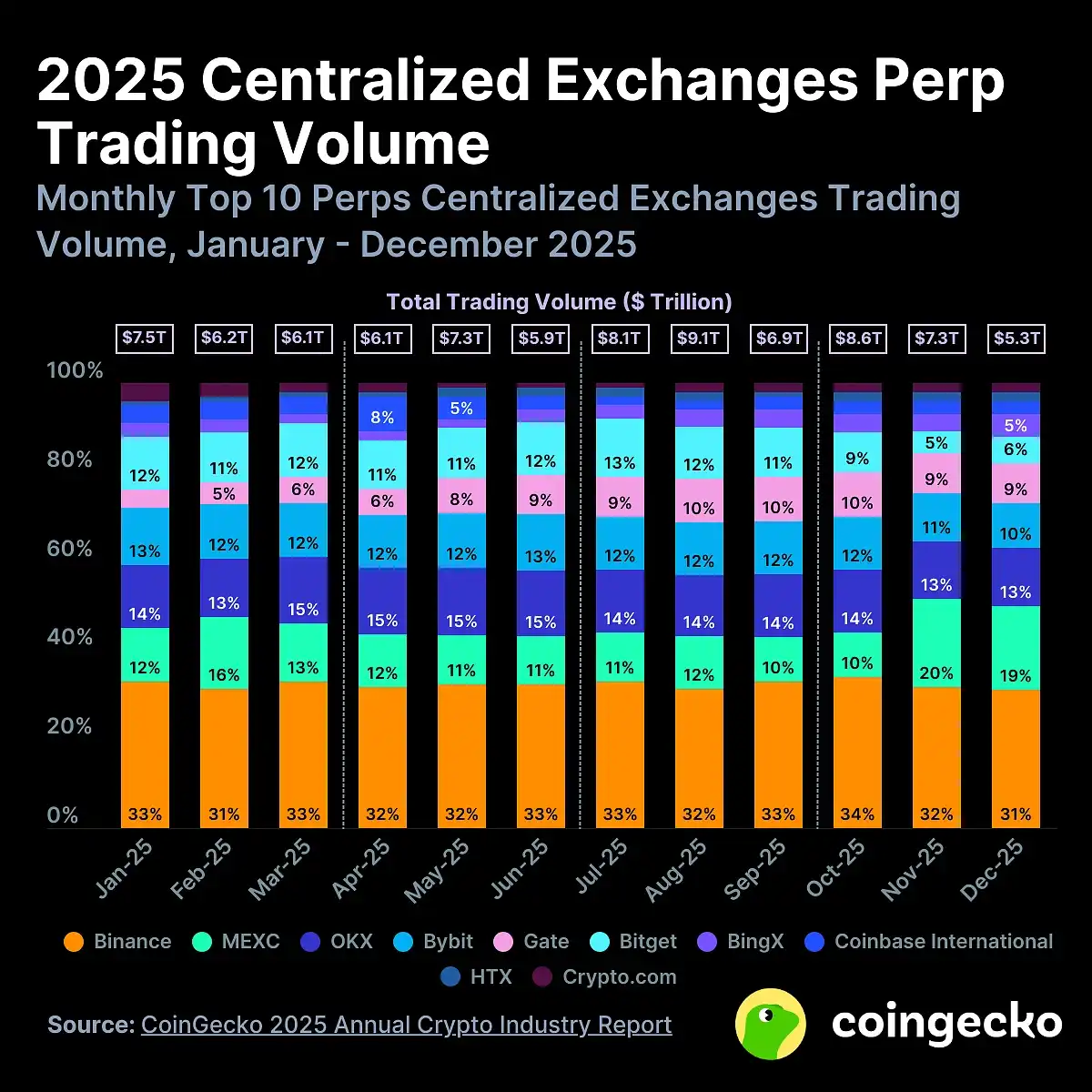
Perpetual contracts have long dominated the global crypto derivatives market. According to CoinGecko's 2025 annual report, the cumulative trading volume of crypto derivatives on centralized exchanges globally was approximately $85.7 trillion, with perpetual contracts accounting for about 78%. In 2025, the cumulative volume of perpetual contracts on decentralized exchanges reached about $6.7 trillion (a 346% year-over-year increase).
Ironically, while traditionalist regulators in Washington debated compliance, offshore decentralized perpetual platforms like Hyperliquid had already extended their reach to S&P 500, crude oil, and gold through on-chain synthetic assets. By the end of May 2026, Hyperliquid's perpetual trading volume had risen to $586.12 billion, and according to Allium on-chain data, the total open interest for Hyperliquid's network-wide derivatives also hit a record high of nearly $60 billion at the end of May. An increasing number of individuals and institutions are choosing to trade on its platform.
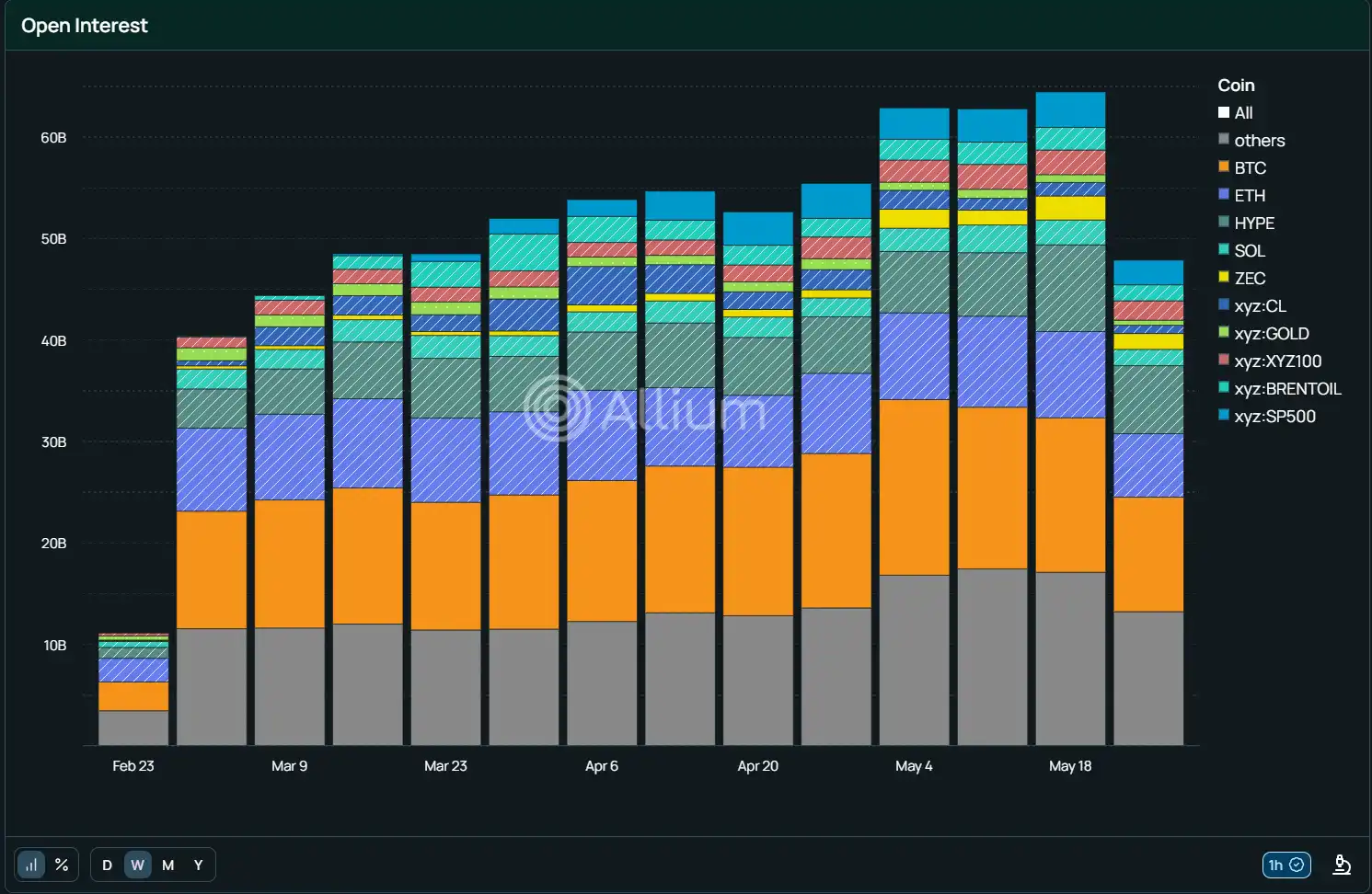
Hyperliquid Latest Open Interest

This unprecedented approval by the CFTC is not just an accommodation to the crypto market; it is a necessary "onshore defense battle" forced upon the compliant world by the innovative pressure from offshore "everything-as-a-perpetual-asset."

In contrast, while regulated Bitcoin futures like those on CME provide stable hedging tools for institutions, their leverage and trading characteristics differ from the perpetual products favored by retail/professional traders.

This approval by the CFTC undoubtedly opens a new battleground for Kalshi in the prediction market. The boundary between prediction markets and traditional crypto derivatives markets has completely blurred; Kalshi can leverage its compliant event-settlement logic to tap into the perpetual capital pool originally belonging to centralized exchanges. For Coinbase, the trading volume and revenue from its perpetual contracts will likely be reflected concretely in its next financial report.

U.S. traders previously relied heavily on offshore platforms, facing custody risks, regulatory uncertainty, and barriers to institutional access. The release of this regulatory policy, which supports crypto collateral, will attract traditional institutions like hedge funds and family offices to participate. Traders can hold leveraged positions long-term to hedge spot exposure without frequent operations; it will also attract some offshore traffic back to U.S. compliant channels.

Simultaneously, the approval for Kalshi and Coinbase will stimulate the accelerated launch of other products like ETH perpetuals, forming a more complete crypto derivatives matrix. In the long term, this policy may enhance the U.S.'s competitiveness in the global crypto derivatives ecosystem, attracting more capital, talent, and infrastructure, creating favorable conditions for deeper integration between crypto assets and traditional finance.

Now may indeed be the most regulation-friendly era for the crypto industry.

Preguntas relacionadas

QWhat were the two major actions taken by the CFTC on May 29th regarding crypto derivatives?

AOn May 29th, the CFTC officially approved Kalshi's application to list a Bitcoin perpetual contract, and issued a no-action letter to Coinbase Financial Markets, allowing it to offer certain perpetual futures products to U.S. customers through a foreign affiliate.

QWhy was the approval of a 'true' Bitcoin perpetual contract in the U.S. considered a significant step?

AIt was significant because, under the traditional Commodity Exchange Act framework, perpetual contracts (with no expiry date) conflicted with the conventional definition of futures. The approval moves crypto derivatives from a regulatory gray area towards a clear, compliant path for truly perpetual products within the U.S.

QAccording to the article, what percentage of global centralized crypto derivatives trading volume do perpetual contracts represent?

AAccording to CoinGecko's 2025 annual report data cited in the article, perpetual contracts accounted for approximately 78% of the cumulative trading volume on global centralized crypto derivatives exchanges.

QWhat does CFTC Chairman Mike Selig say is an important step in making the U.S. a global crypto hub?

ACFTC Chairman Mike Selig stated that introducing true perpetual contracts in the United States is an important step in advancing the U.S. as a global crypto hub.

QHow does the article characterize the CFTC's approval in relation to offshore platforms like Hyperliquid?

AThe article characterizes the CFTC's approval as a defensive move 'onshore,' a compromise by the regulated world in response to the innovation and growth of offshore platforms that have already popularized perpetual contracts for a wide range of assets, including traditional ones like the S&P 500.

Lecturas Relacionadas

Who Funds the Agents?

**Summary: Who Funds AI Agents?** OpenAI recently shut down a feature allowing AI agents to shop for users, highlighting the challenge of creating a secure and regulated environment for agent-driven transactions. While payment infrastructure exists, a crucial governance layer—defining spending limits, fraud detection, tax handling, and return policies—is largely missing. The potential is enormous: AI agents already processed $73M across 176M transactions last year, with McKinsey forecasting this could grow to $3-5T in global consumer commerce by 2030. The core competition isn't just about processing payments, which can be very cheap (especially with crypto-based settlement), but about controlling the rules that govern agent spending. Key players like Stripe and Coinbase are racing to dominate this governance layer. Stripe's acquisition of wallet provider Privy allows it to set spending policies, identity checks, and human-in-the-loop approvals directly at the wallet level. Similarly, Coinbase's stack, including its x402 protocol and AgentKit, embeds governance rules. This vertical integration across settlement, wallet, and governance layers is becoming the dominant strategy. Control over the governance layer is where significant future value lies. If agents handle trillions in transactions, even a small fee for managing compliance, fraud prevention, and policy enforcement could generate billions in annual revenue. The companies that successfully integrate across the payment stack will capture value from idle agent balances, transaction fees, and governance services, positioning themselves as the foundational banks of the AI agent economy.

marsbitHace 7 min(s)

Who Funds the Agents?

marsbitHace 7 min(s)

A Nation Blocks Chips, a Giant Buys a Nuclear Power Plant: Why It's Time to Seriously Consider DeAI

**Title: Great Powers Blockade Chips, Giants Buy Nuclear Plants: Why It's Time to Seriously Consider DeAI** In May 2026, the US closed loopholes for Chinese firms to acquire advanced NVIDIA chips via overseas subsidiaries. That same month, Kenya halted a $1B geothermal data center project involving Microsoft, fearing its immense energy consumption. Meanwhile, Huawei announced mass production of its Ascend AI chip. These disparate events underscore a new reality: the competition for computing power ("compute") has escalated beyond the tech industry, becoming a geopolitical and infrastructural battleground. A new era of oligopoly is forming, with control over the AI stack—from GPU chips (NVIDIA) and cloud platforms (AWS, Azure, Google Cloud) to foundational models (OpenAI, Anthropic)—concentrating in a few Western "AI Octopus" corporations. This centralization creates systemic risks: pricing power and platform lock-in for users, infrastructure fragility, and a widening "compute divide" that threatens to marginalize nations without independent AI capacity. An "AI Iron Curtain" is deepening through export controls. In response, some nations like Saudi Arabia and the UAE are investing heavily to buy compute power, aiming to transition from oil to AI economies. The EU seeks to triple its compute capacity by 2030 to reduce dependency. However, the spending gap is vast, with four US tech giants alone planning ~$750B in AI capex for 2026. The race is increasingly constrained by energy, with AI tasks consuming up to 1000x more power than web searches, pushing firms to even acquire nuclear plants. This landscape is fueling interest in Decentralized AI (DeAI). It proposes a third way: using open protocols to coordinate a global network of idle GPUs, independent developers, and data centers, creating an AI infrastructure without a single controlling entity. Leveraging blockchain and cryptographic verification, DeAI aims to break market concentration, disperse energy demands, reduce geopolitical dependencies, and enhance transparency. While still nascent in performance and stability, DeAI's core promise is not immediate superiority but providing a crucial alternative architecture to resist monopoly, censorship, and centralized power. As specialized AI hardware costs fall and open-source models flourish, the window to build this foundation is open. The very existence of such competition serves as a vital check against the inevitable abuse of concentrated power.

marsbitHace 1 hora(s)

A Nation Blocks Chips, a Giant Buys a Nuclear Power Plant: Why It's Time to Seriously Consider DeAI

marsbitHace 1 hora(s)

Outpoll Review: A Prediction Market Platform Built for Active Traders

Outpoll Review: A Prediction Market Platform Built for Active Traders In recent years, prediction markets have grown from a niche sector to a mainstream arena, attracting billions in trading volume and institutional capital. However, the user experience and tools for traders have not kept pace. Outpoll, a new global prediction market platform, aims to fill this gap by providing enhanced trading infrastructure for active and professional traders. Built on standard prediction market principles, Outpoll allows users to trade on the outcome of specific events. It uses fully collateralized contracts with USDC settlement, charges a competitive 0.1% fee per trade, and provides clear settlement rules upfront to minimize disputes. A key focus for Outpoll is its professional-grade trading tools. The platform supports limit and market orders, as well as take-profit and stop-loss orders for open positions—features uncommon in prediction markets. For automated trading, Outpoll offers comprehensive REST and WebSocket APIs, enabling portfolio management, price arbitrage, and integration with existing tools. The platform also features a creator-led market model, where approved experts and community leaders can create and manage markets for niche topics under platform supervision. Its integrated interface combines news feeds directly with trading functions, allowing users to monitor events and manage positions seamlessly. Outpoll launched with a native Android app (available on Google Play) and plans an iOS version later this year. In summary, Outpoll distinguishes itself with trader-focused tools, practical APIs, transparent and collateralized markets, integrated news, and an expanding creator program. For active traders, its advanced order types and API access alone make it a platform worth watching. Outpoll is now globally accessible via outpoll.com and Google Play.

marsbitHace 1 hora(s)

Outpoll Review: A Prediction Market Platform Built for Active Traders

marsbitHace 1 hora(s)

Trading

Spot
Futuros

Artículos destacados

Cómo comprar ERA

¡Bienvenido a HTX.com! Hemos hecho que comprar Caldera (ERA) sea simple y conveniente. Sigue nuestra guía paso a paso para iniciar tu viaje de criptos.Paso 1: crea tu cuenta HTXUtiliza tu correo electrónico o número de teléfono para registrarte y obtener una cuenta gratuita en HTX. Experimenta un proceso de registro sin complicaciones y desbloquea todas las funciones.Obtener mi cuentaPaso 2: ve a Comprar cripto y elige tu método de pagoTarjeta de crédito/débito: usa tu Visa o Mastercard para comprar Caldera (ERA) al instante.Saldo: utiliza fondos del saldo de tu cuenta HTX para tradear sin problemas.Terceros: hemos agregado métodos de pago populares como Google Pay y Apple Pay para mejorar la comodidad.P2P: tradear directamente con otros usuarios en HTX.Over-the-Counter (OTC): ofrecemos servicios personalizados y tipos de cambio competitivos para los traders.Paso 3: guarda tu Caldera (ERA)Después de comprar tu Caldera (ERA), guárdalo en tu cuenta HTX. Alternativamente, puedes enviarlo a otro lugar mediante transferencia blockchain o utilizarlo para tradear otras criptomonedas.Paso 4: tradear Caldera (ERA)Tradear fácilmente con Caldera (ERA) en HTX's mercado spot. Simplemente accede a tu cuenta, selecciona tu par de trading, ejecuta tus trades y monitorea en tiempo real. Ofrecemos una experiencia fácil de usar tanto para principiantes como para traders experimentados.

369 Vistas totalesPublicado en 2025.07.17Actualizado en 2026.06.02

Cómo comprar ERA

Discusiones

Bienvenido a la comunidad de HTX. Aquí puedes mantenerte informado sobre los últimos desarrollos de la plataforma y acceder a análisis profesionales del mercado. A continuación se presentan las opiniones de los usuarios sobre el precio de ERA (ERA).

活动图片













