A Visual-Native Harness for Multimodal Models is Here!
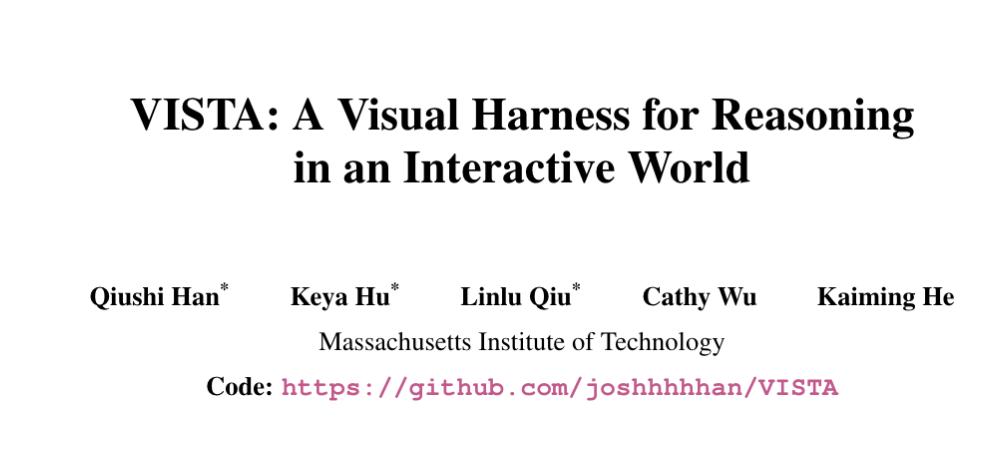
Recently, in their latest paper "VISTA: A Visual Harness for Reasoning in an Interactive World," Kaiming He's team proposed a set of visual-native harnesses.
VISTA.
It allows existing multimodal models to directly observe the environment, save raw frames, and look back, zoom in, and check details during reasoning, without the need for training from scratch.
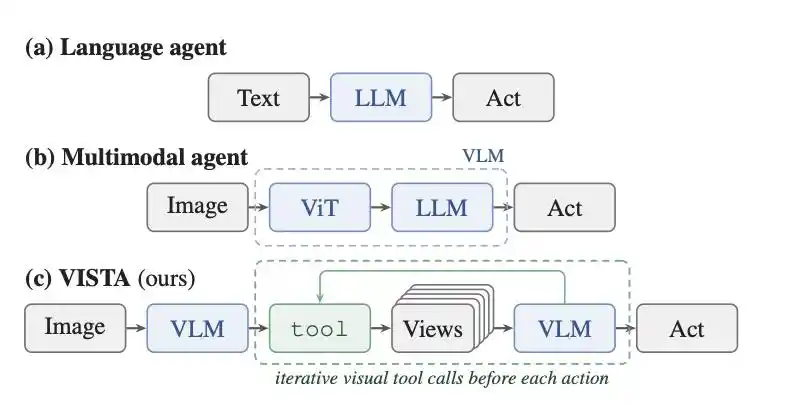
Compared to the traditional approach of abstracting the environment into text or code, VISTA preserves raw visual information. The model can recall previously seen frames back into the context based on the current problem, to participate in judgment and reasoning.
Based on this method, visual experience becomes a context that the model can call upon and re-examine at any time, and multimodal models now have a native scaffold built around visual memory.
In evaluations, equipped with VISTA, Claude Opus 5.0 completed all 25 publicly available games in ARC-AGI-3, achieving a perfect relative human action efficiency score of 100, using 57.4% fewer game actions than the baseline of first-time human players.
Using GPT-5.6 Sol, it also cleared all games with a score of 99.
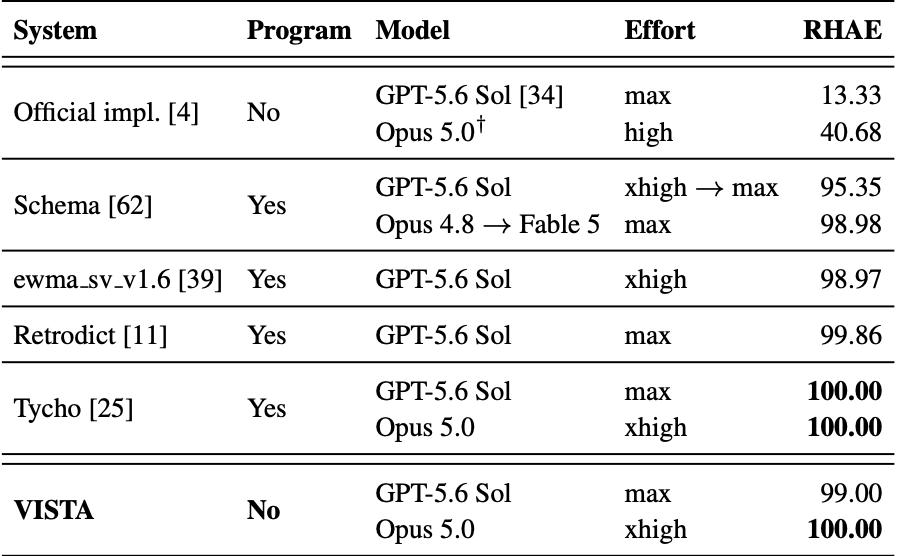
Going further, the team validated this method on browser games, mazes, and connect-the-dots puzzles, and listed more physically-grounded embodied tasks as future research directions.
How was this achieved?
A Visual-Native Scaffold
From ResNet, Mask R-CNN to MAE, visual perception and representation learning have always been a main thread in Kaiming He's research.
This time, VISTA focuses on a new question: how can a model accumulate, preserve, and utilize visual experience during continuous interaction?
The answer is Harness.
Last November, Anthropic used long-term programming tasks as an example to explain how Harness helps models span multiple context windows to continuously advance tasks.
Specifically, the Harness maintains a task list to record pending items, and uses progress files and code logs to save completed work.
In this way, even when the model enters a new context window, it can read this information to understand what was done before and what needs to be done next.
Complex tasks can thus be executed step-by-step, results checked, and work continued across different context windows.
It can be said that this Harness, which mainly saves task state through text and code, has to some extent driven the recent explosion in Agent capabilities.
However, in real environments, mere textual memory is clearly insufficient.
Because once in a real visual environment, the model needs to remember not only the position and orientation of objects, but also what exactly changed in the environment before and after each action.
Moreover, when the model first sees an image, it may not know which details will become important later.
At the same time, this visual information is difficult to fully record in a text note in advance, and even harder to guarantee that the recorded information will still be sufficient when the model later performs tasks.
In benchmarks like ARC-AGI-3, an existing approach is to first convert the screen into a textual grid of numbers, and then have the model write programs to simulate environment rules and verify action plans.
(Note: ARC-AGI-3 is a set of interactive visual reasoning benchmarks that do not provide game rules or objectives in advance. Agents must figure out how to clear the game through observation and action.)
The problem is, the more complex the environment, the harder it is to completely translate the appearance, spatial relationships, and dynamic changes of objects into text and code. Also, as the interaction history grows longer, earlier screens are gradually moved out of context or replaced by textual summaries.
Thus, here, VISTA's research question becomes:
How can an agent re-examine previously seen visual information when needed for reasoning, without additional training of the base model?
Based on this, VISTA saves every frame returned by the environment as-is outside the context, including animation frames during actions, and retrieves them when the model needs them.
In the ARC-AGI-3 evaluation, it can both compare screens from different times and zoom in locally to check orientation markers on small squares.
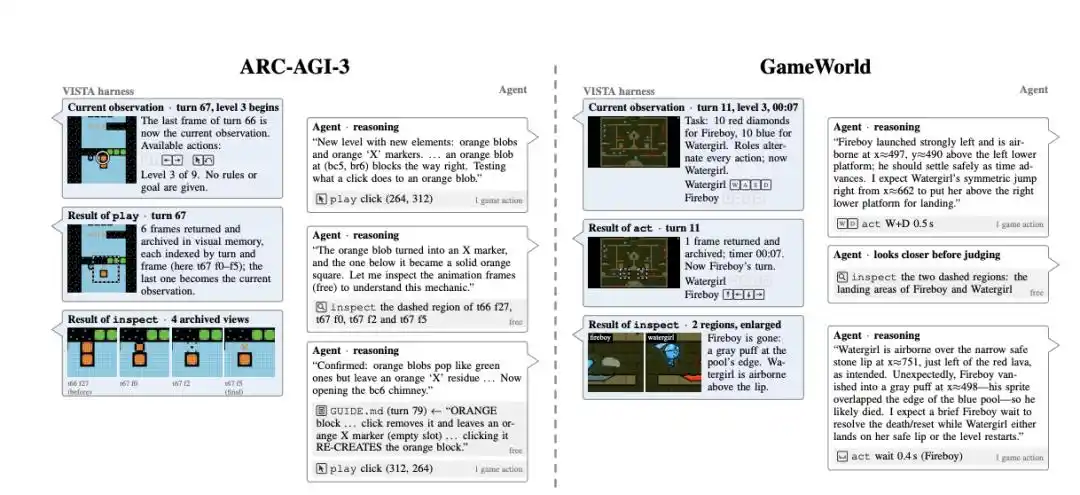
Here, textual notes record the model's current understanding, while raw frames preserve evidence for its re-evaluation.
The study terms this mechanism explicit attention to interaction history, where the model selects which visual information to bring back into context based on the problem it is considering.
For such selection to be possible, the system must save raw frames and provide tools for retrieval and inspection at any time.
Specific Implementation
To enable the model to preserve and utilize past visual experience, VISTA designs three core components:
Visual Observation, Lossless Visual Memory, and Active Visual Inspection. These components each have distinct roles, responsible for allowing the model to see the screen clearly, save history, and review on demand.
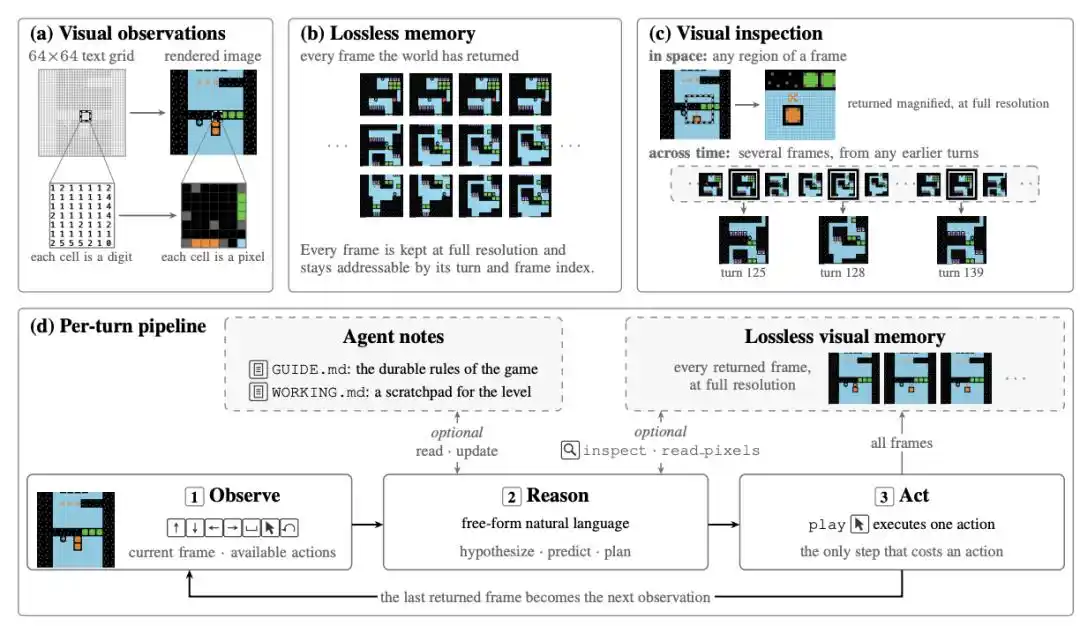
First is Visual Observation, responsible for providing the environment screen to the model.
In the ARC-AGI-3 experiment, VISTA upscales the officially provided 64×64 screen to a 512×512 PNG image, preserving the color, appearance, and spatial relationships of objects, allowing the model to directly observe the environment.
Second is Lossless Visual Memory, responsible for saving the screens seen by the model.
After each action, VISTA completely saves all frames returned by the environment, including animation intermediate frames during the action, and indexes them by round and frame number.
This way, the model doesn't have to judge in advance which information is worth remembering, but can first save the complete visual experience for later use.
Finally, Active Visual Inspection, responsible for letting the model review historical frames on demand.
Using the inspect tool, the model can specify a historical round and retrieve the corresponding frame, or crop and zoom into a local area to check details.
If it wants to know what a particular operation actually changed, the model can also retrieve multiple frames at once to compare before and after the action.
The entire process is akin to giving the model a visual archive it can browse at any time. It can not only see the current environment but also actively review past observations to inform its next actions.
So, how do these three components work together specifically?
According to VISTA's execution flow, at the start of each round, the model first observes the current screen and available actions, then, combined with previously accumulated experience, judges the current state of the environment and proposes a hypothesis for the next action.
If existing information is insufficient, the model can call tools to review historical frames, zoom into local areas, or even read specific pixel information to find further evidence.
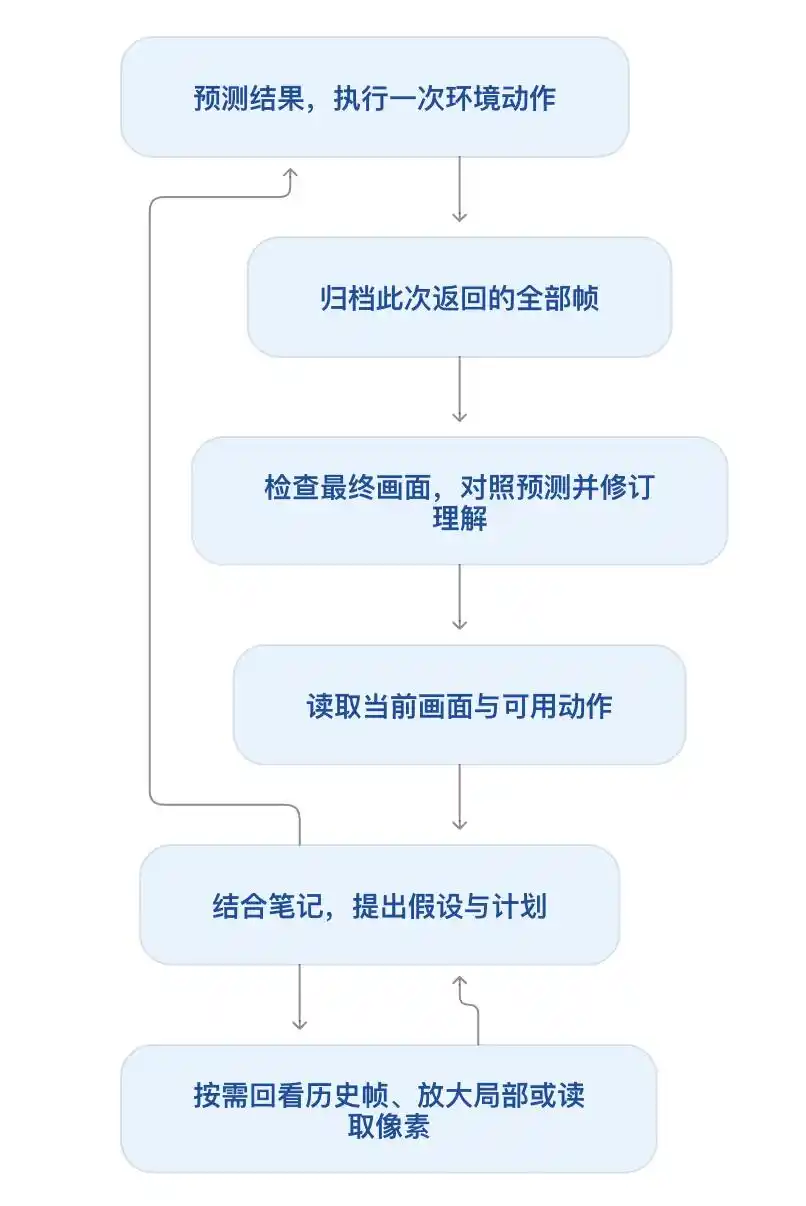
After finding evidence, the model doesn't act directly. Instead, it first predicts what changes this operation might bring.
Once the action is executed, it compares the actual result with the prediction, checks if its judgment was correct, and accordingly refines its understanding of the game rules.
Through repetition, the model can explore the environment while accumulating experience during continuous interaction.
Of course, having just a visual archive isn't enough. To keep the model coherent during long tasks, VISTA also introduces two text notes:
GUIDE.md: Records reusable rules and experiences between different levels.
WORKING.md: Records the status, progress, and subsequent plans for the current level.
When the context approaches its limit, the model first organizes a handover summary, then enters a new context window to continue the task. Previous text notes, action history, and visual archives are all preserved.
There's another noteworthy design: while VISTA completely saves historical frames, it doesn't dump all images into the model's context at once.
In the full scheme, after each action, the framework by default only shows the model the final frame. As for intermediate frames during the action, they are uniformly saved in the visual archive, to be retrieved only when the model actively requests them.
This preserves complete visual information while avoiding having large amounts of historical images continuously occupying context space.
More importantly, VISTA doesn't train a new model for this purpose.
Environment understanding, action planning, and reasoning are still performed by off-the-shelf multimodal models, while the Harness is responsible for executing tool calls, saving visual history, and providing relevant evidence when the model needs it.
In other words, what VISTA changes is not the model itself, but the way the model acquires, stores, and uses visual information.
Experimental Validation
Beyond the experiments mentioned at the beginning, the team also tested VISTA on the GameWorld, AI GameStore, and BabyVision benchmarks, covering tasks like browser games, mazes, and connect-the-dots.
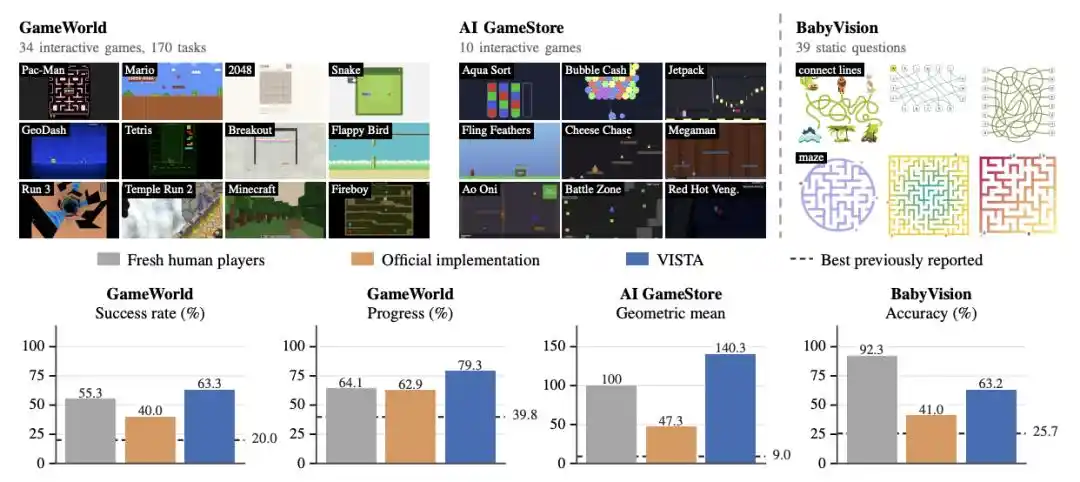
Using the same GPT-5.6 Sol model, compared to the official base framework, VISTA increased the success rate from 40.0% to 63.3% across 170 tasks in GameWorld;
On the 10 games in AI GameStore, the composite score rose from 47.3 to 140.3 (with the human median normalized to 100);
On the 39 selected maze and connect-the-dots problems in BabyVision, accuracy improved from 41.0% to 63.2%. For this last set of static-image-only tasks, the model could also improve judgment by zooming into local areas and checking pixels.
These results indicate that saving raw frames and allowing the model to review on demand can further unleash the capabilities of existing multimodal models.
The same VISTA framework, with minimal adaptation, can be used for different games and puzzles, also demonstrating its application potential in more visual tasks.
In conclusion, the research points future validation towards more physically-grounded embodied tasks: enabling models to save, review, and utilize their own visual experience in continuously changing environments to decide their next actions.
Author Introduction
Finally, let's introduce the authors of this work.
The three co-first authors of the paper are Qiushi Han, Keya Hu, and Linlu Qiu. The other two authors are Cathy Wu and Kaiming He.
Qiushi Han (Josh Han) is currently a Ph.D. student at the MIT Operations Research Center, advised by Cathy Wu.

Keya Hu is currently a Ph.D. student in the MIT Department of Electrical Engineering and Computer Science, jointly advised by Kaiming He and Jacob Andreas.
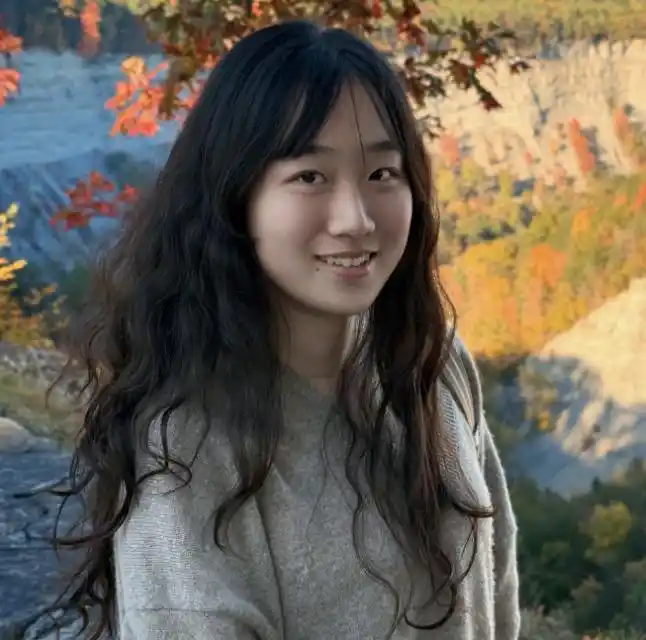
She graduated with a bachelor's degree from the ACM Honors Class at Shanghai Jiao Tong University. Her research interests focus on the intersection of language and vision, aiming to build agents with higher data efficiency and stronger generalization capabilities.
Linlu Qiu is currently a Ph.D. student in the MIT Department of Electrical Engineering and Computer Science and the Computer Science and Artificial Intelligence Laboratory, advised by Yoon Kim and Jacob Andreas.
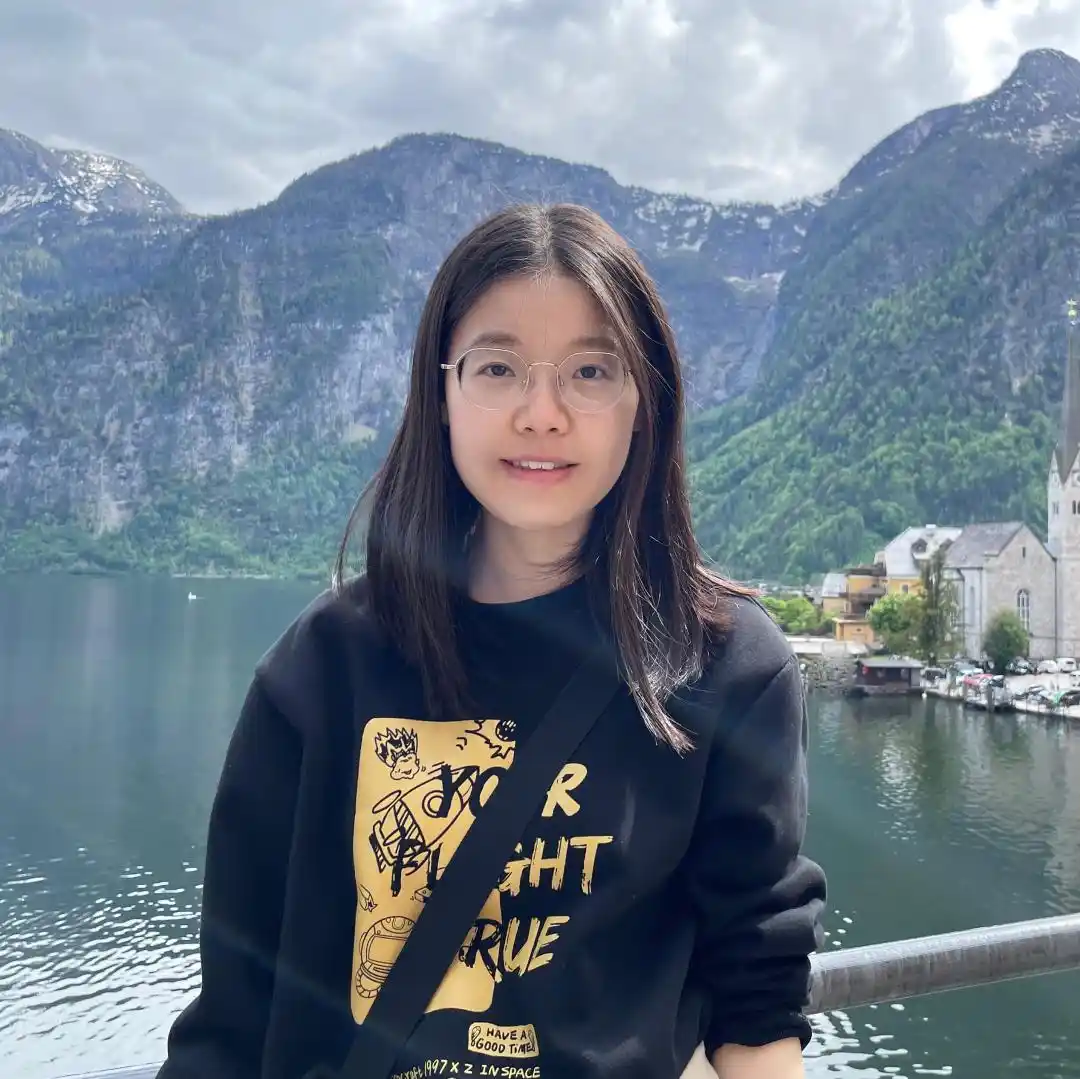
Her research directions include natural language processing and machine learning. She has conducted research at Google Research and Meta FAIR.
Cathy Wu is currently an Associate Professor in the MIT Department of Civil and Environmental Engineering and the Institute for Data, Systems, and Society, researching how to use machine learning and reinforcement learning to improve complex systems like transportation.

She received her bachelor's and master's degrees from MIT and later earned her Ph.D. from UC Berkeley.
Kaiming He is currently a tenured Associate Professor in the MIT Department of Electrical Engineering and Computer Science, and a main author of works such as ResNet, Mask R-CNN, and MAE.

He received his bachelor's degree from Tsinghua University and his Ph.D. from The Chinese University of Hong Kong. He previously worked at Microsoft Research Asia and FAIR, joining MIT in 2024.
Reference Link [1]https://arxiv.org/pdf/2610.02200
This article is from the WeChat public account "QbitAI", author: henry