Justin Sun Sues Trump Family: What $75 Million Bought Was Only a Blacklist

marsbitPublicado a 2026-04-23Actualizado a 2026-04-23

Resumen

Justin Sun, founder of Tron, has filed a lawsuit in federal court against World Liberty Financial (WLF), alleging he was made the "primary target of a fraudulent scheme" after investing $75 million. Sun claims the investment secured him an advisor title and WLFI tokens, which were later frozen by WLF, causing "hundreds of millions in losses." The dispute began in late 2024 when Sun's investment helped revive WLF's struggling token sale, which ultimately raised $550 million. Shortly after, the SEC dropped its lawsuit against Sun following Donald Trump's inauguration. However, relations soured when Sun refused WLF's demands for additional funding. In August 2025, WLF added a "blacklist" function to its smart contract, allowing it to unilaterally freeze tokens. Sun's holdings, worth approximately $107 million, were frozen, and he was threatened with token destruction. The lawsuit highlights WLF's structure, which directs 75% of token sale profits to the Trump family, who had earned $1 billion by December 2025. WLF's CEO is Zach Witkoff, son of U.S. Middle East envoy Steve Witkoff. The project faces scrutiny for opaque operations, including a controversial loan arrangement on the Dolomite platform, co-founded by a WLF advisor. Despite Sun's history with the SEC, the case underscores centralization risks within DeFi, as WLF controls governance and holds powers to freeze assets arbitrarily. Sun's tokens remain frozen as legal proceedings begin.

Author: Ada, Deep Tide TechFlow

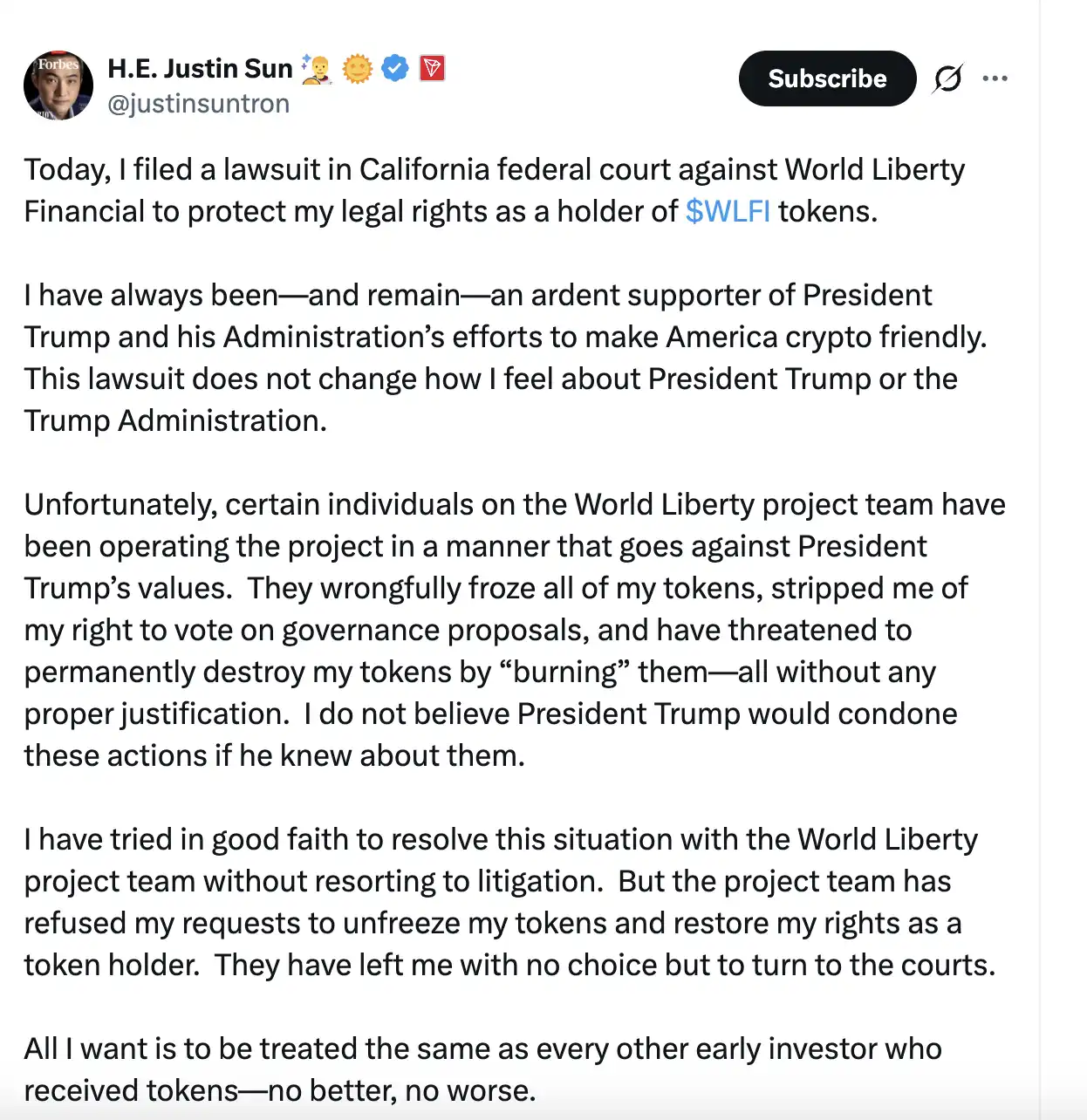
Justin Sun invested $75 million and got an advisor title, a pile of frozen tokens, and a federal court lawsuit in return.

On April 22, the founder of Tron formally sued World Liberty Financial in San Francisco federal court, accusing it of making him "the primary target of its fraudulent scheme," causing him and his companies to suffer "losses amounting to hundreds of millions of dollars." He also accused WLF of being currently "on the verge of collapse" and "severely insolvent," and planning to pay 95% of the token sale proceeds to "company insiders."

The person in the crypto circle best at calculating got calculated this time.
The $75 Million "Pledge of Allegiance"

Rewind to the end of 2024.

World Liberty Financial had just launched the sale of WLFI tokens, and the scene was embarrassingly quiet, with only $22 million in sales in the first month.

Justin Sun stepped in. First, he threw in $30 million, later increased to $45 million, plus 1 billion tokens received for advisory services, totaling an investment of approximately $75 million. He became World Liberty's largest public investor.

After Sun bought, other investors followed, and the project ultimately raised about $550 million. World Liberty Financial later publicly admitted that Sun helped the project "come back to life."

At that time, the SEC was suing Sun, accusing him of market manipulation, selling unregistered securities, and paying celebrities to promote without disclosure. However, after Trump took office in January 2025, the SEC voluntarily suspended its lawsuit against Sun. In March 2026, the two sides settled for $10 million, with Sun not admitting any wrongdoing.

A $30 million investment got rid of a lawsuit that could have bankrupted him. Sun calculated this account very clearly.

Refused to Inject More Capital, Immediately Blacklisted

The honeymoon period was short.

According to the complaint, World Liberty Financial continuously asked Sun to make additional investments throughout 2025, including asking him to mint World Liberty Financial's USD1 stablecoin on the Tron network. Sun refused.

By July 2025, the relationship completely broke down.

What happened next was less a commercial dispute and more an on-chain manhunt.

In August 2025, World Liberty Financial modified the WLFI token's smart contract, inserting a "blacklist" function. The project team could unilaterally freeze any holder's tokens without notice, without reason, and without a governance vote.

A month later, Sun tried to transfer his WLFI tokens. But his wallet was blacklisted, and approximately $107 million worth of governance tokens were frozen, with voting rights revoked.

Later, World Liberty Financial threatened to "burn" (destroy) his tokens. In the blockchain world, burn means permanent eradication; the asset ceases to exist.

Sun claimed he had tried to "resolve the matter amicably," but the other party refused to unfreeze the tokens and restore his rights.

"They left me with no choice but to turn to the courts," he wrote on X.

World Liberty Financial CEO Zach Witkoff responded that Sun's allegations were "completely without merit" and said Sun had engaged in "improper conduct," forcing World Liberty Financial to take action to "protect itself and its users."

No one explained what this "improper conduct" specifically was.

The President's ATM

To understand why Sun was frozen, one must first see what World Liberty Financial really is.

On the surface, it is a "decentralized finance" project, claiming to let small investors control their own funds. It has a governance token WLFI, a stablecoin USD1, and DeFi lending products.

But peel back this layer, and the core structure is a profit pipeline.

The Trump family receives 75% of the net proceeds from WLFI token sales. By December 2025, the family had already profited $1 billion from this, while holding $3 billion worth of unsold tokens. The reserve assets for the USD1 stablecoin are invested in U.S. Treasury bonds, and the interest income generated also flows to family entities. Based on a market cap of $4.2 billion and current Treasury yields, the stablecoin alone could generate approximately $160 million in annual income.

This doesn't even include the biggest chunk.

In January 2025, just four days before Trump's inauguration, an investment entity of Abu Dhabi royal family member Sheikh Tahnoon bin Zayed acquired a 49% stake in World Liberty Financial for $500 million. The agreement was signed by Eric Trump. $187 million flowed directly into entities controlled by the Trump family, and at least $31 million went to entities linked to the Witkoff family.

Zach Witkoff, CEO and co-founder of World Liberty Financial. His father, Steve Witkoff, is the U.S. Special Envoy to the Middle East.

Senator Elizabeth Warren called it "blatant corruption." The House of Representatives subsequently launched an investigation. Trump himself said he was "unaware" of the deal.

Dolomite: Borrowing Your Own Money

In early 2026, on-chain data showed World Liberty Financial deposited 5 billion of its own WLFI tokens into the DeFi lending platform Dolomite as collateral, borrowing approximately $75 million in stablecoins. Over $40 million of this was transferred to Coinbase Prime, which usually means the tokens were converted into fiat currency.

And Dolomite's co-founder, Corey Caplan, is simultaneously an advisor to World Liberty Financial.

Your own tokens, deposited into a platform run by your own advisor, borrowing your own issued stablecoins, and then converting to cash.

This operation pushed the utilization rate of Dolomite's USD1 lending pool to 100%. Ordinary depositors were locked in, unable to withdraw their funds. And World Liberty Financial's collateral accounted for 55% of Dolomite's total value locked (TVL).

World Liberty Financial's response: "We, as an anchor borrower, created attractive yields for the platform."

In other words, they used their own issued tokens as collateral on their advisor's platform to borrow their own issued stablecoins. In traditional finance, this is called a related-party transaction, requiring separate auditing and disclosure. In DeFi, there wasn't even an announcement.

Sun publicly challenged this on April 12, saying the World Liberty Financial team treated users as a "personal ATM" and that he was the "first and biggest victim." Three days later, World Liberty Financial introduced a governance proposal.

Ultimatum

The governance proposal on April 15 was nominally about "governance restructuring." The actual content: 6.228 billion WLFI tokens (62% of the total supply) would be subject to a new unlocking schedule. The 45.2 billion tokens held by founders, team, and advisors needed to accept a 10% burn (approx. 4.52 billion tokens), then enter a 2-year lock-up period followed by 3-year linear release.

Holders who did not accept the new terms would have their tokens frozen indefinitely.

Sun called this proposal "one of the most ridiculous governance scams I have ever seen." But he couldn't vote against it because his tokens were already frozen.

Look at the distribution of voting power. In a USD1 governance proposal passed in January 2026, the top nine wallets controlled nearly 60% of the voting power.

WLFI's price action says it all. It hit an all-time high of $0.46 in September 2025 and has been falling since. On April 11, it touched an all-time low of $0.0767, down 84% from its high.

Early buyers who got in at $0.015 still have paper gains. But if you're Justin Sun, your $75 million investment bought tokens once worth over $1 billion, but now they are frozen and potentially facing permanent destruction.

The Same Mirror

Justin Sun is no innocent victim.

He has been accused by the SEC of market manipulation and fraud, and his investment timing precisely coincided with his legal troubles.

Precisely because he is not innocent, this case is interesting.

A person who made his fortune by "rug pulling" is treated with the same tactics by a larger power structure. The contrast here speaks volumes, more than any whitepaper.

World Liberty Financial promised "decentralized finance," user control over assets, no middlemen, no censorship.

But in reality, the smart contract has a backdoor, the project team can freeze your tokens at any time, governance votes are controlled by nine wallets, and the founders use your deposits to lend to themselves.

Sun's original words on X were: "Unfortunately, certain individuals within the World Liberty Financial project team are operating the project in a manner inconsistent with President Trump's values."

Even at the moment of filing the lawsuit, he was still saving face for Trump. A person who spent $75 million, after having all his assets frozen, still carefully distinguished between "President Trump" and "certain individuals within the project team" in the complaint.

The most interesting part of this case is not whether Sun can get his tokens back. It's how the court will characterize WLFI. If it is a security, then World Liberty Financial's act of modifying the contract and freezing holder assets without a vote could constitute fraud under federal securities law.

WLFI is currently quoted at $0.078, down about 84% from its high. The adequacy of the USD1 stablecoin reserve is being questioned. The risk in Dolomite's lending pool remains unresolved. The House investigation is ongoing. But the Trump family has already cashed out over $1 billion.

The earliest maturity window for Sun's convertible bonds is in 2027. Court scheduling could take over a year. During this time, WLFI tokens will continue to unlock, and more people will be forced to accept the choice of "either agree to the new terms or be frozen forever."

Preguntas relacionadas

QWhat is the core allegation in Justin Sun's lawsuit against World Liberty Financial?

AJustin Sun alleges that World Liberty Financial made him 'the primary target of its fraudulent scheme,' causing him and his companies to suffer 'hundreds of millions of dollars in losses.' He also claims the company is 'on the brink of collapse' and 'severely insolvent,' with plans to pay '95% of the token sale proceeds to company insiders.'

QWhat specific action did World Liberty Financial take that led to Justin Sun's assets being frozen?

AIn August 2025, World Liberty Financial modified the WLFI token's smart contract to include a 'blacklist' function. This allowed the project to unilaterally freeze any holder's tokens without notice, reason, or a governance vote. Sun's tokens, worth approximately $107 million, were frozen when he tried to transfer them a month later.

QHow is the Trump family financially connected to World Liberty Financial according to the article?

AThe Trump family receives 75% of the net proceeds from WLFI token sales, having already profited $1 billion by December 2025. They also hold $3 billion in unsold tokens. Furthermore, interest income from the USD1 stablecoin's treasury reserves flows to family entities, generating an estimated $160 million annually.

QWhat controversial transaction involving Dolomite is described in the article?

AWorld Liberty Financial deposited 5 billion of its own WLFI tokens into the DeFi lending platform Dolomite as collateral to borrow approximately $75 million in stablecoins. Over $40 million of this was transferred to Coinbase Prime, likely to be converted to cash. This is controversial because Dolomite's co-founder is also an advisor to World Liberty Financial, creating a clear conflict of interest.

QWhat was the 'ultimatum' presented to token holders in the April 15th governance proposal?

AThe proposal required that 45.2 billion tokens held by founders, team, and advisors be subject to a 10% burn (approx. 4.5 billion tokens) and then locked for 2 years with a 3-year linear release schedule. Holders who did not accept these new terms would have their tokens frozen indefinitely.

Lecturas Relacionadas

AI PC Battle: Bet on the Toll Booth, Not the Camp

**Title:** The AI PC Battle: Don't Bet on Sides, Bet on the Tollbooth **Summary:** The AI PC competition is moving beyond simple "x86 vs. Arm" narratives. The core investment thesis should focus on identifying which players can sustain margins, cash flow, and pricing power throughout the upgrade cycle, rather than backing a particular architecture. The opportunity is analyzed in three layers: 1. **The Advanced Foundry Tollbooth:** TSMC is positioned to collect "tolls" regardless of which chip designer wins, due to its dominant ~70% share in advanced semiconductor manufacturing, which is essential for high-end AI PC chips. 2. **Compute & Platform Spillover:** AMD represents an offensive in the x86 CPU+GPU space, while NVIDIA leverages its GPU and CUDA software stack dominance. Both benefit from the demand for increased local AI compute. 3. **Architecture Diffusion & Turnaround Plays:** ARM and Intel offer potential for significant upside (elasticity), but investments here require stricter discipline due to higher execution risks and competitive challenges. The industry is transitioning from concept to shipment validation. While short-term forecasts for AI PC adoption have been revised down slightly due to tariffs and procurement delays, the long-term trend towards AI becoming a standard PC feature remains intact. The key driver for upgrade cycles will be whether compelling enterprise applications (e.g., privacy-sensitive computing, low-latency inference) emerge beyond consumer-focused features like meeting summarization. Investment strategy should prioritize companies with platform-level advantages and recurring revenue streams. TSMC offers high certainty as the foundational tollbooth. AMD presents a strong offensive play within the established ecosystem. ARM and Intel are higher-risk, higher-potential-reward turnaround bets. The report cautions against chasing short-term hype and emphasizes a disciplined, long-term approach focused on buying ecosystem strength and cash-flow certainty after market enthusiasm subsides. **Key Risks:** Underwhelming AI PC applications slowing upgrade cycles; slow improvement in Windows on Arm compatibility; macro/tariff impacts on PC demand; potential advanced node supply-demand mismatches affecting TSMC; high overall AI sector valuations making stocks vulnerable to a risk-off shift in markets.

marsbitHace 14 min(s)

AI PC Battle: Bet on the Toll Booth, Not the Camp

marsbitHace 14 min(s)

Ten-Thousand-Word Analysis: From $10 to $290, MRVL Wins the Entire AI Era by 'Not Making GPUs'

Marvell Technology's stock price surged from under $10 in 2016 to a record $290 in June 2026, fueled not by making GPUs, but by dominating AI infrastructure connectivity. This analysis argues the market misvalues MRVL as merely a smaller Broadcom in custom AI chips, overlooking its true, unique position. Marvell's core strength lies in enabling high-speed data flow for AI clusters through three interconnected businesses. First, it holds a commanding ~70% market share in high-speed optical DSPs (essential for data center light modules), a deep-moat business with accelerating growth. Second, its custom AI chip design business serves hyperscalers like AWS, Microsoft, and Google, with a significant revenue pipeline despite lower margins. Third, stable cash flows come from Ethernet switch chips and enterprise storage controllers. Together, they form a full-stack "AI data movement" platform. CEO Matt Murphy's transformative leadership since 2016, involving strategic divestments, key acquisitions (like Inphi for optical DSPs), and securing long-term agreements with major cloud providers, repositioned the company. A pivotal $2 billion strategic investment from NVIDIA in 2026 underscored Marvell's critical role in the AI ecosystem, particularly through collaborations like NVLink Fusion. While Marvell faces risks—including client concentration (losing the Amazon Trainium3 design), lower-margin business mix, competitive threats, insider selling, and complex supply chains—its fundamentals remain strong. The optical interconnect moat is widening with the acquisition of Celestial AI (photonics fabric), and financial metrics show accelerating revenue growth and operating leverage. With a PEG ratio suggesting undervaluation relative to its growth, the thesis is that the market undervalues Marvell's monopolistic position in AI "plumbing" while overemphasizing its competitive custom chip segment. The story transcends investing, symbolizing how in any complex system—from the internet to AI—the value of "connection" ultimately surpasses that of individual "nodes."

marsbitHace 43 min(s)

Ten-Thousand-Word Analysis: From $10 to $290, MRVL Wins the Entire AI Era by 'Not Making GPUs'

marsbitHace 43 min(s)

AI Relay Stations Spark Heated Debate on Zhihu: Behind Cheap Tokens, What Are Users Really Worried About?

A discussion on Zhihu about "AI relay stations" shifted the niche developer topic of "cheap tokens" into broader user awareness. Users moved beyond simply questioning the legitimacy of these services to focus on practical concerns: Where do cheap tokens truly come from? Is the model being accessed the real one? Can relay stations see prompts, code, and API keys? For occasional users, are the risks worth it? The core debate centered less on price and more on trust. A primary worry is model authenticity—the risk of "model swapping," where users paying for a premium model might be routed to a cheaper one, creating an information asymmetry. Others argued that cost comparisons matter; while cheaper than official pay-as-you-go APIs, relay stations may not be the lowest-cost option versus subscriptions, domestic models, or free tiers, making user needs assessment crucial. Speculation about token sources ranged from legitimate bulk discounts to gray-area methods like account sharing or exploiting regional pricing. This opacity makes risk assessment difficult for users. Data security emerged as a critical concern, especially for enterprise use. When processing sensitive information like code, contracts, or client data, the inability to verify a relay station's data handling, retention, or access policies poses significant compliance and confidentiality risks. The evolving consensus suggests relay stations can be used cautiously for low-sensitivity, disposable tasks (e.g., summarizing public info, simple translation). However, they should not be the default for sensitive, professional, or production workflows involving proprietary data, Agents, or automated systems. Recommendations include avoiding large prepayments, not relying on a single service, using test prompts to monitor quality, anonymizing data where possible, and keeping official channels as backups. Ultimately, the discussion framed tokens not just as a billing unit but as a measure of real cost encompassing price, model integrity, data security, and service stability. The popularity of relay stations highlights user demand for affordable access, but the debate underscores a key trade-off: the savings from cheap tokens may come at the price of trust, transparency, and control over one's data and AI experience.

marsbitHace 1 hora(s)

AI Relay Stations Spark Heated Debate on Zhihu: Behind Cheap Tokens, What Are Users Really Worried About?

marsbitHace 1 hora(s)

In-Depth Research Report on TradFi: The Convergence Wave of Crypto and Traditional Finance

In 2026, the crypto industry is undergoing a profound infrastructure-level transformation—TradFi assets are migrating on-chain at an unprecedented pace. According to CoinGecko's Q1 2026 report, the total value locked (TVL) of tokenized real-world assets (RWA) has surpassed $31 billion, a nearly 4x increase from $7.8 billion at the beginning of 2025, with the sector’s aggregate market capitalization reaching $19.3 billion. Among these, the market cap of tokenized stocks surged from $2 million to $486 million, with Q1 spot trading volume reaching $15.1 billion—a single quarter already surpassing the entire second half of 2025. RWA perpetual contract Q1 trading volume reached a staggering $524.8 billion, far exceeding the $313 billion for all of 2025. Meanwhile, BlackRock's BUIDL fund has reached $2.3 billion in scale and has filed for two new tokenized funds, signaling that the world's largest asset manager's tokenization strategy is evolving from pilot to product suite expansion. HTX, as a core participant in the crypto exchange sector, officially launched TradFi perpetual futures products including NVDA, AAPL, MSFT, META, and SPY in 2026, enabling crypto users to gain 24/7 trading access to core U.S. equities. Boston Consulting Group predicts that global tokenized asset scale could reach $16 trillion by 2030, while McKinsey offers a conservative estimate of approximately $2 trillion. The on-chain migration of TradFi assets is no longer a "future narrative" but a structural transformation unfolding in real time, as crypto exchanges evolve from single crypto asset trading platforms toward "multi-asset-class trading infrastructure."

HTX LearnHace 1 hora(s)

In-Depth Research Report on TradFi: The Convergence Wave of Crypto and Traditional Finance

HTX LearnHace 1 hora(s)

Trading

Spot
Futuros

Artículos destacados

Cómo comprar SUN

¡Bienvenido a HTX.com! Hemos hecho que comprar SUN (SUN) sea simple y conveniente. Sigue nuestra guía paso a paso para iniciar tu viaje de criptos.Paso 1: crea tu cuenta HTXUtiliza tu correo electrónico o número de teléfono para registrarte y obtener una cuenta gratuita en HTX. Experimenta un proceso de registro sin complicaciones y desbloquea todas las funciones.Obtener mi cuentaPaso 2: ve a Comprar cripto y elige tu método de pagoTarjeta de crédito/débito: usa tu Visa o Mastercard para comprar SUN (SUN) al instante.Saldo: utiliza fondos del saldo de tu cuenta HTX para tradear sin problemas.Terceros: hemos agregado métodos de pago populares como Google Pay y Apple Pay para mejorar la comodidad.P2P: tradear directamente con otros usuarios en HTX.Over-the-Counter (OTC): ofrecemos servicios personalizados y tipos de cambio competitivos para los traders.Paso 3: guarda tu SUN (SUN)Después de comprar tu SUN (SUN), guárdalo en tu cuenta HTX. Alternativamente, puedes enviarlo a otro lugar mediante transferencia blockchain o utilizarlo para tradear otras criptomonedas.Paso 4: tradear SUN (SUN)Tradear fácilmente con SUN (SUN) en HTX's mercado spot. Simplemente accede a tu cuenta, selecciona tu par de trading, ejecuta tus trades y monitorea en tiempo real. Ofrecemos una experiencia fácil de usar tanto para principiantes como para traders experimentados.

537 Vistas totalesPublicado en 2024.12.12Actualizado en 2025.03.21

Cómo comprar SUN

Discusiones

Bienvenido a la comunidad de HTX. Aquí puedes mantenerte informado sobre los últimos desarrollos de la plataforma y acceder a análisis profesionales del mercado. A continuación se presentan las opiniones de los usuarios sobre el precio de SUN (SUN).

活动图片