Justin Sun Prize’s new round honors human–AI collaboration on Erdős problems

cointelegraphPublished on 2026-10-06Last updated on 2026-10-06

Abstract

On October 5, 2026, the Justin Sun Prize announced new recipients for contributions to solving Erdős problems: independent researcher Wouter van Doorn, Ph.D. student Quanyu Tang, and researcher Yanyang Li. Their collaborative work resolved multiple long-standing mathematical questions from a catalog of over 1,200 problems. Notably, they solved Erdős Problem #650, a project that exemplified human-AI collaboration, utilizing ChatGPT for proof strategy and the Aristotle AI system to assist in formal verification with the Lean software. Van Doorn also produced computer-checkable proofs for problems #369, #457, and #469, while Tang resolved #1044 and contributed to #1196. The prize emphasizes rigorous, verifiable proof and supports advances in mathematics, formal verification, and AI-assisted discovery. Awards are distributed in cryptocurrency.

Geneva, Switzerland, October 5, 2026 — The Office of Justin Sun today announced the newest recipients of the Justin Sun Prize: independent researcher Wouter van Doorn, mathematics Ph.D. student Quanyu Tang, and mathematics researcher Yanyang Li from Nanjing’s Southeast University, recognized for contributions spanning six Erdős problems.

Wouter van Doorn is an independent number theorist who began researching mathematics as an undergraduate in 2010 and continued collaborating and publishing after leaving academia following his master’s degree. Quanyu Tang (汤泉宇) is a mathematics Ph.D. student at the University of Science and Technology of China whose research spans number theory, combinatorics and AI-assisted mathematical discovery.

Erdős problems are mathematical questions posed or popularized by Hungarian mathematician Paul Erdős about numbers, patterns and other mathematical structures. Often simple to state but difficult to solve, they have helped shape research in number theory and combinatorics, with some remaining open for decades. The Erdős catalog, compiled and maintained by Thomas Bloom, a mathematician and Royal Society University Research Fellow at the University of Manchester, has more than 1200 problems.

Van Doorn and Tang worked with Yanyang Li, from Southeast University’s School of Mathematics in Nanjing, to solve Erdős Problem #650, determining exactly how many integers can always be matched to distinct multiples within a specified interval. Van Doorn also produced computer-checkable proofs in Lean, software for verifying mathematical reasoning, for #369, concerning consecutive integers with restricted prime factors; #457, about whether a short run of consecutive integers can collectively contain every prime in a given range; and #469, concerning whether the reciprocals of a special class of numbers expressible as sums of their divisors add to a finite total.

Tang separately resolved #1044, establishing a sharp lower limit for boundary lengths of regions defined by polynomials, and contributed alongside Li to a wider team’s solution of #1196, bounding weighted sums over sets of integers in which no member divides another.

Their work on #650 offers a concrete example of how human judgment and AI can complement each other. ChatGPT helped develop the proof strategy, while Aristotle, an AI system for mathematical reasoning, repaired a gap during Lean formalization. The researchers then simplified the argument and wrote the final proofs and exposition.

“This experience taught me how public feedback can sharpen a research question, and how AI-assisted discovery can combine mathematical judgment, collaboration and rigorous verification,” Tang said.

These are the program’s first confirmed awards, recognizing both mathematical discovery and the work needed to make proofs independently checkable. Information about the Justin Sun Prize, its problem catalog and recipient contributions is available through the program’s public GitHub repository.

The prizes will be paid out in either USDT on TRON (TRC-20) or USDC on Ethereum (ERC-20) based on the recipient’s choice. For more information, please visit www.hejustinsun.com/prize.

About the Office of Justin Sun

The Office of Justin Sun supports Justin Sun’s global business, philanthropic and public initiatives across technology, blockchain, artificial intelligence, scientific research, investment, art and space exploration.

Justin Sun is the Ambassador and former Permanent Representative of Grenada to the World Trade Organization and the Founder of TRON. TRON is the leading blockchain for the stablecoin revolution, processing over $13 trillion in volume since its inception. In the world’s emerging markets, people rely on USDT on TRON to access the global financial system.

A protégé of Alibaba founder Jack Ma, Sun has been recognized internationally for his work in the digital asset industry, including a Forbes cover profile in April 2025 and multiple appearances on the Forbes 30 Under 30 list. In August 2025, he flew aboard Blue Origin’s NS-34 mission, becoming the 712th person in history to travel to space. His broader interests span technology, investment, philanthropy, art, gaming, and space exploration.

Office of Justin Sun Contact:

info@hejustinsun.com

About Justin Sun Prize

The Justin Sun Prize is an academic initiative established by Justin Sun to support advances in mathematics, formal verification, and AI-assisted scientific discovery. The prize is decentralized and built around the principle that mathematical work should be judged by the strength, rigor, and verifiability of the proof itself, not the prestige or reputation of those submitting it.

Justin Sun established the prize in his own name as a long-term commitment to return wealth created through mathematics and technology back to mathematics itself. Its legacy is intended to be defined by the body of work it recognizes and the laureates whose discoveries stand the test of time. The prize links clearly defined mathematical challenges to machine-verifiable proof. Its guiding principles are openness, public benefit and open-source access.

Visit https://www.hejustinsun.com/prize for more information.

Media contact

thejustinsunprize@hejustinsun.com

Trending Cryptos

Related Questions

QWho are the recipients of the latest round of the Justin Sun Prize and what is a key aspect of their recognized work?

AThe recipients are independent researcher Wouter van Doorn, mathematics Ph.D. student Quanyu Tang, and mathematics researcher Yanyang Li. A key aspect of their work is their contributions to solving multiple Erdős problems, with their work on problem #650 highlighting human-AI collaboration.

QWhat is an Erdős problem and who maintains a major catalog of these problems?

AErdős problems are mathematical questions posed or popularized by Hungarian mathematician Paul Erdős. They are often simple to state but difficult to solve. A major catalog of over 1200 such problems is compiled and maintained by Thomas Bloom, a mathematician and Royal Society University Research Fellow at the University of Manchester.

QIn the solution to Erdős Problem #650, what specific roles did AI tools ChatGPT and Aristotle play according to the article?

AIn the solution to Erdős Problem #650, ChatGPT helped develop the proof strategy, while the AI system Aristotle repaired a gap during the Lean formalization process. The researchers then simplified the argument and wrote the final proofs and exposition.

QWhat are the stated guiding principles of the Justin Sun Prize as described in the article?

AThe stated guiding principles of the Justin Sun Prize are openness, public benefit, and open-source access. It is built around the principle that mathematical work should be judged by the strength, rigor, and verifiability of the proof itself.

QHow are the Justin Sun Prize payments made to recipients?

AThe prize payments are made in the form of either USDT on the TRON network (TRC-20) or USDC on the Ethereum network (ERC-20), based on the recipient's choice.

Related Reads

Aave's Half-Year Report Card: A 97-Person Team Burned $20 Million in Half a Year, What Is the DeFi Leader Up To?

Aave Labs' 180-day report (Q2–Q3 2026) reveals a 97-person team that logged ~100,000 hours, completed 6,096 tracked items, shipped 28 product or protocol deployments, and spent nearly $19.48 million (excluding token compensation), while the Aave protocol generated about $44.58 million in revenue. Total deposits grew roughly 40% in Q3 to $33.8 billion, but this followed a sharp Q2 decline driven by the rsETH bridge exploit and a broader DeFi contraction, so the rebound was largely a partial recovery. Protocol revenue actually fell about 37% quarter-over-quarter, from $27.29 million to $17.29 million, as high Q2 liquidation fees (including Chainlink SVR) dropped sharply and borrowing interest income declined, even though GHO interest, swap fees, and stablecoin utilization improved. The report also signals Aave's expansion beyond crypto-native lending. Aave V4, launched in March, reached $1.34 billion in deposits by October 1, and now supports tokenized equities via an Equities Hub on Base, custody-based institutional lending with Anchorage and Chainlink, and externally operated independent instances such as EtherFi and Sentora that share revenue with the DAO. Aave Labs is also pursuing consumer and enterprise distribution through the Aave App (over $45 million in user balances), Stable Vaults for embedded yield, and an MCP Server letting AI assistants read protocol data and prepare—but not sign—transactions. Under the Aave Will Win Framework, the DAO funds development and receives gross brand-product revenue. The core open questions are growth quality, whether new businesses generate durable revenue, and balancing concentrated execution against DAO dependence on a key service provider.

marsbit6m ago

Aave's Half-Year Report Card: A 97-Person Team Burned $20 Million in Half a Year, What Is the DeFi Leader Up To?

marsbit6m ago

Circle Partners With DBS to Expand Institutional USDC Access Across Asia

Circle, the issuer of the USDC stablecoin, has partnered with Singapore-based DBS Bank to expand institutional access to USDC across Asia. Announced on November 18, the agreement allows eligible institutional clients to mint and redeem the dollar-backed stablecoin directly through DBS, with near-instant settlement between US dollars and USDC available 24 hours a day. This gives institutions another way to access USDC without relying entirely on cryptocurrency exchanges and other secondary-market liquidity providers, supporting corporate treasury operations, payment settlement and liquidity management. Institutions can convert between dollars and USDC without being restricted by conventional banking hours or payment cut-off times. Access is limited to eligible institutional clients rather than retail customers. The agreement builds on DBS and Circle's participation in Project BLOOM, an industry initiative led by the Monetary Authority of Singapore focused on developing infrastructure for the safe and scalable use of tokenised money. DBS reported that 88% of large corporations surveyed were already deploying or piloting tokenised money applications, with more than three in five adopting or planning to adopt stablecoins. Evy Theunis, head of digital assets at DBS's Institutional Banking Group, said the partnership would give institutions more choice in managing and transferring value, while Circle Chief Commercial Officer Kash Razzaghi said it would help expand institutional access to USDC across Asia. Transaction limits, fees and a detailed country-by-country rollout schedule were not disclosed.

TheNewsCrypto17m ago

Circle Partners With DBS to Expand Institutional USDC Access Across Asia

TheNewsCrypto17m ago

From Crypto VC to Traditional VC: The Three Essential Capabilities of Venture Capital

In this article, Big Brain Holdings investor Derrick Cui reflects on his transition from crypto venture capital to traditional VC in AI, reindustrialization, and space, contrasting crypto's short liquidity cycles and narrative-driven token prices with traditional VC's decade-long capital lockups and illiquid equity. He explains why LPs still allocate to venture despite poor average returns and illiquidity: each year produces rare companies capable of returning an entire fund; business success defies checklists, rewarding subjective judgment; consensus is often wrong, so non-consensus bets offer asymmetric upside; and top investors can repeatedly generate excess returns across cycles. He describes the investor's job as deal sourcing, diligence, and pitching, noting AI tools have lowered sourcing barriers but顶级 deals still come from genuine relationships, and that likability is an underrated professional asset. He then details three core capabilities: (1) Data—separating verifiable facts from founder promises, using third-party validation to pierce polished narratives; (2) Context—building comparative, industry-wide knowledge to judge talent and technical bottlenecks, now accelerated by reasoning models that shift the key skill from reading papers to asking higher-quality questions; and (3) Storytelling—constructing a rigorous "Right to Win" narrative that explains why a company prevails across multiple possible futures, sometimes via systematic cluster bets (e.g., SMRs for AI energy demand) rather than single-company wagers. He also admits past mistakes: being "nerd-sniped" by technical brilliance that doesn't equal a great business, chasing non-consensus ideas for their own sake, and rejecting the "spray and pray" mentality. Finally, he warns that fundraising incentives—DPI substitutes, markups, co-investment halo, hot-round chasing—can distort investment decisions, and concludes that VC is a trainable skill built on data capture, better questions, and credible winning narratives.

marsbit31m ago

From Crypto VC to Traditional VC: The Three Essential Capabilities of Venture Capital

marsbit31m ago

Research Report Interpretation | Space Fund Scale Grew to $18 Billion in One Year, but In-Orbit Direct Investment Accounts for Only 3%

Barclays analysts Katherine Ogundiya and team published a 61-page report on November 16 introducing an "in-S.P.A.C.E." framework for the in-orbit economy, screening 37 commercial space activities down to 15 priority areas and 3 wildcard sectors. Global space-themed fund assets grew from $1.24 billion in Q2 2024 to over $18 billion by Q2 2026, yet only 3% is directly invested in in-orbit operations, while 47% sits in semiconductors, components, and software. Private markets are more direct: of 33 space unicorns worth about $92 billion, 9 in-orbit operators account for roughly $26 billion, or 28%. Global government space spending reached $141 billion in 2025, up 7.4%. The report identifies five physical bottlenecks—launch concentration, spectrum and network routing, orbital congestion, in-orbit servicing standards, and regulatory approval—noting China and the U.S. accounted for over 82% of orbital launch attempts from 2024 to July 2026, with SpaceX and CASC together near 71%, and Starlink performed over 207,000 collision-avoidance maneuvers between December 2025 and May 2026. Among the highest-scoring priority tracks, GEO satellite life extension offers clear economics: about 85% of GEO satellites retire from fuel depletion, and extending life five years costs roughly $65 million versus $150–300 million for a replacement. Orbital AI computing and data centers scored only 8, ranking as a wildcard due to unresolved thermal, power, and economic challenges. Barclays maps over 350 companies across four investment paths: integrated launch and space systems players like Rocket Lab (RKLB) and Firefly (FLY), bottleneck-breaking specialists such as Astroscale, MDA Space, Mynaric, and Thales, "picks and shovels" suppliers including Linde (LIN) and Air Liquide, and downstream applications like Planet Labs (PL) and AST SpaceMobile (ASTS). A heavy-lift rocket launch now consumes about 8,000 tonnes of liquid oxygen, five times a traditional large rocket's 1,600 tonnes, with Linde projecting about $1 billion in annual space revenue by 2030.

marsbit1h ago

Research Report Interpretation | Space Fund Scale Grew to $18 Billion in One Year, but In-Orbit Direct Investment Accounts for Only 3%

marsbit1h ago

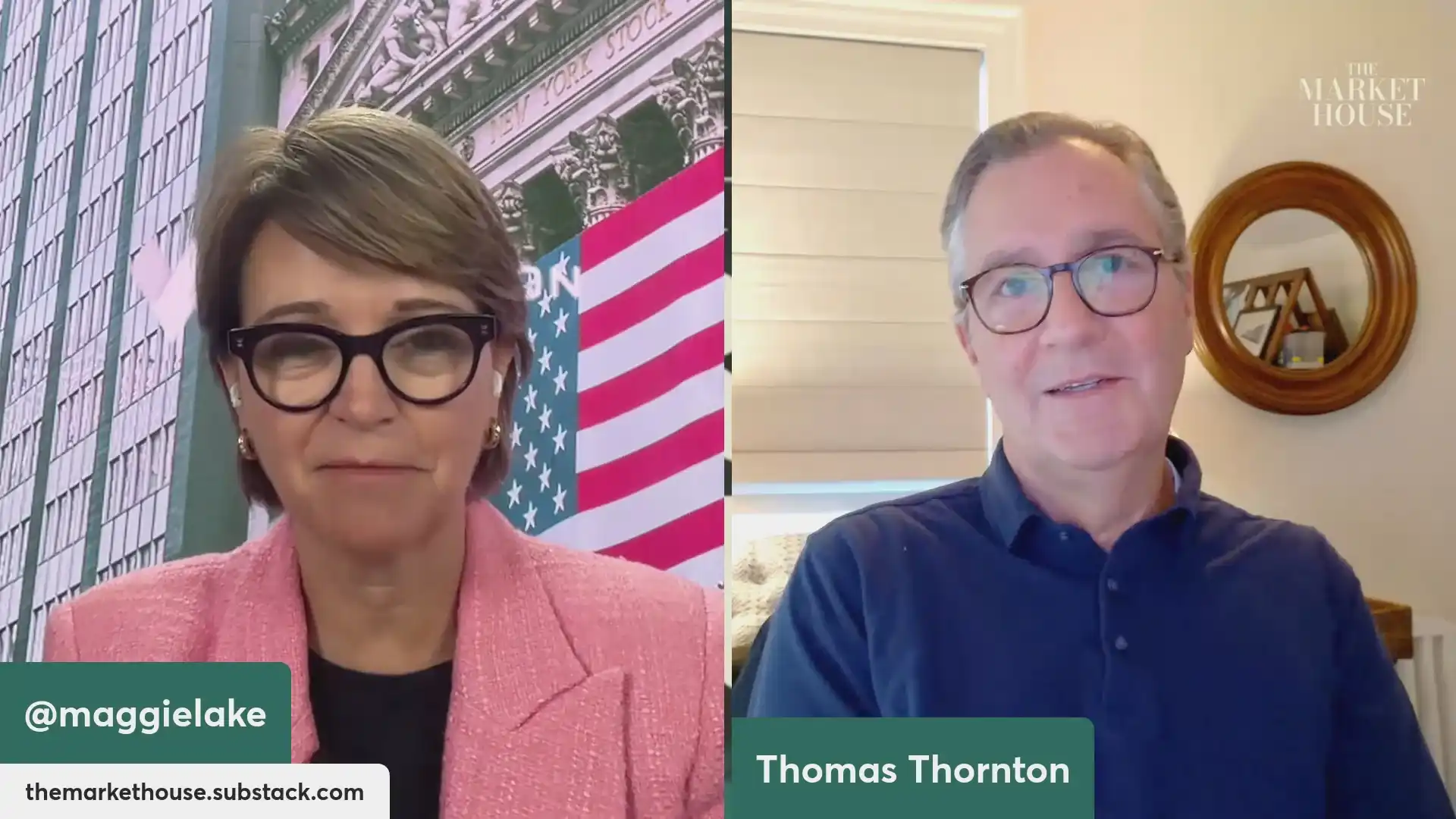
The AI Bubble Has Already Burst, Yet Retail Investors Are Still Frantically Buying the Dip: A Hedge Fund Veteran Warns Nvidia's Risks Are Far From Over

Former hedge fund trader Tom Thornton warns that the AI bubble has already burst, yet retail investors remain trapped in "buy the dip" muscle memory while institutions steadily reduce tech exposure. He points to record single-week inflows into QQQ (~$13.4 billion) even as prices fell—a classic topping pattern where dip-buying eventually fails and confidence collapses. Thornton argues AI's boom rests on a fragile chain of circular financing deals that must unfold perfectly; several links are already cracking. On Nvidia, he stresses that DOJ and congressional investigations aren't short-term noise—any evidence of knowingly bypassing export controls could trigger criminal, not just civil, liability and hammer the business model and valuation. He expects management to spin earnings positively, but even a slight guidance cut could crush the stock and wash out retail dip-buyers, making 2027 a tougher year for markets. Thornton is watching DeMark indicators on the Nasdaq 100 and Mag 7 for true capitulation, noting defensive sectors like staples and utilities are now flashing sell signals. He remains long gold, has started buying silver and gold miners (GDX), is baffled by Anthropic IPO valuations, exited Alibaba on Nvidia-related news, would short a SpaceX-Tesla merger on antitrust grounds, and says the ultimate contrarian buy signal is a front-page photo of a floor trader with his head in his hands.

marsbit1h ago

The AI Bubble Has Already Burst, Yet Retail Investors Are Still Frantically Buying the Dip: A Hedge Fund Veteran Warns Nvidia's Risks Are Far From Over

marsbit1h ago

Trading

Spot

Hot Articles

How to Buy SUN

Welcome to HTX.com! We've made purchasing SUN (SUN) simple and convenient. Follow our step-by-step guide to embark on your crypto journey.Step 1: Create Your HTX AccountUse your email or phone number to sign up for a free account on HTX. Experience a hassle-free registration journey and unlock all features.Get My AccountStep 2: Go to Buy Crypto and Choose Your Payment MethodCredit/Debit Card: Use your Visa or Mastercard to buy SUN (SUN) instantly.Balance: Use funds from your HTX account balance to trade seamlessly.Third Parties: We've added popular payment methods such as Google Pay and Apple Pay to enhance convenience.P2P: Trade directly with other users on HTX.Over-the-Counter (OTC): We offer tailor-made services and competitive exchange rates for traders.Step 3: Store Your SUN (SUN)After purchasing your SUN (SUN), store it in your HTX account. Alternatively, you can send it elsewhere via blockchain transfer or use it to trade other cryptocurrencies.Step 4: Trade SUN (SUN)Easily trade SUN (SUN) on HTX's spot market. Simply access your account, select your trading pair, execute your trades, and monitor in real-time. We offer a user-friendly experience for both beginners and seasoned traders.

11.3k Total ViewsPublished 2024.03.29Updated 2026.06.02

How to Buy SUN

Discussions

Welcome to the HTX Community. Here, you can stay informed about the latest platform developments and gain access to professional market insights. Users' opinions on the price of SUN (SUN) are presented below.

活动图片