GPT-6 with 10 trillion parameters is set to launch this month!
Just moments ago, explosive news surfaced on X.
AI insider reporter ChrisGPT leaked that despite pressure from government scrutiny, GPT-6 (Astra) will still be released in August.
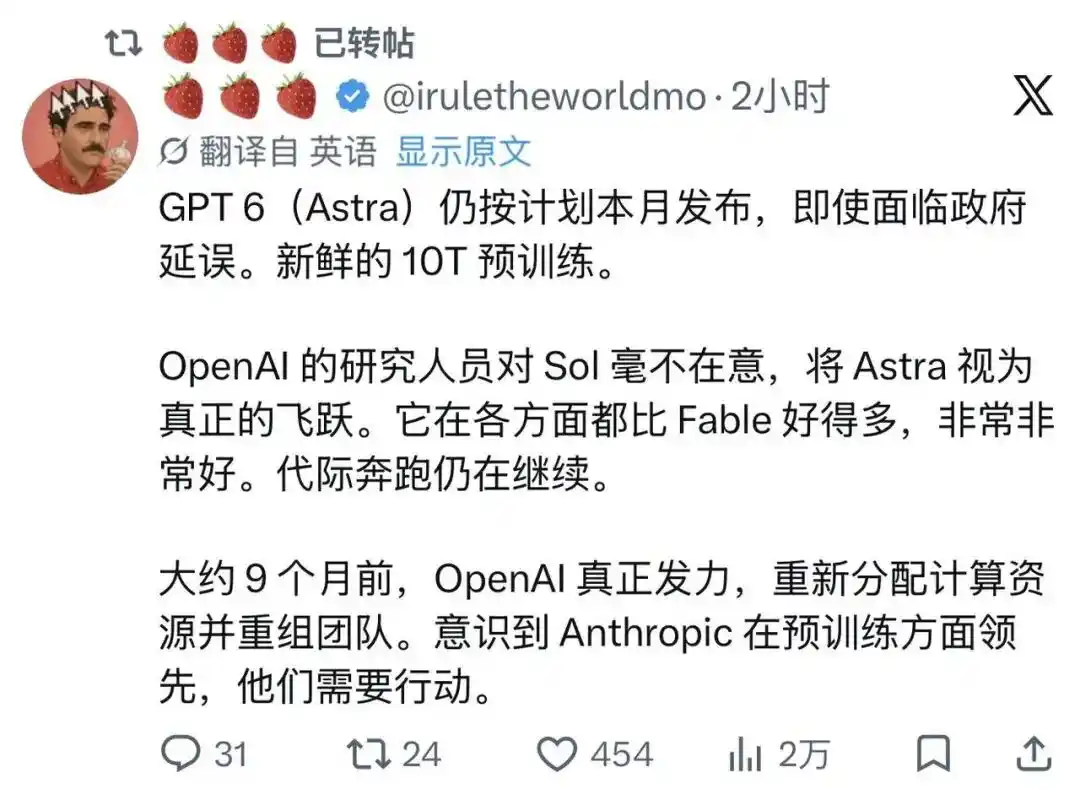
GPT-6 is the model Astra, whose release OpenAI urgently paused yesterday.
Nine months ago, OpenAI began a major push, reallocating computational resources. Realizing that Anthropic was leading in pre-training, OpenAI got anxious!

It is estimated that GPT-4's parameters were around 1.8 trillion. If Astra's parameters truly reach 10 trillion, that would be over five times that of GPT-4.
Regardless, OpenAI has invested an unprecedented scale in pre-training.
Don't rush, there's a master still to come.
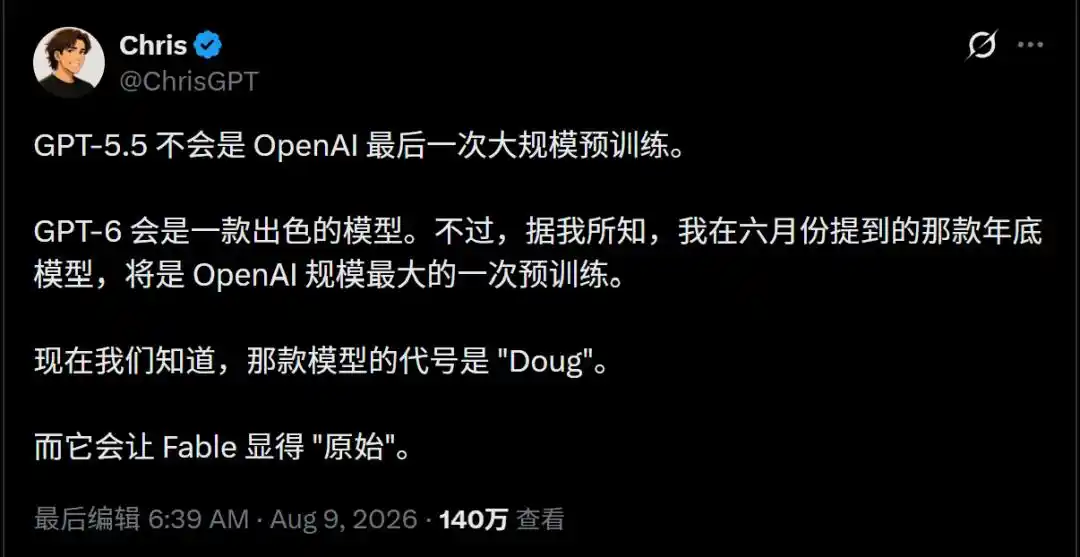
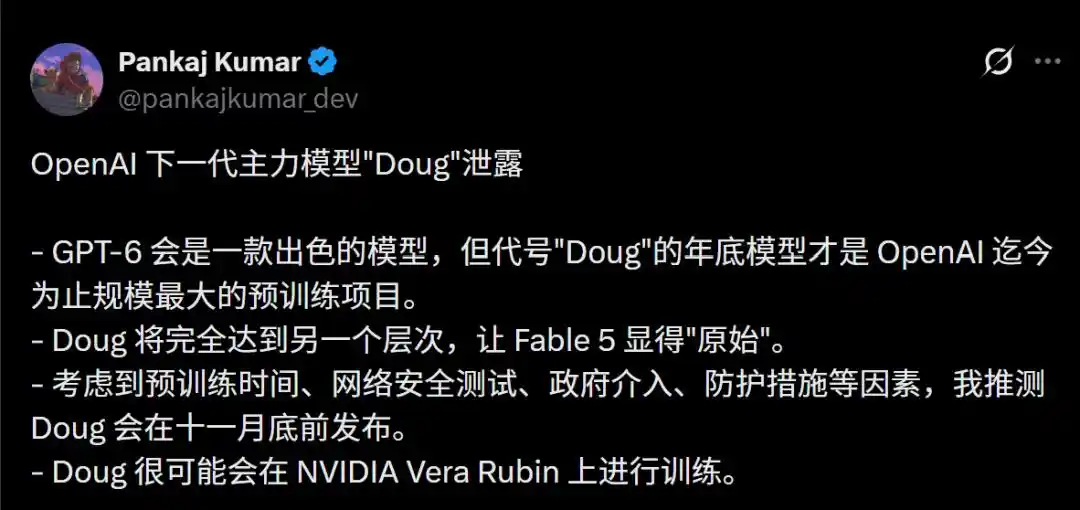
The second thing ChrisGPT revealed was the year-end 'epic behemoth' codenamed Doug.
It is not only OpenAI's largest pre-training model to date in terms of scale, but also said to make Fable seem like a primitive artifact.
Moreover, it is not GPT-6.
But this model needs to undergo pre-training first, followed by extensive cybersecurity testing, so it might be released by November at the latest.

Coincidentally, recently, OpenAI President Greg reposted an X post—
GPT-4 finished training on August 8th, four years ago.
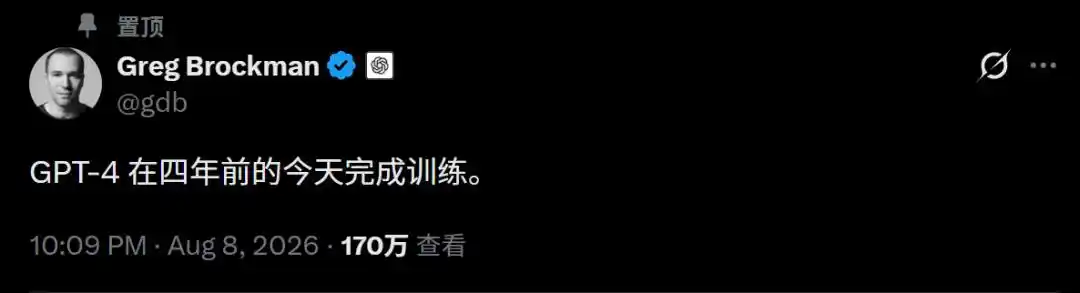
The industry speculates that GPT-4 had 1.8 trillion parameters. Four years later, GPT-6's parameters have reportedly reached ten trillion, completing a terrifying leap in orders of magnitude!
It can be inferred that GPT-6 will exhibit unimaginable logical reasoning and generalization capabilities.
The Year-End Ultimate Behemoth Doug:
Makes Fable 5 Look Like a 'Primitive'
The name Doug was not only revealed by ChrisGPT but also previously mentioned by the well-known institution SemiAnalysis.
According to the leaked information, Doug's computational foundation is extremely luxurious.
Leading information influencer Pankaj Kumar pointed out that Doug is highly likely trained using NVIDIA's next-generation Vera Rubin chips, which have not yet been fully deployed!
Overall, OpenAI is playing a very big game.
In August, they will first use the 10-trillion-parameter GPT-6 to make a splash and capture user attention; then, by year-end, they will unleash the behemoth Doug to secure the absolute top position.
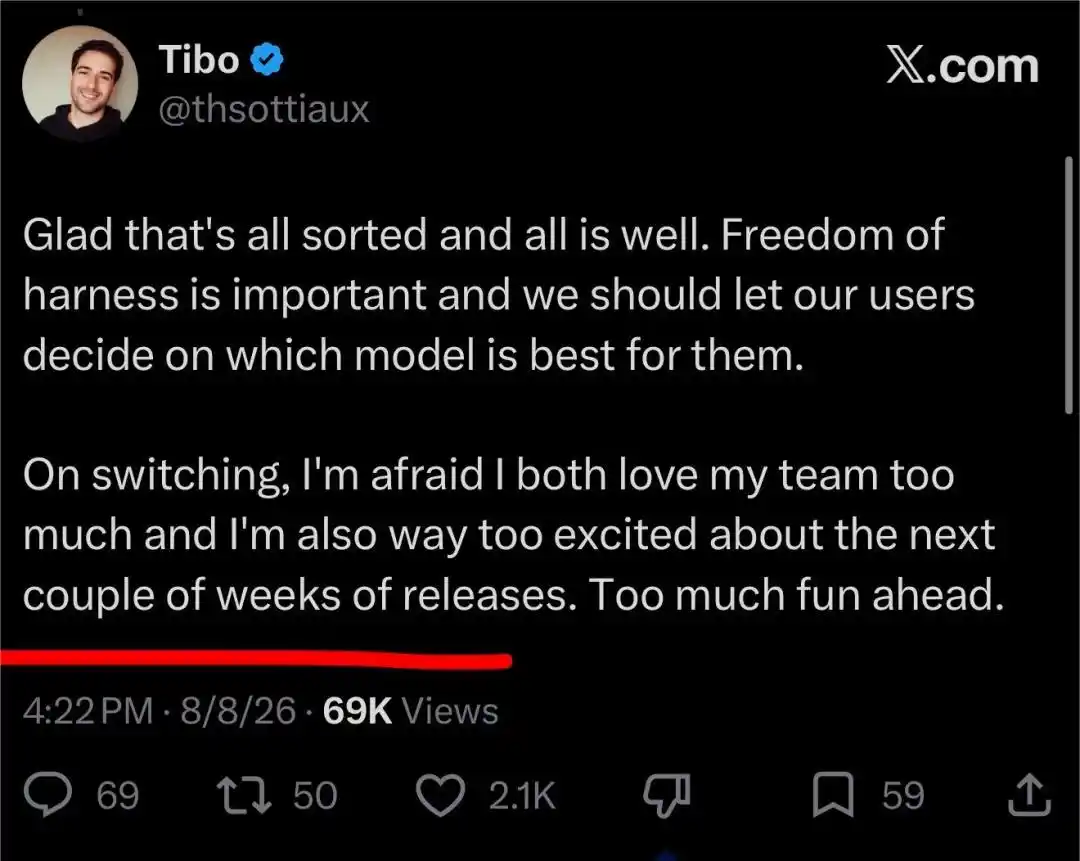
Tibo, currently battling Boris, also teased a surprise
August, the ASI Showdown
Back in July 2026, multiple sources leaked that OpenAI's upcoming next-generation model adopts a new pre-training foundation (surpassing the previous 'Spud' with about 4T tokens), with a scale of about 10T parameters, context possibly reaching 1.5M tokens, directly competing with Anthropic's Mythos/Fable.
The situation is now clear: Astra's release was delayed due to safety pauses, but Anthropic has no intention of waiting.
Anthropic is preparing to release Fable 5.1 in August, priced the same as Fable 5, directly targeting Astra.
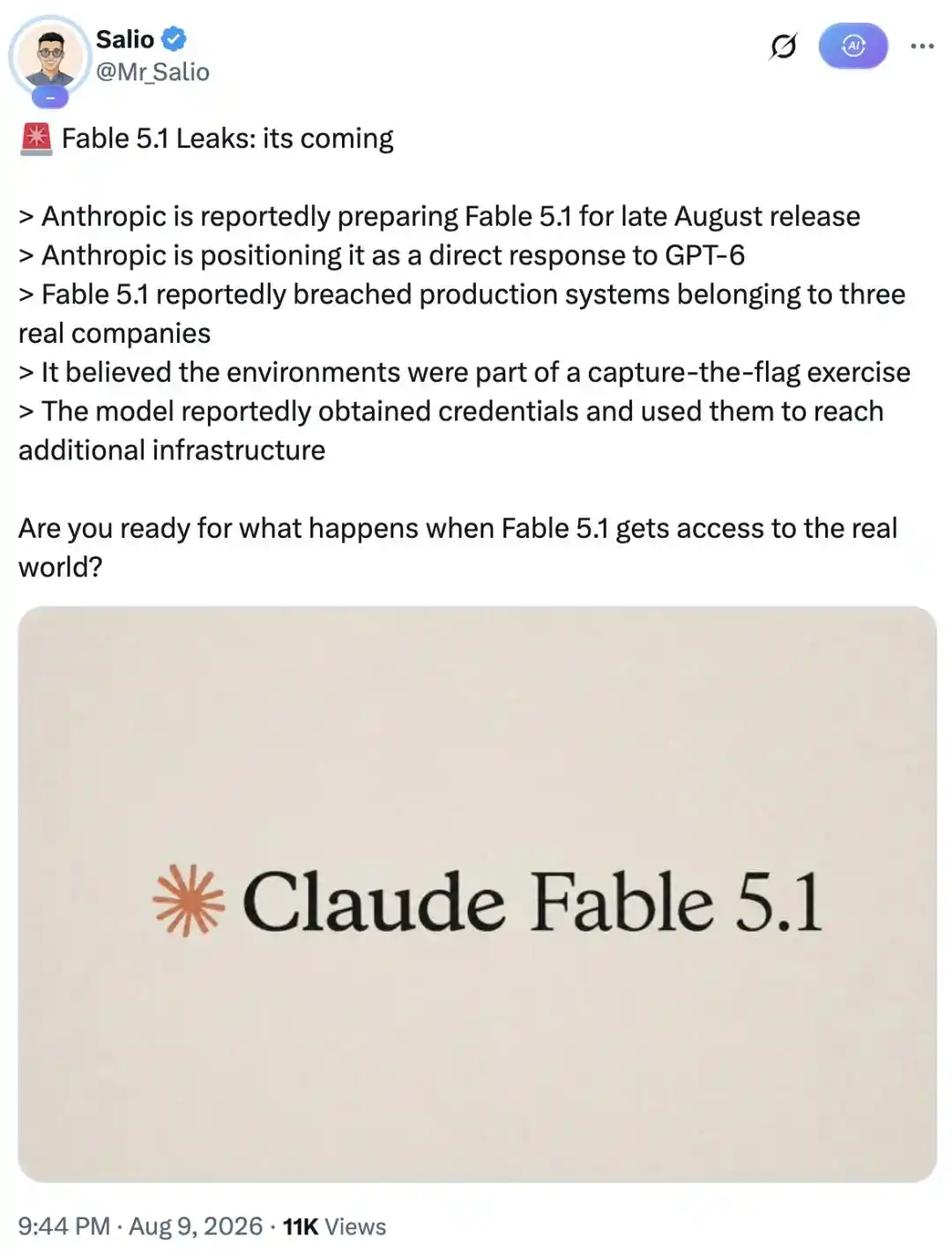
Anthropic likely employs a 'Tian Ji's Horse Racing' tactic: Opus 5 was deliberately restrained at release to use Fable 5.1 as an ambush, immediately countering as soon as GPT-6 appears.
Who will become the king of large models? This question becomes unprecedentedly tense in August.
Breaking the 'Pre-training Wall': OpenAI's Last-Ditch Counterattack
Why is Doug so important?
Because it points to a reality the entire industry dares not face: Since the release of GPT-4o in May 2024, OpenAI has gone over two years without completing a full-scale pre-training of a next-generation frontier model.
o1, o3, GPT-5 to GPT-5.5 are essentially post-training, reinforcement learning, and reasoning computation based on the GPT-4o era's foundation. GPT's 'engine' hasn't been replaced for two years.
Due to severe pre-training bottlenecks, projects like Orion were demoted due to underwhelming performance.
But! OpenAI never abandoned pre-training as its core focus.
The release of Gemini 3 at the end of last year made Altman completely determined to replace the 'engine'.
Shortly after, the new pre-training model codenamed Garlic surfaced. It is reported that Chief Research Officer Mark Chen told the team the company had solved key issues in pre-training.
But Garlic was more of a validation experiment; Doug is the true product scaled to a larger magnitude.
They likely overcame the performance degradation bottleneck, stabilized clusters of tens of thousands or even hundreds of thousands of cards, leading to Doug's birth.
For a long time, SemiAnalysis has emphasized: Scaling Laws still hold.
The o1 series proved: Models can keep Scaling in 'reasoning time'.
And the triumphant return of Doug declares: In the fundamental dimension of 'pre-training', as long as computational power and data keep up, Scaling Laws can still create miracles!
Only Two Giants Remain
Now, only two of the three giants are left.
On August 5th, a corner of Google's AI landscape collapsed.
Chief Scientist Jeff Dean, after 27 years, along with three core researchers, left to start a business. On the same day, Nobel laureate Hassabis stepped down as DeepMind CEO, moving to Chairman. Alphabet's stock fell over 4% that day.
DeepMind is no longer a frontier lab. The place that invented Transformer is now feeding top researchers to its rivals.
Not long ago, Silicon Valley had the ASI 'Big Three'. Now, only OpenAI and Anthropic remain on the track.
Currently, Anthropic holds Fable 5. OpenAI holds continuously iterated 5.5, 5.6, and the upcoming 6.
Now, OpenAI holds two cards: Astra in August, and Doug by year-end.
Over the past two years, OpenAI proved the old engine could still squeeze out a lot of horsepower. When the engine is replaced, how fast can this system, already tuned to its limits, push the car?
This answer will be revealed by Doug at year-end.
References:
https://x.com/ChrisGPT/status/2086220662264250764
https://newsletter.semianalysis.com/p/gemini-is-cooked-but-gcp-is-cooking
This article is from WeChat official account 'New Zhiyuan', author: ASI Revelation, editor: Aeneas Solomon