Just now, DeepSeek V4 updates with DSpark, improving inference speed by 80%

marsbitPublicado a 2026-06-27Actualizado a 2026-06-27

Resumen

DeepSeek has updated its DeepSeek V4 model with the DSpark speculative decoding framework, achieving a significant 60-85% speedup in generation for Flash models and 57-78% for Pro models while maintaining the same overall throughput. This engineering-focused update, rather than a core architectural change, introduces DSpark to address latency and throughput bottlenecks in high-concurrency production environments. DSpark combines high-throughput parallel generation with adaptive load-aware verification. Its key innovations include a semi-autoregressive generation architecture to model dependencies within token blocks and a hardware-aware confidence-scheduled verification system. This system uses a confidence head to predict token acceptance probabilities, allowing it to dynamically optimize verification length per request and allocate compute only to tokens with the highest expected payoff. The asynchronous scheduler is designed for real-world deployment, ensuring zero-overhead scheduling and continuous CUDA graph replay while preserving the target model's output distribution. In tests across mathematical reasoning, code generation, and daily dialogue, DSpark outperformed state-of-the-art models like Eagle3 and DFlash, increasing average acceptance length by 26.7%-30.9% and 16.3%-18.4% respectively on Qwen3 target models. DeepSeek also open-sourced DeepSpec, a full-stack codebase for training and evaluating speculative decoding draft models, providing a standardized toolkit...

Just now, DeepSeek V4 received an update.

It newly launched the speculative decoding framework DSpark, and simultaneously open-sourced the full-stack speculative decoding framework DeepSpec that supports this version.

DeepSeek-V4-Pro-DSpark is not a new architecture model, but rather introduces a speculative decoding module based on DeepSeek-V4-Pro. The focus of this update is on engineering deployment, not iteration of the model's core capabilities itself.

DSpark has been deployed in the real online traffic of DeepSeek-V4 (Flash and Pro), significantly accelerating the inference speed of large language models (LLMs).
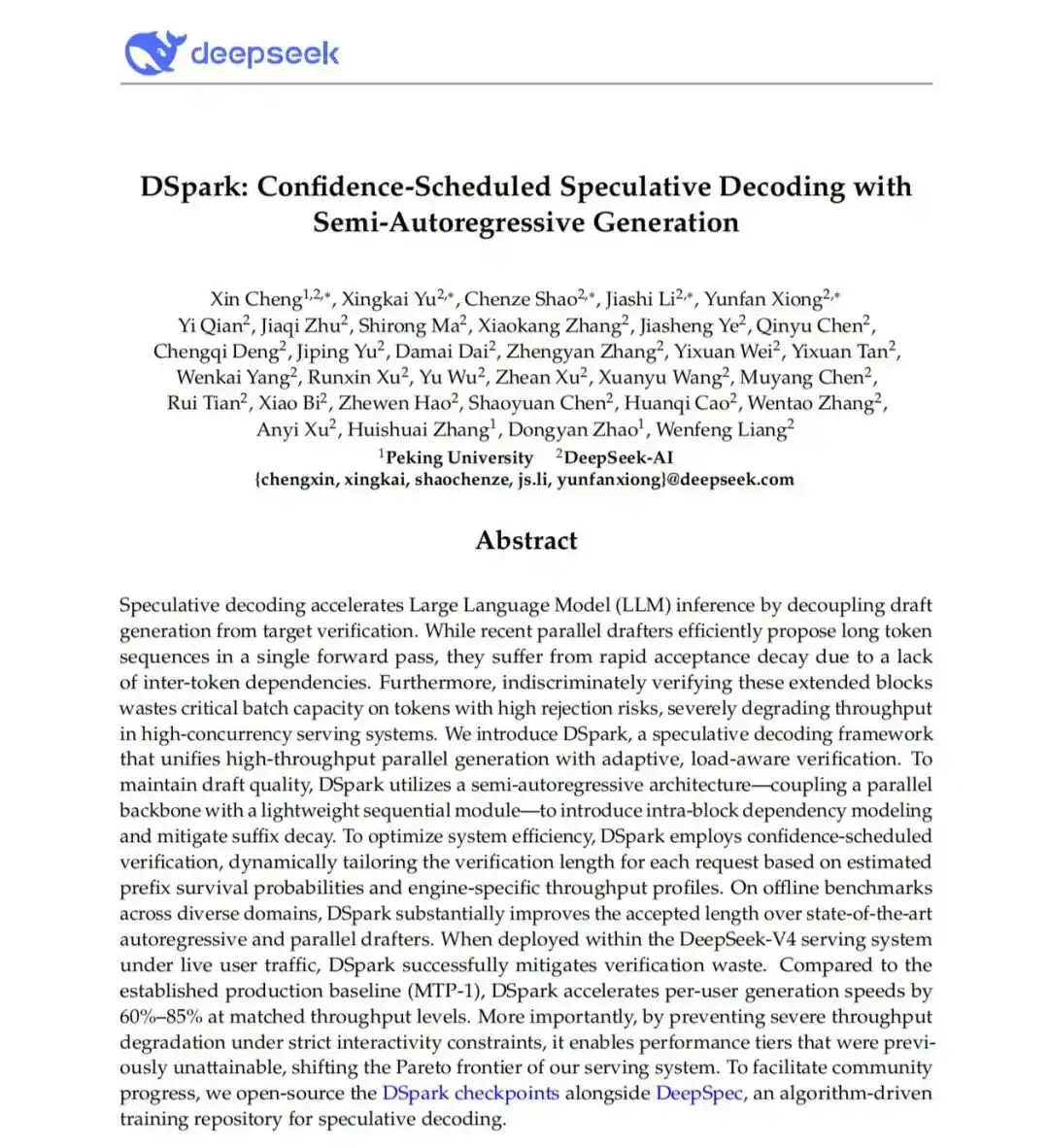
Technical Report: DSpark: Confidence-Scheduled Speculative Decoding with Semi-Autoregressive Generation

Technical Report Link: https://github.com/deepseek-ai/DeepSpec/blob/main/DSpark_paper.pdf

The core purpose of DSpark is to solve the latency and throughput bottlenecks faced by LLM inference in production environments (especially in high-concurrency scenarios). In short, DSpark successfully combines high-throughput "parallel generation" with adaptive "load-aware verification."

Speculative decoding is a technique to accelerate large language model inference without altering the model's output distribution. Its core idea is to introduce a lightweight "draft model" to pre-generate several candidate tokens, which are then batch-verified and accepted by the target model. This transforms serial, token-by-token generation into parallel, batch verification, greatly reducing end-to-end latency.

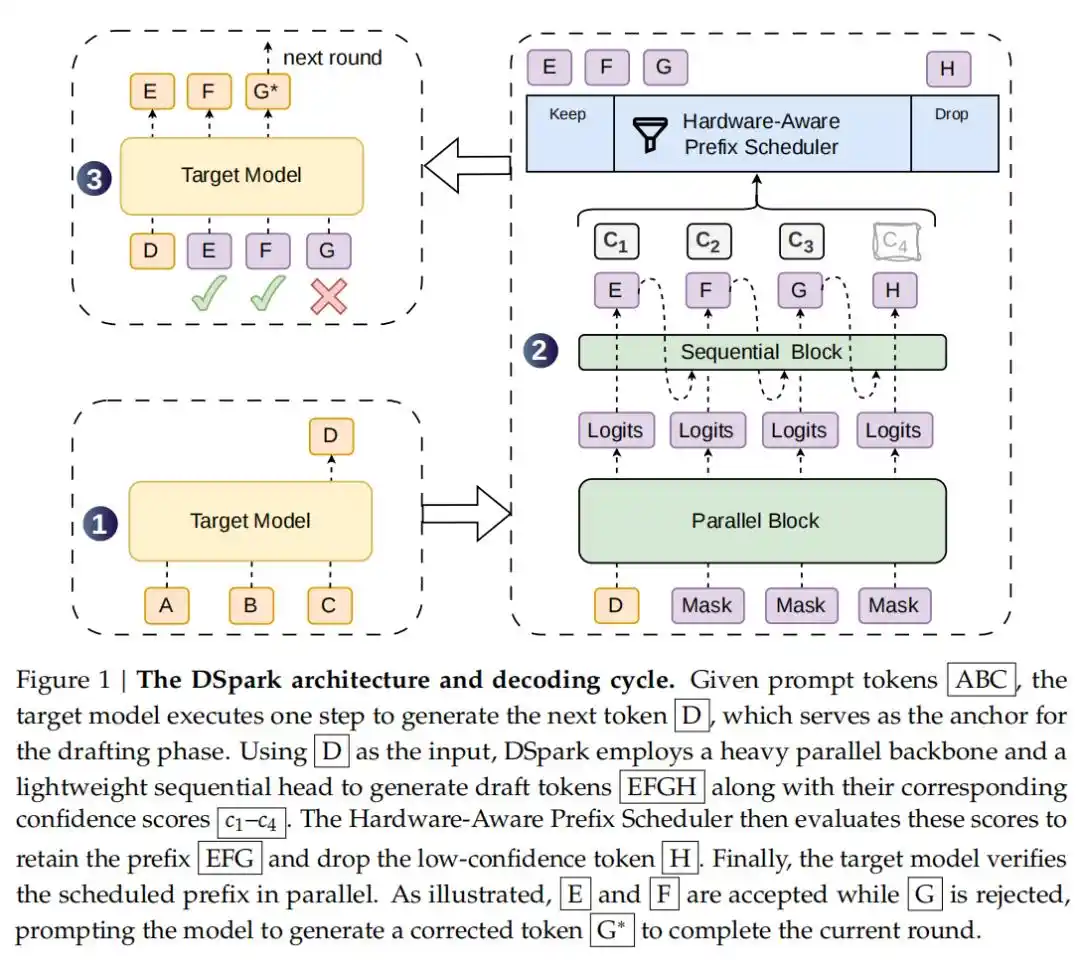
Building on this, DSpark's innovation lies in introducing a Semi-Autoregressive Generation architecture: it retains the high-throughput advantage of parallel draft models while incorporating a lightweight serial module to model dependency relationships between tokens within a block. This alleviates the issue of acceptance rate decay that parallel draft models tend to suffer in later positions.

In addition, there is Hardware-Aware Confidence-Scheduled Verification: previous speculative decoding would often blindly send all generated draft tokens for verification. Under high system load, these tail tokens, which have a very high probability of being rejected, waste valuable batch processing computing power. DSpark introduces a Confidence Head to estimate the survival probability of each token. Combined with a hardware-aware prefix scheduler, the system can dynamically tailor the optimal verification length for each request based on real-time engine throughput characteristics, allocating computing power only to tokens with the highest expected payoff.

To be deployed in real online infrastructure, DSpark's scheduler adopts an asynchronous mechanism to be compatible with zero-overhead scheduling (ZOS) and continuous CUDA graph replay. It uses historical predictions from the previous two steps to decide the current dynamic truncation length, thereby hiding scheduling latency, avoiding GPU pipeline stalls, and simultaneously guaranteeing the complete and lossless restoration of the target model's output distribution.
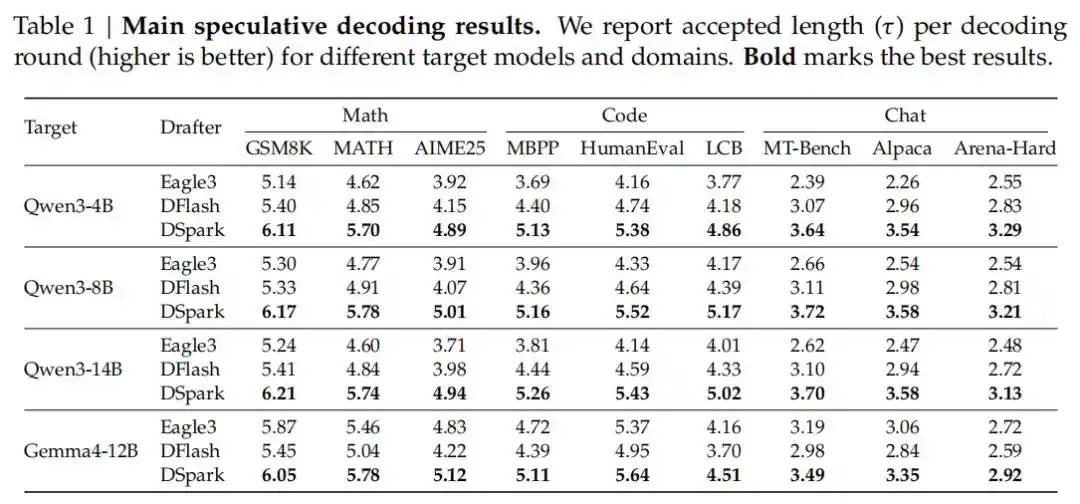
In tests covering multiple domains such as mathematical reasoning, code generation, and daily conversation, DSpark significantly outperformed the current state-of-the-art autoregressive model (Eagle3) and parallel draft model (DFlash). For example, on Qwen3 series (4B, 8B, 14B) target models, its average acceptance length improved by 26.7% to 30.9% compared to Eagle3, and by 16.3% to 18.4% compared to DFlash.
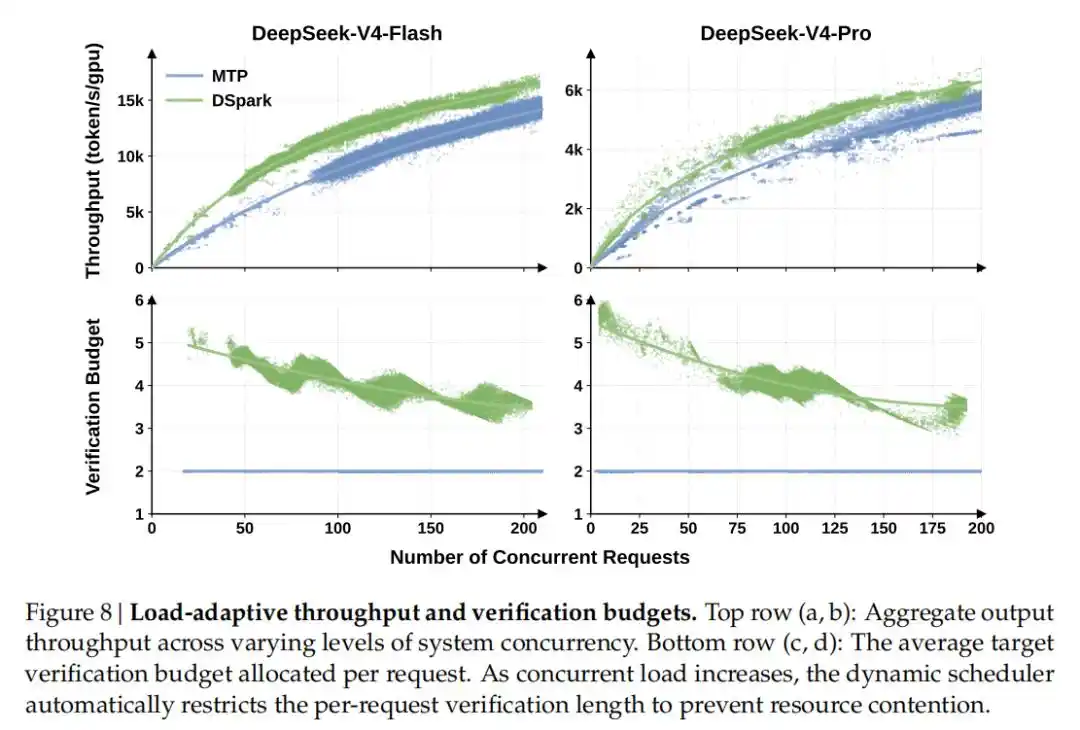
Compared to the previous generation single-token production benchmark (MTP-1) in deployment, while maintaining the same overall throughput, DSpark increased user generation speed by 60%-85% (Flash model) and 57%-78% (Pro model) respectively.
Released alongside DSpark is DeepSpec, a full-stack codebase for training and evaluating speculative decoding draft models. It is the "open-source infrastructure" that hosts this solution and other advanced algorithm implementations, containing data preparation tools, draft model implementations, training code, and evaluation scripts.

DeepSpec splits the overall workflow into three stages: data preparation, training, and evaluation. The three stages need to be run sequentially, with the output of the previous stage serving as input for the next.

In the data preparation stage, one needs to download prompt data, regenerate answers using an inference engine on the target model, and build the target cache. Notably, taking the default Qwen/Qwen3-4B configuration as an example, the target cache volume can reach about 38 TB, requiring thorough assessment of storage resources before use.

The training stage can be launched via bash scripts/train/train.sh. This script will call train.py and launch a worker for each visible GPU. Users can choose different algorithm and target model configurations in the config/ directory by specifying config_path. The project also supports adjusting training settings by overriding config_path, target_cache_dir, and using --opts to modify individual configuration fields.

Regarding hardware, DeepSpec's default configuration and scripts are designed for a single-node 8-GPU environment. If there are fewer GPUs, users need to correspondingly reduce the number of visible GPUs in CUDA_VISIBLE_DEVICES.

The evaluation stage is launched via bash scripts/eval/eval.sh. The evaluation script will use the trained draft model checkpoint to measure acceptance on multiple speculative decoding benchmark tasks. The project's currently listed evaluation datasets include GSM8K, MATH500, AIME25, HumanEval, MBPP, LiveCodeBench, MT-Bench, Alpaca, and Arena-Hard-v2, covering different task types such as mathematical reasoning, code generation, dialogue ability, and comprehensive Q&A.

In terms of algorithms, DeepSpec currently has three built-in draft models: DSpark, DFlash, and Eagle3. For target model series, the project currently supports Qwen3 and Gemma.

The open-sourcing of DeepSpec integrates the engineering practices of speculative decoding, which were previously scattered across various research teams, into a reproducible and extensible standardized toolchain. For researchers and engineers hoping to accelerate inference for their own large models, this means they can directly train custom draft models on a mature framework, skipping a large amount of repeated infrastructure building work.

Reference Links:

https://github.com/deepseek-ai/DeepSpec/blob/main/DSpark_paper.pdf

https://github.com/deepseek-ai/DeepSpec

This article is from the WeChat public account "Machine Heart" (ID: almosthuman2014), authors: Ze Nan, Yang Wen


Preguntas relacionadas

QWhat is the main innovation introduced in the DeepSeek V4 update mentioned in the article?

AThe main innovation introduced is the speculative decoding framework DSpark, which features a Semi-Autoregressive Generation architecture and Confidence-Scheduled Verification.

QAccording to the article, what was the core motivation for developing DSpark?

AThe core motivation was to solve the latency and throughput bottlenecks faced by LLM inference in production environments, especially under high-concurrency scenarios.

QHow does DSpark's Confidence-Scheduled Verification aim to improve efficiency compared to previous speculative decoding methods?

AIt uses a Confidence Head to assess each token's survival probability and a hardware-aware scheduler to dynamically determine the optimal verification length per request. This allocates computing power only to tokens with the highest expected payoff, avoiding wasted effort on tokens likely to be rejected.

QWhat performance improvement does DSpark achieve over the previous single-token production baseline (MTP-1) for the Flash model, according to the article?

ADSpark improves user generation speed by 60% to 85% for the Flash model while maintaining the same overall throughput.

QWhat is DeepSpec, and what purpose does it serve according to the article?

ADeepSpec is a full-stack open-source codebase released alongside DSpark. It is an infrastructure for training and evaluating speculative decoding draft models, providing tools for data preparation, model implementation, training, and evaluation to streamline custom draft model development.

Lecturas Relacionadas

Must-Watch Events Next Week|CLARITY Act Could Face Senate Vote; SpaceX, Circle to Report Earnings (8.3-8.9)

**Summary: Key Events and Developments to Watch (August 3-9)** The upcoming week is marked by significant financial disclosures, key legislative deadlines, and notable product updates. **Major Financial Events:** Several companies are scheduled to release their Q2 2026 earnings. American Bitcoin (ABTC) will report on August 3, followed by SpaceX and Hut 8 Mining Corp. on August 4, and Circle on August 5. Notably, a significant portion of SpaceX shares (up to 12% of total shares) will be unlocked on August 6 following their earnings release. **Key Legislative Deadline:** The U.S. Senate faces an August 7 deadline to secure 60 votes for the CLARITY Act, a bipartisan bill aiming to establish a federal regulatory framework for cryptocurrencies. The Senate may hold a full vote on the bill during the week. **Economic Data:** The U.S. July Non-Farm Payrolls report will be released on August 7, providing crucial labor market data. **Technology & Product Updates:** * **Shutdowns:** DeFi portfolio tracker Zapper and wallet app Ctrl Wallet will cease operations on August 3. * **Upgrades:** LayerZero will deprecate its v1 relayers on August 3. XRP Ledger's new version 3.3.0, featuring five new functions, is expected next week. * **AI:** Elon Musk announced that the advanced Grok 4.6 AI model is set for release around August 7. * **Bitcoin:** The BIP-110 forced signaling for a potential Bitcoin network change is scheduled to begin around August 8. **Other Notable Events:** Chinese robotics firm Unitree Tech has set its preliminary price inquiry for its IPO for August 5. South Korean exchange Upbit will delist AQT and AERGO tokens on August 3.

marsbitHace 1 hora(s)

Must-Watch Events Next Week|CLARITY Act Could Face Senate Vote; SpaceX, Circle to Report Earnings (8.3-8.9)

marsbitHace 1 hora(s)

Stocks Are Plummeting More Sharply Than Cryptocurrencies. Where Has the Money Gone?

Stock Markets Plunge Deeper Than Cryptocurrencies: Where Did the Money Go? In late July, Seoul's Kospi index triggered circuit breakers for two consecutive days, plummeting over 40% from its June high. The collapse was led by heavyweight stocks like SK Hynix, whose record profits still disappointed investors, and devastating leveraged ETFs, with one major product losing over 83% of its value. This signaled a global, forced deleveraging targeting the most crowded trades. Interestingly, while stocks exhibited extreme volatility akin to crypto markets, Bitcoin rose nearly 15% in July after a prior steep drop. Analysis shows the money fleeing equities did not flow into Bitcoin. Instead, Bitcoin had already absorbed its sell-off in May-June, when U.S. spot Bitcoin ETFs saw historic outflows. The true safe-haven beneficiary was gold, whose price rose over 20% year-on-year, highlighting a decoupling between Bitcoin and gold as "digital gold." The sell-off was a targeted unwinding of leveraged positions in tech and semiconductors, accelerated by broker-dealer risk management and shifts in the AI narrative, including new competition from Chinese memory chipmakers. The retreat path was clear: from high-valuation tech stocks to cash and U.S. Treasuries, then to gold. For Bitcoin to attract sustained institutional inflows, conditions like eased global liquidity pressure, a "soft-landing" Fed rate cut, and U.S. regulatory clarity via legislation like the stalled CLARITY Act are needed. Currently, Bitcoin is not a safe haven but an already-cleared asset. Its low correlation with tech stocks, however, makes it a potential diversification play for institutional portfolios once the storm passes. The money isn't here yet, but the positioning is underway.

marsbitHace 1 hora(s)

Stocks Are Plummeting More Sharply Than Cryptocurrencies. Where Has the Money Gone?

marsbitHace 1 hora(s)

In Conversation with Ray Dalio: We Are Currently in an AI Bubble, with 1% of My Portfolio in Bitcoin

Ray Dalio, founder of Bridgewater Associates, warns in an interview that the current AI boom shows classic bubble characteristics, which could lead to significant economic downturns as seen in past cycles like 1929 or 2000. He explains that speculative enthusiasm, fueled by debt and overvaluation, often precedes a crash when rising rates or taxation force asset sales, causing widespread losses and recession. Dalio also outlines his "Big Cycle" theory, describing an approximate 80-year pattern where widening wealth gaps, massive government deficits, and shifting geopolitical power (like China's rise) create internal conflict and global instability. He emphasizes that we are in a late-cycle, transitional phase where traditional powers like the US and UK face decline. For personal wealth protection, Dalio advises diversification beyond cash into assets like stocks, bonds, real estate, and particularly gold, which he prefers over Bitcoin. While he holds about 1% of his portfolio in Bitcoin as a non-printable hard asset, he views gold as more secure from technological or governmental threats. Regarding AI's impact, Dalio believes it will disproportionately benefit capital owners, worsening inequality by replacing both physical and cognitive labor. He suggests that human intuition and emotional intelligence, combined with AI, will be key for future workers. On taxation, Dalio argues that wealth taxes are impractical and risk triggering asset sell-offs, reducing productive investment. He points to the UK as a cautionary example of debt, low productivity, and political strife. Geopolitically, Dalio foresees a more regionalized world, with the US showing weakness in prolonged conflicts like with Iran, akin to past imperial declines. The ideal outcome, he suggests, is coexisting powerful blocs (e.g., Americas, China-Asia Pacific) without major war.

marsbitHace 5 hora(s)

In Conversation with Ray Dalio: We Are Currently in an AI Bubble, with 1% of My Portfolio in Bitcoin

marsbitHace 5 hora(s)

Trading

Spot
活动图片




