A counterintuitive phenomenon is unfolding in China's embodied AI sector—a group of startups that are still raising funds intensively themselves have begun making external investments on a large scale.
Poke Robots, this family robot company founded in March 2026, invested in Huiguang Innovation on June 24—only 3.8 months passed from its founding to its first external investment. At that time, it was still in its Series A funding stage.
Zhijian Dynamics, founded in Hangzhou in July 2025, invested in Moke Robotics on July 2, 2026, while its own Series A fundraising was still ongoing. It started pursuing fundraising and external investments simultaneously within less than a year of its founding.
Just two days ago (August 4), five embodied AI companies (Luming Robot, Mibee Technology, Zibianliang Robot, Songyan Dynamics, and Zhiyuan Robot) jointly invested in the same AI data company—Kaiwang Data—with an amount of several hundred million RMB.
On the surface, this is not just an "aggressive" move by a single company; from a sector perspective, a collective action trend among leading players is already quite evident.
These cases collectively point to one trend: In 2026, for the embodied AI sector, "investing while fundraising" has evolved from a special strategy of a few leading companies to a normal behavior for sector participants.
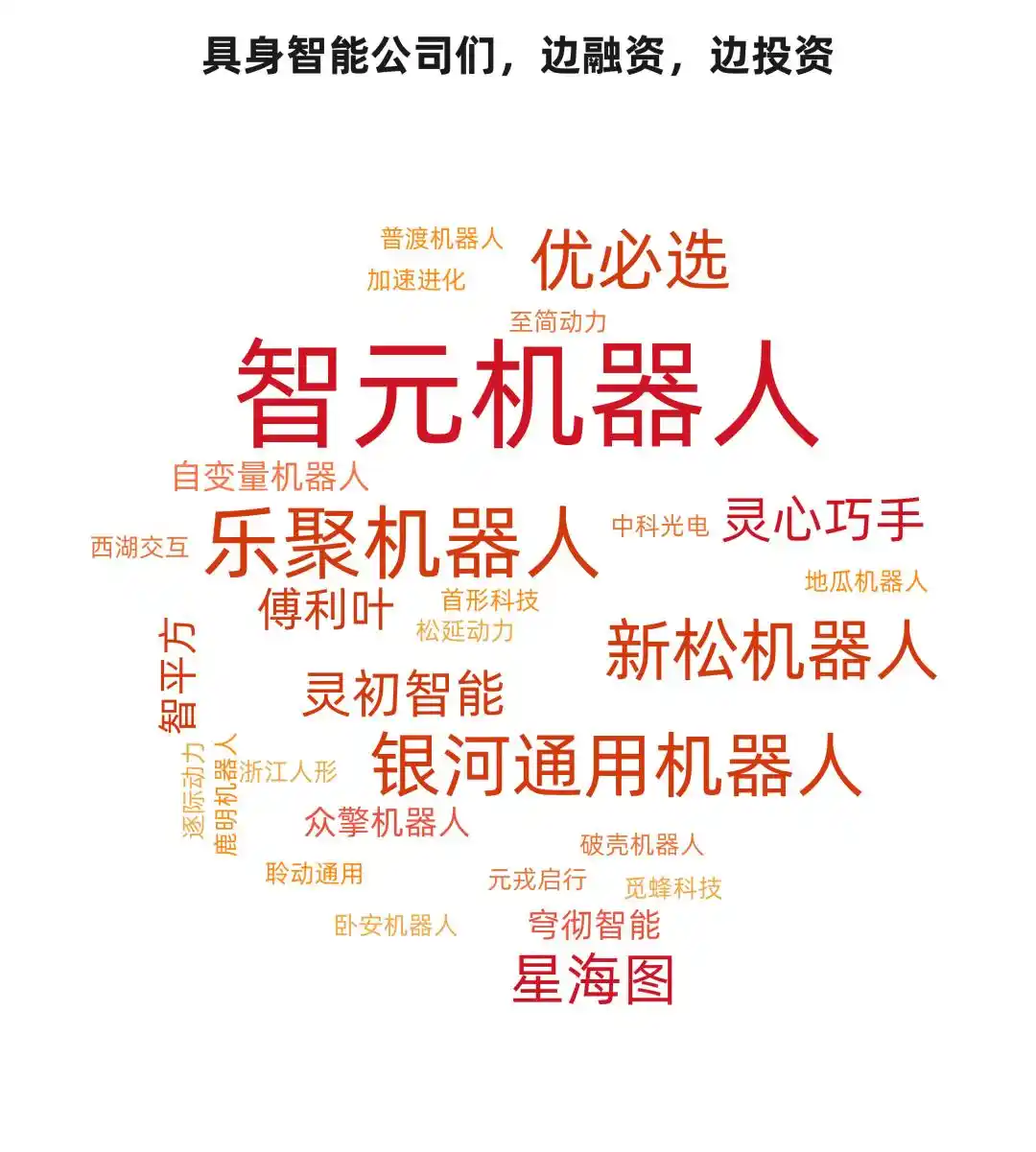
We searched the ITJuzi database to collate all companies labeled "embodied AI" that have records of external investments. We ultimately identified 29 investing entities and over 100 investment events, covering nearly one hundred invested companies.
This article attempts to answer several core questions:
What do these companies themselves do?
How long after founding did they start investing?
What is their investment frequency?
What industrial competition logic does this reflect?
1. Who They Are: A Profile of the 29, 'Investing While Fundraising' Enterprises
First, a basic fact: Among the 29 embodied AI companies making external investments, 59% (17 companies) have humanoid robot platforms as their core business. This indicates that external investment is no longer limited to sporadic actions by a few component manufacturers or software companies; humanoid robot platform companies constitute the main force of investors.
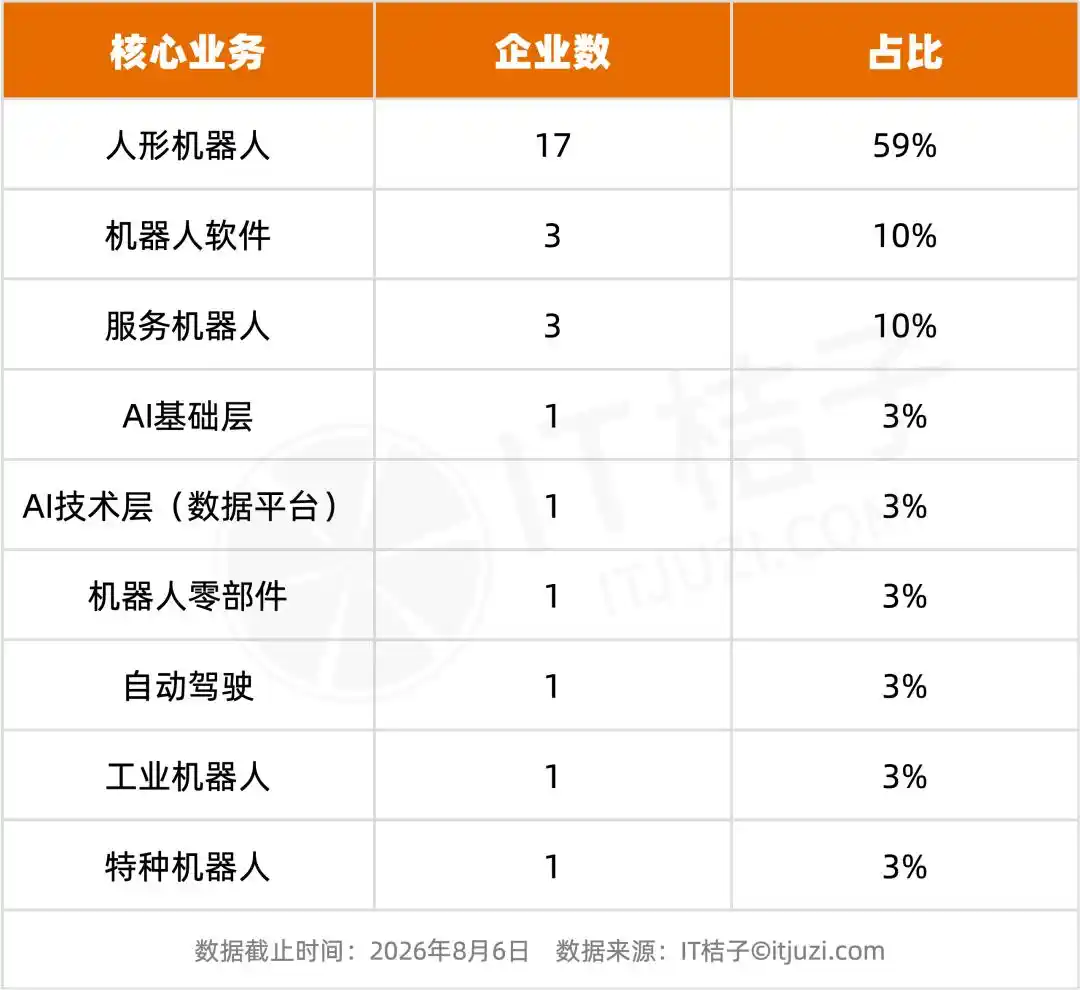
Three characteristics can be observed from the above distribution.
First, humanoid robot platform companies are the primary force, with 17 companies, nearly 60%, far exceeding the sum of all other sub-sectors—platform companies are investing most actively because they have the greatest need to integrate upstream and downstream into their own product systems.
Second, 3 robot software companies and 3 component companies have made investments, indicating that investment behavior is spreading from "building platforms" to companies "building brains" and "building joints". Lingxin Qiaoshou is a typical example (invested companies are in turn making external investments).
Third, 1 industrial robot company and 1 special-purpose robot company each—Siasun's 2016 investment and Zhongke Optoelectronics's 2016 investment both belong to "historical investments by established companies," showing a significantly different logic from the investments of the new generation of embodied AI enterprises.
Geographically, Shenzhen ranks first with 11 companies (38%), Shanghai and Beijing each have 6 companies (21% each), Hangzhou has 2, and Ningbo, Hefei, Shenyang, and Xi'an each have 1. The Pearl River Delta and Yangtze River Delta together account for over 80%, highly consistent with the overall geographical pattern of the embodied AI industry.
More noteworthy is the "status" of the companies: 16 of the 29 are unicorns (55%), including Zhiyuan Robot, Galaxy General, Xinghai Tu, Zhipingfang, and Zuji Dynamics.
This indicates that external investment is already quite common among leading players in the sector, not limited to a few aggressive ones. 3 are listed (UBTech, Siasun, Woonan), 2 have entered Pre-IPO (Leju, Zuji Dynamics), showing high synchronization between the capitalization process and investment behavior.
2. How Long After Founding Did They Start Investing? Average 3.3 Years, But the New Generation is Clearly Faster
Looking at the time gap from "founding" to "first external investment" for these 29 companies, a clear polarization emerges:
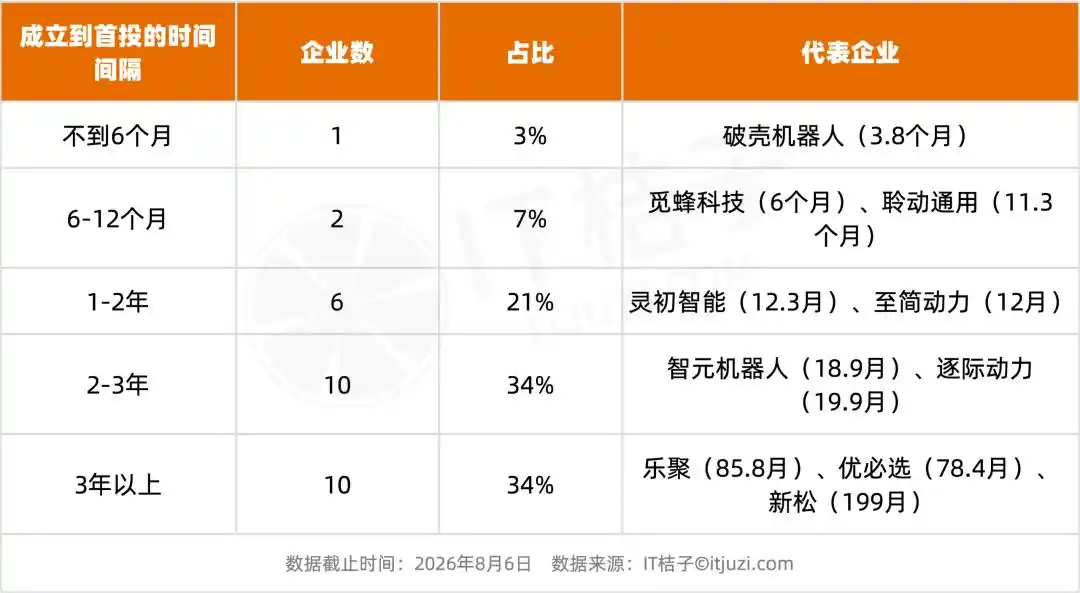
The average time from founding to first external investment is 39.7 months (about 3.3 years), but this figure is inflated by several established companies.
If we only look at "new generation" companies founded after 2023 (21 companies total), the average interval shortens to 22.8 months (less than 2 years).
A clear trend is: the younger the company, the earlier it starts investing.
Siasun Robot, founded in 2000, waited 16 years to make its first investment; UBTech waited 6.5 years; while Zhiyuan Robot, founded in 2023, started intensive layout after only 19 months, and Poke Robots, founded in 2026, joined the investor ranks in just over 3 months.
This indicates that "investing while fundraising" is expanding from a special strategy of a few leading companies to a larger, younger group of enterprises.
Among the 29, 13 (45%) made their first investment in 2026, of which 8 made their first move only in the second half of 2026. The inflection point from "isolated phenomenon" to "collective behavior" is happening right now.
3. Investment Frequency: Zhiyuan Robot Leads Significantly
The number of investments by the 29 companies varies greatly, ranging from 1 to 37 deals. Layered by number and frequency of investments:
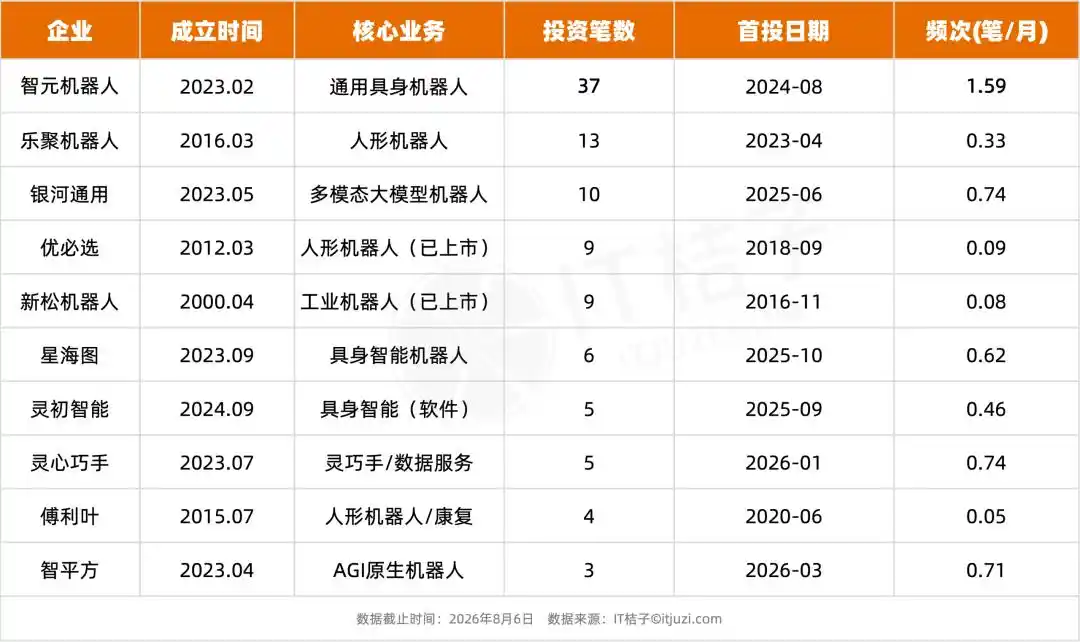
(The remaining 18 companies each have 1-2 deals, omitted here.)
Zhiyuan Robot is the leading CVC in this sector.
Zhiyuan Robot was founded in February 2023, initiated its first external investment in August 2024, and completed 37 investments in the subsequent 23 months, averaging 1.6 deals per month.
This density is significantly higher than other peers in the sector and approaches the frequency of some professional investment institutions. Its investments cover 32 invested companies, ranging from core components like motors and dexterous hands, to software layers like embodied brains and data platforms, and further to robot platforms and application scenarios, almost covering the entire humanoid robot industry chain.
Galaxy General, Lingxin Qiaoshou, Zhipingfang, and Zhongqing Robot in the second tier all have frequencies around 0.7 deals/month, but their total investment volume is still far lower than Zhiyuan's.
Although Leju ranks second with 13 deals, due to its earlier first investment time (April 2023), spanning over 3 years, its monthly average frequency is 0.33 deals.
Lingxin Qiaoshou is noteworthy.
As a robot component (dexterous hand) company, it only started its first external investment in January 2026, completing 5 deals within half a year, mostly jointly with Zhiyuan Robot.
It is both an invested company of Leju and is extending investments downstream—this role transition from "component supplier to CVC" is relatively rare in traditional manufacturing.
4. "Invested Becoming Investors": Second-Order Transmission of the Ecosystem Chain
Among the 29 investors, 5 are also investment targets of other embodied AI companies. In other words, they were first invested in by leading companies, and subsequently started making external investments themselves:
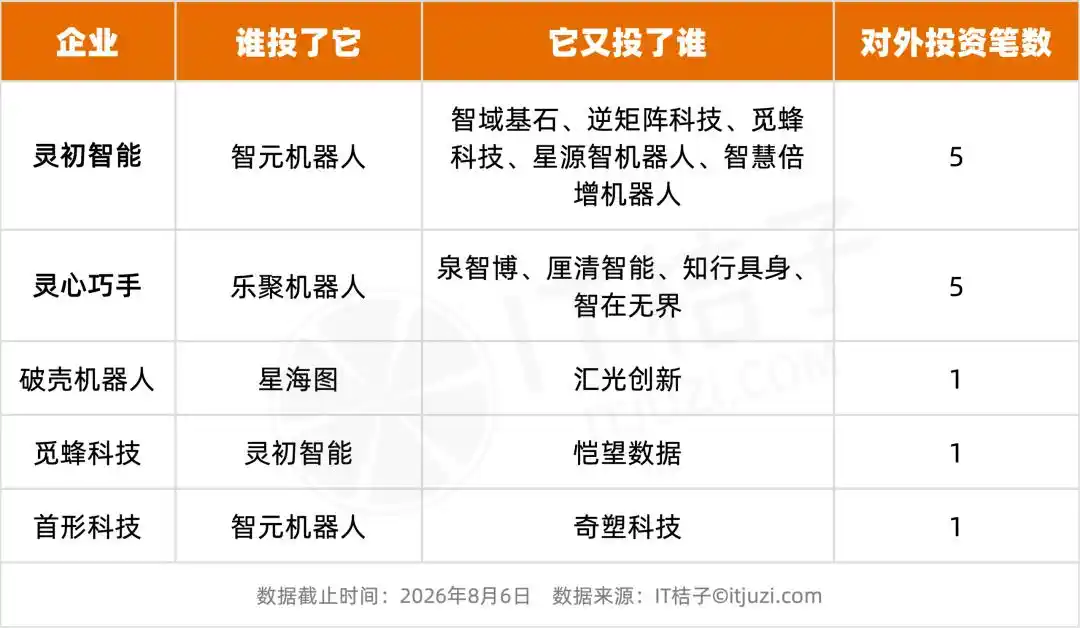
This forms a clear "investment transmission chain": Zhiyuan invests in Lingchu Intelligence → Lingchu invests in Mibee Technology → Mibee Technology invests in Kaiwang Data. Three layers of nesting, each layer involves an "invested party turning into an investor."
Traditional industrial investment often follows the pattern of "no grass grows under big trees"—
If a large enterprise invests in an upstream company, the upstream company becomes dependent on the large enterprise.
But the embodied AI sector is showing a different ecosystem: companies invested in by leading enterprises are themselves becoming investment nodes, extending new investment chains downward.
This structure exhibits network-like characteristics, which is distinctly different from the traditional single linear tree-like relationship.
5. Connecting These Numbers for Analysis
Returning to the initial question: Why are these companies actively making external investments while still fundraising themselves?
First, look at the numbers.
Before 2025, embodied AI companies making external investments were mainly a few companies like Zhiyuan, Leju, UBTech, and Siasun.
But entering 2026, the list expanded rapidly—among the 29 companies, 13 made their first investment in 2026, with 8 making their first move only in the second half of 2026.
A company like Poke Robots, founded just 3.8 months ago, and Mibee Technology, still in its angel round, are already appearing as investors.
This speed of diffusion indicates that "investing while fundraising" is expanding from a special strategy of leading companies to a strategic choice commonly adopted by sector participants.
Next, look at the speed.
A noteworthy reverse pattern can be observed here: the younger the company, the earlier it starts investing.
The 21 "new generation" companies founded after 2023 took an average of only 22.8 months from founding to their first external investment, while established companies founded before 2016 waited an average of over 70 months.
The logic behind this is relatively clear—Siasun waited 16 years to act because it had ample time to gradually build its own supply chain; while Zhiyuan Robot, founded only in 2023, faced a fiercely competitive window by 2024. Its time window did not allow for slow self-construction, forcing it to integrate upstream and downstream into its own ecosystem through investment.
Fourier waited 5 years, UBTech waited 6.5 years because when they were born, the sector was still in its early stages, and initial funding was sufficient to support their own R&D cycles; new generation companies, from their founding, are in a red ocean driven by both "capital + technology." After raising funds, they need to quickly invest in the next round of competition. Trading investment for time is the common strategic choice for this group of companies.
Finally, look at the structure.
If we only see leading companies investing in early-stage companies, this is still a traditional "big tree diagram"—large companies investing in small companies. But the data shows a more complex situation.
Among the 29 investors, 5 are themselves also investment targets:
Lingchu Intelligence, after being invested in by Zhiyuan, promptly made 5 investments; Lingxin Qiaoshou, after being invested in by Leju, also made 5 investments; going one layer further, Mibee Technology, after being invested in by Lingchu, promptly invested in Kaiwang Data.
In other words, invested companies are becoming new investment nodes, transmitting the capital and strategic intent of leading companies layer by layer deeper into the industry chain. Once this network structure takes shape, the difficulty for latecomers to break it may increase exponentially—this competition has surpassed the level of individual companies, involving the contention for entire ecological niches.
Combining these three dimensions, the conclusion is relatively clear:
This is not simply "aggressive investment"; its core logic lies in using capital leverage to accelerate industrial integration, forming a new competitive strategy.
Technology is iterating rapidly, the supply chain is not yet mature, and industry standards are far from established—in such a window period, the ability to most quickly integrate upstream and downstream into one's own ecosystem may directly affect a company's survival probability and competitive position within the window.
6. ITJuzi Observation
The numbers themselves—29 companies, 125 investments, starting to invest on average less than 3 years after founding—visually present the trend.
In any previous technology cycle, it has been rare to see so many young companies, while themselves not yet profitable and still fundraising intensively, begin making external investments on a large scale.
When over half of the investments occur in angel and seed rounds, and when investment targets are concentrated in key nodes of the industry chain like dexterous hands, joint motors, embodied brains, and data platforms, the investment logic leans more towards strategic integration than financial returns.
Such companies are attempting to compress the supply chain integration that traditionally takes a decade into two or three years, accelerated through capital.
Of course, this strategy also faces uncertainties:
The technological path of investment targets may deviate from the mainstream direction, integration effects are variable, and continuous capital consumption may also affect their own fundraising pace.
With Unitree passing its IPO review on the STAR Market, Leju having submitted listing materials, and a reserve team of nearly 40 companies forming for IPOs, the capitalization process of this sector is further accelerating.
At that time, "investing while fundraising" may evolve from a phenomenon requiring special discussion to a regular action of the entire industry—just as few people today specifically discuss why an internet company does strategic investment.
Data Source: ITJuzi Database
Data Retrieval Method: itjuzi-mcp interface search
Data Scope: Companies marked with the "Embodied AI" tag, having records of external investments
Time Scope: As of August 6, 2026
This article is from the WeChat public account "ITJuzi" (ID: itjuzi521), author: Judy