June’s $7.7B stablecoin outflow points to Bitcoin’s next bottom – Here’s how!

ambcryptoPublicado a 2026-07-13Actualizado a 2026-07-13

Resumen

The article analyzes how large stablecoin outflows can signal a potential bottom for Bitcoin. In June, the crypto market saw a $7.7 billion stablecoin outflow—the largest in four years—indicating capital is leaving the ecosystem entirely rather than rotating to sidelines. This sustained liquidity drain mirrors conditions of the 2022 bear market. However, a key divergence is noted: the capital did not flow into traditional safe havens like gold. Meanwhile, Bitcoin Dominance (BTC.D) has held near 60%, suggesting remaining capital is still concentrated in Bitcoin. The recent decline in Stablecoin Dominance (STABLE.D) may signal the liquidity contraction is slowing. The article concludes that if STABLE.D continues to trend lower, it could indicate sidelined capital is returning, potentially marking a bottom for Bitcoin and the start of its next upward move.

Liquidity often separates a market bottom from a prolonged bear phase.

The logic is simple: During a risk-off market, capital can either move to the sidelines or leave the crypto ecosystem altogether.

Understanding the difference between these two behaviors is key to identifying whether the market is approaching a bottom or entering a deeper bear phase.

Notably, this is where the latest stablecoin flows come into focus. As the chart below shows, the stablecoin market cap has fallen by nearly $10 billion since May, with $7.7 billion leaving in June alone, marking the largest monthly contraction since the Terra-Luna collapse in May 2022.
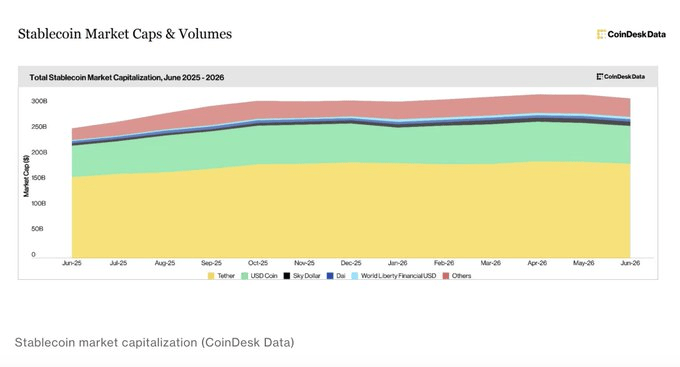
Source: CoinDesk

In other words, the crypto market has seen two straight months of liquidity leaving the ecosystem, with June posting the biggest stablecoin outflow in four years.

That’s a strong sign the market remains firmly in a risk-off phase, drawing clear parallels with the liquidity conditions seen during the 2022 bear market.

From a technical perspective, this liquidity contraction lined up with Bitcoin’s 3.6% correction in May and a 20.45% decline in June.

Together, these signals suggest BTC’s current correction is looking less like a bottoming process and more like the type of liquidity-driven weakness that defined the 2022 bear cycle.

The next question is whether that trend is starting to change.

Stablecoin dominance hints at Bitcoin’s next bottom

Normally, a risk-off environment typically drives capital into traditional safe-haven assets.

However, that’s not what happened this time. Gold closed May down 1.6% and June down 11.73%; even stablecoins recorded their largest monthly outflow.

In other words, the capital leaving stablecoins did not rotate into gold, suggesting investors weren’t simply shifting from one defensive asset to another.

According to AMBCrypto, that divergence could be one of the key signals to watch this cycle. As the chart below shows, Stablecoin Dominance (STABLE.D) has fallen 6.5% so far this month after climbing more than 20% over the previous two months.

At the same time, Bitcoin Dominance (BTC.D) has continued to hold around 60%, despite slipping nearly 3% over the same period.
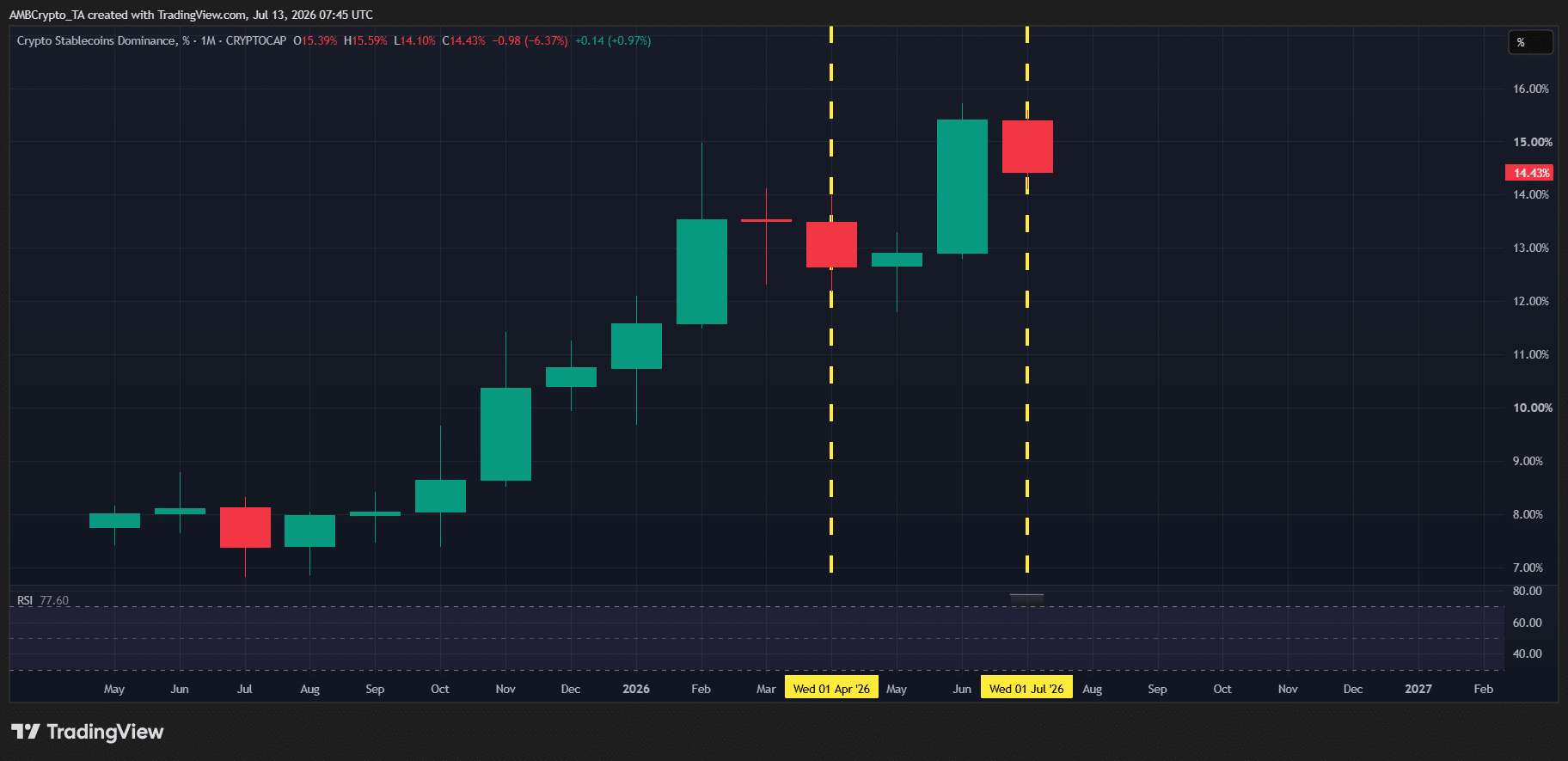
Source: TradingView (STABLE.D)

Taken together, these signals suggest the liquidity contraction that accelerated through May-June may be starting to slow.

More importantly, with BTC.D still holding near 60%, and there is no meaningful rotation into gold, and capital remains largely “Bitcoin-centric.” That’s a notable shift from the 2022 bear market, where liquidity broadly exited risk assets instead of staying concentrated in Bitcoin.

Therefore, if STABLE.D continues to trend lower, it would suggest sidelined capital is gradually moving back into the market. That makes a bottom in STABLE.D one of the key signals to watch, as it could coincide with Bitcoin finding a bottom and beginning its next move higher.


Final Summary

  • June saw the largest stablecoin outflow in four years, but the money didn’t move into gold, suggesting investors are staying on the sidelines.
  • With STABLE.D falling and BTC.D holding near 60%, a bottom in stablecoin dominance could signal Bitcoin’s next move higher.


Preguntas relacionadas

QWhat does the article identify as a key factor in distinguishing a market bottom from a prolonged bear phase?

AThe article identifies liquidity and its movement as the key factor. Specifically, whether capital is moving to the sidelines within the crypto ecosystem or leaving the ecosystem altogether during a risk-off market.

QAccording to the article, what was significant about the stablecoin outflow in June?

AThe stablecoin outflow in June amounted to $7.7 billion, marking the largest monthly contraction in the stablecoin market cap since the Terra-Luna collapse in May 2022. This indicated the market remained firmly in a risk-off phase.

QWhy does the divergence between stablecoin outflows and gold's performance matter, according to the analysis?

AThe capital leaving stablecoins did not rotate into gold, which was also declining. This suggests investors were not simply shifting between defensive assets but were likely moving capital to the sidelines or out of the risk-asset ecosystem entirely, a behavior different from typical safe-haven rotations.

QWhat two metrics does the article suggest watching to gauge a potential Bitcoin bottom, and what is their recent trend?

AThe article suggests watching Stablecoin Dominance (STABLE.D) and Bitcoin Dominance (BTC.D). STABLE.D has fallen 6.5% in the current month after a previous rise, while BTC.D has continued to hold around 60% despite a slight slip. A bottom in STABLE.D could signal Bitcoin's bottom.

QHow does the current liquidity dynamic differ from the 2022 bear market, as described in the article?

AIn the current situation, capital remains largely 'Bitcoin-centric' with BTC.D holding strong near 60%, and there's no broad rotation into gold. This contrasts with the 2022 bear market, where liquidity broadly exited risk assets (including Bitcoin) instead of staying concentrated within Bitcoin.

Lecturas Relacionadas

Prime Minister Backing, SBI's "Shopping Spree," Lawson's Pilot: Japan Seizing the Compliance Dividend in Crypto

Japan is moving decisively to establish itself as a leader in the compliant crypto ecosystem through a coordinated national strategy. This commitment is underscored by consistent high-level political support, with successive prime ministers addressing the WebX conference to promote regulatory reform and position Web3 as a core industry. The financial giant SBI Holdings is executing a strategic, multi-billion dollar investment spree to build a comprehensive infrastructure stack. Key moves include acquiring the major exchange Bitbank, investing in core infrastructure firms like Gauntlet and EDX Markets, and forming "SBI Solana Global" to develop a yen-denominated stablecoin (JPYSC) and tokenized assets on the Solana network. Concurrently, a pilot by convenience store chain Lawson will test stablecoin payments in a real-world retail setting. The Japanese approach combines high regulatory barriers, which limit competition, with strategic capital from established financial conglomerates (zaibatsu) rather than standalone crypto firms. Upcoming tax reforms, planning to slash crypto capital gains tax from 55% to 20%, are designed to attract domestic savings. This integrated model—strict licensing, deep-pocketed traditional finance, real-world use cases, and favorable taxation—creates a formidable, closed-loop system for early entrants like SBI. It offers a potential blueprint for other jurisdictions seeking to formalize their crypto industries, signaling a shift from regulatory arbitrage to a race for compliance and legitimacy.

marsbitHace 20 min(s)

Prime Minister Backing, SBI's "Shopping Spree," Lawson's Pilot: Japan Seizing the Compliance Dividend in Crypto

marsbitHace 20 min(s)

An AI Uncovers a 15-Year-Old Linux Vulnerability in 5 Seconds, While Another AI Turns an Innocent Journalist into a Car Thief Suspect

AI Discovered a 15-Year-Old Linux Bug but Also Wrongly Targeted a Journalist An AI security tool, VEGA, identified "GhostLock" (CVE-2026-43499), a severe Linux kernel vulnerability hidden for 15 years since 2011, affecting nearly all distributions. Exploiting a flaw in the kernel's lock management, an attacker could gain root privileges in about 5 seconds from a standard user account. This demonstrates AI's growing ability to find complex bugs humans missed. In a stark contrast, another AI system caused a dangerous police confrontation. Automotive journalist Joel Feder was surrounded by four police cars after Flock Safety's automated license plate recognition (ALPR) cameras mistakenly flagged his vehicle. The error originated from a typo in a national stolen vehicle database ("34 03 DTM" was entered as "34 DTM"). Feder's manufacturer plate, "34 10 DTM," was misread due to its small font, triggering a nationwide alert. Police, with hands on holsters, detained Feder for an hour before resolving the mistake. The two cases highlight the dual nature of AI in security. On one hand, it can efficiently uncover critical software vulnerabilities, enhancing safety. On the other, it can exponentially amplify human errors—like a simple data entry mistake—when deployed in automated, large-scale surveillance systems without adequate human oversight. The incident underscores the critical need for robust review mechanisms in AI-driven decision systems, especially in high-stakes areas like law enforcement. The greatest vulnerability in the AI era may not be in code, but in the unchecked delegation of final judgment to automated processes.

marsbitHace 46 min(s)

An AI Uncovers a 15-Year-Old Linux Vulnerability in 5 Seconds, While Another AI Turns an Innocent Journalist into a Car Thief Suspect

marsbitHace 46 min(s)

Is Ethereum Truly a "World Computer"?

Ethereum has long been branded as a "world computer," yet its current infrastructure reveals significant geographic concentration, challenging this claim. An analysis of validator node distribution shows the network heavily leans toward Western nations. The U.S. alone hosts 38.19% of all validators, while Germany accounts for 13.04%, meaning these two countries comprise over half the network. Notably, a substantial portion of U.S. validators are residential nodes run from home connections, reflecting grassroots participation. In contrast, representation from Asia, South America, the Middle East, and Africa is minimal. Examining only professionally-operated institutional validators shows a more balanced picture, with countries like Singapore, Hong Kong, Japan, and South Korea collectively reaching nearly 25%. This shift indicates strategic institutional deployment to meet local regulatory requirements and reduce latency for regional users. A core problem is Ethereum's peer-to-peer gossip protocol, which systematically disadvantages regions with low node density. Late message arrival reduces a node's "peer score," pushing it to the network's periphery, further delaying future messages. This can impact validator rewards and network performance in these areas, posing a challenge to decentralization. However, this geographic imbalance also presents a significant opportunity. For Ethereum to truly become a global settlement layer, localized infrastructure is essential. Pioneering reliable validator operations in underserved regions like the Middle East, South America, or Africa could establish a crucial first-mover advantage, meeting growing demand for compliant, low-latency staking services in these markets.

marsbitHace 1 hora(s)

Is Ethereum Truly a "World Computer"?

marsbitHace 1 hora(s)

Trading

Spot
活动图片