Jack Dorsey’s Block Job Cuts Signal Operational Efficiency Push As SUBBD Token Drives Creator Economy 2.0

bitcoinistPublicado a 2026-02-09Actualizado a 2026-02-09

Resumen

Jack Dorsey's Block Inc. is undergoing strategic restructuring, including layoffs affecting up to 10% of its workforce, signaling a shift from aggressive growth to operational efficiency. This move aims to improve margins and focus on core initiatives like Bitcoin hardware. Meanwhile, the SUBBD Token is emerging as a decentralized alternative for the creator economy, combining AI and blockchain to reduce platform fees and automate workflows. Having raised over $1.4M in its presale, SUBBD offers AI-driven tools and staking rewards, positioning itself as a Web3 solution for content creators seeking greater autonomy and efficiency.

The recent strategic restructuring at Block Inc., led by Jack Dorsey, marks a definitive shift in the fintech landscape. We are seeing a hard pivot from aggressive expansion to rigorous operational discipline.

By executing targeted layoffs, reportedly affecting up to 10% of its roughly 11,000 staff during annual performance reviews this February, the parent company of Square and Cash App is signaling that the era of ‘growth at all costs’ has formally concluded. According to a report from Bloomberg over the weekend.

This move, which follows the March 2025 elimination of 931 roles, is part of a broader overhaul intended to better integrate Cash App with Square, while the company is also investing in its internal AI productivity tool, Goose.

This isn’t merely a cost-cutting exercise; it’s a recalibration of resources designed to improve margins and focus on high-conviction bets like Bitcoin hardware and the self-custody wallet, Bitkey.

For the broader market, this move suggests efficiency is the new alpha. Investors are increasingly rewarding companies that demonstrate lean operations and clear paths to profitability rather than bloated headcount metrics, a sentiment reflected in the 5% jump in Block’s shares following the report. However, a second-order effect is rippling through the digital economy.

As centralized giants tighten their belts, the creators and merchants who rely on these platforms are realizing the fragility of their dependence on legacy tech stacks. When major platforms restructure, user fees often stagnate (or rise) while support services dwindle.

This corporate austerity is inadvertently accelerating the migration toward decentralized solutions where efficiency isn’t just a corporate mandate, but a user benefit. The friction between platform profitability and creator earnings is creating a vacuum for Web3 alternatives that use automation to lower costs. Emerging protocols are now using artificial intelligence to offer the same operational efficiency Dorsey seeks for Block, but democratized for individual creators.

Leading this charge is SUBBD Token ($SUBBD), a project merging AI utility with blockchain transparency to disrupt the $85B content creation industry.

Decentralized AI Tools Offer Creators Sovereign Efficiency

While legacy fintech firms like Block streamline their internal operations, the SUBBD Token ecosystem is deploying technology to streamline the external workflow of content creators. The core value proposition here addresses a critical inefficiency in the current market: the extractive nature of Web2 platforms. These giants can take up to 70% of a creator’s revenue while offering limited tools for growth.

SUBBD utilizes an Ethereum-based architecture to remove these intermediaries, but its primary differentiator lies in its integration of proprietary AI models.

The platform functions as a comprehensive operational suite. Features like the AI Personal Assistant automate routine interactions, while AI Voice Cloning and AI Influencer Creation tools allow creators to scale their output without expanding their overhead, effectively mirroring the ‘do more with less’ philosophy currently sweeping Silicon Valley.
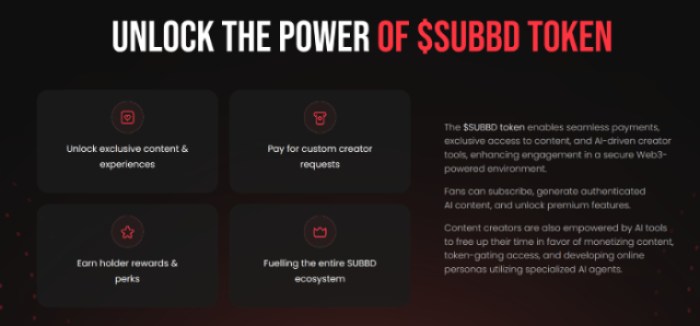
By automating content generation and fan engagement, SUBBD allows creators to maintain high-volume output without the burnout associated with the traditional influencer treadmill. Plus, the platform’s governance model (HoneyHive) ensures that protocol upgrades are dictated by token holders rather than a centralized board seeking to cut costs at the expense of user experience.

FIND OUT MORE ABOUT SUBBD TOKEN

SUBBD Presale Momentum Highlights Demand For Web3 Monetization

The market’s appetite for efficient, AI-driven infrastructure is evident in the early capital flows into the SUBBD Token presale. $SUBBD has successfully raised over $1.4M, signaling strong conviction from retail and early-stage investors. With tokens currently priced at $0.057495, the entry point reflects a valuation that anticipates significant growth as the platform rolls out its beta features.

This capital injection suggests that smart money is looking for exposure to the intersection of two high-growth narratives: the maturation of the creator economy and the utility of generative AI.

Beyond the immediate price action, the project’s staking mechanics offer a clear incentive structure designed to reduce sell pressure and reward long-term alignment. Investors can lock tokens to earn a fixed 20% APY in the first year, a yield that significantly outpaces traditional dividend stocks or savings rates.

This staking model also unlocks utility benefits, including access to exclusive livestreams and ‘behind the scenes’ drops, effectively gamifying the holding process. As Ethereum (ERC-20) compatible assets continue to dominate the DeFi landscape, SUBBD’s seamless integration into the broader EVM ecosystem ensures liquidity and accessibility, positioning it as a serious contender against legacy subscription models.

Get your $SUBBD on the official presale site

This article is for informational purposes only and does not constitute financial advice. Cryptocurrency investments carry inherent risks, including high volatility and potential loss of capital.


Criptos en tendencia

Preguntas relacionadas

QWhat is the primary reason behind Block Inc.'s recent layoffs and restructuring?

ABlock Inc. is undergoing a strategic restructuring to shift from aggressive expansion to rigorous operational discipline, focusing on improving margins, integrating Cash App with Square, and investing in high-conviction projects like Bitcoin hardware and the Bitkey self-custody wallet.

QHow did the market react to Block's announcement of job cuts?

AThe market reacted positively, with Block's shares jumping 5% following the report, as investors increasingly reward companies that demonstrate lean operations and clear paths to profitability.

QWhat problem does the SUBBD Token aim to solve for content creators?

ASUBBD Token addresses the extractive nature of Web2 platforms, which can take up to 70% of a creator's revenue, by using a decentralized Ethereum-based architecture and AI tools to remove intermediaries, automate workflows, and reduce costs for creators.

QWhat are some key AI features offered by the SUBBD platform?

AThe SUBBD platform offers an AI Personal Assistant to automate interactions, AI Voice Cloning, and AI Influencer Creation tools to help creators scale their output efficiently without increasing overhead.

QWhat financial incentive does SUBBD Token offer to investors during its presale?

ASUBBD Token offers staking with a fixed 20% APY in the first year, which rewards long-term holders and reduces sell pressure, along with utility benefits like access to exclusive livestreams and content drops.

Lecturas Relacionadas

Can Generative Models Finally Be Trained End-to-End? The Core Is a For Loop

This article introduces a novel training paradigm for generative models called Explorative Modeling (XM), which enables true end-to-end training. Traditionally, powerful generative models like autoregressive and diffusion models are not trained end-to-end. They are trained to predict a single small step but require iterative multi-step sampling for inference. This "exposure bias" leads to error accumulation and limits performance. The core challenge XM addresses is "mode blurring." In generative tasks, a single input (e.g., "generate a dog") corresponds to many valid outputs (multiple modes). Standard training objectives like reconstruction loss force the model to average these modes, producing unrealistic, blurry outputs. To avoid this, existing models break generation into many small, almost deterministic steps, sacrificing end-to-end training. XM tackles this by restructuring the training loop itself. Its key insight is to amplify "generative expressivity." For each training input, instead of generating one sample, the model generates K candidate outputs. Only the candidate closest to the real data is used for computing the loss and updating the model via backpropagation. This simple "best-of-K" mechanism is implemented as a short for-loop. By exploring multiple possibilities, the model learns to distribute its guesses across different modes rather than collapsing to their uninformative average. The paper demonstrates that "exploration" acts as a new, powerful scaling axis. Gains from XM increase with model size, data scale, and compute. Experiments show improvements in FID scores for image generation and significant efficiency gains, sometimes outperforming larger models without exploration. When pushed to the limit, XM enables fully single-step, end-to-end generative models. In robotics tasks, an "Explorative Policy" matched the performance of a 100-step Diffusion Policy with a single forward pass, drastically improving inference speed. While the best-of-K concept is not entirely new, the authors' contribution lies in formally understanding it as a direct method to boost generative expressivity without fragmenting the generation process. This work suggests that as models scale, enhancing exploration during training may become crucial for overcoming fundamental performance bottlenecks.

marsbitHace 48 min(s)

Can Generative Models Finally Be Trained End-to-End? The Core Is a For Loop

marsbitHace 48 min(s)

Annual Salary of Millions Competing for Electricians, Meta Rushes to Open Its Own Technical School

The AI boom is facing an unexpected bottleneck: a severe shortage of skilled construction workers and electricians. As tech giants like Meta, OpenAI, and Alphabet race to build massive data centers—such as OpenAI's $16 billion "Stargate" project—they are hitting a critical labor wall. The U.S. needs an estimated 130,000 more electricians, 240,000 construction workers, and 150,000 supervisors by 2030 for AI infrastructure alone, but tens of thousands of electrician jobs go unfilled each year. While AI companies offer high premiums, with electricians earning up to $280,000 annually, worker scarcity still causes massive losses—delays on a single project can cost $14.2 million per month. The complexity of building AI data centers, which require immense power (equivalent to powering hundreds of thousands of homes), sophisticated electrical systems, and advanced liquid cooling solutions, demands highly skilled technicians who are in short supply. To combat this, companies are investing heavily in training. Meta has committed $115 million to a free training school offering tuition, housing, and stipends, targeting 5,000 new workers. OpenAI is partnering with unions to secure skilled labor. These efforts are paying off, with a significant rise in Gen Z interest in trade schools over college. However, the power demands are staggering. AI data centers are driving a rapid surge in electricity consumption, projected to account for up to 12% of U.S. power use by 2028 and raising costs for consumers. Furthermore, the construction boom is project-based, leading to a potential future glut of trained workers once building peaks, which could depress wages industry-wide. The race for AI supremacy now depends as much on skilled hands as on advanced chips.

marsbitHace 2 hora(s)

Annual Salary of Millions Competing for Electricians, Meta Rushes to Open Its Own Technical School

marsbitHace 2 hora(s)

Trading

Spot
活动图片