It's 2026 Already, DAOs Should Have Matured by Now

比推Publicado a 2026-01-29Actualizado a 2026-01-29

Resumen

By 2026, DAO governance is maturing beyond idealistic experiments. In 2025, major protocols shifted from pure community governance to hybrid models with clearer operational control, as seen with Arbitrum’s OpCo and Uniswap’s DUNI framework. Voting participation declined but became more concentrated among professional delegates, while token value accumulation gained prominence through buybacks, fee switches, and staking mechanisms. Key conflicts, like Gnosis terminating Karpatkey and Aave’s revenue dispute with Aave Labs, highlighted accountability gaps. Looking ahead, DAOs will formalize legal structures, prioritize risk management, and leverage AI for decision-making. Governance tokens must capture economic value to sustain engagement. The evolution reflects a balance between decentralized oversight and operational efficiency, signaling DAO’s maturation into more effective, accountable organizations.

Author: Pink Brains

Compiled by: Deep Tide TechFlow

Original title: It's 2026 Already, DAOs Should Have Matured by Now


Deep Tide Guide: 2025 was a critical inflection point for decentralized governance (DAO). After years of idealistic experimentation, mainstream protocols began to seriously address core pain points such as power distribution, accountability mechanisms, and sustainability. This article is written by veteran DAO delegate Pink Brains, based on their practical experience of casting 725 votes in top protocols like Aave, Lido, and Gnosis. It provides an in-depth analysis of the shift in DAOs from "community autonomy" to a "hybrid operation" model.

The author points out that governance tokens alone are no longer sustainable. In the future, DAOs will evolve towards economic alignment, legal entity formation, and AI-assisted decision-making. This is not just a review of governance; it's a prophecy book for the evolution of Web3 organizational structures in 2026.

Full text below:

2025 marked a turning point for decentralized governance.

After years of experimentation, major protocols began confronting fundamental questions about power distribution, accountability, and sustainability.

The answers weren't always pleasant, but they were necessary.

What We Achieved in 2025

2025 was also the first year of our operation as an active DAO Delegate.

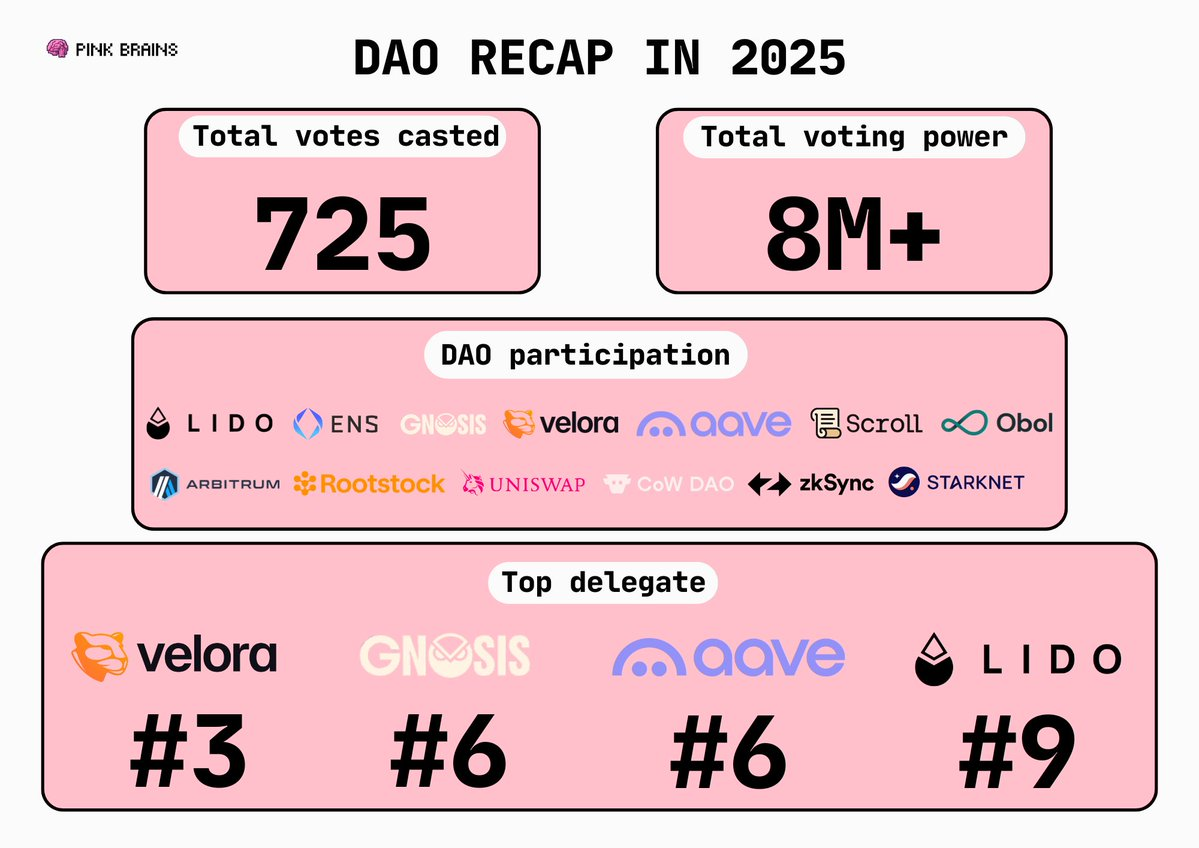
  • Casted 725 votes across 18 protocols

  • Held over 8 million in voting power

  • Top 10 delegate in Aave and Lido

  • Top 3 delegate in Velodrome

  • Top 6 delegate in Gnosis

This perspective, grounded in actual governance work, gave us clear insight into the patterns reshaping DAOs in 2025 and defined their trajectory entering 2026.

Changes in DAOs in 2025

Shift in Operational Model: From Pure Community Governance to Hybrid Control

The most notable change in 2025 was the shift from purely community-based governance towards hybrid models with clearer operational control.

  • @arbitrum introduced an Operating Company (OpCo), channeling all DAO operations through a unified structure.

  • @JupiterExchange completely paused governance for nearly six months to reassess its approach.

  • @Uniswap launched the DUNI framework, centralizing operational authority.

  • @Gnosis's DAO executed a hard fork amidst reduced community engagement. Scroll transitioned to a CEO-led structure.

  • @Scroll_ZKP suspended its DAO, shifting focus to centralized governance.

  • Recently, the Celo Foundation merged with @cLabs into a unified core contributor organization.
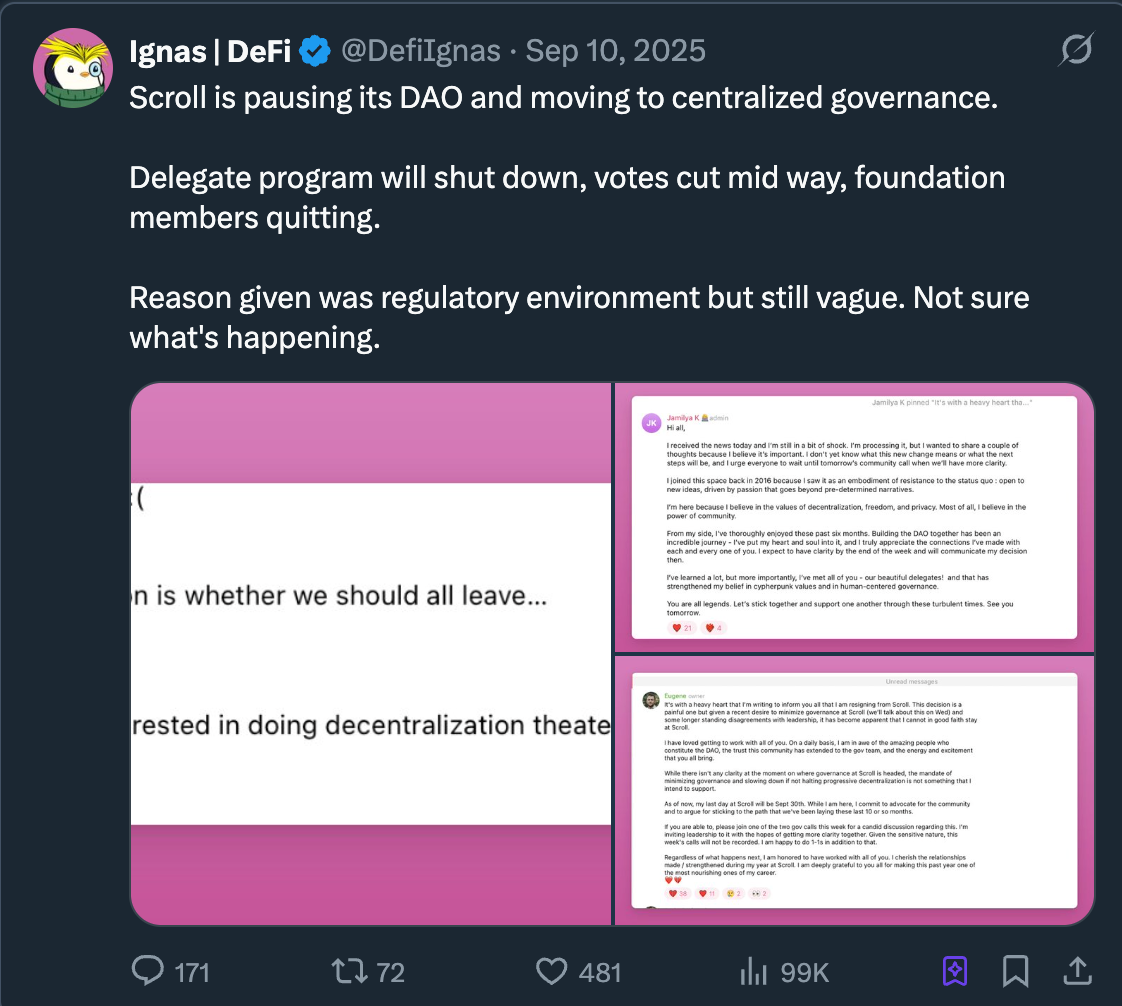
The motivation for this shift was DAOs hitting scaling limits. Execution became the bottleneck. Full-community votes were often too slow for operations, too noisy for technical nuances, and too vulnerable for security-sensitive actions.

Consequently, governance power concentrated towards smaller, high-context groups, while the broader community shifted towards oversight functions, as seen in the next section.

Fewer Voters, But More Concentrated Power

In 2025, the number of proposals and participating voters dropped significantly across major DAOs. However, the voting power behind each proposal remained strong.

  • Lido saw an increase in participation after adopting a dual governance framework.

  • Arbitrum and Uniswap still had the highest overall participation, but both saw a decrease in the number of voters.
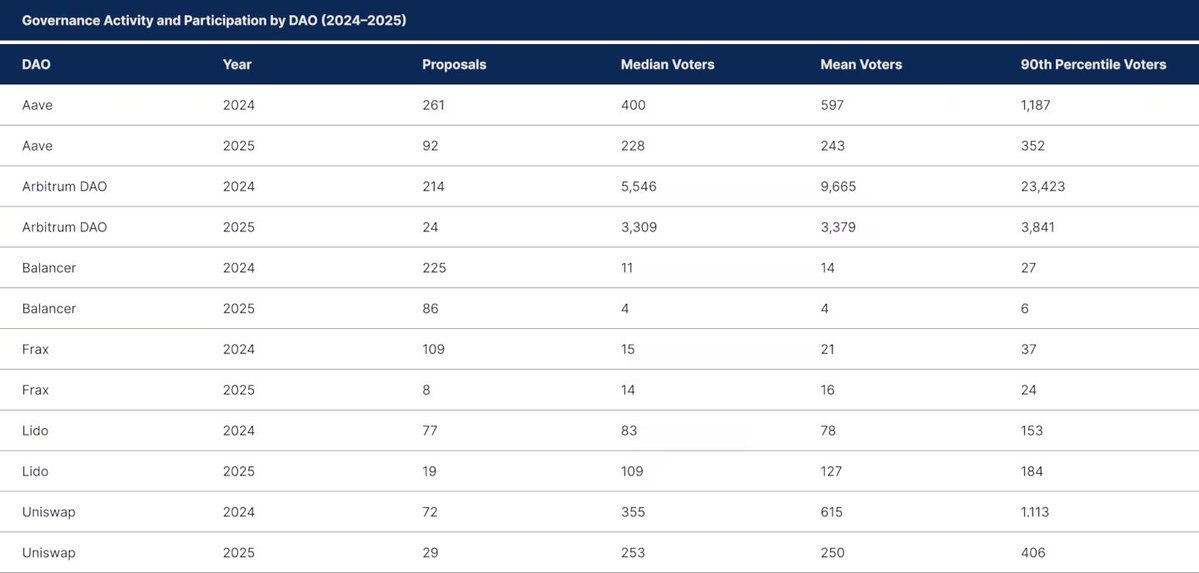
Caption: From DeFiLlama's State of DeFi 2025 Report

This does not signal the failure of governance. Instead, governance became more bundled, more operationally abstract, and less frequent.

Governance influence migrated to a small number of highly active Delegates and heavily capitalized participants.

Value Accrual for Token Holders

"Token buyback," "buyback and burn," and "fee switch" became central themes in 2025.
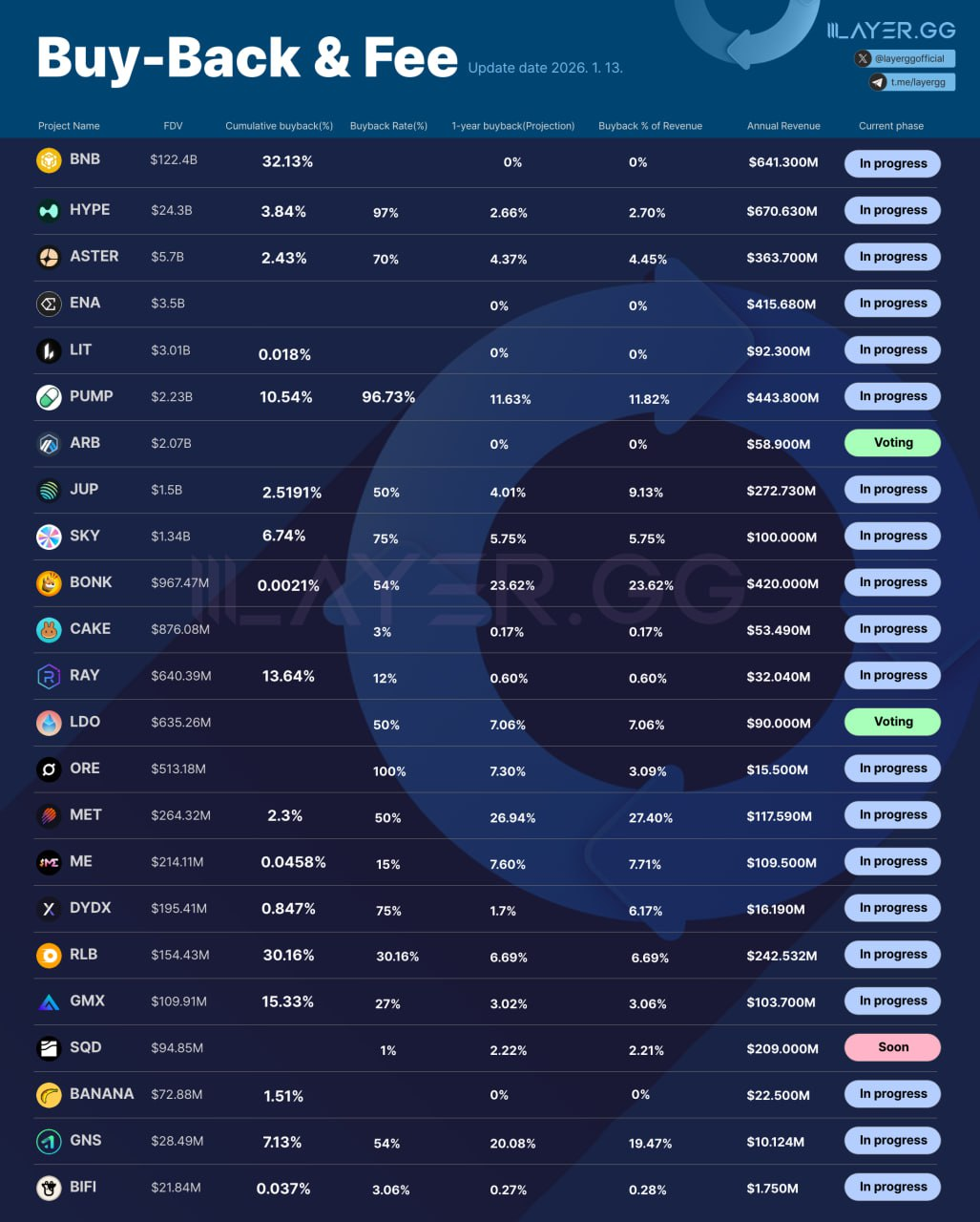
For years, token utility revolved around voting rights and incentive distribution, but offered minimal economic value to token holders. 2025 changed this equation.

  • Lido adopted a buyback framework.

  • Uniswap DAO activated the long-awaited fee switch, pledging to burn nearly $600 million worth of UNI tokens.

  • Aave implemented a token buyback mechanism. Optimism launched a buyback program.

  • CoW Protocol increased solver profitability in a way that benefits token holders.

This trend addresses a key challenge in tokenomics. Buybacks and burns reduce circulating supply, making the token more scarce. If demand holds steady, the price strengthens. When token holders can actually benefit from the protocol's success, they are more incentivized to buy, hold, and participate in governance decisions long-term.

Who Really Owns the DAO?

Two major controversies forced DAOs to confront structural flaws.

  • Gnosis voted to terminate Karpatkey's treasury mandate due to fee disputes, underperformance, and a ~$700k loss related to a liquidity issue.

  • Tensions between Aave DAO and Aave Labs escalated when it was discovered that ~$10 million annually in swap fees from the CoW Swap integration were flowing to Aave Labs instead of the DAO. A vote on brand ownership failed, and the controversy left a harder question: what does "DAO-owned" really mean when the core team controls development and distribution?

These conflicts forced protocols to fill the gaps in accountability and governance structures.

Legal Infrastructure is Adapting to DAOs

Despite DeFi's growth, most DAOs still lack clear legal structures, creating liability and regulatory risks as protocols scale.

While jurisdictions like Wyoming have introduced DAO LLC frameworks, and Switzerland offers mature legal pathways, most DAOs remain in a legal gray area.

2026 Trend Predictions

Centralized DAOs as a New Practice

Protocols will develop clear frameworks to delineate "community decisions" from "operational decisions," moving beyond the false binary of "fully decentralized" or "fully centralized."

  • Operational Execution: Will be handled by Labs teams, not foundations.

  • Community Oversight: DAO delegates and the community will be responsible for treasury strategy, long-term direction, and major structural decisions.

Governance Shifts Towards Risk Management Infrastructure

The DAO of the future will be less like a forum full of chatter. More teams will bifurcate decisions into concave decisions and convex decisions.

Concave problems require:

  • Pre-approved guardrails and automated execution.

  • Professional oversight (risk services, auditors, security teams).

  • Rapid response frameworks for emergencies and market shocks.

  • Fewer proposals, but each decision carries higher economic impact.

Convex problems (like product direction) require decisive leadership, where the DAO acts as a "brake" or "checkpoint," not a "steering wheel."

By 2026, this will be standard for lending, stablecoins, perps, and any protocol where financial risk can compound quickly.

The End of Governance Tokens? Value Capture is a Must

Continuing into 2026, tokens with only governance functions will struggle to maintain long-term engagement.

Delegates, whales, and strategic holders won't consistently provide protection for the system without seeing a return profile. Protocols will increasingly adopt at least one value accrual path:

  • Token buyback frameworks.

  • Fee diversion or revenue sharing.

  • Staking tied to protocol cash flows.

  • Treasury strategies aimed at supporting token value.

When holders gain economically from the protocol's success, they are incentivized to stay attentive, participate, and protect the system.
Legal Structures Shift from Optional to Necessary

Regulatory pressure and real-world legal challenges will push DAOs towards formal entity formation, seeking a balance between decentralized governance and legal clarity.

Professional Delegation

As governance complexity increases, token holders will increasingly delegate to full-time professional delegates. While this concentrates voting power, it may improve decision quality. Meanwhile, weaker delegate institutions that cannot financially sustain themselves will fold, as governance work becomes more professional, political, and costly.
Privacy, AI & Futarchy

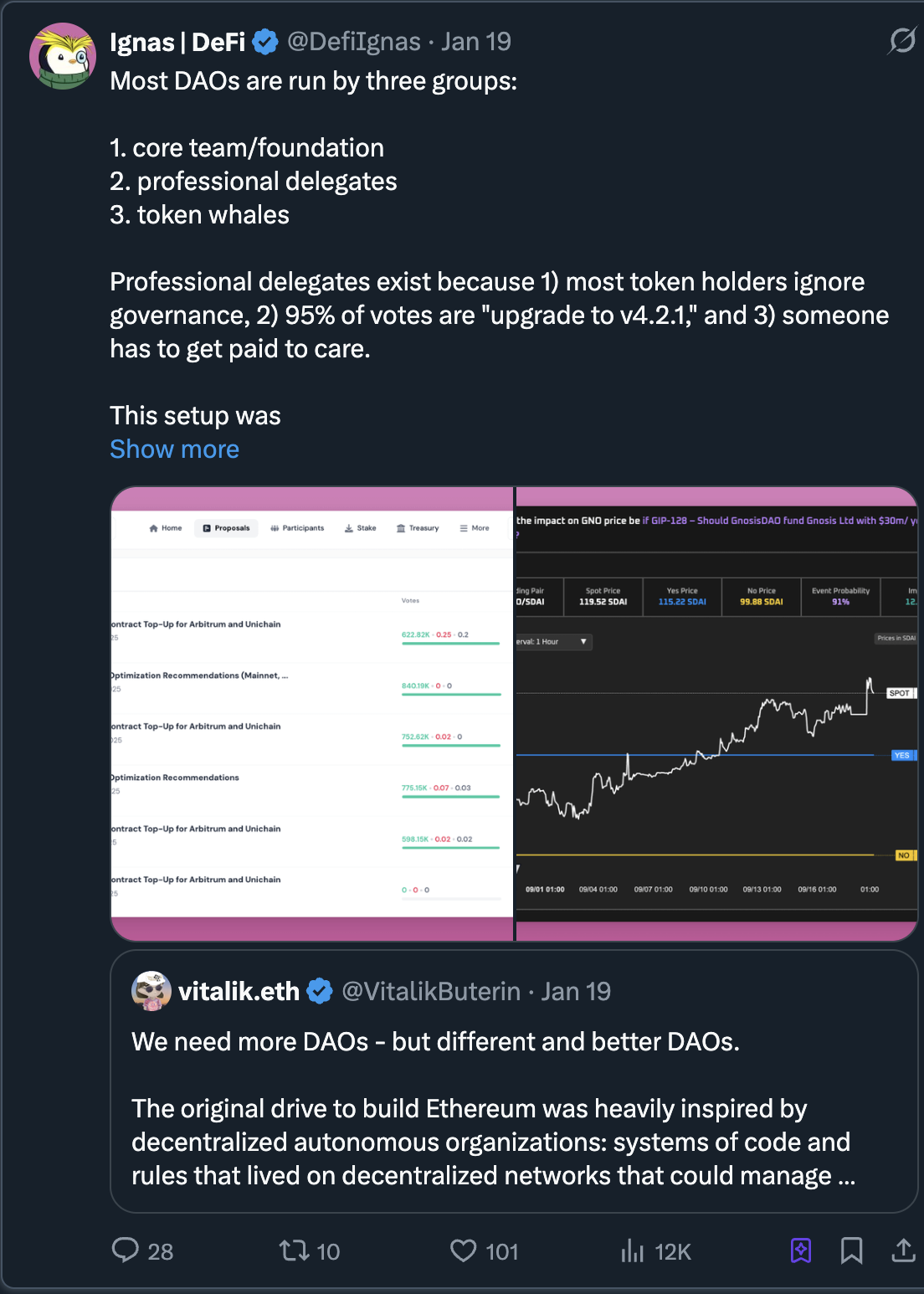
Public governance is a social game. When every vote is publicly visible, decisions are influenced by reputation, pressure, and alliances, rather than purely the protocol's best interest. Therefore, governance privacy will become more important in the future.

AI will address decision fatigue. It can assist in analyzing proposals and auto-voting on routine upgrades based on user-defined preferences, requiring human intervention only for disputes or high-impact matters.

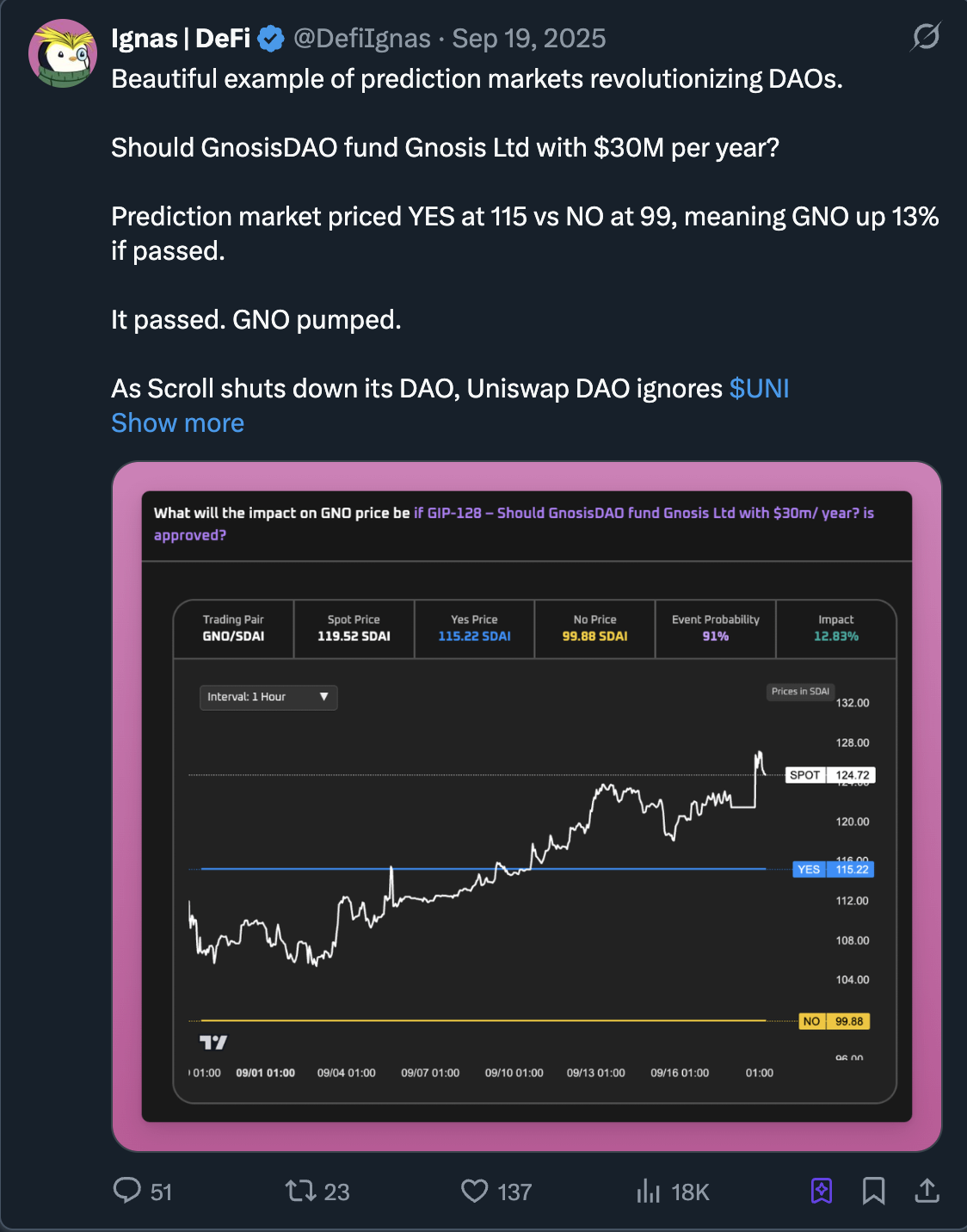
Futarchy markets will also play a larger role in DAOs. They let market signals predict which option might create value. Gnosis is testing this model, using retail prediction markets to reflect sentiment on proposals.
Crypto is Maturing, and So Are DAOs

The shifts we see in DAO operations, economic alignment, accountability conflicts, and professionalization represent maturation, not the end of DAOs.

DAOs are evolving from ideological experiment to organizational architecture that balances "decentralized oversight" with "proven operational efficiency." We believe DAO governance becomes meaningful if teams can align with community interests: moving fast when action is needed, letting growth benefit token holders, and holding all participants—core teams and delegates alike—accountable.

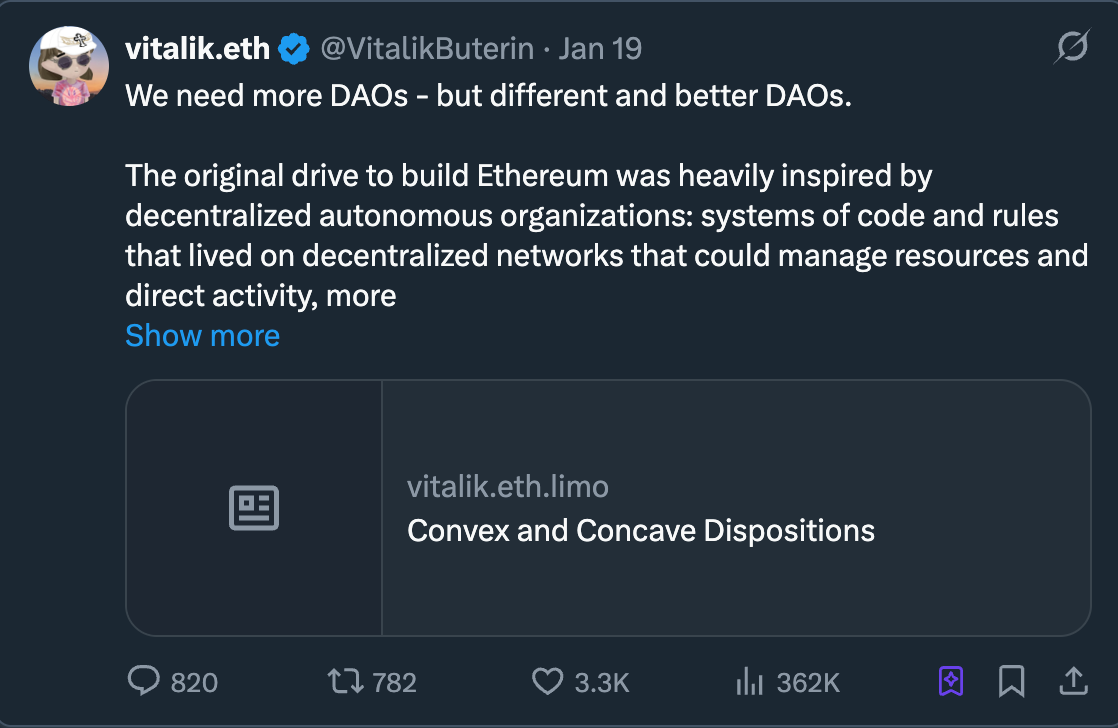
As Vitalik said: We need more DAOs, but different and better DAOs.
If you believe in the value of DAOs, we can be your voice.

Effective delegation is more than just casting a vote; it means doing the actual work: reading proposals, being active on forums, understanding risks, and voting against bad decisions, even when it's not the popular choice.

This is how we operate as delegates: through clear communication and educational content, helping the protocol grow while staying aligned with community incentives.


Twitter:https://twitter.com/BitpushNewsCN

BitPush TG Discussion Group:https://t.me/BitPushCommunity

BitPush TG Subscription: https://t.me/bitpush

Original link:https://www.bitpush.news/articles/7607064

Preguntas relacionadas

QWhat was the most significant shift in DAO operational models in 2025, according to the article?

AThe most significant shift was the transition from pure community governance to hybrid control models with clearer operational authority, as seen with protocols like Arbitrum introducing operational companies (OpCo) and Uniswap launching the DUNI framework.

QHow did the trend of token buybacks and fee switches address a key challenge in tokenomics in 2025?

AIt addressed the challenge of providing minimal economic value to token holders. By implementing buyback frameworks, fee switches, and revenue-sharing mechanisms, protocols made tokens more scarce and valuable, aligning token holder incentives with the protocol's long-term success.

QWhat two major controversies in 2025 forced DAOs to confront structural flaws in accountability?

AThe two major controversies were: 1) Gnosis DAO voting to terminate Karpatkey's treasury mandate due to fee disputes and performance issues, and 2) The conflict between Aave DAO and Aave Labs over the misdirection of approximately $10 million in annual swap fees.

QWhat is the predicted role of AI in DAO governance for 2026, as outlined in the article?

AAI is predicted to help solve decision fatigue by analyzing proposals and automating votes on routine upgrades based on user-defined preferences, requiring human intervention only for contentious issues or decisions with significant impact.

QWhat does the article suggest is the future for governance tokens that only have voting utility?

AThe article suggests that governance tokens with only voting utility will struggle to maintain long-term engagement. They must incorporate value-capture mechanisms like buyback frameworks, fee sharing, or staking tied to protocol cash flows to be sustainable.

Lecturas Relacionadas

Ethereum Q1 2026 Report: Fees Decline, Users and Transaction Volume Hit New Highs

Ethereum Q1 2026 Report: Fees Down, Users & Transactions Hit New Highs Token Terminal's Q1 2026 report on Ethereum presents a pivotal development: the network achieved record highs in monthly active users (13.2M, +85.9% YoY), total transactions (200.4M, +81.5% YoY), and throughput (25.78 TPS), while transaction fees on the mainnet plummeted by 47.9% quarter-over-quarter. This shift is attributed to the network's strategic move into a "low fees for scale" phase, exemplified by the Fusaka upgrade which increased data capacity and lowered block space costs, releasing pent-up demand (a manifestation of Jevons's Paradox). The report highlights a core narrative shift for Ethereum: from a DeFi-centric blockchain to a global financial settlement layer. It maintains a dominant position in tokenized assets, holding majority market shares among top chains in stablecoins (61.8%), tokenized funds (73.0%), and tokenized commodities (84.0%). Growth in tokenized funds (+73.1% YoY) and commodities (+325.9% YoY) was particularly strong, driven by institutions like BlackRock and JPMorgan entering the space. Contrasting these usage gains, several USD-denominated value metrics declined in Q1: fully diluted market cap fell 30.3% QoQ, total value locked (TVL) dropped 11.0%, and ecosystem transaction volume decreased 24.0%. The report interprets this as Ethereum prioritizing long-term network expansion and cementing its role as the default settlement layer for finance over short-term fee capture. The commentary from Etherealize argues that, much like the early internet, Ethereum's open, permissionless model is poised to win over closed alternatives as institutional tokenization accelerates.

marsbitHace 1 hora(s)

Ethereum Q1 2026 Report: Fees Decline, Users and Transaction Volume Hit New Highs

marsbitHace 1 hora(s)

He Just Raised 2.7 Billion, and Li Fei-Fei Also Invested

Pete Florence, a former senior research scientist at Google DeepMind and a key contributor to the Vision-Language-Action (VLA) model architecture, is deliberately distancing his startup, Generalist AI, from the trendy "world model" label. He argues that the industry should prioritize concrete goals over buzzwords. His goal is to create robots that can perform a vast range of unseen tasks with high speed and success rates, without needing task-specific training data. Recently, his company raised $400 million (¥2.7 billion) at a $2 billion valuation. Notable investors include NVIDIA's NVentures, Bezos Expeditions, NFDG, as well as Xiaomi co-founder Lin Bin, Zoom founder Eric Yuan, and renowned AI scientist Fei-Fei Li. Florence's approach stems from his academic background at MIT under Professor Russ Tedrake, focusing on understanding the physical world. After joining DeepMind, he developed models like Transporter Network and co-created the VLA framework. He left in 2025 to found Generalist AI. The company has launched two models: GEN-0, which demonstrated that scaling laws apply to physical motion, and GEN-1. GEN-1 was trained on over 500,000 hours of physical interaction data collected via a specialized wearable device. It achieves a 99% success rate on precise mechanical tasks like folding boxes and maintains performance three times faster than its predecessor. Florence believes GEN-1 is reaching a commercial utility threshold similar to the GPT-3 inflection point. The substantial funding round, following GEN-1's release, signifies strong investor confidence in Generalist AI's practical, goal-driven path to creating versatile, useful robots, regardless of the "world model" terminology.

marsbitHace 1 hora(s)

He Just Raised 2.7 Billion, and Li Fei-Fei Also Invested

marsbitHace 1 hora(s)

Two Legends Lost in Three Days: Is Google's AI Talent Dam Cracking?

In three days, Google lost two AI legends. On June 18, Noam Shazeer, co-author of the seminal "Attention is All You Need" paper and Gemini co-lead, left for OpenAI. Just 48 hours later, John Jumper, 2024 Nobel laureate and AlphaFold lead, departed DeepMind for Anthropic. This follows Andrej Karpathy joining Anthropic in May. These moves highlight a structural trend: top AI talent is concentrating at mission-driven, pre-IPO firms like OpenAI and Anthropic, while Google becomes a primary source. The exodus stems from a core mission mismatch. Google's ad-centric model often subordinates AI research to product and revenue goals, creating friction for pioneers like Shazeer, who returned in 2024 only to leave again. In contrast, OpenAI and Anthropic offer singular focus on pushing AI boundaries, whether towards AGI or safety-aligned models, which deeply appeals to top researchers like Jumper. Financial incentives amplify the pull. With both OpenAI and Anthropic nearing IPO, employees stand to gain immensely from equity, an upside Google's mature stock cannot match. Furthermore, the 2023 merger of Google Brain and DeepMind, intended to consolidate strength, has instead created cultural tension and slowed the path from research to product, as evidenced by Gemini's pace. This talent redistribution is reshaping the AI landscape. While Google retains vast data and compute resources, its true crisis is the quiet, continuous loss of the people who define the field's future. The real moat in AI is not infrastructure, but the concentration of brilliant minds—a battle Google is currently losing.

marsbitHace 3 hora(s)

Two Legends Lost in Three Days: Is Google's AI Talent Dam Cracking?

marsbitHace 3 hora(s)

Behind the AI Report Card, Lies a Chinese 'Exam Setter'

Beyond the familiar performance charts like MMLU-Pro and MMMU, which major AI models strive to ace, stands a key "examiner": Chinese-Canadian researcher Wenhu Chen. An assistant professor at the University of Waterloo and founder of TIGERLab, Chen addresses the crucial need for more rigorous AI evaluation. As models like GPT-4 began scoring near-perfect results on older benchmarks like MMLU, it became difficult to distinguish their true capabilities. In response, Chen introduced MMLU-Pro in 2024, featuring harder, more reasoning-focused questions with more answer choices, successfully reintroducing meaningful performance gaps. His work extends to multi-modal evaluation with MMMU and its enhanced version, MMMU-Pro. These benchmarks test a model's ability to understand and reason with complex information from images, charts, and text across diverse academic subjects, exposing the significant challenges even top models face in genuine comprehension. Chen's background in complex QA, table reasoning, and his experience at Google DeepMind on projects like Gemini inform his approach. He understands that effective benchmarks must anticipate how models might "cheat" by memorizing data or avoiding visual analysis. His lab also actively researches video understanding and generation models (e.g., UniVideo, Vamba), ensuring his evaluation work is grounded in practical model-building challenges. Now at Meta's Super Intelligence Lab, Chen continues his focus on multi-modal data and evaluation, representing the deep yet often unseen contributions of Chinese talent in shaping the fundamental tools of the AI industry.

marsbitHace 3 hora(s)

Behind the AI Report Card, Lies a Chinese 'Exam Setter'

marsbitHace 3 hora(s)

Trading

Spot
Futuros
活动图片