Is There More to Kyle Samani's Exit from the Crypto World?

Odaily星球日报Publicado a 2026-02-10Actualizado a 2026-02-10

Resumen

Kyle Samani, co-founder of Multicoin Capital, recently announced his departure from the crypto industry, sparking controversy due to his subsequent critical remarks. Shortly after leaving, he expressed disillusionment with Web3 and blockchain, claiming they are merely financial ledgers with limited impact—a statement he quickly deleted. He later attacked Hyperliquid, accusing it of facilitating crime and operating opaquely, which many viewed as hypocritical given his past success and influence in crypto. This abrupt shift has led to speculation about underlying reasons for his exit. Analysts note that Multicoin Capital continues investing in Hyperliquid, and co-founder Tushar Jain included it in the firm’s future investment themes, while omitting Samani’s favored DePIN sector. Some, like Ran Neuner, suggest Samani may have been forced out due to internal conflicts, possibly bound by non-compete clauses. Despite Samani’s exit, other industry leaders like Tushar Jain, Haseeb Qureshi, and Chris Dixon reaffirm their belief in crypto’s future. They argue that the industry is maturing, moving from pioneers to builders, and compare its evolution to the early internet—foundational infrastructure must precede broader applications. The consensus remains that crypto’s narrative and potential are far from exhausted.

Original | Odaily Planet Daily (@OdailyChina)

Author | Azuma (@azuma_eth)
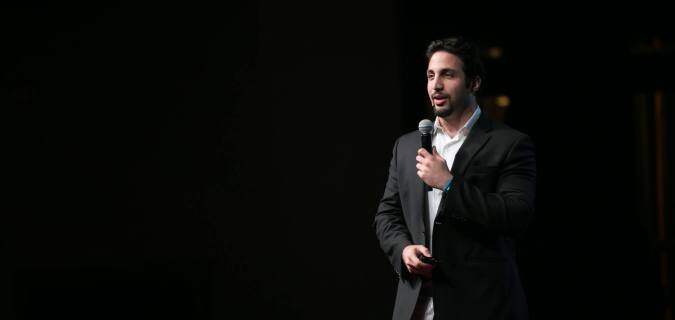
Just days after Multicoin Capital co-founder Kyle Samani announced his exit from the crypto industry, the goodwill he had accumulated over the years has rapidly eroded.

"Burning Bridges" Is Truly Disgusting

Objectively speaking, Kyle Samani has made positive contributions to the cryptocurrency industry over the years. Whether it's the continuous financial support for early-stage projects (regardless of motive, focusing on the effect) or the narrative guidance and ideological evangelism at the conceptual level, he has directly or indirectly influenced the industry's direction.

From a purely results-oriented perspective, Kyle Samani indeed achieved unimaginable "major results" in the crypto industry. For this reason alone, it's quite reasonable for Hasseb Qureshi to call him the "best investor in the industry" or for Mable to refer to him as a "top player."

  • Odaily Note: Hasseb Qureshi is a partner at Dragonfly Capital. He once stated that "investing is like a sport, and Kyle Samani is the highest scorer of all time, unmatched," details in 《The Man Who Best Shilled SOL Exits the Crypto World》; Mable is a former partner at Multicoin Capital and co-founder of Trends. After Kyle Samani's exit, she wrote a viral article 《The Game Continues, But Kyle's Version Is Over》.

But precisely because of this, the "ugly face" Kyle Samani has frequently shown in the days since his exit is even more repulsive.

First, on the day of his exit, while replying to Stix founder Taran, Kyle Samani stated: "Crypto just isn't as interesting as many people (including myself) once thought. I used to believe in the Web3 vision, believe in DApps, but now I don't. Blockchains are fundamentally asset ledgers. They will reshape finance, but that's about it, not much more."
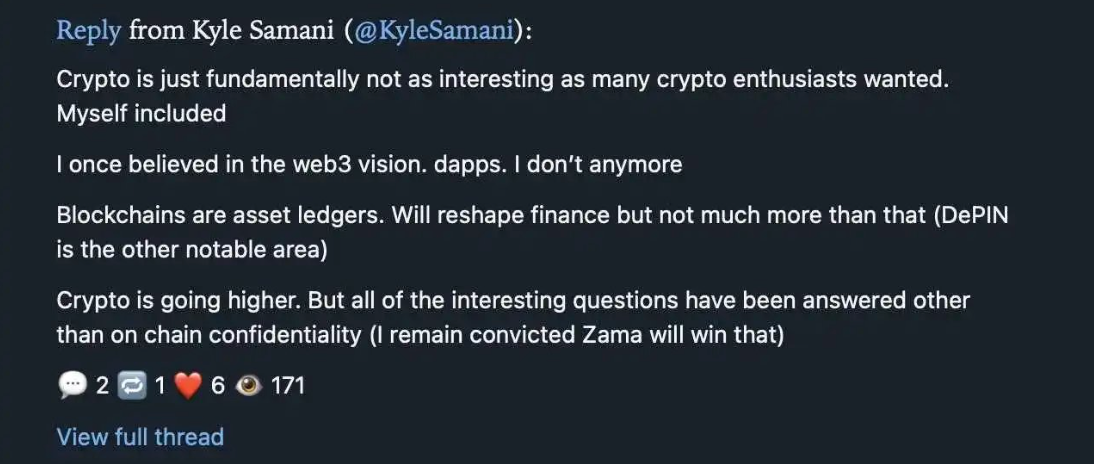
This post was quickly deleted by Kyle Samani... Well, clearly this was his true feeling never revealed before, but the fact that he deleted it at least means he knew "burning bridges" wasn't a good look.

But unfortunately, he didn't stop there. On February 8th, Kyle Samani once again lashed out at the industry that made him: "Hyperliquid embodies almost every negative aspect of cryptocurrency. The founders fled their home country to start it, openly facilitating crime and terrorism, the system is closed-source, and it still requires permission."
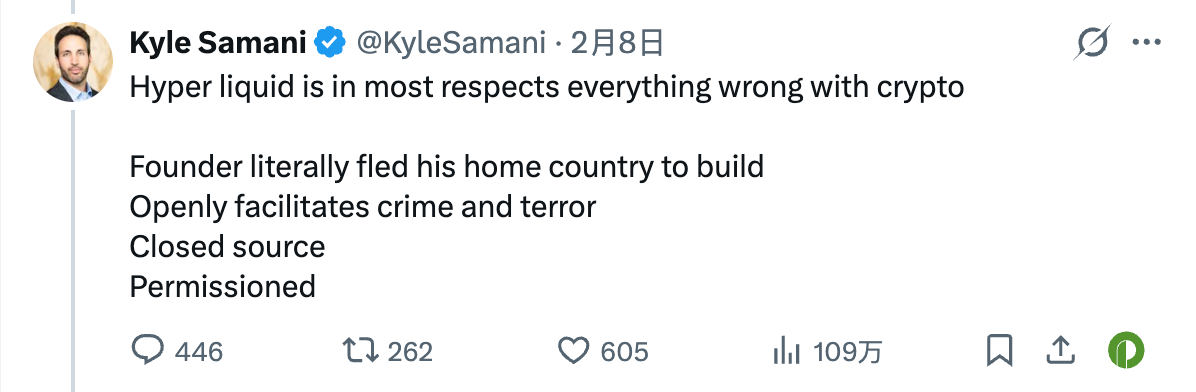
Although being outspoken has always been a controversial label attached to Kyle Samani, this illogical and clearly factually incorrect "mindless rant" was untenable. Coupled with his new identity as an outsider, the statement seemed even more突兀. In the past, Kyle Samani's outrageous remarks could at least gain some group support based on stance (e.g., siding with Solana, long-term criticism of Ethereum). This time, however, he was standing outside the industry, completely negating the entire crypto sector.

The direction of the fallout was predictable: Kyle Samani successfully provoked widespread anger.

It's understandable for someone who lost money in crypto to criticize it; people always need an emotional outlet. But Kyle Samani, a beneficiary who gained immense wealth and achieved class transition in crypto, couldn't wait to turn around and stomp on it immediately after announcing his exit. This inevitably feels hypocritical and disgusting.

To put it bluntly, this is a classic case of "biting the hand that feeds you" — Kyle Samani wants to take away the benefits bestowed by the industry while eagerly cutting ties with it. How can such a huge便宜 exist?

An Eerie Sense of Incongruity: Is There More to the Exit?

Another very incongruous point is that Kyle Samani chose Hyperliquid as his attack target; on the other hand, Multicoin Capital continues to increase its bet on Hyperliquid.

In the same week Kyle Samani announced his exit, on-chain analyst MLM detected multiple large purchases of HYPE by an address suspected to belong to Multicoin Capital (https://hypurrscan.io/address/0xd4d56a30a4a745f8ba732e8b453b7066260fbc10#txs).

Crypto Banter founder Ran Neuner discovered that in the five-year investment theses published the weekend prior by Multicoin's other co-founder, Tushar Jain, Hyperliquid was prominently listed as a representative project for the third thesis, "Financial Globalization," while DePIN, which Kyle Samani had long been extremely bullish on, was completely absent.
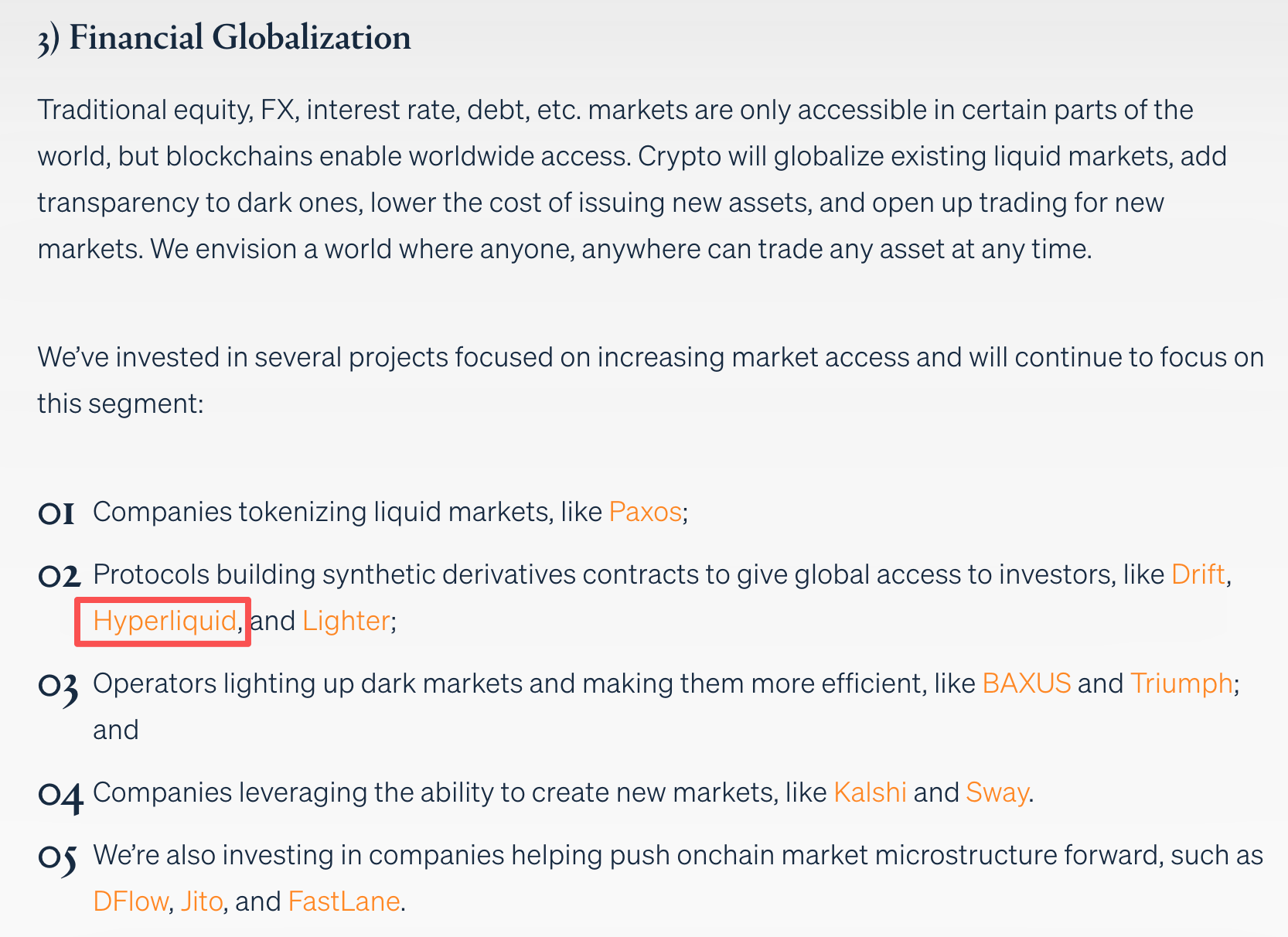
Ran Neuner offered a hypothesis based on this: that Kyle Samani did not leave voluntarily but had conflicts with Tushar Jain, was eventually forced out, and due to non-compete clause restrictions, Kyle Samani had to exit the crypto industry entirely...

Although this speculation lacks any factual evidence, it seems to better explain the aforementioned incongruities and Kyle Samani's sudden attitude shift — Would you rather believe that a top mind long dedicated to the crypto industry suddenly realized its emptiness? Or would you rather believe that Kyle Samani turned his back only because he harbored resentment and could no longer profit from the industry?

Whether out of faith in the industry's future or residual recognition of Kyle Samani's past achievements, emotionally, I lean towards the second possibility. As for the truth, it might only be revealed someday in the future when no one cares about this matter anymore.

No Future for the Crypto Industry?

Over the past few years, we have seen many instances of talent flowing from the crypto world to the AI world, but the exit of a标志性 figure like Kyle Samani has dealt a heavy blow to confidence in the entire crypto industry.

So, does the industry really have no future? This is clearly not a question that can be answered by personal opinion. After Kyle Samani chose to leave, several true thought leaders of comparable stature used their own logic to explain why they remain bullish on the industry's future.

Tushar Jain's信念 remains firm. The eight investment theses he published for Multicoin Capital still focus on the crypto world.

Haseeb Qureshi believes that Kyle Samani's departure is the truest sign of the industry maturing. Pioneers and settlers are often not the same people, this is driven by the laws of human nature — "I remain very bullish on crypto. I know it's strange to say this amidst market turmoil, as people have little patience for dreams that will take a decade to realize. The era of dreamers is over, but the era of builders is coming. This in itself is neither good nor bad."

a16z Crypto partner and Web3 concept pioneer Chris Dixon, drew an analogy with the development规律 of the internet to refute Kyle Samani's view that cryptocurrency can only reshape finance — "Infrastructure and distribution networks often precede new application categories. The internet didn't start with social media, streaming, or online communities, but with packet switching, TCP/IP, and basic connectivity. It was only after hundreds of millions of people came online that entirely new cultural and economic categories emerged. Crypto is likely similar. A reasonable guess is that we need to get hundreds of millions of people on-chain first through financial applications like payments, stablecoins, savings, and DeFi, before we see meaningful adoption in media, gaming, AI, or other areas that might be further out."

The future is created by people. As long as more people share the same consensus, the flame of the crypto narrative can be rekindled.


Preguntas relacionadas

QWhat was Kyle Samani's stated reason for leaving the cryptocurrency industry, as revealed in his deleted post?

AHe stated that he no longer believes in the Web3 vision and DApps, claiming that blockchains are essentially just asset ledgers that will reshape finance and nothing more.

QWhich specific project did Kyle Samani attack after his departure, and what was the nature of his criticism?

AHe attacked Hyperliquid, claiming it 'embodies almost everything wrong with crypto,' accusing it of being founded by people who fled their country, facilitating crime and terrorism, being closed-source, and still requiring permission.

QWhat contradiction or 'weird dissonance' does the article point out regarding Multicoin Capital's actions and Kyle Samani's statements?

AWhile Kyle Samani publicly attacked Hyperliquid, on-chain data showed that Multicoin Capital's address was making large purchases of HYPE (Hyperliquid's token), and his partner Tushar Jain listed Hyperliquid as a key investment theme.

QWhat alternative theory does the article present to explain Kyle Samani's sudden departure and negative comments?

AThe theory is that Kyle Samani did not leave voluntarily but was forced out due to a conflict with his partner Tushar Jain, and his negative comments are a result of his frustration and being bound by a non-compete clause.

QHow do other major industry figures like Chris Dixon and Haseeb Qureshi counter Kyle Samani's pessimistic view on crypto's future?

AChris Dixon compared crypto to the early internet, arguing that financial applications are the foundational infrastructure that will eventually lead to broader adoption in media, gaming, and AI. Haseeb Qureshi stated that the departure of pioneers is a sign of the industry maturing, and the era of builders is now beginning.

Lecturas Relacionadas

Must-Watch Events Next Week|CLARITY Act Could Face Senate Vote; SpaceX, Circle to Report Earnings (8.3-8.9)

**Summary: Key Events and Developments to Watch (August 3-9)** The upcoming week is marked by significant financial disclosures, key legislative deadlines, and notable product updates. **Major Financial Events:** Several companies are scheduled to release their Q2 2026 earnings. American Bitcoin (ABTC) will report on August 3, followed by SpaceX and Hut 8 Mining Corp. on August 4, and Circle on August 5. Notably, a significant portion of SpaceX shares (up to 12% of total shares) will be unlocked on August 6 following their earnings release. **Key Legislative Deadline:** The U.S. Senate faces an August 7 deadline to secure 60 votes for the CLARITY Act, a bipartisan bill aiming to establish a federal regulatory framework for cryptocurrencies. The Senate may hold a full vote on the bill during the week. **Economic Data:** The U.S. July Non-Farm Payrolls report will be released on August 7, providing crucial labor market data. **Technology & Product Updates:** * **Shutdowns:** DeFi portfolio tracker Zapper and wallet app Ctrl Wallet will cease operations on August 3. * **Upgrades:** LayerZero will deprecate its v1 relayers on August 3. XRP Ledger's new version 3.3.0, featuring five new functions, is expected next week. * **AI:** Elon Musk announced that the advanced Grok 4.6 AI model is set for release around August 7. * **Bitcoin:** The BIP-110 forced signaling for a potential Bitcoin network change is scheduled to begin around August 8. **Other Notable Events:** Chinese robotics firm Unitree Tech has set its preliminary price inquiry for its IPO for August 5. South Korean exchange Upbit will delist AQT and AERGO tokens on August 3.

marsbitHace 1 hora(s)

Must-Watch Events Next Week|CLARITY Act Could Face Senate Vote; SpaceX, Circle to Report Earnings (8.3-8.9)

marsbitHace 1 hora(s)

Stocks Are Plummeting More Sharply Than Cryptocurrencies. Where Has the Money Gone?

Stock Markets Plunge Deeper Than Cryptocurrencies: Where Did the Money Go? In late July, Seoul's Kospi index triggered circuit breakers for two consecutive days, plummeting over 40% from its June high. The collapse was led by heavyweight stocks like SK Hynix, whose record profits still disappointed investors, and devastating leveraged ETFs, with one major product losing over 83% of its value. This signaled a global, forced deleveraging targeting the most crowded trades. Interestingly, while stocks exhibited extreme volatility akin to crypto markets, Bitcoin rose nearly 15% in July after a prior steep drop. Analysis shows the money fleeing equities did not flow into Bitcoin. Instead, Bitcoin had already absorbed its sell-off in May-June, when U.S. spot Bitcoin ETFs saw historic outflows. The true safe-haven beneficiary was gold, whose price rose over 20% year-on-year, highlighting a decoupling between Bitcoin and gold as "digital gold." The sell-off was a targeted unwinding of leveraged positions in tech and semiconductors, accelerated by broker-dealer risk management and shifts in the AI narrative, including new competition from Chinese memory chipmakers. The retreat path was clear: from high-valuation tech stocks to cash and U.S. Treasuries, then to gold. For Bitcoin to attract sustained institutional inflows, conditions like eased global liquidity pressure, a "soft-landing" Fed rate cut, and U.S. regulatory clarity via legislation like the stalled CLARITY Act are needed. Currently, Bitcoin is not a safe haven but an already-cleared asset. Its low correlation with tech stocks, however, makes it a potential diversification play for institutional portfolios once the storm passes. The money isn't here yet, but the positioning is underway.

marsbitHace 1 hora(s)

Stocks Are Plummeting More Sharply Than Cryptocurrencies. Where Has the Money Gone?

marsbitHace 1 hora(s)

In Conversation with Ray Dalio: We Are Currently in an AI Bubble, with 1% of My Portfolio in Bitcoin

Ray Dalio, founder of Bridgewater Associates, warns in an interview that the current AI boom shows classic bubble characteristics, which could lead to significant economic downturns as seen in past cycles like 1929 or 2000. He explains that speculative enthusiasm, fueled by debt and overvaluation, often precedes a crash when rising rates or taxation force asset sales, causing widespread losses and recession. Dalio also outlines his "Big Cycle" theory, describing an approximate 80-year pattern where widening wealth gaps, massive government deficits, and shifting geopolitical power (like China's rise) create internal conflict and global instability. He emphasizes that we are in a late-cycle, transitional phase where traditional powers like the US and UK face decline. For personal wealth protection, Dalio advises diversification beyond cash into assets like stocks, bonds, real estate, and particularly gold, which he prefers over Bitcoin. While he holds about 1% of his portfolio in Bitcoin as a non-printable hard asset, he views gold as more secure from technological or governmental threats. Regarding AI's impact, Dalio believes it will disproportionately benefit capital owners, worsening inequality by replacing both physical and cognitive labor. He suggests that human intuition and emotional intelligence, combined with AI, will be key for future workers. On taxation, Dalio argues that wealth taxes are impractical and risk triggering asset sell-offs, reducing productive investment. He points to the UK as a cautionary example of debt, low productivity, and political strife. Geopolitically, Dalio foresees a more regionalized world, with the US showing weakness in prolonged conflicts like with Iran, akin to past imperial declines. The ideal outcome, he suggests, is coexisting powerful blocs (e.g., Americas, China-Asia Pacific) without major war.

marsbitHace 5 hora(s)

In Conversation with Ray Dalio: We Are Currently in an AI Bubble, with 1% of My Portfolio in Bitcoin

marsbitHace 5 hora(s)

Trading

Spot
活动图片




