Is CFTC ‘ready to take responsibility’ for $3T crypto market?

ambcryptoPublicado a 2026-04-02Actualizado a 2026-04-02

Resumen

The U.S. Commodity Futures Trading Commission (CFTC) is positioning itself as a leading regulator for the $3 trillion cryptocurrency market. Chair Michael Selig stated the agency is prepared to take on this responsibility and is working with the SEC to harmonize federal oversight. This shift comes amid broader U.S. regulatory improvements, which have supported significant market growth, including a stablecoin market cap exceeding $319 billion. The CFTC has taken steps like publishing a crypto-asset system and offering regulatory relief to developers. However, key legislation, such as the CLARITY Act, remains stalled in Congress. A clearer regulatory framework is seen as crucial for further industry expansion.

Cryptocurrency adoption has accelerated in recent years, prompting governments to develop clearer regulatory frameworks. The United States leads in public adoption and maintains a relatively strong regulatory environment, with scores of 7.7 and 6.2 out of 10, respectively.
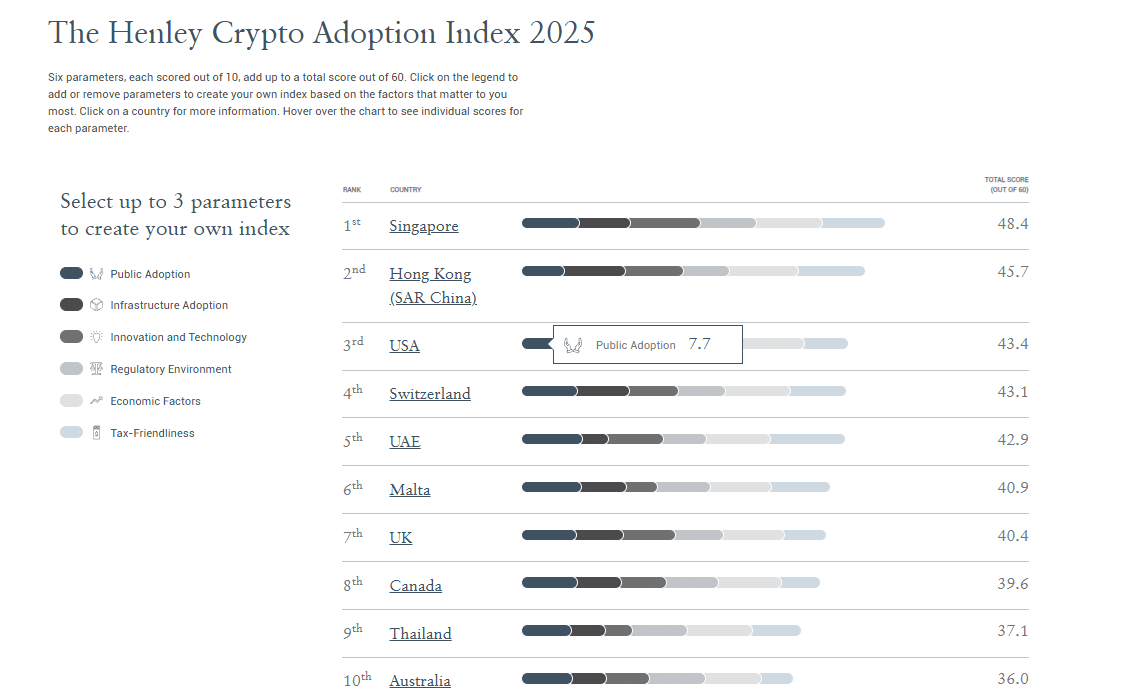
Source: Henley Global

A more favorable regulatory tone, particularly during the Trump administration, has strengthened its position. As the sector expands, the Commodity Futures Trading Commission [CFTC] has taken on a more prominent role, aiming to reduce regulatory burdens and support industry growth.

CFTC signals readiness to oversee crypto market

CFTC Chair Michael Selig said the agency is well prepared to regulate the crypto industry. As part of a summary marking his 100 days in the office, Selig stated,

CFTC is ready to take responsibility for a $3 trillion crypto asset market.

In his statement, he reported that the CFTC and the SEC have formed a joint effort to harmonize federal oversight of the crypto asset market. However, he did not provide a timeline for when Congress might pass a formal market structure bill.

The recent remarks came as the United States Senate continued to review the CLARITY Act. The bill has stalled in the committee amid a dispute over stablecoin yield and related provisions.

Easing crypto regulation accelerates growth.

Besides CFTC’s willingness to lead the crypto industry, the Chair noted major regulatory steps taken to caution the sector.

Selig criticized the prior administration over the use of enforcement in crypto regulation. In doing so, he stated that the agency had improved the regulatory environment by providing no-action relief to digital wallet software developers.

The CFTC published the Taxonomy, the first crypto-asset classification system, which distinguishes digital securities from commodities. Also, the agency argued that it had addressed clarity concerns over tokenized collateral and had launched an innovation task force.

Notably, improvements in regulatory environments, especially with the passage of the GENIUS Act, strengthened market adoption. In fact, stablecoins have grown substantially, exceeding $319 billion in market cap and over $100 billion in trading volume.
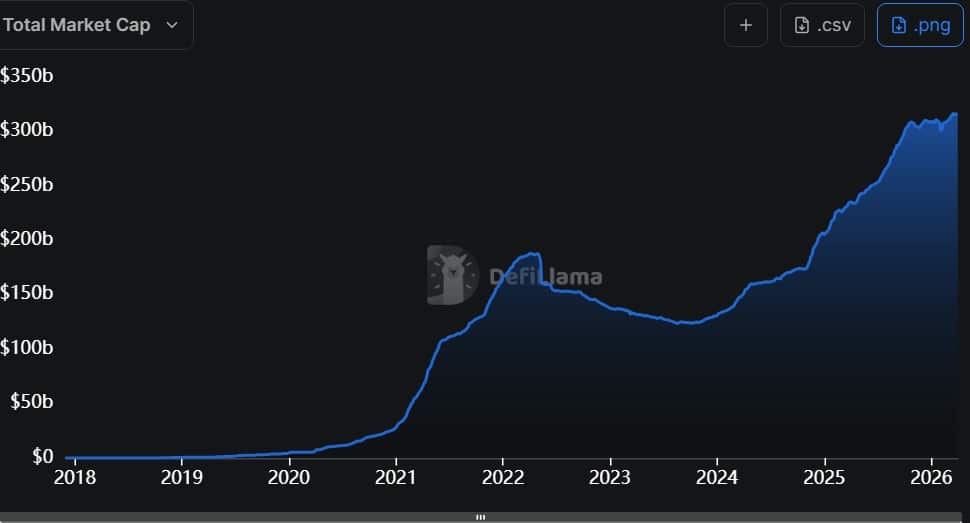
Source: DeFiLlama

The sector’s growth underscores the need for legal clarity, and if properly enacted, the entire crypto market could grow further. Thus, improving regulatory conditions is good news for the broader crypto market and could significantly boost the market if further progress is made.


Final Summary

  • The Commodity Futures Trading Commission is emerging as a key regulator, signaling readiness to oversee a $3 trillion crypto asset market.
  • CFTC Chair Michael Selig confirmed coordination with the Securities and Exchange Commission to align federal oversight.

Preguntas relacionadas

QWhat is the CFTC's stated readiness regarding the crypto market, and what specific market size was mentioned?

ACFTC Chair Michael Selig stated that the agency is ready to take responsibility for a $3 trillion crypto asset market.

QWhich two US agencies have formed a joint effort to harmonize federal oversight of the crypto market?

AThe Commodity Futures Trading Commission (CFTC) and the Securities and Exchange Commission (SEC) have formed a joint effort for this purpose.

QWhat major legislative act is currently stalled in the US Senate, and what is the primary dispute causing the delay?

AThe CLARITY Act is stalled in committee, primarily due to a dispute over stablecoin yield and related provisions.

QWhat specific action did the CFTC take to improve the regulatory environment for digital wallet software developers?

AThe CFTC provided no-action relief to digital wallet software developers.

QWhat is the name of the first crypto-asset classification system published by the CFTC, and what is its primary function?

AThe CFTC published the Taxonomy, which is the first crypto-asset classification system designed to distinguish digital securities from commodities.

Lecturas Relacionadas

70% of the Public Opposes AI, Americans Hope the U.S. Loses the AI War

70% of Americans believe AI development is moving too fast, with growing public resistance evolving from online criticism to real-world protests and violence. This widespread anti-AI sentiment stems from fears of job losses, rising utility costs, environmental damage, threats to democracy, and financial instability. Key incidents illustrate the backlash: Google's former CEO Eric Schmidt was loudly booed at a graduation for promoting AI; AI company ads are vandalized; protests and even violent attacks target AI firms and data centers. Polls show deep public pessimism and strong local opposition to data center construction, often surpassing resistance to nuclear power plants. The core grievances are economic and practical: AI is seen as automating jobs, concentrating wealth, and increasing household electricity and water bills due to massive data center resource demands. Environmentalists also oppose AI's high energy use and carbon emissions. This opposition has turned AI into a major political issue in the US. While the Trump administration prioritizes AI innovation for global competition, bipartisan pushback is growing. Democrats and factions within the MAGA movement are forming temporary alliances to support stricter regulations and local bans on new data centers, pressuring the administration to choose between its tech industry backers and its voter base. The situation highlights a profound national divide over AI's future.

marsbitHace 28 min(s)

70% of the Public Opposes AI, Americans Hope the U.S. Loses the AI War

marsbitHace 28 min(s)

Agents Take Over Traffic Distribution Power: What Are Tencent, ByteDance, and Alibaba Competing For?

In the race to dominate the AI era's entry point, China's tech giants—Tencent, ByteDance, and Alibaba—are aggressively deploying AI Agents to control the future of traffic distribution. Alibaba is pursuing a dual-track "closed loop + openness" strategy. Its Qianwen app is evolving into a super-Agent integrated across its ecosystem (Taobao, Alipay, etc.) to handle complex tasks like travel planning. Concurrently, it is opening its platform to external brands (Luckin Coffee, KFC) and has launched a B2B Agent platform, "Wukong," targeting enterprise automation. Its other flagship, Quark, aims to be an "AI super search box" for information and tasks. ByteDance is executing an omnipresent "sprawl strategy." Its Doubao app boasts over 300 million monthly active users and is evolving into a default AI entry point for daily life, with plans for paid versions and e-commerce integration. Its core weapon is the Kouzi platform, a visual "AI assembly factory" for developers to build custom Agents. ByteDance is also pushing hardware integration, collaborating on AI phones and developing smart glasses to embed Doubao everywhere. Tencent is playing its long-held "ultimate card" by quietly embedding an AI Agent directly into WeChat. This Agent, accessible via a swipe, can understand user commands and automatically execute tasks by calling upon WeChat's millions of mini-programs (e.g., finding and ordering coffee). This leverages WeChat's unparalleled 1.4-billion-user ecosystem to position the app as an AI-powered "service operating system," a move that could dramatically reshape the competitive landscape. The core battleground is shifting from competing for "user screen time" to competing to be the "default execution layer" for user intent. The business model is evolving from an "attention economy" to an "intent economy," where the Agent that can most efficiently fulfill a user's need gains control over service access and token flow. This represents a fundamental change in how users connect with digital services, making the fight for the Agent入口 (entry point) a pivotal moment for redefining industry leadership in the AI age.

marsbitHace 2 hora(s)

Agents Take Over Traffic Distribution Power: What Are Tencent, ByteDance, and Alibaba Competing For?

marsbitHace 2 hora(s)

Trading

Spot
Futuros
活动图片

