Is Bitcoin’s Reset Complete? BTC Steadies Above $70K as Markets Debate the Next Move

bitcoinistPublicado a 2026-02-10Actualizado a 2026-02-10

Resumen

After a sharp decline to $60,000, Bitcoin has stabilized above $70,000, though the recovery remains fragile. On-chain data shows significant deleveraging, with a major whale selling over $340 million in BTC and reducing holdings from $11 billion to $2.2 billion. Open interest also fell sharply, indicating reduced market leverage and momentum. While some view the sell-off as a healthy reset, others caution it may be a bull trap. Key support is at $60,000, with resistance near $73,000–$75,000. Broader factors like equity market rebounds and ETF inflows provide some stability, but the market awaits clearer signals from macro conditions and institutional conviction.

After one of its sharpest swings in over a year, Bitcoin (BTC) is attempting to find balance. Prices have stabilized above $70,000 following a rapid drop to $60,000 last week, but the calm has done little to settle the broader debate; is this a completed reset, or just a pause before another move lower?

The recent volatility has flushed out leverage, forced large players to cut risk, and shifted sentiment from optimism to caution. While dip buyers have returned, on-chain data, derivatives metrics, and macro signals suggest the market remains in a fragile holding pattern rather than a clear recovery.
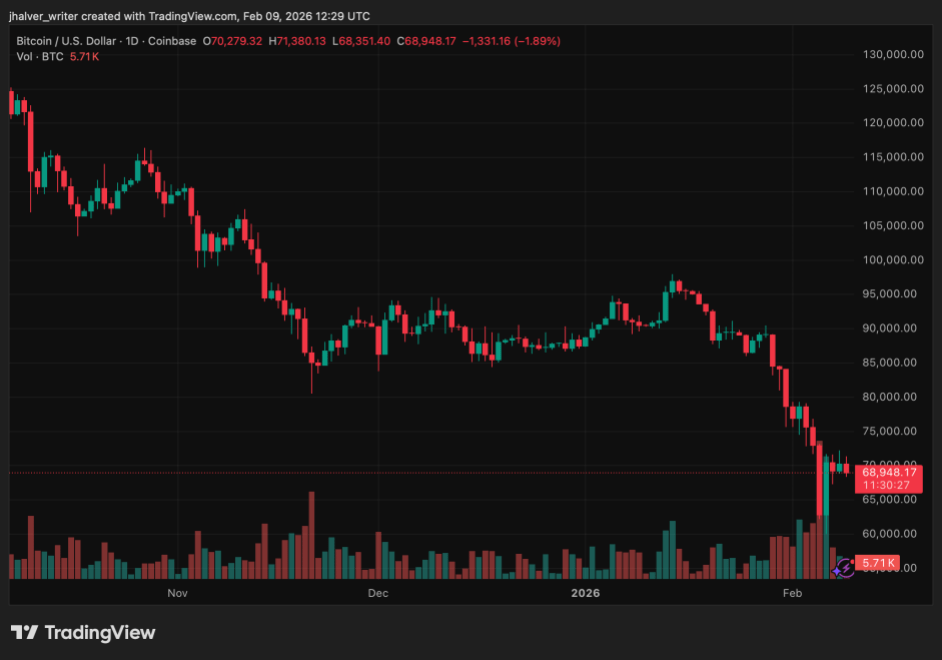
BTC's price trends to the downside on the daily chart. Source: BTCUSD on Tradingview

Whales Step Back as Leverage Unwinds

One of the clearest signs of the reset came from whale activity. On-chain data shows that the so-called Hyperunit whale sold more than $340 million in Bitcoin, sending the funds to Binance after months of aggressive, leveraged trading across crypto markets. The move followed a major liquidation on a large Ethereum position, which reportedly resulted in losses of roughly $250 million.

At its peak, the wallet held over $11 billion in Bitcoin. Holdings have since fallen to about $2.2 billion, signaling a shift away from expansion toward capital preservation.

The selling coincided with a broader decline in Bitcoin open interest, which fell from around $61 billion to near $49 billion, pointing to widespread deleveraging rather than fresh short positioning.

This reduction in leverage has eased immediate downside pressure but has also reduced momentum, leaving Bitcoin without strong directional conviction.

Bitcoin Price Stabilizes, But Signals Remain Mixed

Bitcoin was trading around $70,000–$71,000 in Asian hours on Monday, holding steady after last week’s rapid rebound. Technical indicators still show weak momentum, with subdued volume and no clear signs of either buyers or sellers being firmly in control.

Market participants are split. Some analysts argue that the recent washout has removed excess risk and created conditions for a healthier base. Others warn that similar rebounds in this cycle have turned into bull traps, especially when driven by short-term traders rather than long-term accumulation.

Support near $60,000 remains a key level to watch, while resistance between $73,000 and $75,000 is seen as a test for any sustained upside.

Macro, Sentiment, and Structural Questions

Beyond price action, broader factors are shaping the debate. Global equity markets rebounded, helping risk assets stabilize, while US spot Bitcoin ETFs recorded modest inflows as investors selectively bought the dip.

At the same time, concerns around long-term narratives, from Bitcoin’s safe-haven role to emerging discussions about quantum computing risks, continue to hover in the background.

Bitcoin’s ability to hold above $70,000 suggests the forced reset may be largely complete. Whether that turns into a durable recovery or another leg lower will depend on liquidity, conviction from larger players, and how markets respond to upcoming macro data.

Cover image from ChatGPT, BTCUSD chart on Tradingview

Criptos en tendencia

Preguntas relacionadas

QWhat is the current price range of Bitcoin and what key level is being watched for support?

ABitcoin is currently trading around $70,000–$71,000, with the key support level to watch near $60,000.

QWhat significant action did the 'Hyperunit whale' take, and what did it signal?

AThe 'Hyperunit whale' sold more than $340 million in Bitcoin, sending the funds to Binance. This move, which followed a major liquidation on a large Ethereum position, signaled a shift away from aggressive, leveraged trading toward capital preservation.

QWhat does the decline in Bitcoin open interest indicate about the market?

AThe decline in Bitcoin open interest, which fell from around $61 billion to near $49 billion, points to widespread deleveraging across the market rather than the establishment of fresh short positions.

QAccording to the article, what are the two opposing views among analysts regarding the recent price action?

ASome analysts argue the recent washout has removed excess risk and created conditions for a healthier base, while others warn that similar rebounds have turned into bull traps, especially when driven by short-term traders rather than long-term accumulation.

QBesides price, what broader factors are influencing the Bitcoin market debate?

ABroader factors include the rebound in global equity markets, modest inflows into US spot Bitcoin ETFs, and lingering concerns around long-term narratives such as Bitcoin's safe-haven role and emerging discussions about quantum computing risks.

Lecturas Relacionadas

Must-Watch Events Next Week|CLARITY Act Could Face Senate Vote; SpaceX, Circle to Report Earnings (8.3-8.9)

**Summary: Key Events and Developments to Watch (August 3-9)** The upcoming week is marked by significant financial disclosures, key legislative deadlines, and notable product updates. **Major Financial Events:** Several companies are scheduled to release their Q2 2026 earnings. American Bitcoin (ABTC) will report on August 3, followed by SpaceX and Hut 8 Mining Corp. on August 4, and Circle on August 5. Notably, a significant portion of SpaceX shares (up to 12% of total shares) will be unlocked on August 6 following their earnings release. **Key Legislative Deadline:** The U.S. Senate faces an August 7 deadline to secure 60 votes for the CLARITY Act, a bipartisan bill aiming to establish a federal regulatory framework for cryptocurrencies. The Senate may hold a full vote on the bill during the week. **Economic Data:** The U.S. July Non-Farm Payrolls report will be released on August 7, providing crucial labor market data. **Technology & Product Updates:** * **Shutdowns:** DeFi portfolio tracker Zapper and wallet app Ctrl Wallet will cease operations on August 3. * **Upgrades:** LayerZero will deprecate its v1 relayers on August 3. XRP Ledger's new version 3.3.0, featuring five new functions, is expected next week. * **AI:** Elon Musk announced that the advanced Grok 4.6 AI model is set for release around August 7. * **Bitcoin:** The BIP-110 forced signaling for a potential Bitcoin network change is scheduled to begin around August 8. **Other Notable Events:** Chinese robotics firm Unitree Tech has set its preliminary price inquiry for its IPO for August 5. South Korean exchange Upbit will delist AQT and AERGO tokens on August 3.

marsbitHace 1 hora(s)

Must-Watch Events Next Week|CLARITY Act Could Face Senate Vote; SpaceX, Circle to Report Earnings (8.3-8.9)

marsbitHace 1 hora(s)

Stocks Are Plummeting More Sharply Than Cryptocurrencies. Where Has the Money Gone?

Stock Markets Plunge Deeper Than Cryptocurrencies: Where Did the Money Go? In late July, Seoul's Kospi index triggered circuit breakers for two consecutive days, plummeting over 40% from its June high. The collapse was led by heavyweight stocks like SK Hynix, whose record profits still disappointed investors, and devastating leveraged ETFs, with one major product losing over 83% of its value. This signaled a global, forced deleveraging targeting the most crowded trades. Interestingly, while stocks exhibited extreme volatility akin to crypto markets, Bitcoin rose nearly 15% in July after a prior steep drop. Analysis shows the money fleeing equities did not flow into Bitcoin. Instead, Bitcoin had already absorbed its sell-off in May-June, when U.S. spot Bitcoin ETFs saw historic outflows. The true safe-haven beneficiary was gold, whose price rose over 20% year-on-year, highlighting a decoupling between Bitcoin and gold as "digital gold." The sell-off was a targeted unwinding of leveraged positions in tech and semiconductors, accelerated by broker-dealer risk management and shifts in the AI narrative, including new competition from Chinese memory chipmakers. The retreat path was clear: from high-valuation tech stocks to cash and U.S. Treasuries, then to gold. For Bitcoin to attract sustained institutional inflows, conditions like eased global liquidity pressure, a "soft-landing" Fed rate cut, and U.S. regulatory clarity via legislation like the stalled CLARITY Act are needed. Currently, Bitcoin is not a safe haven but an already-cleared asset. Its low correlation with tech stocks, however, makes it a potential diversification play for institutional portfolios once the storm passes. The money isn't here yet, but the positioning is underway.

marsbitHace 1 hora(s)

Stocks Are Plummeting More Sharply Than Cryptocurrencies. Where Has the Money Gone?

marsbitHace 1 hora(s)

In Conversation with Ray Dalio: We Are Currently in an AI Bubble, with 1% of My Portfolio in Bitcoin

Ray Dalio, founder of Bridgewater Associates, warns in an interview that the current AI boom shows classic bubble characteristics, which could lead to significant economic downturns as seen in past cycles like 1929 or 2000. He explains that speculative enthusiasm, fueled by debt and overvaluation, often precedes a crash when rising rates or taxation force asset sales, causing widespread losses and recession. Dalio also outlines his "Big Cycle" theory, describing an approximate 80-year pattern where widening wealth gaps, massive government deficits, and shifting geopolitical power (like China's rise) create internal conflict and global instability. He emphasizes that we are in a late-cycle, transitional phase where traditional powers like the US and UK face decline. For personal wealth protection, Dalio advises diversification beyond cash into assets like stocks, bonds, real estate, and particularly gold, which he prefers over Bitcoin. While he holds about 1% of his portfolio in Bitcoin as a non-printable hard asset, he views gold as more secure from technological or governmental threats. Regarding AI's impact, Dalio believes it will disproportionately benefit capital owners, worsening inequality by replacing both physical and cognitive labor. He suggests that human intuition and emotional intelligence, combined with AI, will be key for future workers. On taxation, Dalio argues that wealth taxes are impractical and risk triggering asset sell-offs, reducing productive investment. He points to the UK as a cautionary example of debt, low productivity, and political strife. Geopolitically, Dalio foresees a more regionalized world, with the US showing weakness in prolonged conflicts like with Iran, akin to past imperial declines. The ideal outcome, he suggests, is coexisting powerful blocs (e.g., Americas, China-Asia Pacific) without major war.

marsbitHace 4 hora(s)

In Conversation with Ray Dalio: We Are Currently in an AI Bubble, with 1% of My Portfolio in Bitcoin

marsbitHace 4 hora(s)

Trading

Spot

Artículos destacados

Cómo comprar MOVE

¡Bienvenido a HTX.com! Hemos hecho que comprar Movement (MOVE) sea simple y conveniente. Sigue nuestra guía paso a paso para iniciar tu viaje de criptos.Paso 1: crea tu cuenta HTXUtiliza tu correo electrónico o número de teléfono para registrarte y obtener una cuenta gratuita en HTX. Experimenta un proceso de registro sin complicaciones y desbloquea todas las funciones.Obtener mi cuentaPaso 2: ve a Comprar cripto y elige tu método de pagoTarjeta de crédito/débito: usa tu Visa o Mastercard para comprar Movement (MOVE) al instante.Saldo: utiliza fondos del saldo de tu cuenta HTX para tradear sin problemas.Terceros: hemos agregado métodos de pago populares como Google Pay y Apple Pay para mejorar la comodidad.P2P: tradear directamente con otros usuarios en HTX.Over-the-Counter (OTC): ofrecemos servicios personalizados y tipos de cambio competitivos para los traders.Paso 3: guarda tu Movement (MOVE)Después de comprar tu Movement (MOVE), guárdalo en tu cuenta HTX. Alternativamente, puedes enviarlo a otro lugar mediante transferencia blockchain o utilizarlo para tradear otras criptomonedas.Paso 4: tradear Movement (MOVE)Tradear fácilmente con Movement (MOVE) en HTX's mercado spot. Simplemente accede a tu cuenta, selecciona tu par de trading, ejecuta tus trades y monitorea en tiempo real. Ofrecemos una experiencia fácil de usar tanto para principiantes como para traders experimentados.

314 Vistas totalesPublicado en 2024.12.13Actualizado en 2026.06.02

Cómo comprar MOVE

Discusiones

Bienvenido a la comunidad de HTX. Aquí puedes mantenerte informado sobre los últimos desarrollos de la plataforma y acceder a análisis profesionales del mercado. A continuación se presentan las opiniones de los usuarios sobre el precio de MOVE (MOVE).

活动图片













