Is a Super IPO Wave Coming? Will It Drain and Crash the U.S. Stock Market?

marsbitPublicado a 2026-05-26Actualizado a 2026-05-26

Resumen

The article discusses concerns about a potential "super IPO wave" hitting the U.S. stock market, with major companies like SpaceX, OpenAI, and Anthropic preparing to go public. While these large IPOs could collectively raise hundreds of billions, raising fears of a market "blood drain," analysis suggests the impact may be limited. Key points include: * Historical data shows IPO waves often coincide with strong market returns, as they typically occur during periods of high investor demand. * Model estimates suggest even the largest IPOs might only cause a market dip of around 1%. They are more likely to trigger a routine market pullback rather than end a bull market. * The current demand side remains supportive due to high household cash balances, strong corporate earnings growth, continued stock fund inflows, and robust share buyback announcements. * The main risk lies in concentrated investor positions, particularly in large-cap tech stocks, which are at elevated levels. A shift in funds towards new issuances could pressure these crowded sectors. * Recent fund flows show strength concentrated in U.S. and tech stocks, while other regions like Europe and Japan are experiencing outflows. The conclusion is that the IPO wave itself is unlikely to crash the market unless it coincides with a weakening in underlying demand factors like earnings or fund inflows into U.S. equities. The focus should be on whether demand can continue to absorb the new supply.

Author: Zhao Ying

Source: Wall Street Insights

U.S. equity capital raising has been recovering from its 2023 low, and may accelerate significantly in the coming months: a batch of mega IPOs are lining up, with individual fundraising sizes potentially reaching tens of billions of dollars. The most direct market concern is that these new listings will 'drain' capital from existing U.S. stocks, especially when index holdings and large-cap positions are already high.

Super IPOs from SpaceX, OpenAI, and Anthropic are queuing up to list in the U.S. SpaceX's registration statement (S-1) was formally disclosed last week, with its IPO expected to be scheduled for the second week of June, making it the first of the three companies to complete a public offering. OpenAI plans to go public as soon as September this year, significantly earlier than previous market expectations, and Anthropic may seek an IPO as early as October this year.

According to Wind Trading Desk, Deutsche Bank Securities strategist Parag Thatte wrote in a report on May 22: 'Under our demand-supply framework, an increase in issuance itself could indeed have a negative impact on stocks, but the effect is only moderate; both past academic literature and empirical evidence from issuance waves clearly show that issuance waves are usually accompanied by strong stock market returns, as they occur during periods of strong stock demand.'

The core judgment of this research is not that 'issuance is harmless', but that 'issuance is not the main cause'. Increased supply can cause short-term disturbances; the largest IPO alone, when put into the model, might drag the market down by about 1%. If the listing schedule is concentrated and these new listings squeeze out other stocks from index benchmarks, the impact could be greater. However, this still looks more like a trigger for a common pullback rather than a sufficient condition for the end of a bull market. The U.S. stock market experiences a pullback of over 3% on average every 1 to 2 months, with many potential triggers, IPOs being just one of them.

What truly supports this judgment is that the demand side hasn't collapsed yet. The household sector still holds high cash balances, corporate profit growth is strong, equity funds are still seeing inflows, and buyback announcements remain at high levels. The issue isn't 'whether there is enough money to buy new shares', but whether demand can continue to outpace supply. Another boundary condition is that large-cap stocks, especially large-cap tech stocks, already have elevated positioning; that is where sensitivity is higher.

This issuance wave seems large, but it's not excessive within the context of the entire U.S. stock market.

The quarterly pace of U.S. equity issuance has risen from a low of about $30 billion in early 2023 to the current level of about $120 billion. In the coming months, a batch of mega IPOs could push the pace up another notch.
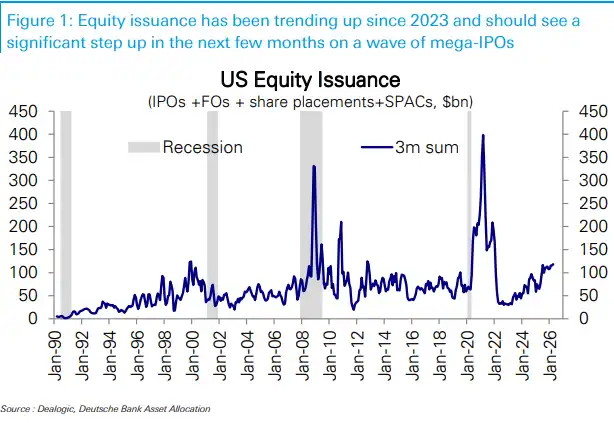
Looking at IPOs alone, some of the upcoming large projects could have fundraising sizes equivalent to the total amount raised by all U.S. listings in the past nine months. Expanding the scope to all U.S. equity issuance, including secondary offerings, this would be equivalent to about two months of issuance volume.

But from a different perspective, the pressure is much smaller. Even the largest anticipated IPO's fundraising amount is just slightly above 0.1% of the current total market capitalization of the S&P 500. This is also why 'increased supply' alone is insufficient to conclude 'the U.S. stock market will inevitably fall': the absolute amount is eye-catching, but relative to the market size, it's not extreme.

Historically, issuance waves have been more like companions to bull markets.

Over the past 30+ years, the U.S. stock market has experienced several cycles of rising equity issuance. In historical samples, the stock market typically performed strongly during these phases: the median return for the S&P 500 in the first 3 months after an issuance wave began was about 8%; extending to 12 months, returns exceeded 20%.

Exceptions are clear: during the 2008–2009 global financial crisis, entities like financial institutions were forced to raise capital, and rising issuance occurred amid heavy selling. This type of 'forced capital replenishment' issuance is not the same as companies raising capital during normal market conditions when valuations and demand are favorable.

Academic literature also leans towards this direction of causality: stronger stock markets and higher expected profitability tend to appear first, followed by issuance waves; the issuance itself has limited negative impact on the concurrent market. The more troublesome part comes later – following an issuance wave, stock market returns eventually weaken, but this 'eventually' can be delayed for a long time and cannot be simply used as a short-term sell signal.

Models suggest an impact of about 1%, but concentrated listings could amplify the perceived effect.

The demand-supply framework considers several forces together: investor positioning changes, equity fund flows, buybacks, and issuance. Issuance, being an increase in supply, is naturally a negative factor, all else being equal.

Calculations show that the largest IPO alone might cause a market decline of about 1%. If listing times are highly concentrated, or if new listings squeeze out allocations to other constituent stocks after entering index benchmarks, the actual pressure could be somewhat greater.

But it's important to distinguish between 'downside risk' and 'systematic selling pressure'. Pullbacks of over 3% occur in the U.S. stock market on average every 1 to 2 months. An IPO wave could become the catalyst for one such pullback, but it doesn't necessarily change the market's direction. Unless the demand side weakens simultaneously, supply shocks alone are unlikely to bring down the index.

The demand side is still holding up for now: cash, profits, and buybacks are all providing support.

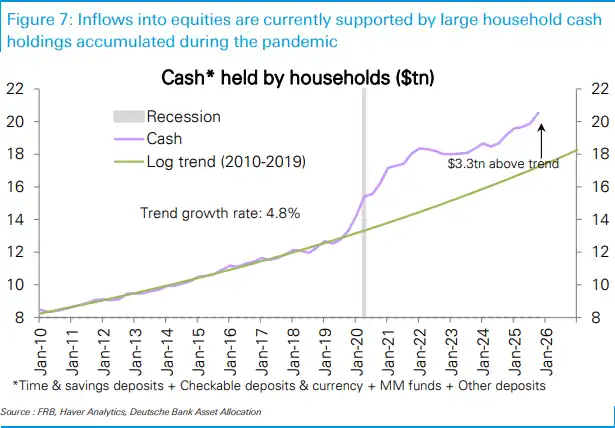
The household sector remains a key buffer. Cash balances accumulated during the pandemic are still very high; household cash holdings are about $3.3 trillion above the 2010–2019 trend level. Relative to personal income, cash holdings are also at elevated levels, giving households the capacity to direct a larger portion of new savings into financial assets, including stocks.
Profits are another pillar of support. The correlation between equity fund inflows and S&P 500 profit growth since 2003 is about 54%. First-quarter profit growth has been described as one of the strongest in over two decades, explaining why capital is still willing to chase equity assets.

Buybacks are also a significant component of demand. S&P 500 buyback announcements remain strong, meaning companies themselves are still providing buying power. Increased issuance brings supply, while buybacks and fund inflows provide absorption capacity; the current balance hasn't clearly tilted towards the supply side yet.

Positioning is not uniformly overheated; crowding is mainly in large-cap tech.

Overall equity positioning is only slightly overweight, at the 53rd percentile since 2010. Active investor positioning is lower, around the 47th percentile, close to neutral; systematic strategy positioning is somewhat higher, around the 64th percentile.

The real crowding is in large-cap stocks, especially large-cap tech. Large-cap positioning is at the 85th percentile, and large-cap tech is at the 93rd percentile. This means that if an IPO wave triggers capital rebalancing, the most likely targets for market focus would not be 'all stocks', but the already heavily held sectors.

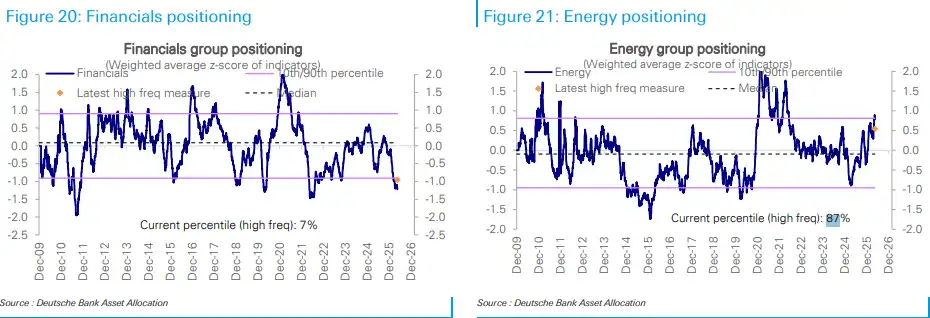
The sector distribution is also uneven. Energy positioning is high, at the 87th percentile; large-cap growth and tech overall are slightly overweight. Financials are significantly underweight, at the 7th percentile; Materials is even more extreme, at the 0th percentile. The U.S. stock market is not uniformly positioned, and supply shocks won't land evenly in every corner.
Fund flows are not uniformly optimistic; strength is concentrated in the U.S. and tech.

In the most recent week, equity fund inflows slowed significantly to $2.4 billion. U.S. equity funds still saw inflows of $9.5 billion, and broad global funds had inflows of $10.3 billion, but regions outside the U.S. experienced significant outflows.

Japanese equity funds saw outflows of $4.4 billion, the largest in five weeks; European funds saw outflows of $2.3 billion, marking the sixth consecutive week of outflows; Emerging markets had outflows of $7.9 billion, also for the sixth straight week. Among these, China-related funds saw outflows of $9.7 billion, while South Korea and Taiwan saw inflows of $3 billion and $1.7 billion respectively.

Sectoral flows were even more concentrated. Tech funds saw inflows of $9 billion, the largest in seven months. Meanwhile, bond fund inflows reached $30.5 billion, rising to a five-month high. Capital is not unidirectionally pouring into risk assets but is flowing divergently among U.S. equities, tech, and bonds.

This is also the most crucial area to watch under the IPO wave: not the number of new listings itself, but whether demand continues to concentrate in a few strong assets. If profits, buybacks, and U.S. equity inflows continue to provide support, the issuance wave will likely be just short-term noise; if crowded tech positioning loosens and equity inflows cool, then supply pressure could transform from a 'modeled disturbance of about 1%' into a harder-to-digest problem.


Preguntas relacionadas

QAccording to the article, will a wave of super IPOs definitely cause the US stock market to collapse?

ANo, the article argues that a wave of IPOs alone is unlikely to cause a market collapse. While it may trigger a short-term pullback of around 1%, it is not a sufficient condition for ending a bull market. Historical evidence shows IPO waves often accompany strong market returns due to concurrent high demand. The key factor is whether demand (from cash balances, earnings, fund inflows, buybacks) continues to outpace the new supply.

QWhat are the key demand-side factors supporting the US stock market mentioned in the analysis?

AThe key demand-side factors supporting the market are: 1) High cash balances in the household sector, 2) Strong corporate earnings growth, 3) Continued inflows into equity funds, and 4) High levels of share buyback announcements. These factors collectively provide a buffer to absorb the increased supply from new stock issuance.

QWhich specific companies are highlighted as part of the upcoming 'super IPO' wave?

AThe article highlights three companies: SpaceX (with its S-1 filed and an IPO expected in the second week of June), OpenAI (planning an IPO as early as September), and Anthropic (potentially seeking an IPO as early as October).

QAccording to the Deutsche Bank strategist's model, what is the estimated direct impact of the largest IPOs on the market?

AAccording to the Deutsche Bank strategist's demand-supply framework model, the largest IPOs alone could potentially drag the market down by approximately 1%. However, the impact could be amplified if the listings are highly concentrated or if they crowd out other stocks in major indices.

QWhere is investor positioning most crowded, making it potentially more sensitive to market shifts?

AInvestor positioning is most crowded in large-cap stocks, particularly large-cap technology. The article states that large-cap tech positioning is at the 93rd percentile. This sector is therefore more sensitive to potential fund rebalancing or shifts in market sentiment compared to the overall market, which is only modestly overweight.

Lecturas Relacionadas

Will Ethereum's Native Privacy Proposal EIP-8182 Absorb Liquidity from Other Privacy Coins?

The article discusses Ethereum Improvement Proposal (EIP) 8182, titled "Private ETH and ERC-20 Transfers," a draft proposal to integrate native privacy directly into the Ethereum protocol layer (L1). Currently, Ethereum transactions are fully transparent, and existing privacy solutions like Tornado Cash are third-party dApps with limitations: small anonymity sets (mixing pools), lack of interoperability, and regulatory vulnerability. EIP-8182 aims to create a large, unified "shared shielded pool" and zero-knowledge proof (ZK) precompiles within the core protocol. Key features include a massive, shared anonymity pool for all users and dApps, significantly enhancing privacy strength; native support for private transfers of ETH and any ERC-20 token; a decentralized system contract architecture without admin controls or fees; and the use of ZK proofs to validate transactions without revealing specific details. If implemented, this upgrade could position Ethereum as the world's largest privacy-focused blockchain. By offering a built-in, highly private environment with a vast user base and liquidity, it might attract institutional and individual users, potentially drawing liquidity away from dedicated privacy coins like Zcash and Monero, or even users seeking privacy on Bitcoin. The integration could transform Ethereum from a transparent public ledger into a dominant privacy-centric platform, with potential future enhancements like fully homomorphic encryption (FHE) for compliance capabilities.

marsbitHace 6 min(s)

Will Ethereum's Native Privacy Proposal EIP-8182 Absorb Liquidity from Other Privacy Coins?

marsbitHace 6 min(s)

Investors Frantically Snap Up AI Firms with 'No Profits': A High-Stakes Gamble on 'the Right to Define the Future'

"Investors are pouring billions into Chinese AI startups with no profits, betting on the future of the industry. A state-backed fund is reportedly in talks to lead DeepSeek's funding at a $45B valuation, just weeks after it was valued at $10B. Along with companies like Zhipu AI, MiniMax, and Kimi (backed by Meituan and Alibaba), their combined valuation exceeds $140B. This isn't a typical venture capital play. Investors are paying for 'future definition rights'—a chance to set the standards for the next tech era. Morgan Stanley notes a 6-12 month window for this scarcity premium before more AI companies go public. Despite massive losses, these companies show strong growth. Zhipu AI's API revenue grew 60x, Kimi's annual recurring revenue doubled to $200M in a month, and MiniMax turned its gross margin positive, with over 70% of revenue from overseas. Their valuations vastly exceed profitable firms like iFlytek. Crucially, technical progress underpins this growth. DeepSeek's latest model boasts costs just 1% of a leading competitor's, while Zhipu AI has raised API prices due to high demand. However, gaps with top global models remain. Tech giants like Tencent and Alibaba, investing heavily while describing their own AI efforts as 'leaky boats,' are also investing in these startups as a hedge. Key risks loom: the closing scarcity window, computing power bottlenecks limiting growth, and the sustainability of DeepSeek's cost-advantage model. With state capital now a major player, the success of these companies has become a strategic national concern. The next year will test if their soaring valuations can be justified by future profits."

marsbitHace 56 min(s)

Investors Frantically Snap Up AI Firms with 'No Profits': A High-Stakes Gamble on 'the Right to Define the Future'

marsbitHace 56 min(s)

SEC Slams the Brakes at the Last Minute, Halting "Tokenized U.S. Stocks"

On May 22, the U.S. SEC postponed the release of a key "innovation exemption" draft that would have permitted crypto-native platforms to issue and trade tokenized U.S. stocks on decentralized venues without full traditional exchange compliance. This would have legalized a "third-party token" model used overseas, where platforms issue tokens tracking stock prices without the underlying company's involvement, raising unresolved questions about shareholder rights, dividends, and sanctions enforcement. Meanwhile, the SEC had already approved a different, compliant path for tokenization led by Nasdaq and NYSE. Their model integrates tokenized stocks into existing settlement systems (like DTCC), preserving all shareholder rights. This creates a fundamental conflict: crypto platforms seek a permissionless, 24/7 on-chain parallel market, while traditional exchanges advocate for an upgraded, regulated version of the current system. Intense lobbying from traditional exchange groups like the World Federation of Exchanges argued the exemption would create an unfair regulatory advantage and dilute investor protection. Even some compliant crypto firms favored delay. Internally, SEC commissioners were divided on the scope and pace of the exemption. The delay highlights a critical policy crossroads. With significant trading volume already occurring overseas, the SEC's decision will determine whether the U.S. embraces a dual-track system for tokenized equities or sidelines itself from an emerging global infrastructure. The core unresolved question remains the legal status and rights of holders of third-party tokenized stocks. The SEC paused because the draft framework risked creating a major new asset class with profound, unanswered legal implications.

marsbitHace 1 hora(s)

SEC Slams the Brakes at the Last Minute, Halting "Tokenized U.S. Stocks"

marsbitHace 1 hora(s)

Vitalik is Personally 'Dismantling' the Ethereum Foundation

Vitalik Buterin recently published an extensive article addressing core concerns about Ethereum's future direction and the role of the Ethereum Foundation (EF). He clarifies that the EF is not his personal domain nor the central authority of Ethereum; it operates as just one node within the broader ecosystem. The board makes collective decisions, with significant operational work led by Aya Miyaguchi, allowing Vitalik to focus on technical matters. The article critiques the perception that the EF should act like a conventional, fast-moving tech company. Buterin warns that merely chasing higher TPS, lower latency, or better marketing—like other chains—risks diluting Ethereum's foundational values. He draws a parallel to Google's evolution away from its "Don't be evil" ethos. Instead, the EF's renewed mandate is to focus on preserving and strengthening Ethereum's core principles, summarized as CROPS: **C**ensorship-resistance, **R**esistance to capture, **O**pen source, **P**rivacy, and **S**ecurity. The foundation will concentrate its limited resources (holding only ~0.16% of ETH) on these long-term, non-commercializable fundamentals, while ecosystem growth, applications, and market-facing activities should be driven by external teams and capital. Buterin outlines key technical priorities aligned with this vision: 1) Advancing formal verification to mathematically prove the absence of bugs; 2) Enhancing consensus security to maintain operation without reliance on social coordination during outages; and 3) Reducing dependency on intermediaries (like RPCs) to strengthen user sovereignty and privacy. He acknowledges ETH as Ethereum's most valuable asset, crucial for security, but stresses that promoting its value is a task for the wider ecosystem, not the EF. Ultimately, Buterin's message is a strategic refocus: the EF will become a smaller, more focused entity guarding Ethereum's essential, harder-to-achieve properties, ensuring it remains distinct not just in performance but in its commitment to decentralization, resistance, and security.

marsbitHace 1 hora(s)

Vitalik is Personally 'Dismantling' the Ethereum Foundation

marsbitHace 1 hora(s)

Trading

Spot
Futuros
活动图片