Ironlight Group’s big $21 mln bet on tokenized securities: Worth the hype?

ambcryptoPublicado a 2026-03-17Actualizado a 2026-03-17

Resumen

Ironlight Group has secured $21 million in funding from investors including former TD Bank CEO Greg Braca, the Sei Development Foundation, and Laidlaw Private Equity to scale its infrastructure for tokenized securities. The funds will support the development of Ironlight Markets ATS, a platform designed to connect issuance, distribution, and trading of regulated tokenized assets. Laidlaw's managing member emphasized that Ironlight is building critical infrastructure to enable institutional participation in this growing market. The tokenized securities sector is highly competitive, with major players like Securitize, Ondo Finance, and Robinhood already active. However, growth projections are significant: the market is expected to reach between $2 trillion and $11 trillion by 2030, up from the current $27 billion (excluding stablecoins). Tokenized stocks, the fifth-largest segment, recently hit a record $1.05 billion market cap with strong monthly transfer volume and nearly 200,000 holders. Ethereum leads in settlement volume for tokenized securities at nearly $400 million, followed by Solana and BNB Chain. As regulatory clarity improves and adoption accelerates, these blockchain networks may see increased demand. For investors, tracking top settlement layers could provide strategic exposure to the sector’s anticipated expansion.

As the tokenized securities market booms, more players are positioning for a piece of the cake. Ironlight Group, a fintech developing infrastructure for tokenized securities, is the latest to join the race.

The firm announced that it had secured $21 million from Greg Braca, former TD Bank CEO, the Sei Development Foundation, and Laidlaw Private Equity.

The funds will help scale the Ironlight Markets ATS, which seamlessly connects issuance, distribution, and trading to support regulated tokenized securities.

For Hugh Regan, managing member at LaidLaw, safety is the real unlock for institutional adoption of tokenized securities. He added,

We believe Ironlight Group is building the missing layer of infrastructure to support institutional participation in tokenized securities markets.

But the space is already becoming saturated, with players like Securitize, Ondo Finance, XStocks (Backed Finance), Dinari, Remora Markets, Robinhood, and more fighting for market share.

Tokenized securities: Worth the fight?

But the ongoing adoption and growth projection partly explain why firms are rushing into this sector. From Ark Invest to Deutsche Bank Research, the tokenized market growth is projected to reach between $2 trillion and $11 trillion by 2030.

Even if the conservative lower target is met, that would be massive growth from the current global tokenized market cap of $27 billion, excluding stablecoins.

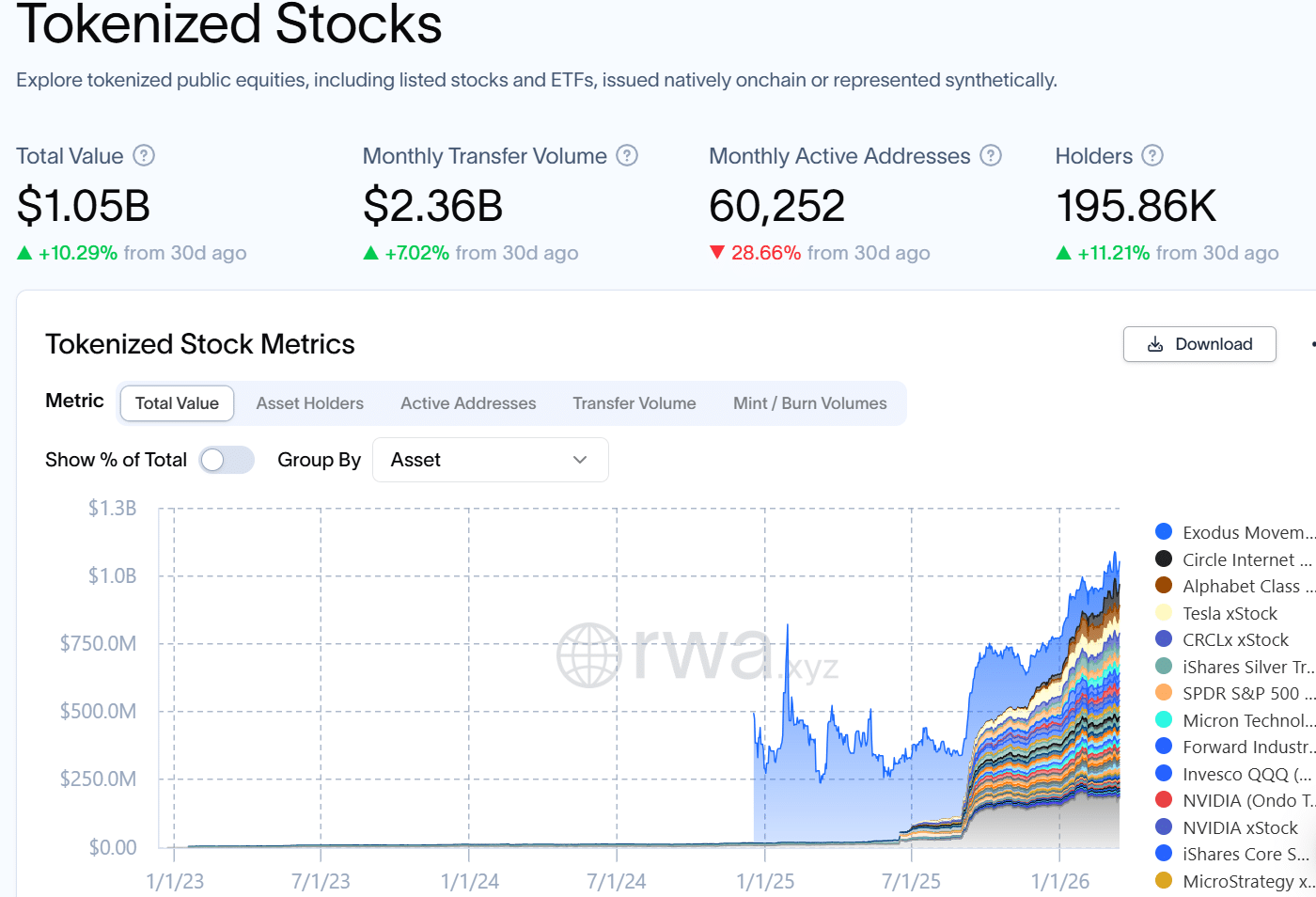
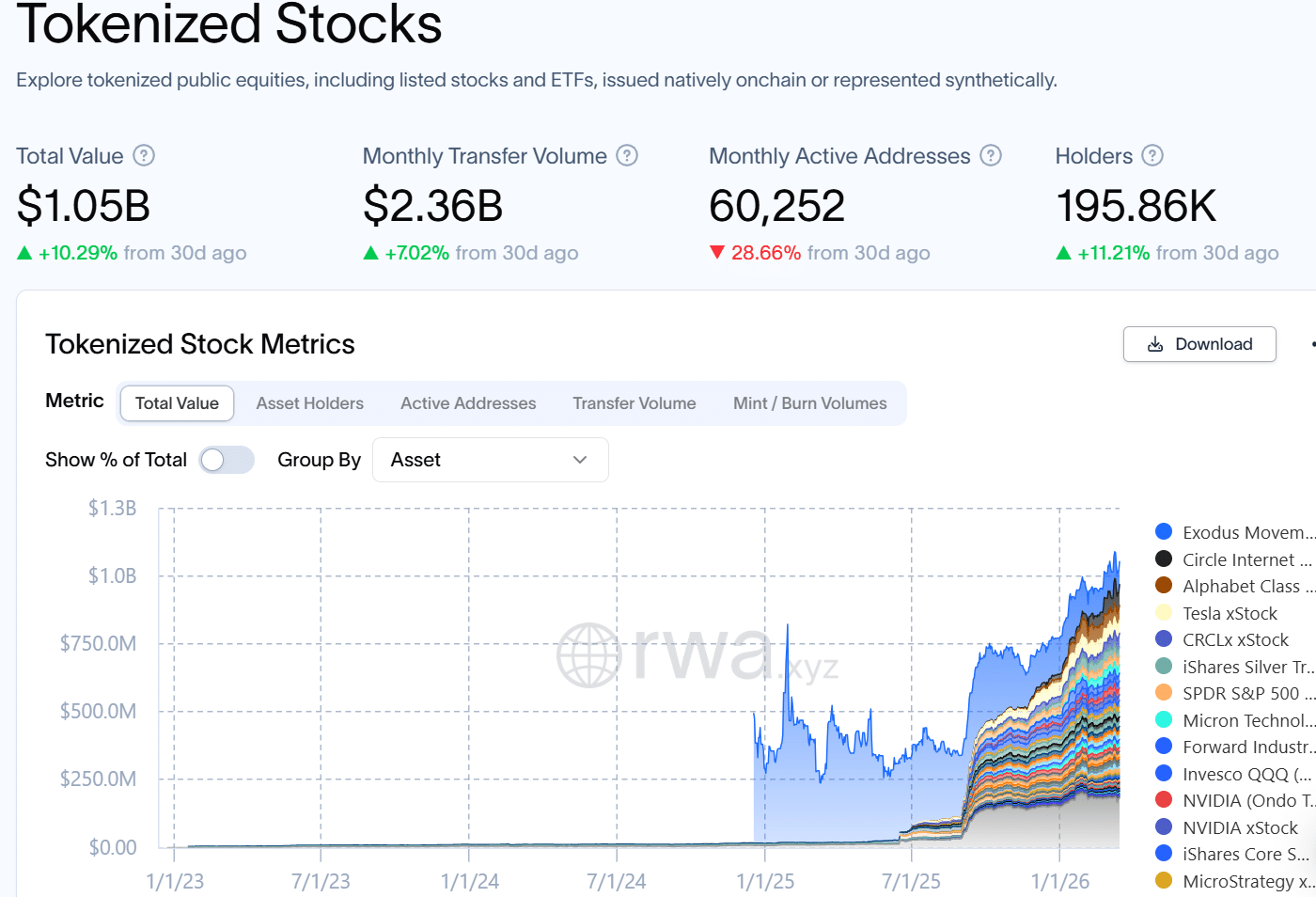
In particular, tokenized stocks are the fifth-largest segment with strong adoption, posting a 10% growth to a record $1.05 billion market cap in the past 30 days.

With over $2 billion in monthly transfer volume and nearly 200K holders, the segment’s rapid traction likely shows why most players are keen to join the race. Besides, the ongoing regulatory guidelines are fueling the momentum.
Source: RWA

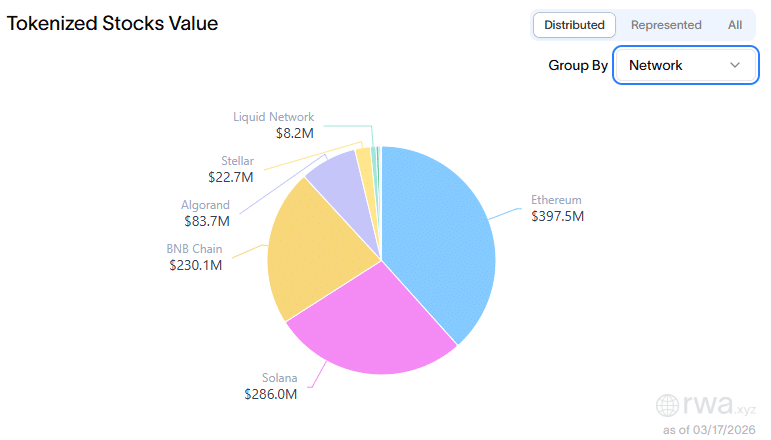
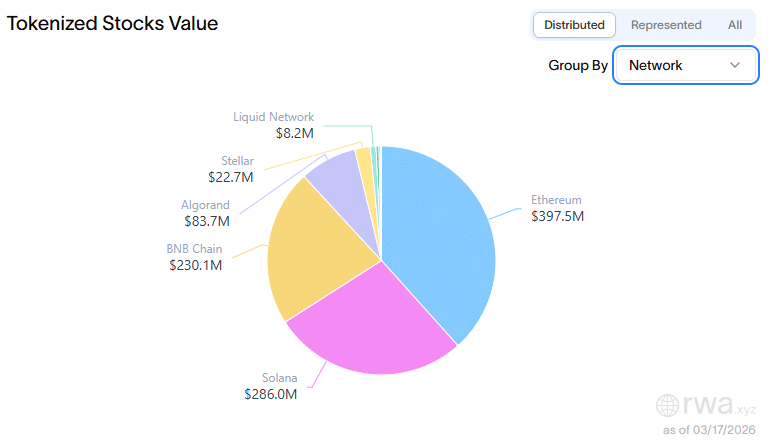
At the network level, Ethereum leads in overall settlement, handling nearly $400 million in tokenized securities. Solana and BNB Chain come in at second and third and control $286 million and $230 million, respectively.

In other words, should the rise in settlement due to tokenized market booms accelerate the demand and value for the underlying token, then these three assets could be one of the best ways to gain exposure to the segment.
Source: RWA

Overall, there is cutthroat competition amongst tokenized securities issuers as new entrants make their moves. For crypto investors, however, tracking the top settlement layers could offer insights on where to place one’s bets if the segment’s growth explodes as projected.


Final Summary

  • Ironlight has joined the tokenized securities race with a $21 million raise to scale its trading platform to accommodate the new products.
  • Ethereum, Solana, and BNB Chain lead as the top three chains for the settlement of tokenized stocks.


Criptos en tendencia

Preguntas relacionadas

QWhat is the Ironlight Group and what recent funding did they secure?

AIronlight Group is a fintech company developing infrastructure for tokenized securities. They recently secured $21 million in funding from Greg Braca (former TD Bank CEO), the Sei Development Foundation, and Laidlaw Private Equity.

QAccording to Hugh Regan, what is the key to institutional adoption of tokenized securities?

AAccording to Hugh Regan, managing member at LaidLaw, safety is the real unlock for institutional adoption of tokenized securities.

QWhat is the projected market size for tokenized securities by 2030, according to the article?

AThe tokenized market is projected to reach between $2 trillion and $11 trillion by 2030, according to projections from firms like Ark Invest and Deutsche Bank Research.

QWhich three blockchain networks lead in the settlement of tokenized securities, and what are their respective volumes?

AEthereum, Solana, and BNB Chain are the top three. Ethereum handles nearly $400 million, Solana controls $286 million, and BNB Chain handles $230 million in tokenized securities settlement.

QWhat is the current market capitalization of the global tokenized market, excluding stablecoins?

AThe current global tokenized market capitalization, excluding stablecoins, is $27 billion.

Lecturas Relacionadas

Amidst Capital's Encirclement, Decentralization is the Sole Defense for Public Blockchains

In a landscape dominated by power and profit motives, the author argues that decentralization is not merely one desirable feature among many in blockchain design—it is the singular, non-negotiable defense against corporate and capital capture. The article adopts a Machiavellian, realist perspective on human institutions, positing that businesses will inevitably attempt to co-opt any valuable network to protect their profits and dominance. While external attacks like 51% forks are often discussed, the greater existential risk is internal capture—the gradual erosion of a protocol’s neutrality by vested interests, as seen historically with platforms like Visa and Google. The piece critiques permissioned chains, highly centralized “permissionless” layer-1s, and layer-2s without sufficient decentralization (e.g., single sequencers) as inherently vulnerable. These compromised systems, promoted by established financial players, are framed as delaying tactics to stifle truly open networks that threaten existing high-fee, inefficient business models. Real-world examples, such as closed enterprise consortiums that exclude competitors, illustrate how such systems cement oligopolies rather than foster innovation. The author concludes that while decentralized protocols like Ethereum are imperfect and costly to operate, they represent the only viable long-term equilibrium. In a market where value naturally flows to the most secure and neutral settlement layer, only maximally decentralized public blockchains can resist being subsumed by capital and powerful incumbents.

Foresight NewsHace 12 min(s)

Amidst Capital's Encirclement, Decentralization is the Sole Defense for Public Blockchains

Foresight NewsHace 12 min(s)

Who Decides the Rules of Bitcoin? BIP-110 Ignites Governance Debate

Bitcoin's governance is once again at the center of a heated debate, this time ignited by BIP-110, the "Reduced Data Temporary Softfork." This proposal aims to curb non-monetary data (like inscriptions and Runes) by introducing seven new consensus-layer restrictions over a year, such as limiting new output scripts to 34 bytes and restoring the OP_RETURN cap to 83 bytes. The controversy stems from BIP-110's fundamental shift: it moves the battle against "spam" from node relay and miner policies to the consensus layer, rendering currently valid transactions invalid. Supporters, arguing that default policy governance has failed (highlighted by Bitcoin Core v30's relaxation of OP_RETURN limits), see this as necessary to protect node resources and Bitcoin's monetary focus. Opponents, led by figures like Michael Saylor and Adam Back, warn it dangerously centralizes governance. Saylor listed 110 reasons against it, criticizing its low 55% miner activation threshold and potential for chain splits. Back emphasized Bitcoin's "permissionless" ethos, arguing no single group should impose value judgments via consensus rules. Further complicating matters, technical critiques suggest BIP-110 may be technically circumventable, and a "BlockSlop" vulnerability in its upgrade path poses a consensus risk. The debate has drawn in diverse stakeholders: miners (with pools like Ocean signaling support and Foundry polling clients), node operators (like Bitcoin Knots), and new players like corporate treasury holder MicroStrategy (Saylor), whose market influence adds a novel dimension. Ultimately, BIP-110 acts as a governance stress test, exposing the unresolved question: who decides Bitcoin's rules? It pits the authority of miners, node operators, developers, and capital holders against each other, with each side claiming to defend Bitcoin's core principles of neutrality and security.

marsbitHace 28 min(s)

Who Decides the Rules of Bitcoin? BIP-110 Ignites Governance Debate

marsbitHace 28 min(s)

Who Decides Bitcoin's Rules? BIP-110 Ignites Governance Debate

Title: Who Decides Bitcoin's Rules? BIP-110 Ignites Governance Debate A new technical proposal, BIP-110 (Reduced Data Temporary Softfork), has sparked a fundamental governance debate within the Bitcoin community. It aims to impose new consensus rules for one year to limit non-financial data (like inscriptions and Runes) on-chain, moving beyond simple node and miner policy filters to invalidate currently valid transactions. Supporters argue that default policies have failed due to workarounds, necessitating consensus-layer changes to protect Bitcoin's core monetary function from data spam. Critics, including Michael Saylor and Adam Back, contend this dangerously centralizes judgment, undermines permissionlessness, and sets a risky governance precedent. They advocate for market-based solutions like fees or Layer 2s instead. The debate exposes deeper tensions: miners are divided on activation; node operators assert their sovereignty; Bitcoin Core developers influence defaults without direct accountability; and large corporate holders like MicroStrategy now wield narrative influence. Technically, BIP-110 may not fully block data and carries a disclosed consensus bug risk. Ultimately, BIP-110 acts as a stress test, forcing the community to confront the unresolved question: who legitimately decides what Bitcoin is and how it evolves, amidst competing claims from miners, nodes, developers, and capital holders.

链捕手Hace 40 min(s)

Who Decides Bitcoin's Rules? BIP-110 Ignites Governance Debate

链捕手Hace 40 min(s)

Zcash's New Node Zakura Goes Live: Privacy Payments Can Reach 50,000 TPS, Aiming to Rival Visa and Mastercard

Zcash, a privacy-focused cryptocurrency, has launched a new full node software called Zakura version 1.0.0. Developed by Zcash co-founder Sean Bowe and Dev Ojha, with private ZEC donations, its goal is to enable Zcash to process over 50,000 transactions per second (TPS)—matching the scale of Visa and Mastercard—while maintaining full transaction privacy and verifiability. This addresses a key bottleneck, as Zcash currently handles only about 1 private transaction per second. Zakura is a fork of the Zcash Foundation's Zebra node. It features chain pruning and snapshots, reducing disk usage and allowing new nodes to sync in under two minutes. It also offers compatibility with the legacy `zcashd` client interface. The scalability challenge stems from the large data size of privacy proofs. Bowe's Tachyon project aims to use recursive proofs to reduce consensus-layer data needs from ~500 MB/s to ~100 MB/s. For wallet scalability, Valar Group is researching Private Information Retrieval (PIR) tech to allow wallets to fetch their data privately. Zakura supports fast block propagation and the upcoming "Ironwood" network upgrade (NU6.3), scheduled for activation around July 28th. Ironwood was created to contain a critical inflation bug discovered in the Orchard shielded pool in May 2024. The fix uses "turnstiles" to trap any counterfeit ZEC created during the vulnerability period within the shielded pool, preventing it from entering circulation and restoring supply integrity.

marsbitHace 55 min(s)

Zcash's New Node Zakura Goes Live: Privacy Payments Can Reach 50,000 TPS, Aiming to Rival Visa and Mastercard

marsbitHace 55 min(s)

Trading

Spot

Artículos destacados

Cómo comprar HYPE

¡Bienvenido a HTX.com! Hemos hecho que comprar Hyperliquid (HYPE) sea simple y conveniente. Sigue nuestra guía paso a paso para iniciar tu viaje de criptos.Paso 1: crea tu cuenta HTXUtiliza tu correo electrónico o número de teléfono para registrarte y obtener una cuenta gratuita en HTX. Experimenta un proceso de registro sin complicaciones y desbloquea todas las funciones.Obtener mi cuentaPaso 2: ve a Comprar cripto y elige tu método de pagoTarjeta de crédito/débito: usa tu Visa o Mastercard para comprar Hyperliquid (HYPE) al instante.Saldo: utiliza fondos del saldo de tu cuenta HTX para tradear sin problemas.Terceros: hemos agregado métodos de pago populares como Google Pay y Apple Pay para mejorar la comodidad.P2P: tradear directamente con otros usuarios en HTX.Over-the-Counter (OTC): ofrecemos servicios personalizados y tipos de cambio competitivos para los traders.Paso 3: guarda tu Hyperliquid (HYPE)Después de comprar tu Hyperliquid (HYPE), guárdalo en tu cuenta HTX. Alternativamente, puedes enviarlo a otro lugar mediante transferencia blockchain o utilizarlo para tradear otras criptomonedas.Paso 4: tradear Hyperliquid (HYPE)Tradear fácilmente con Hyperliquid (HYPE) en HTX's mercado spot. Simplemente accede a tu cuenta, selecciona tu par de trading, ejecuta tus trades y monitorea en tiempo real. Ofrecemos una experiencia fácil de usar tanto para principiantes como para traders experimentados.

251 Vistas totalesPublicado en 2024.12.11Actualizado en 2026.06.02

Cómo comprar HYPE

Discusiones

Bienvenido a la comunidad de HTX. Aquí puedes mantenerte informado sobre los últimos desarrollos de la plataforma y acceder a análisis profesionales del mercado. A continuación se presentan las opiniones de los usuarios sobre el precio de HYPE (HYPE).

活动图片