IOSG: U.S. Bonds, AI, and Inflation Can't All Be Had. Which Side Should BTC Bet On?

marsbitPublicado a 2026-08-27Actualizado a 2026-08-27

Resumen

**Title: IOSG: Can't Have It All – Treasury Bonds, AI, and Inflation. Where Should BTC Bet?** **Core Thesis:** Washington is likely to prioritize stabilizing the Treasury market and sustaining the AI investment cycle, accepting higher inflation for longer as the trade-off. This creates sustained tailwinds for both gold and Bitcoin by injecting liquidity and shifting duration risk away from private balance sheets. **Key Issue:** The critical macro price is no longer the Fed funds rate, but the yield investors demand to hold long-term US Treasuries. Recent surges in 10-year and 30-year yields stem from a combination of persistent inflation risks, heavy fiscal supply, thinning demand for duration, and new competition for capital from massive AI infrastructure investments. **The Trilemma:** The US faces a difficult choice between controlling inflation, maintaining Treasury market stability, and fostering the AI growth cycle. Political pressure suggests inflation control is the most likely sacrifice. **Treasury's Response:** Measures by Treasury Secretary Besant focus on defending the bond market: supporting the Yen to prevent forced Japanese Treasury sales, increasing long-end liquidity via repos (effectively shortening government debt maturity), and a potential shift toward more short-term bill issuance. This could generate significant liquidity, reigniting "currency debasement" trades. **Gold's Role:** Gold's ~90% surge since mid-2024 is not just an inflation hedge but a b...

Author | Momir @ IOSG

Core Thesis: Washington will most likely choose to preserve the stability of the Treasury market and the AI investment cycle, at the cost of allowing inflation to remain elevated for a longer period. This provides a sustained tailwind for both gold and BTC: because it releases liquidity on one hand, and removes duration risk from the balance sheets of the private sector on the other.

The most critical macro price today is no longer the federal funds rate, but the yield at which investors are willing to hold long-term U.S. Treasury bonds.

As of August 24, the 10-year Treasury yield was around 4.70%, and the 30-year yield had recently touched about 5.23%, nearing a two-decade high. This upward move cannot be explained by a single factor. It is the confluence of several forces: persistent inflation risks, ongoing large-scale fiscal supply, thinning marginal demand for long-duration assets, plus a new competitor for capital: AI infrastructure. The result is that investors demand higher compensation to hold long bonds.

To suppress the long end, the Treasury Department indicated it would at least double the size ceiling for its liquidity-supporting repurchase operations. The news triggered a brief pullback in yields, but the gains could not be held. This indicates that the underlying supply and inflation issues cannot be bought back with a few tens of billions in repo operations.

Why U.S. Bonds Are Under Pressure

The war in Iran is a catalyst on several levels:

  • It pushes up oil prices, intensifies cost pressures, and may simultaneously suppress real growth and tax revenue.

  • It raises expenditure expectations: gaps in military supplies are being exposed, and adapting to new forms of warfare requires investment.

AI is also a catalyst, but in a completely different way:

  • Massive investment will boost economic growth and near-term inflation. Overall, this can be considered positive, as it increases the possibility of "thinning out the debt ratio through growth."

  • However, on the other hand, this investment has a voracious appetite for capital, and this demand is already spilling over into the bond market. The balance sheets of hyperscale cloud providers, which are healthy, are now competing with the Treasury for funds in the long-duration segments that were previously dominated by governments.

The Bank for International Settlements estimates that the total bond issuance volume of hyperscale firms will exceed $100 billion in 2025, primarily in long tenors. An analysis from the Dallas Fed uses a figure around $300 billion to represent the investment-grade issuance scale related to AI. After duration adjustment, this is equivalent to up to $360 billion in 10-year equivalent duration.

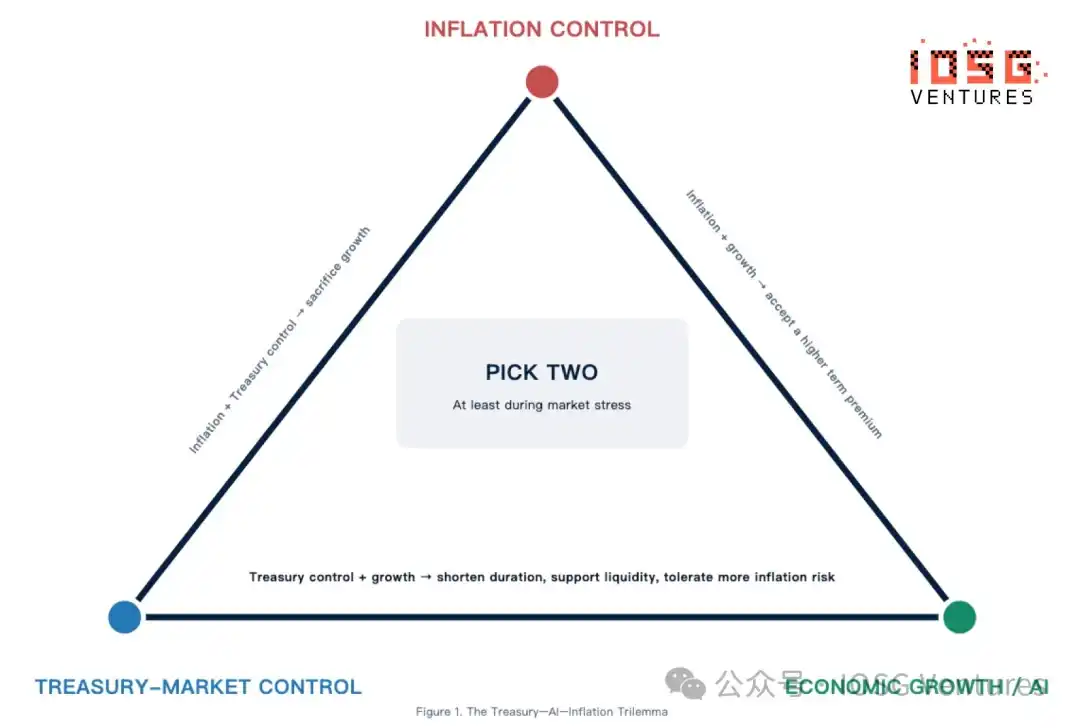
Therefore, in my view, the U.S. faces a difficult-to-resolve trilemma. And it is becoming increasingly clear that strictly controlling inflation is the politically most expendable corner of the three.
U.S. Treasury Secretary Besant's Response: First, Secure the Treasury Market

Besant's recent actions show how closely he is watching the bond market.

  • Support the Yen to reduce the risk of Japan being forced to sell U.S. bonds. Japan is the largest foreign holder of U.S. Treasuries. When it buys yen to support its currency, it needs dollars, and selling U.S. bonds is one way to obtain them: but this would amplify pressure in the Treasury market. Therefore, supporting the yen also reduces the likelihood that Japan will sell Treasuries to fund intervention.

  • Repo illiquid long-end bonds. Repo does not equal debt cancellation. If financed by issuing new short-term Treasury bills, it changes the maturity structure of government liabilities: duration is reduced on one end, while short-term bills increase on the other.

  • Shifting issuance towards the short end is likely the next step.

  • In 2023-24, during the Yellen era, the Treasury heavily relied on short-term bills to meet surging financing needs. Stephen Miran and Nouriel Roubini, in a 2024 paper, termed this practice "aggressive Treasury issuance." Their argument is that the issuance of roughly $800 billion more in short-term bills than the conventional path sucked duration out of the market, with an effect analogous to "stealth QE," easing financial conditions to a degree roughly equivalent to a one-percentage-point rate cut; they also accused the Treasury of using this to boost the Biden administration's prospects in the 2024 election. The likelihood of Trump's Treasury employing similar tactics is increasing.

If these operations proceed as expected, they could unleash a significant wave of liquidity, reigniting the "currency debasement trade."

Gold Has Secured a Seat

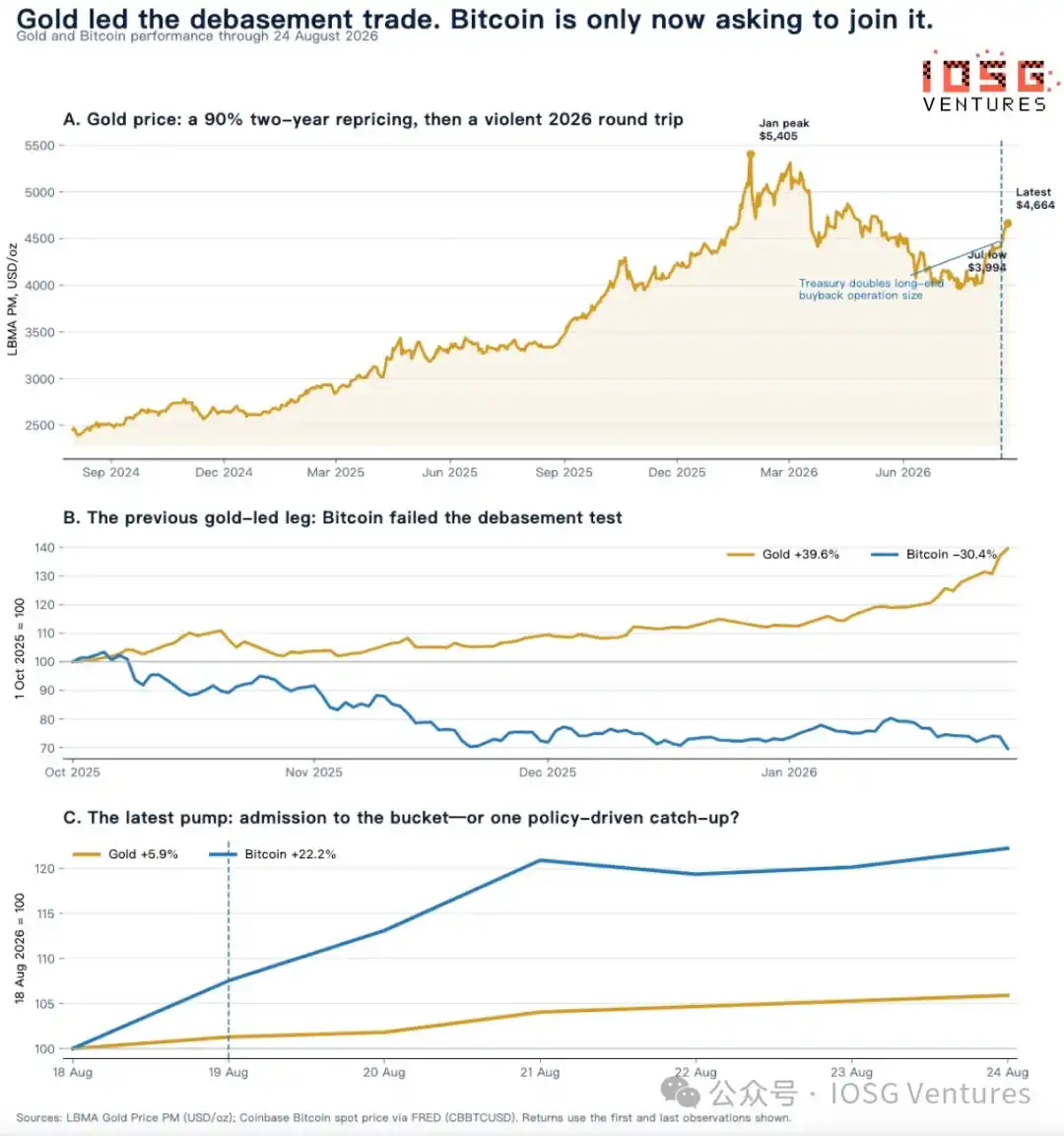
Gold's current rally is not a simple inflation trade. From August 1, 2024, to August 24, 2026, the gold price rose from $2,455 per ounce to $4,664, a gain of approximately 90%. The drivers behind this include: declining trust in the U.S. dollar after its use as a policy weapon, lingering inflation concerns, and perhaps the most critical one: the logic of debasement—expanding the money supply might be the only politically viable path out of this debt cycle.
Is Bitcoin Qualified to Enter the "Debasement Hedge" Category?

Not yet, but the recent rally makes this question worth serious discussion.

In the previous rally led by gold, from October 1, 2025, to gold's peak on January 29, 2026, gold rose 39.6%, while Bitcoin fell 30.4%. For an asset that packages itself as "digital gold," this performance was unflattering.

Recent price action has been different. From August 18 to 24, Bitcoin rose 22.2%, while gold gained 5.9%. This surge began accelerating after the Treasury increased long-end repo operations. However, Washington was also pushing for crypto legislation during the same week, so attribution is not pure. If the market treats it as a stealth QE trade rather than a pure debasement trade, then Bitcoin's outperformance makes sense and is more likely to persist: when global liquidity widens, crypto assets often react strongly.

Conclusion, and What Could Overturn It

This trilemma does not mean inflation will necessarily spiral out of control, or that formal yield curve control is imminent. It is merely a framework to see where the constraints truly lie.

If inflation continues to run above target, the deficit remains around 6% of GDP, and AI-related borrowers keep adding long-duration supply, then the cost of simultaneously preserving Treasury market stability and the growth cycle will increasingly manifest as: shorter debt maturities, normalized liquidity backstops, and tolerance for higher inflation risks. This is bullish for gold and BTC.

Conversely, scenarios that would weaken this thesis include: inflation falling back near 2%, Congress presenting a credible fiscal path, AI infrastructure becoming self-financing, or private demand absorbing the issuance of interest-bearing debt without demanding a higher term premium.

Therefore, the market's next question should not be "when will the Fed cut rates," but this one: which corner of the triangle will Washington allow to break first? If the Treasury accelerates this duration transfer, Bitcoin could face a more sustained tailwind.


Preguntas relacionadas

QWhat are the three conflicting forces (the trilemma) mentioned in the article that the US is currently facing?

AThe article describes a difficult trilemma where the US cannot simultaneously achieve: 1) Strictly controlling inflation, 2) Preserving the stability of the treasury market (keeping long-term yields from rising excessively), and 3) Sustaining the AI investment cycle. The author argues that controlling inflation is the most likely goal to be sacrificed politically.

QAccording to the article, why is the recent behavior of Bitcoin's price significant in relation to gold?

AThe recent price action is significant because it differs from the previous cycle. From late 2025 to early 2026, gold rose ~40% while Bitcoin fell ~30%. However, from August 18 to 24, 2026, Bitcoin surged 22.2% while gold rose only 5.9%. This suggests the market might be interpreting Treasury actions (like increased long-end buybacks) as 'stealth QE' or a liquidity injection, to which crypto assets are highly sensitive, rather than a pure inflation/currency devaluation trade.

QHow does AI investment act as a catalyst for pressure on the US Treasury market?

AAI investment acts as a catalyst in two main ways: 1) It boosts economic growth and near-term inflation, which is generally positive but complicates inflation control. 2) More directly, it creates massive capital demand. Large, creditworthy cloud companies (hyperscalers) are issuing substantial long-duration bonds (estimated at $1000B+ in 2025, equivalent to ~$360B in 10-year duration) to fund AI infrastructure. This means they are competing directly with the US Treasury for long-term investor capital, driving up yields.

QWhat specific actions has US Treasury Secretary Besant taken to address pressure in the bond market?

ATreasury Secretary Besant has taken several actions to stabilize the bond market: 1) Intervening to support the Yen, aiming to reduce the risk that Japan is forced to sell US Treasuries to fund its currency defense. 2) Increasing liquidity-supporting buyback operations for less liquid long-term bonds. 3) The article suggests the next step is likely to shift more government debt issuance towards the short end (T-bills), a tactic used previously which can act like 'stealth QE' by reducing duration in the market.

QWhat is the author's core judgment regarding the likely US policy path and its implication for Bitcoin?

AThe author's core judgment is that Washington will most likely choose to preserve treasury market stability and the AI investment cycle, at the cost of allowing inflation to remain elevated for a longer period. This scenario, involving continued liquidity support and a transfer of duration risk away from the private sector, creates a sustained tailwind for both gold and Bitcoin. If the Treasury accelerates this 'duration transfer,' Bitcoin would face a more persistent favorable environment.

Lecturas Relacionadas

Tether Completes Full Audit by KPMG U.S., 150 Tons of Gold and 100,000 BTC Reserves Verified

Tether Announces Completion of Full Financial Audit by KPMG US, Confirming Gold and BTC Reserves Tether CEO Paolo Ardoino announced that the company has completed its first-ever full financial audit by the "Big Four" accounting firm KPMG US. The audit covers the financial statements of Tether International, S.A. de C.V. as of December 31, 2025. Ardoino stated that Tether's delay in obtaining a full audit was primarily due to the previous US administration's hostile stance towards the digital asset industry. With a more favorable regulatory environment, the company engaged KPMG US for the rigorous review. Ardoino emphasized the audit confirmed the strength of Tether's reserves, including over $6 billion in excess equity. He also revealed the company holds substantial physical assets: approximately 150 tons of gold and over 100,000 Bitcoin (BTC). The audit process reportedly involved physically verifying each gold bar. Addressing past criticism and ongoing skepticism, Ardoino pointed to Tether's ability to handle large-scale redemptions, citing the processing of around $7 billion within 48 hours during market stress in 2022. He stated the company plans to undergo annual full financial audits alongside its ongoing quarterly attestation reports. Regarding a potential private equity round, Ardoino clarified that Tether, as a highly profitable company, does not require external capital but acknowledges significant market interest in its shares. The company remains private and mission-focused, aiming to serve users outside the traditional financial system. Looking ahead, Ardoino expressed Tether's interest in potentially funding initiatives like the "Bitcoin Red Team," which uses AI to audit Bitcoin's code and wallet security for vulnerabilities.

marsbitHace 14 min(s)

Tether Completes Full Audit by KPMG U.S., 150 Tons of Gold and 100,000 BTC Reserves Verified

marsbitHace 14 min(s)

Wall Street's Imagination Can't Keep Up with Nvidia's 'Speed'

NVIDIA once again delivered stellar earnings, with revenue, operating profit, and EPS all hitting record highs for Q2 FY2027 (ended July 26, 2026). Revenue reached $96.221 billion, a 106% YoY increase, while net profit surged 126% to $59.688 billion. The core driver remained the Data Center segment, which grew 117% YoY to $89.023 billion, fueled by ongoing global AI infrastructure investments. The company segmented its Data Center revenue into Hyperscale (large cloud providers) and ACIE (AI cloud, enterprise, industrial, and sovereign AI) categories, with the latter showing faster growth. Notably, shipments of Hopper architecture products to mainland China accounted for less than 1% of Data Center revenue this quarter, and future guidance excludes contributions from China's Data Center compute market. CEO Jensen Huang stated that AI has reached a "tipping point," directly generating productivity and revenue. Financially, NVIDIA maintained robust profitability with a gross margin of 75%. The company also returned approximately $26 billion to shareholders via buybacks and dividends. Looking ahead, product transitions are key. The Blackwell Ultra platform is now in large-scale deployment, while the next-generation Vera Rubin platform, including NVIDIA's first CPU designed for AI agents, has entered full production. The company is also expanding its software ecosystem with tools like the DSX platform for building AI factories. However, NVIDIA's role is evolving beyond chip supplier. It is increasingly involved in financing and facilitating massive AI infrastructure projects, exemplified by its credit support for the SB Energy project in Ohio intended for OpenAI. The company aims to mobilize over $500 billion in third-party capital for such builds, though this raises questions about future capital intensity. For Q3 FY2027, NVIDIA forecasts revenue of approximately $108 billion, signaling continued growth but at a potentially moderated pace. While still dominant, the competitive landscape is intensifying with rivals like AMD and in-house chips from major cloud customers. Key challenges include maintaining growth through the Blackwell-to-Rubin transition, sustaining the pace of AI infrastructure investment, and defending market share as inference workloads grow and competition increases.

marsbitHace 15 min(s)

Wall Street's Imagination Can't Keep Up with Nvidia's 'Speed'

marsbitHace 15 min(s)

MiniMax Starts Earning Money by Relying on Others

MiniMax, a Chinese AI company known initially for its consumer-facing products like Conch AI, has undergone a significant business shift according to its first post-IPO semi-annual report. While overall revenue grew to $117 million (surpassing its full-year 2025 projection), the revenue structure flipped dramatically. Revenue from its open platform and enterprise AI services surged 703.1% to $73.93 million, now constituting 63.4% of total income. In contrast, revenue from its own AI-native products, though doubling to $42.64 million, dropped from 69.7% to 36.6% of the total. This indicates MiniMax is transitioning from a product-centric to a platform-centric model, embedding its AI capabilities into other companies' workflows and developer applications rather than solely relying on its own apps. The company is now monetizing its core model technology as a service. However, profitability remains a challenge. Despite revenue growth of 283.1%, R&D expenses were $297 million—2.55 times revenue—leading to an adjusted net loss of $293 million. A positive sign is improving gross margin, which rose from 12.1% to 17.9%, suggesting initial progress toward scaling efficiently. Geographically, MiniMax demonstrates a "developed in China, monetized globally" model, with 60.8% of its revenue coming from outside mainland China. The report highlights that MiniMax has successfully moved past proving demand and model capability. The critical next phase is demonstrating that its growing enterprise and developer customer base can generate sufficient, sustainable profit to offset the high inherent costs of AI model training and inference.

marsbitHace 25 min(s)

MiniMax Starts Earning Money by Relying on Others

marsbitHace 25 min(s)

He Personally Built o1 and o3, but Suddenly Announced: Humans Can Retire Forever

AI researcher Jerry Tworek, former lead of OpenAI's reasoning models (o1/o3), predicts human AI researchers will be largely obsolete within two years. He argues that while AI agents currently excel at execution (reducing experiment cycles from a month to a day), their creative idea generation remains low-quality. True frontier AI development, he claims, is driven by only 30-50 people globally, with everyone else in supporting roles. A core bottleneck is the Transformer architecture, which he believes is suboptimal but has seen only 3-4 serious replacement attempts at OpenAI in seven years due to massive computational and validation hurdles. He highlights a key paradox: you need significant compute to prove a new direction, but you need proof to get the compute. A breakthrough came when he received dedicated GPU resources, leading to scaling reinforcement learning and the o1 model. Now, through his company Core Automation, he uses AI agents to automate costly R&D tasks. In one case, a $100k AI effort optimized a GPU kernel by 60x, matching rare expert-level performance. This acceleration, he argues, will soon automate even the remaining creative and architectural work of the few top researchers. Looking ahead, Tworek envisions a post-work future where humans pursue excellence for its own sake—like ancient philosophers or dedicated athletes—free from the necessity of labor for societal function. He acknowledges the personal challenge of deriving self-worth from work but is actively building the tools that will make his own expert role, and those of his peers, redundant. The prevailing sentiment among researchers, he notes, is a mix of exhaustion and exhilaration in what may be the final, pivotal chapter of human-led AI advancement.

marsbitHace 30 min(s)

He Personally Built o1 and o3, but Suddenly Announced: Humans Can Retire Forever

marsbitHace 30 min(s)

Trading

Spot
活动图片