IOSG | EIP-8363 Quantitative Review: Slashing Staking 'Subsidies'—What Does Ethereum Want in Return?

marsbitPublicado a 2026-08-25Actualizado a 2026-08-25

Resumen

**Title: IOSG | EIP-8363 Quantitative Review: Cutting Staking "Subsidies"—What Does Ethereum Aim to Gain?** **Summary:** EIP-8363 proposes a mechanism to progressively destroy a larger portion of validator rewards as the staking ratio increases, reaching 100% destruction when 50% of ETH supply is staked. This analysis models its impact on issuance, yield, and staking equilibrium, investigates whether ETH's yield truly explains its price, quantifies the on-chain economy's dependence on this yield, and presents conclusions. Key findings: 1. EIP-1559's fee-burn mechanism has become largely ineffective, with burn rates down 98% since 2022. Issuance policy is now Ethereum's primary remaining lever over ETH supply. 2. At the current staking level (~35% of supply), EIP-8363 would cut issuance by ~58.6% and staking APR by ~56.4%, not eliminate it entirely. The mechanism is self-limiting; under reasonable yield thresholds, the system would stabilize at 26–34% staking with 0.3–0.5% annual issuance. 3. No statistically significant correlation exists between historical staking yield changes and ETH price movements. The natural 37% yield decline since 2023 showed no detectable price impact. 4. The on-chain economy's direct dependence on this yield is limited. Liquid staking tokens (LSTs) like wstETH are crucial as collateral (e.g., 34.2% in major lending markets), but their utility persists as long as yield is positive. Staking-focused ETFs represent a tiny fraction (0.19% of supply...

Author:Mario Chow,IOSG

EIP-8363 Proposal: As the staking ratio increases, burn an increasingly larger portion of validator rewards, reaching 100% burn when 50% of the supply is staked. This article models its impact on issuance, yield, and staking equilibrium; examines whether ETH's yield has ever truly explained its price; quantifies how much of the on-chain economy actually relies on this yield; and presents our conclusions.

All calculations are based on on-chain data and the original EIP. The model is independently constructed, with a discrepancy of less than 2% from publicly available third-party data. Data updated as of August 24, 2026.

One-sentence version of the argument
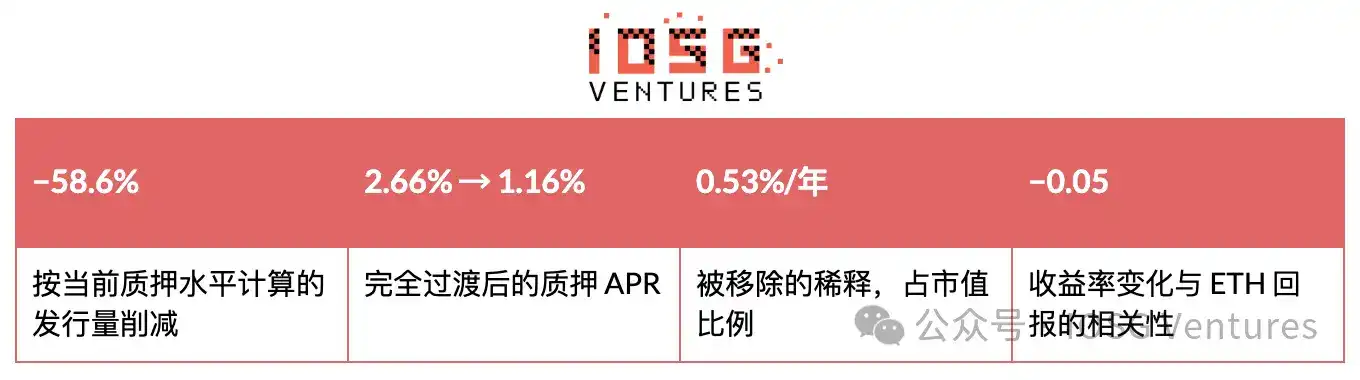
The fee burn is dead, making issuance the only lever Ethereum still has over ETH supply. The proposal halves issuance at current staking levels, not zeroes it; and it's self-limiting: at any reasonable staker hurdle rate, the system ultimately stabilizes with 26–34% of supply staked and issuance at 0.3–0.5%/year. Meanwhile, the portion of yield it cuts shows no detectable relationship with ETH's price.

I. The Burn Mechanism Is Already Broken

EIP-1559 burned 1.48 million ETH in 2022. EIP-1559 burns the base fee, which is essentially congestion pricing; once blobs move rollup data off L1 and the gas limit is raised, congestion disappears: gas usage doubled while the average base fee fell 96%, and burn volume has dropped 98% since 2022. Over the past twelve months, it burned only 25,660 ETH, and the 30-day run rate is even lower: 39 ETH/day, annualized to about 14,300 ETH.
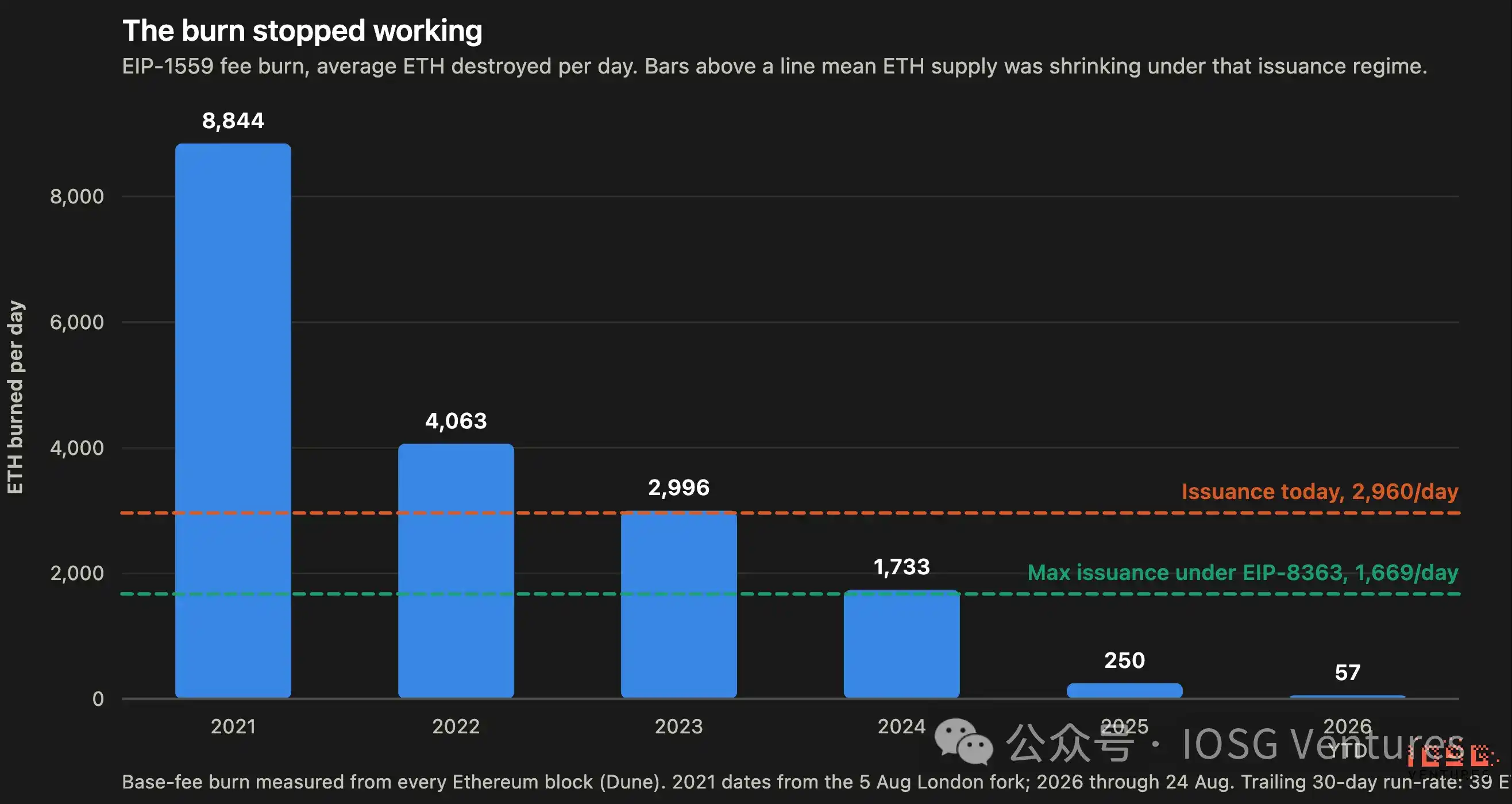
▲ Daily EIP-1559 fee burn volume by year: from 8,844 ETH/day in 2021 to 57 ETH/day in 2026—far below both current issuance and the maximum issuance curve under EIP-8363.

Compared to total issuance of about 1.08 million ETH/year, the burn now offsets only 2.4% of new supply. As a mechanism, "ultrasound money" is over. L2 migration and blob scaling moved the fee base away from L1: L1 gas usage actually doubled over the same period (3.4 billion → 6.7 billion units/month), while the average base fee dropped from 4.00 gwei to 0.17 gwei: this is a price effect, not a demand effect.

Net Issuance: What's Really Happening to Supply

The burn is only half the ledger. Looking at it together with issuance paints a grimmer picture: issuance has never stopped growing, while the offsetting item has vanished beneath it.
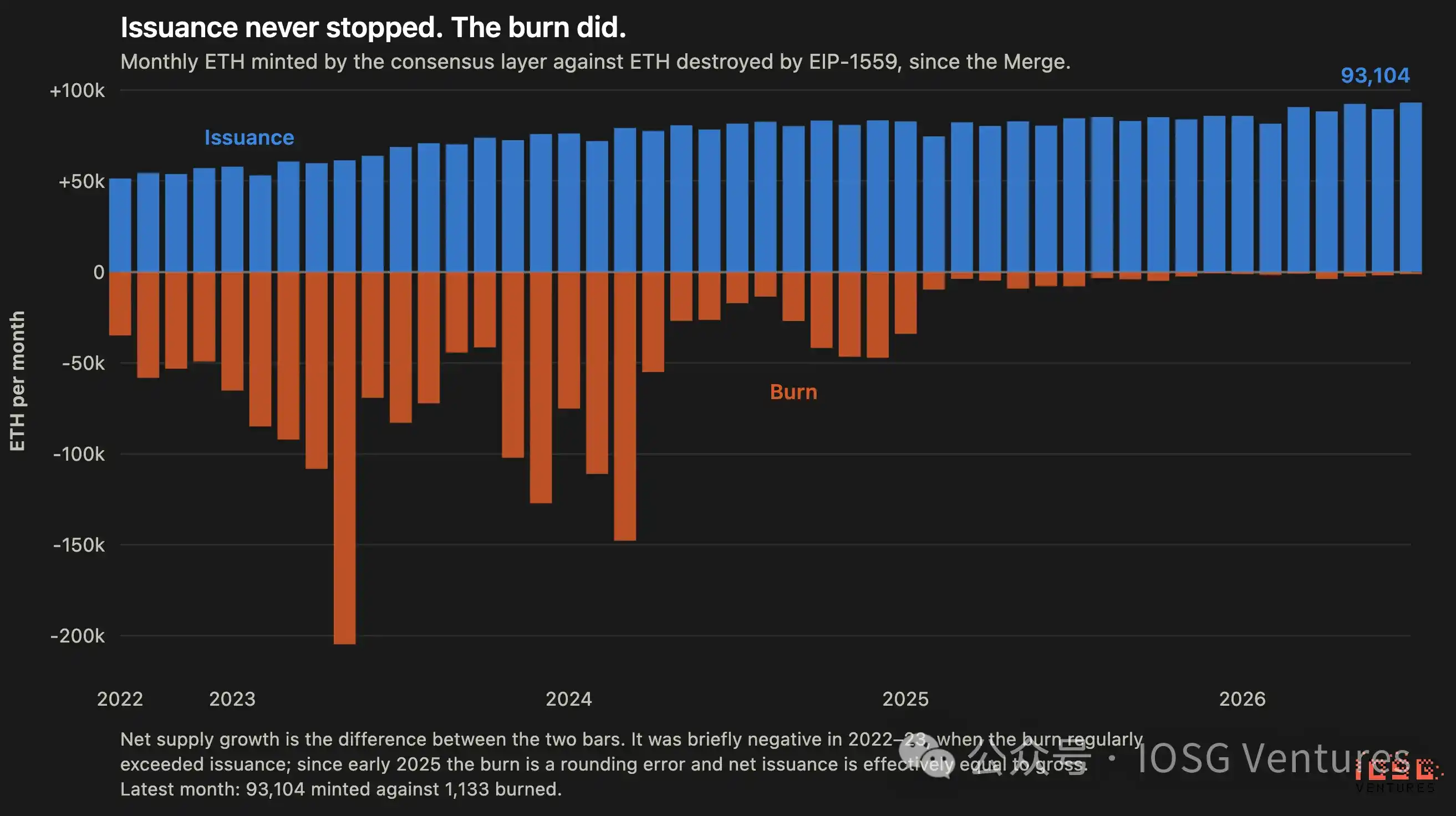
▲ Monthly ETH minted on the consensus layer vs. ETH burned by EIP-1559 since The Merge. Issuance bars have steadily grown; burn bars have shrunk to almost zero by 2025.

Out of the 47 months since The Merge, only 13 were deflationary—the last being March 2024. ETH has been inflationary for 28 consecutive months, and the rate has roughly tripled during this period, from +0.26%/year to +0.87%/year. The reason isn't that issuance increased much (up only 4% since 2024), but that the offset has gone to zero.

This reframes the entire debate. EIP-8363 is often framed as a choice between staking yield and monetary scarcity. But a more accurate understanding is narrower and more forced: issuance policy is now the only lever Ethereum has left over ETH supply, because the demand-driven one no longer works. Whether legislated or not, all supply questions now pass through the issuance curve.

II. What EIP-8363 Actually Does

Before unpacking the mechanism, we need to address the official core motivation: safeguarding network security. The proposal authors believe that once the network staking ratio crosses the 50% red line, Ethereum will lose its 'social layer defense' capability and face systemic parasitic risks from LST oligopolies that are too big to fail. Thus, the proposal attempts to cap staking by forcibly lowering yields. However, grand security philosophies often obscure the real meat on the ledger. Setting aside metaphysical debates about decentralization, what does this mechanism actually mean for the real on-chain economy? Here is a purely quantitative deduction.
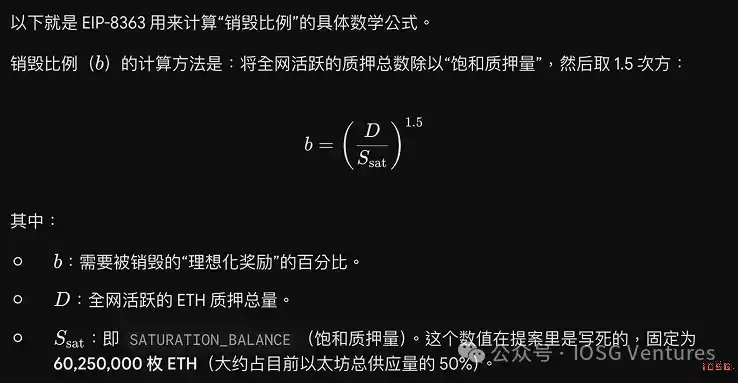
How is the money deducted? (Core Mechanism)

  • Pay first, then burn: Validators initially earn full rewards for all tasks as normal, but the system then directly "burns" a portion of the rewards according to a ratio (assume b).
  • Deduct based on "theoretical full amount," no double penalty: The key here is that the system calculates the burn amount based on the full theoretical reward you should receive, not the actual reward you get. Why? Because if you accidentally go offline, you already don't get the reward; if the system then deducts based on your actual situation, it's too unfair to offline participants. Deducting based on the "theoretical value" ensures motivation to work remains unchanged, and offline participants aren't penalized twice.
  • Extreme case protection: If the Ethereum network experiences severe issues (entering inactivity leak state), this portion of attestation reward burning is paused.
  • Extra income unaffected: This proposal only touches consensus layer rewards. Your side income from running a node—namely, MEV and priority fees—remains completely unaffected.

The two most common misconceptions in the community

Misconception 1: "Ethereum's issuance will be directly cut to zero."

  • Truth: Far from it. At the current staking level of approximately 42.2 million ETH, the burn ratio b is 58.6%.
  • To reduce issuance completely to zero, staked amount would need to surge to 60.25 million ETH (43% higher than current levels). So the accurate statement is: At this stage, the proposal only cuts issuance roughly in half, far from zero.

Misconception 2: "Yields plummet instantly, triggering a DeFi crash on day one."

  • Truth: An 18-month "soft landing" period is officially designed, making the first day almost imperceptible.
  • To prevent sudden shock, upon activation, the proposal will double the base reward factor (the parameter used to calculate rewards) from 64 to 128. This doubling precisely offsets the aforementioned 58.6% burn ratio.
  • In other words, on the first day of the upgrade, net issuance will remain at about 83% of current levels. Over the next 18 months, the parameter will gradually decrease back to the normal 64, with issuance slowly sliding down to 41% of current levels.
  • Summary: Yield decline is spread over a year and a half, not an overnight crash. Arguments fearing an "instant DeFi bubble pop" ignore this buffer mechanism.

III. Baseline: Where Ethereum Actually Is Today
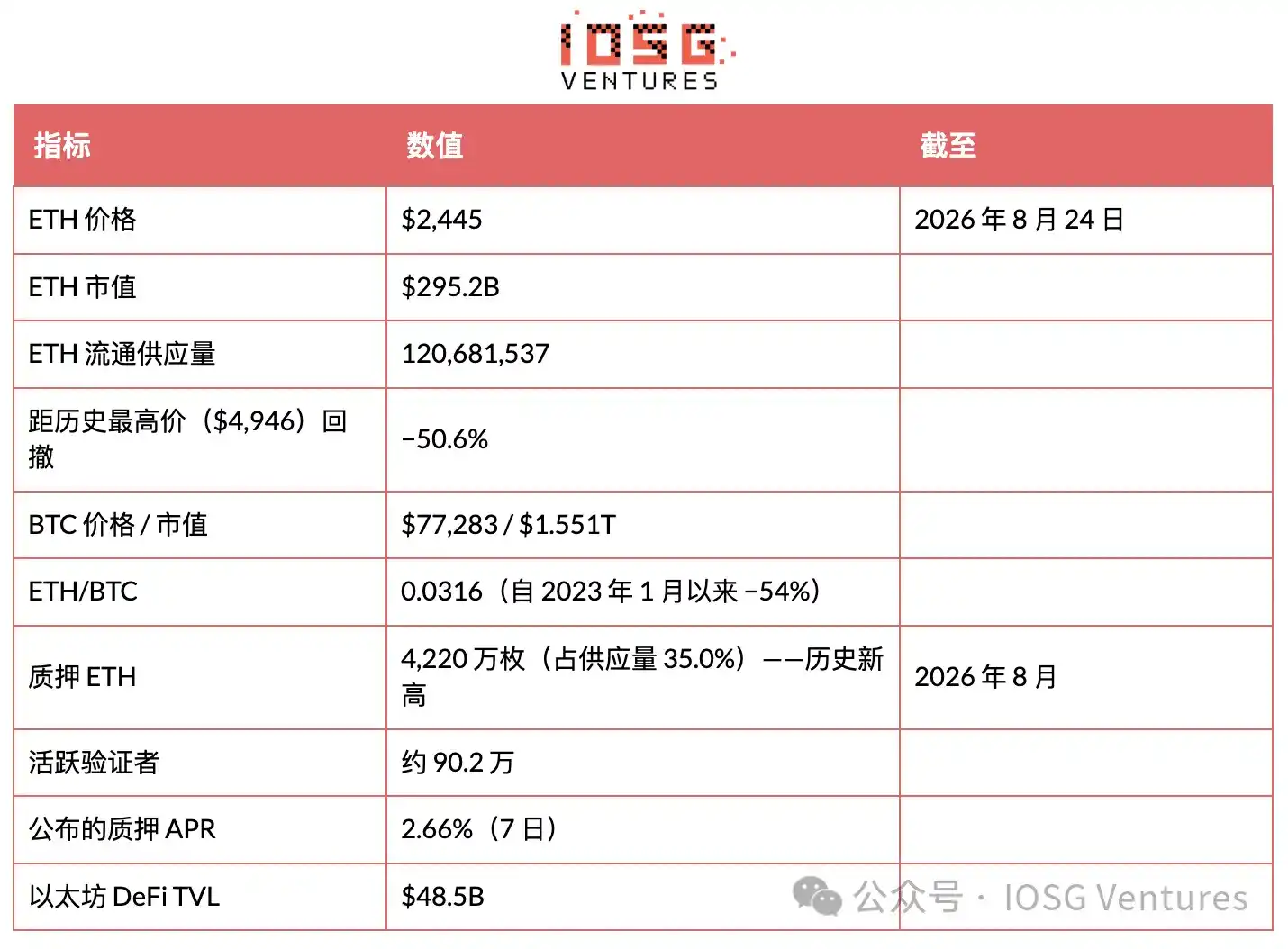
Supply Dynamics
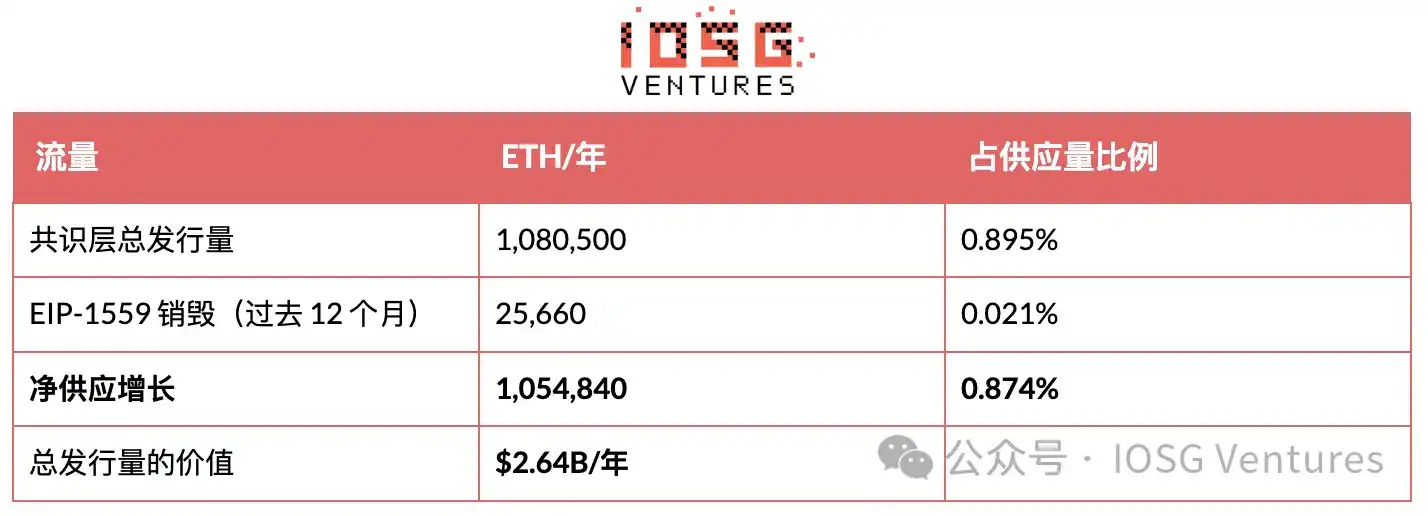
Where Issuance Comes From

All from staking rewards. Post-Merge, new ETH has only one source: payments from the consensus layer to validators, allocated with fixed canonical weights (denominator 64) across three duties: attestation 54/64 (84.4%, 911,672 ETH/year), block proposal 8/64 (12.5%, 135,063), sync committee 2/64 (3.1%, 33,766).

Issuance is modeled as I(S) = 940.9 · √(S/32) ETH/year, i.e., the protocol's own reward curve. At S = 42.2 million, this corresponds to a consensus layer APR of 2.560%. Measured priority fees for the first 23 days of August were 2,623 ETH, annualized to 41.5k ETH: equivalent to 0.098% on the staking base. Summed, this gives 2.658%, almost exactly matching the published 2.66%.

Using measured priority fees, at least 96% of validator income comes from issuance, at most 4% from fees. Proposer payments in MEV-boost beyond direct priority fees are not captured, so the fee share is a lower bound. Regardless, issuance dominates absolutely, and this proportion is key to the entire debate.

IV. Modeling the Proposal

The earliest attempts were to design a whole network around "hiding," not patching an existing one. On this path, two tokens led the way, placing completely opposite bets. The third case was built for banks, not individuals, but belongs to the same family.

Applied at current staking levels, ignoring behavioral response
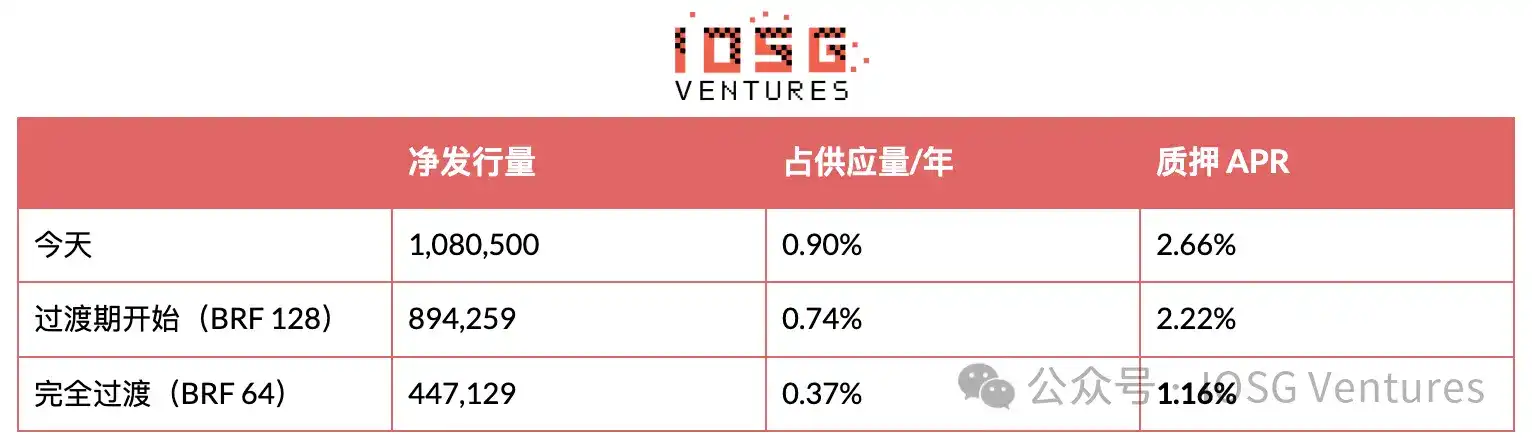
Issuance cut: −58.6%. Staking APR cut: −56.4%. Dilution removed: 633k ETH/year = $1.55B/year = 0.53% of ETH market cap annually.
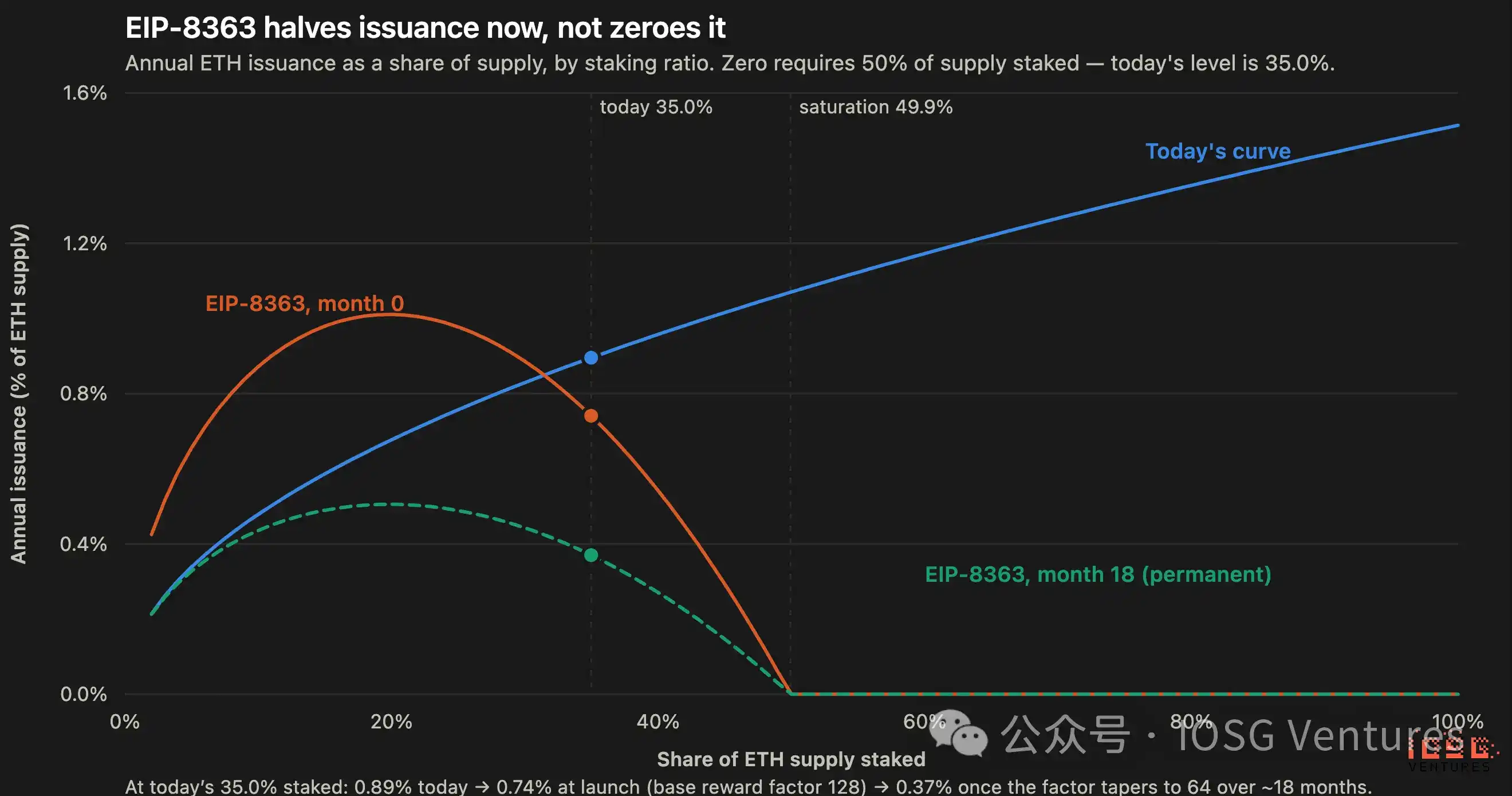
▲ Annual ETH issuance as a percentage of supply vs. staking ratio. Today's curve rises steadily; the EIP-8363 post-activation curve peaks at about 1.0% near 20% staking ratio; the permanent curve peaks at about 0.5%. Both curves drop to zero at 50% staking ratio.

Full curve (after complete transition)
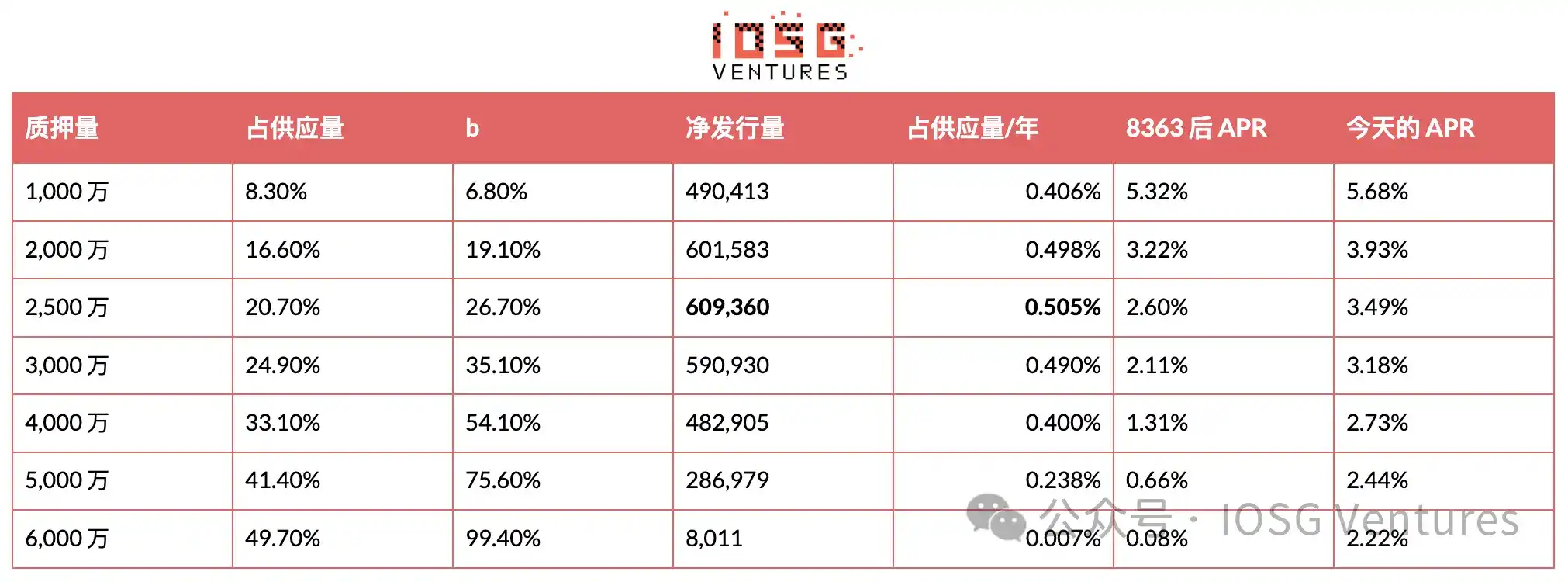
Issuance peaks near 25 million staked, at about 0.505% of supply, then declines—consistent with the EIP's own description.

Equilibrium—The Number That Truly Ends the Debate

Stakers are not passive. If yield falls below their required return, they exit, which both pushes up gross APR and lowers b. Solving for the fixed point:
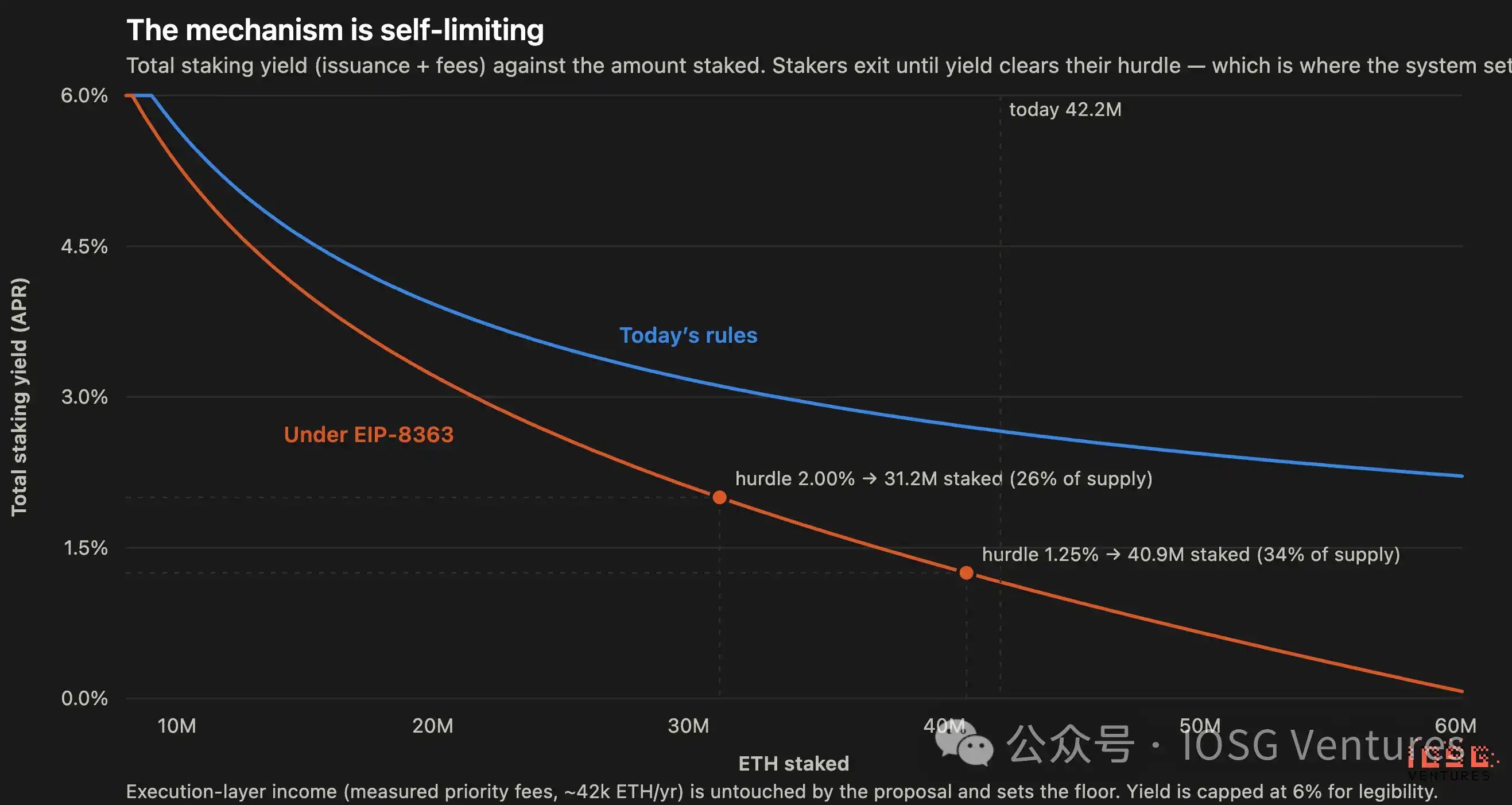
▲ Total staking yield vs. amount of ETH staked under current rules and EIP-8363. The EIP-8363 curve intersects the 2% hurdle at 31.2 million staked and the 1.25% hurdle at 40.9 million.
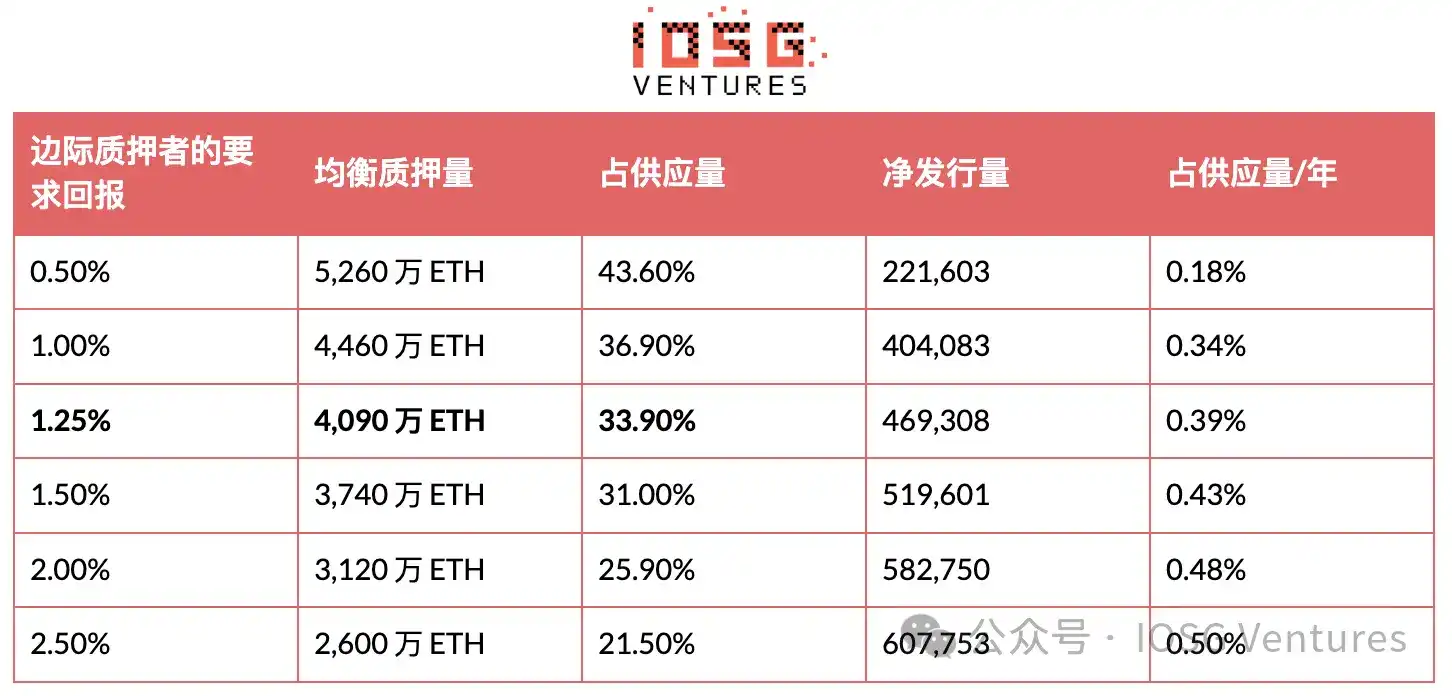
Reading this table against the two loudest claims in the debate:

  • "Issuance will go to zero." Only true if marginal stakers are willing to work for ~0.5% return. At any reasonable required return, ETH still inflates at 0.3–0.5%/year. Supporters exaggerate.
  • "Staking will collapse." At a 2% hurdle, staking stabilizes at 26%: lower than today's 35%, but roughly the level seen throughout 2024. Critics also exaggerate.

This mechanism is self-limiting by design. This is the most interesting property of the design and the least discussed point.

V. Can Staking Yield Explain ETH's Price?

First, address the "question behind the question"

Are staking ratio and yield correlated? Yes: perfectly, and by definition, not observation. This must be clarified first, as it determines what the data can and cannot say.

The reward pool paid by the protocol scales with the square root of the staked balance, so yield per ETH has a closed-form solution:

issuance(S) = 940.9 · √(S/32) ETH/year APR(S) = issuance(S)/S = 166.28 / √S

The more staked, the same pool is divided among more coins. The correlation between staking ratio and issuance yield is −1 by construction. Plotting them together is plotting an identity.

The only free variable is the difference between reported yield and the formula value: fee income. It was about 1.34 percentage points in 2022; today it's 0.10 percentage points.

The correlation itself

Answer: No correlation exists. 43 months, Jan 2023 → Jul 2026. (Data refreshed Aug 24, but this test was not rerun; window ends Jul 2026, price movements after do not affect result.)
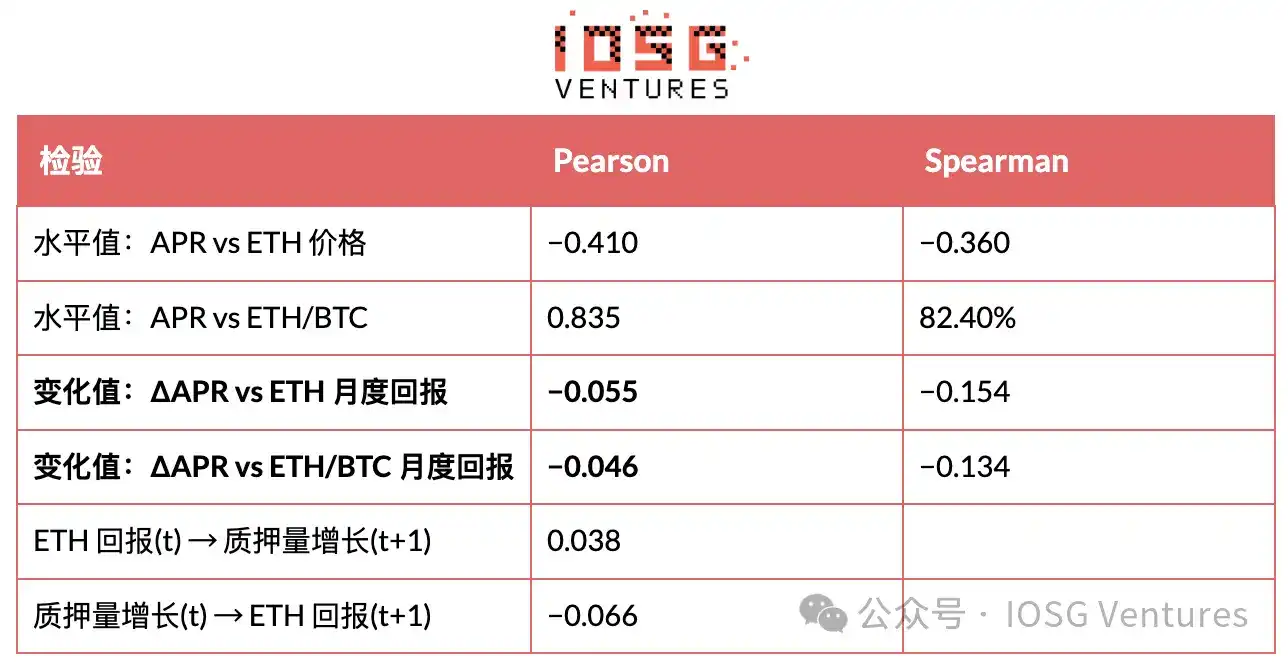
Regression Results
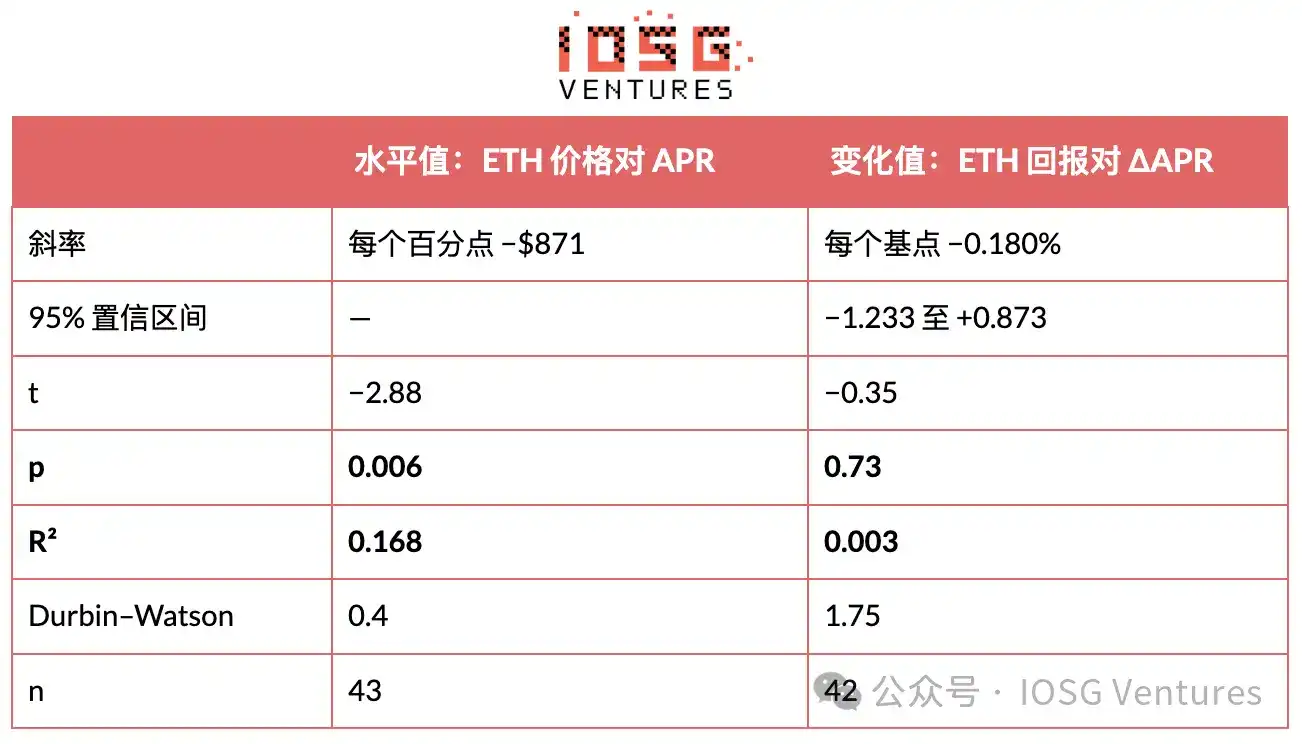
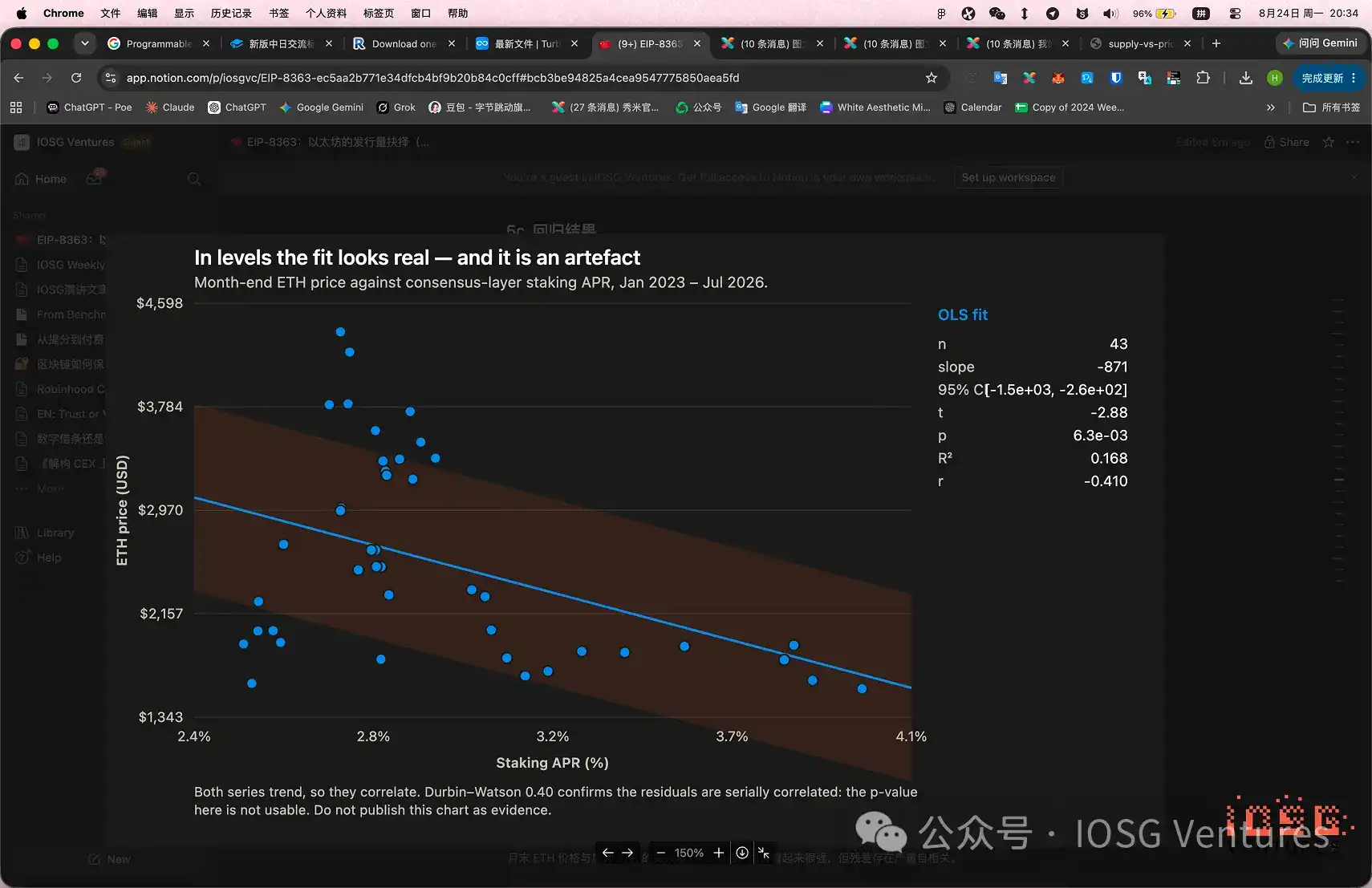
▲ End-of-month ETH price vs. staking APR relationship and OLS fit. The fit looks strong, but residuals show severe autocorrelation.

This level regression is "significant" at p = 0.006—but it's worthless. Durbin–Watson is 0.40, indicating severe serial correlation in residuals, a textbook sign of spurious regression between two trending series. Both variables have trends, so they correlate; standard errors are underestimated, p-values unusable. This chart is kept as a warning, not as evidence.
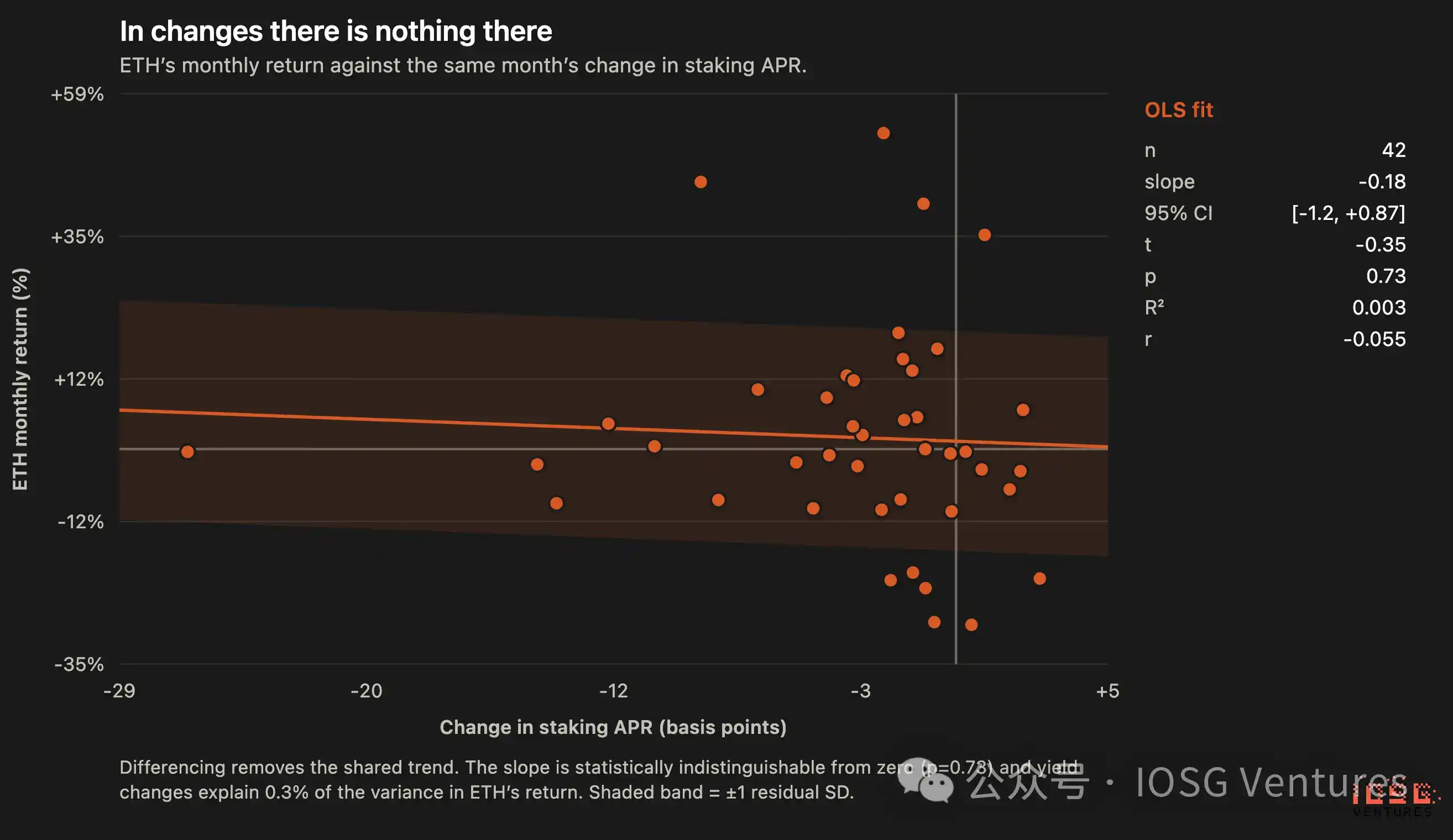
▲ Scatter plot of monthly ETH returns vs. change in monthly staking APR, with near-horizontal OLS fit line and wide residual bands.

After differencing to remove trends, the relationship disappears: p = 0.73, R2 = 0.003. Durbin–Watson is 1.75, indicating a clean setup. The 95% confidence interval comfortably crosses zero in both directions—the data can't even determine the sign of the effect, let alone its magnitude.
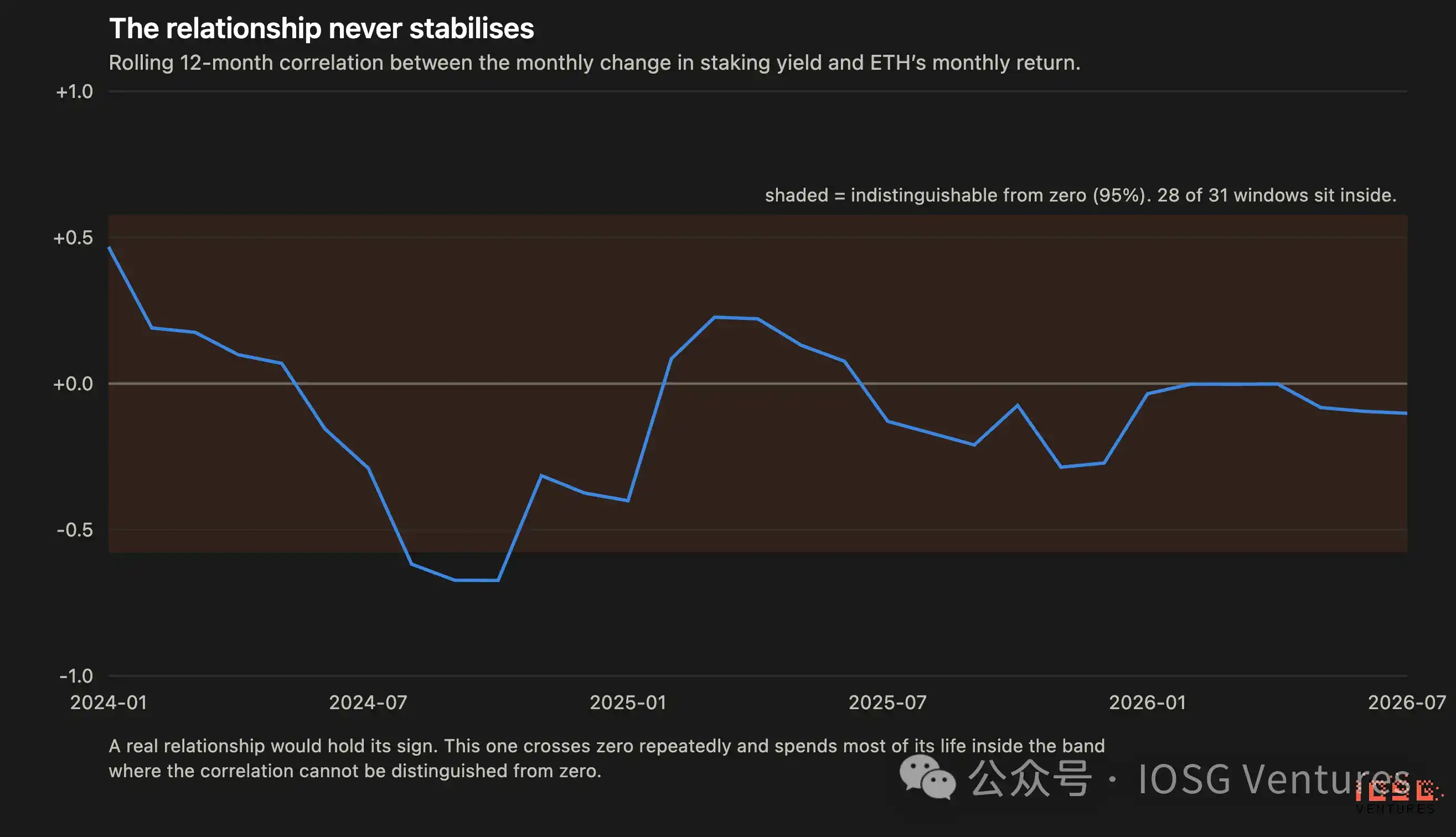
▲ 12-month rolling correlation between changes in staking yield and ETH returns, oscillating around zero and mostly within an interval indistinguishable from zero.

And this isn't a stable relationship hidden in noisy means—the rolling correlation repeatedly crosses zero, spending most of its time in an interval indistinguishable from zero.

From January 2023 to July 2026, ETH's staking yield fell from 3.98% to 2.50%, while ETH/BTC dropped 57%. Over the same window, the monthly correlation between changes in staking yield and ETH returns was −0.05. The yield was always there.

It didn't protect the price, and its compression didn't cause a drop. If a 37% yield reduction brought by the natural existing reward curve had no detectable price effect, the burden of proof lies on anyone claiming "another cut will have an effect."

Caveat: The staking series is reconstructed from on-chain flows, ~5% higher than published data. Direction and shape are reliable, absolute levels not precise.

Supply growth doesn't explain it either

If yield doesn't affect price, what about the actual supply figure this proposal changes? Same test, same window, replacing yield with net supply growth rate.
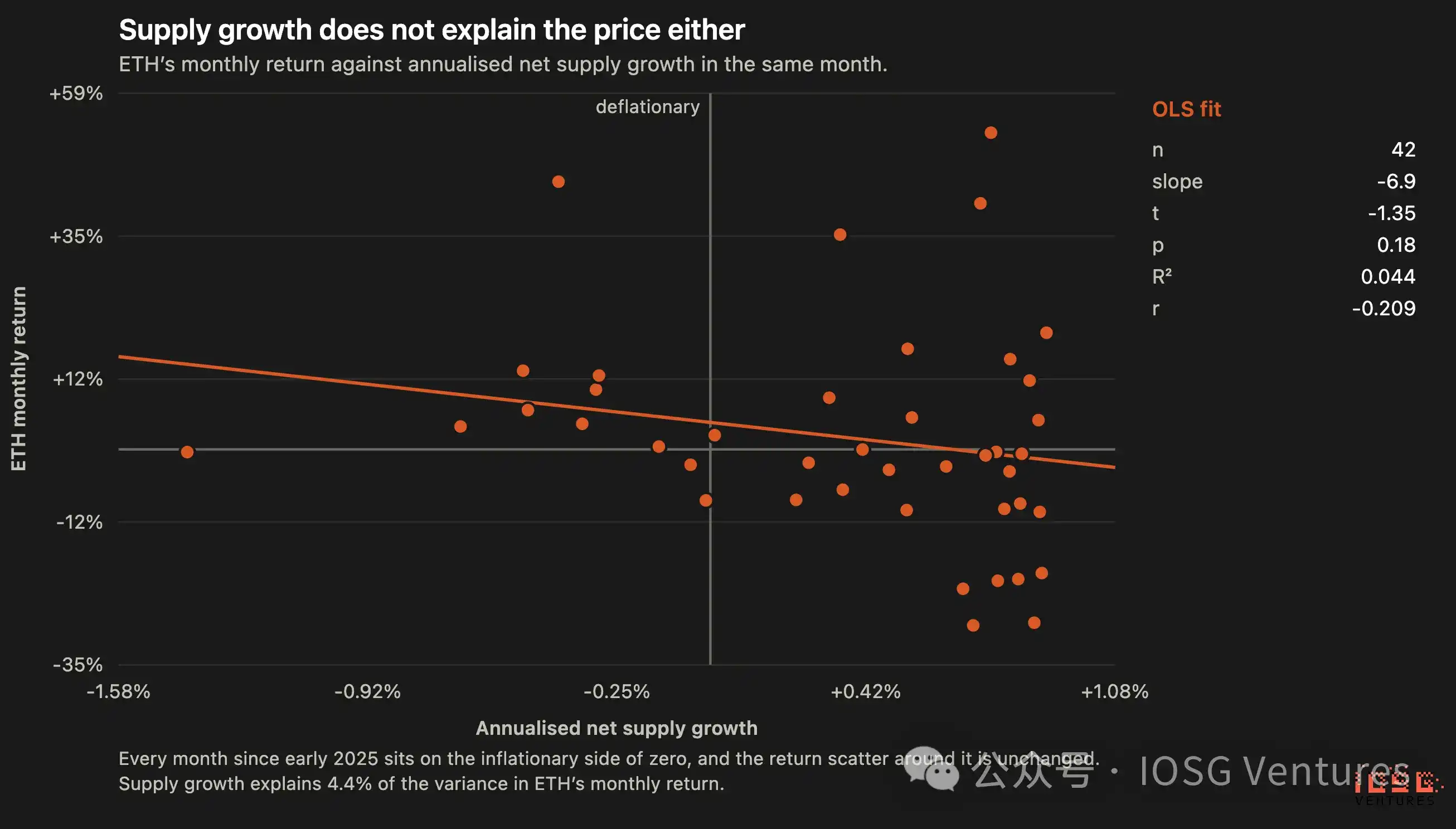
▲ Monthly ETH returns vs. annualized net supply growth rate. The fitted line slopes downward, but scatter is wide, relationship not significant.

Slope −6.9 (each percentage point higher annual supply growth corresponds to 6.9 percentage points lower monthly return), p = 0.18, R2 = 0.044, Durbin–Watson 1.82. 95% interval for slope: −17.1 to +3.4.

Read this result honestly, as it cuts both ways. The relationship is statistically insignificant, interval crosses zero, so it can't serve as evidence that "cutting supply growth boosts price." But it's about fifteen times stronger than the yield relationship (R2 4.4% vs. 0.3%), and the sign matches theoretical prediction. If either variable matters marginally, the data says supply, not yield—and that's precisely the trade EIP-8363 makes.

VI. How Deeply Does the On-Chain Economy Rely on ETH Yield?

Liquid Staking
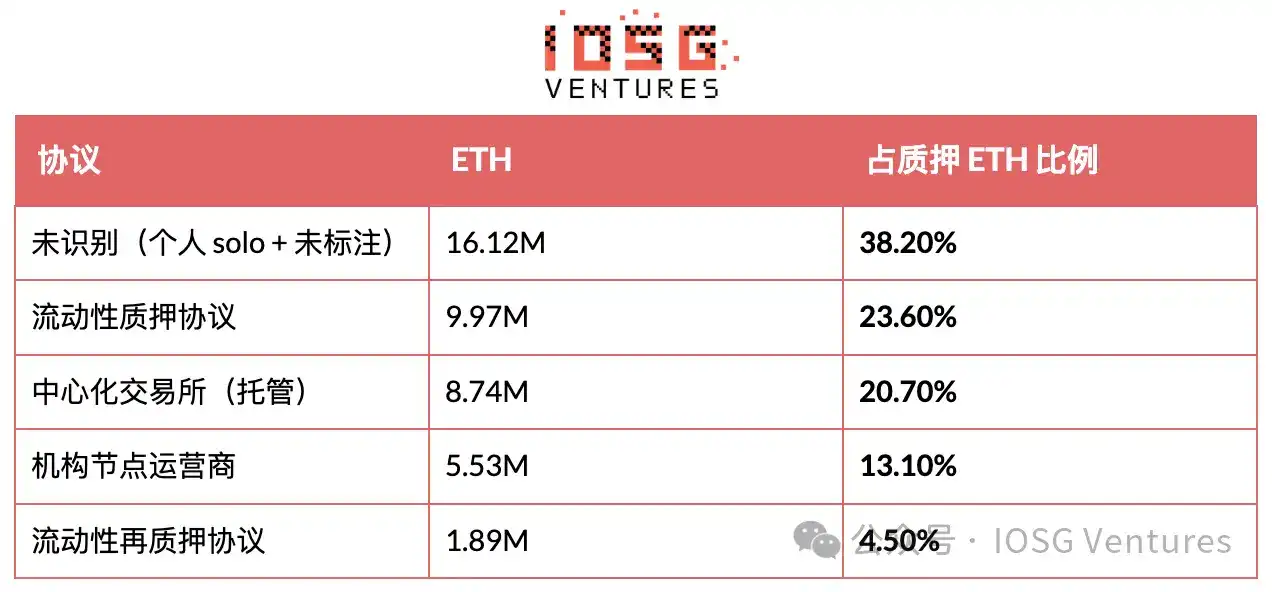
Lido alone accounts for 48% of Ethereum's total $48.5B DeFi TVL. Any claim that "DeFi will be fine" must first withstand this number.

What does the yield cut mean for them respectively?

Liquid staking: Revenue hurt. Lido handles about $602M in staking rewards annually, taking a 10% fee (~$60M/year). Cutting issuance by 58.6% means 633k less ETH in rewards issued per year; at Lido's 22.8% share, that's about $35M less fee income per year: roughly half its income from this segment. Not trivial for Lido, but insignificant at the Ethereum level. And regardless of yield changes, wstETH still beats WETH for any borrower wanting ETH exposure; its role as collateral remains intact.
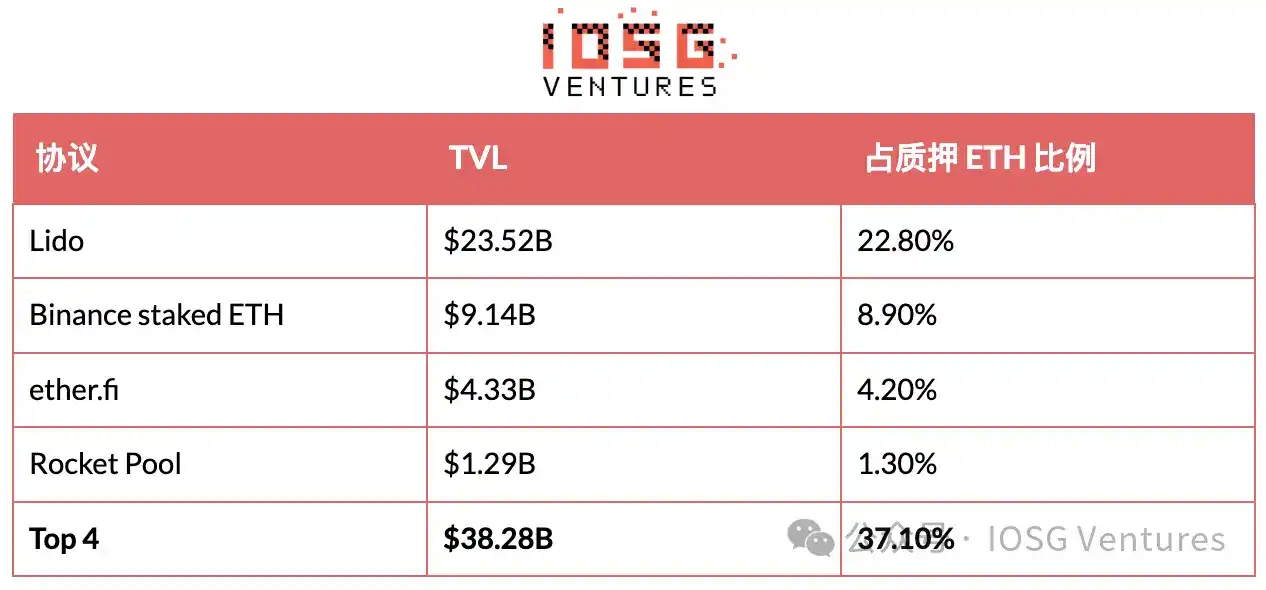
LSTs as Lending Collateral—The True Dependency
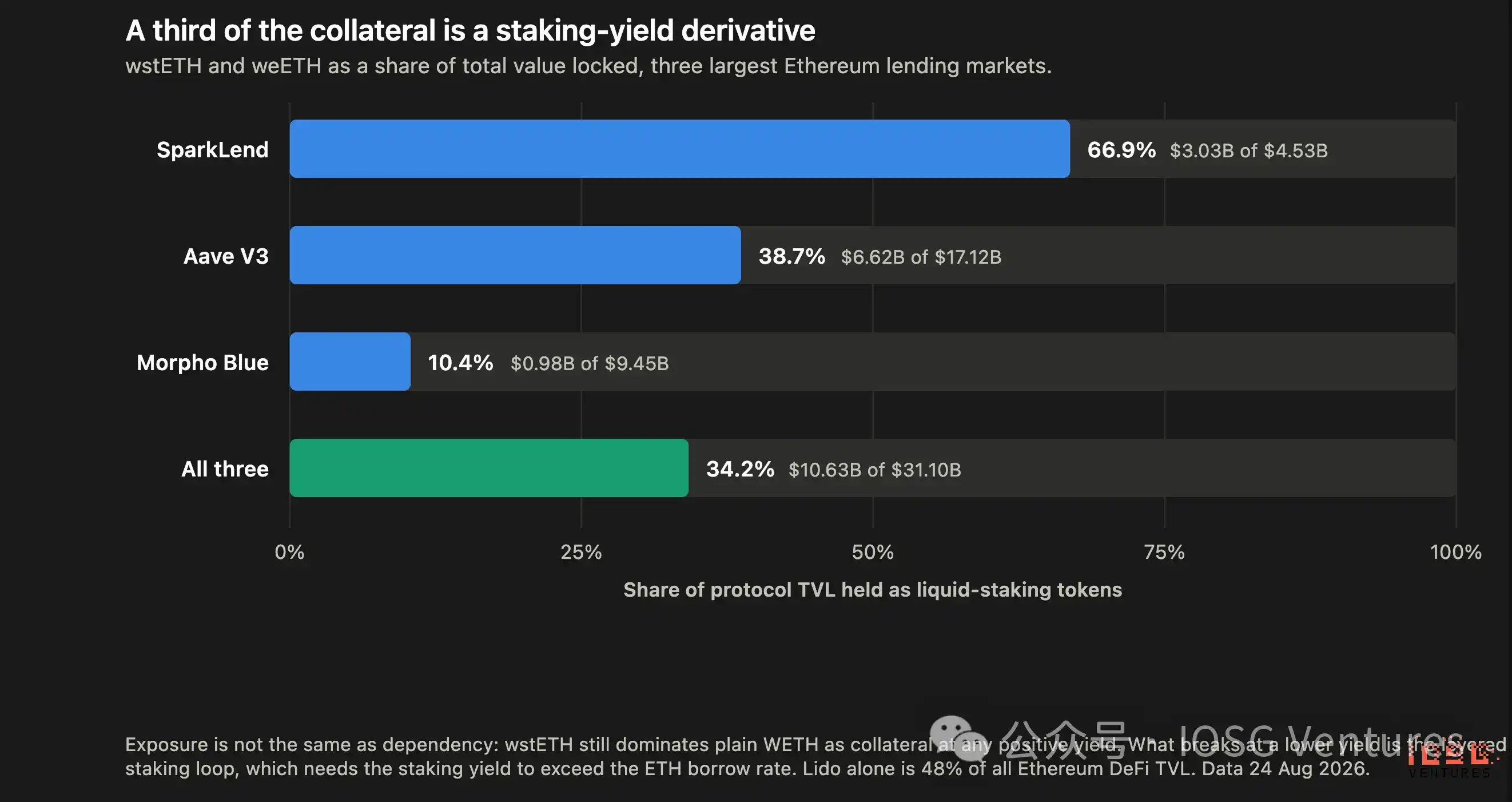
▲ Proportion of liquid staking tokens in TVL: SparkLend 66.9%, Aave V3 38.7%, Morpho Blue 10.4%, combined 34.2%.
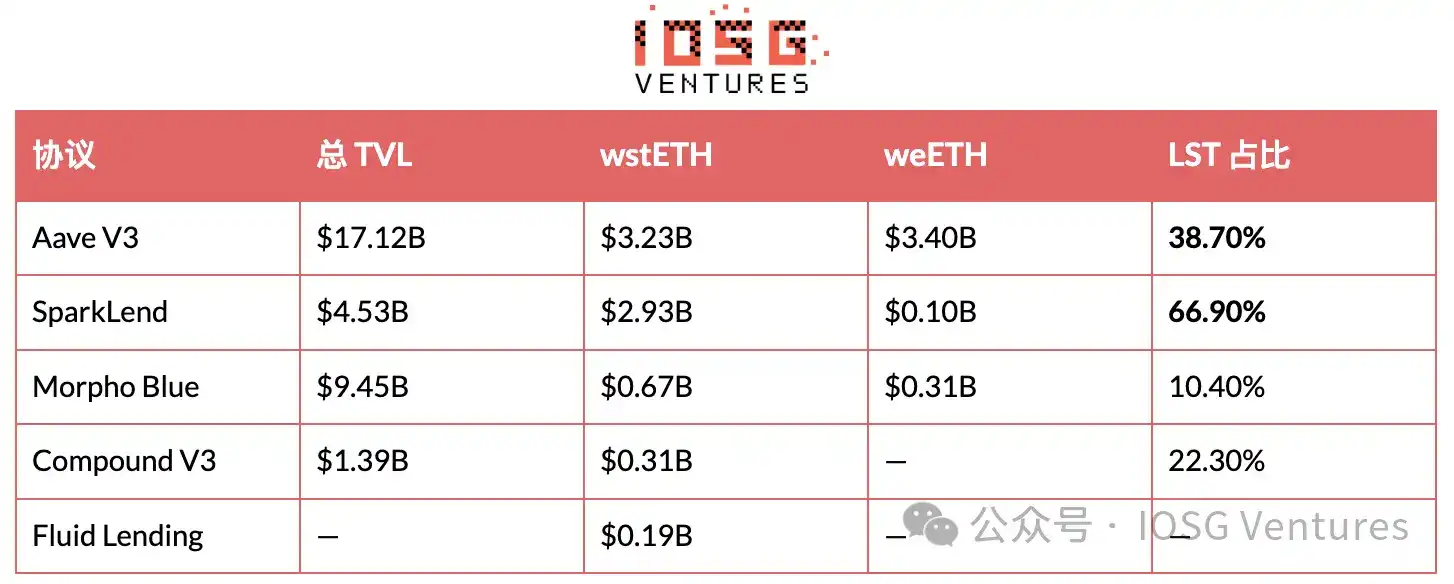
Across Ethereum's three major lending markets, $106.3B out of $311.0B in collateral (34.2%) are staking yield derivatives. SparkLend is a typical single point of failure: two-thirds of that is wstETH.

ETF channel, quantified

The most frequently cited objection: cutting yields will drain institutional buying because staking ETH ETFs market yield to allocators who can't access it directly. This channel is real. But it's also very small today.
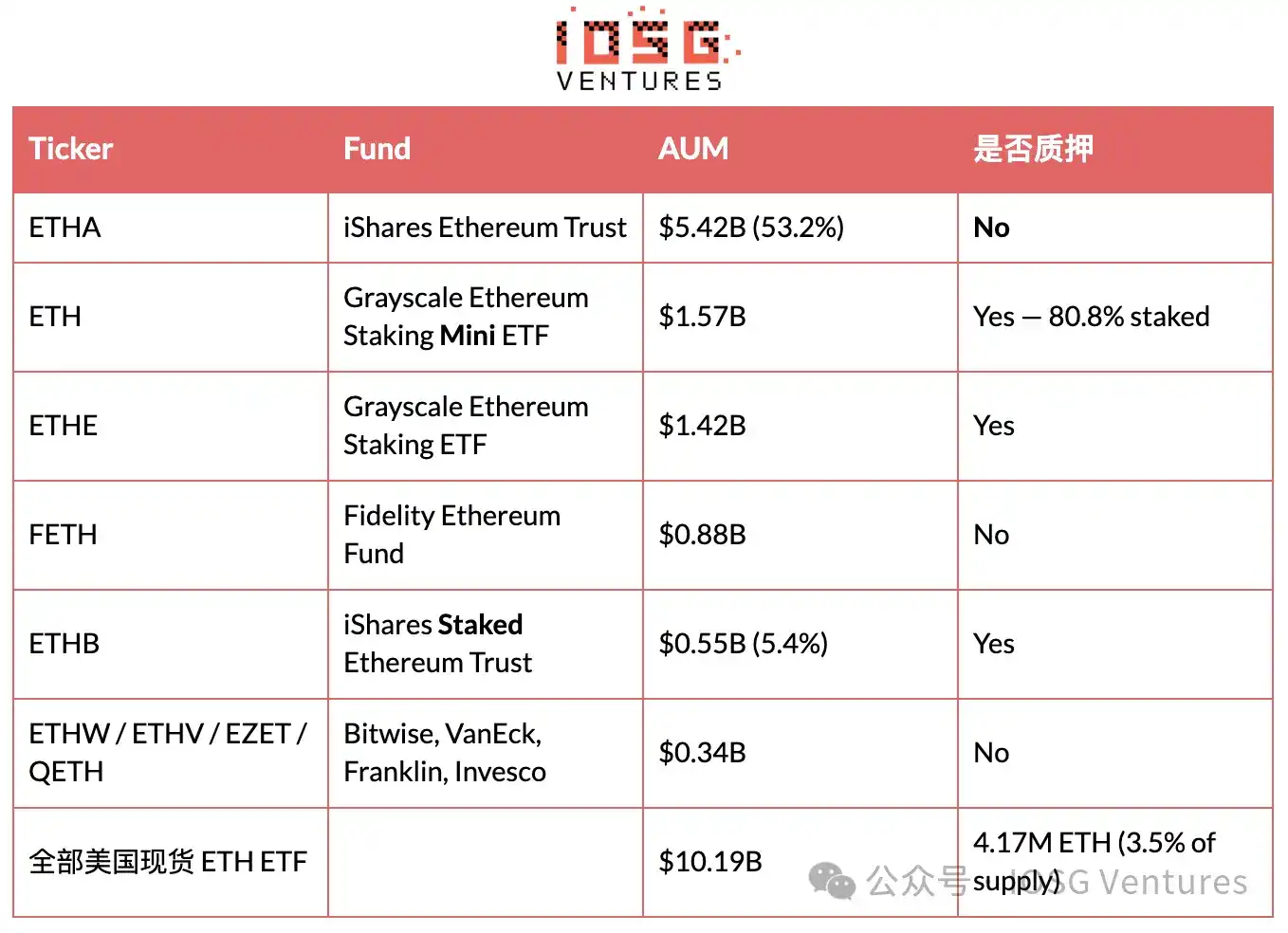
Products that explicitly market yield constitute only 5.4% of ETF assets, 0.53% of all staked ETH, and 0.19% of total ETH supply. BlackRock's non-staking ETH product is ten times its size. Whatever is driving institutional capital into ETH, staking yield is not the main attraction—allocator money overwhelmingly buys non-staking exposure.

Two points prevent this conclusion from being definitive. First, the staking ETF category is still young and growing: Bitwise and Grayscale are now creating staking ETFs for Solana, and Grayscale has one for Hyperliquid, so future risks are larger than current AUM suggests. Second, lower yields will likely slow the conversion of existing non-staking ETF assets into staking share classes, but this is a growth rate impact, not an outflow. Neither changes the order of magnitude: ultimately, this is a $0.5B group arguing over a $1.55B/year redistribution.

VII. Conclusion & Assessment: When "Security Anxiety" Meets "Wealth Redistribution"

First, look beyond the grand security narrative.

We must acknowledge that the core authors of EIP-8363 (like Justin Drake, Jerome) have extremely serious network security motivations. From a game theory perspective, once the network staking ratio crosses the 50% life-or-death line, Ethereum loses its "Social Layer Defense" capability against extreme attacks and faces systemic parasitic risks from LST oligopolies too big to fail. Therefore, the proposal attempts to use economic force—mandatory yield reduction—to lock the staking ratio within a safe zone.

But behind the security philosophy, the reality of on-chain data is even colder.

Since 2022, Ethereum's "Burn" mechanism has existed in name only: burn volume has plummeted 98% and now offsets a mere 2.4% of issuance. Regardless of your stance on the security rationale of EIP-8363, one unavoidable fact is: the old mechanism that "let ETH supply dynamically adjust with market demand" has stalled. In today's L2 economics dominated by Blobs, expecting L1 fee spikes to revive the burn mechanism is wishful thinking. Ethereum's monetary policy is now on "autopilot without a steering wheel," and adjusting issuance is the only lever we can still pull.

Setting aside emotions, the real policy impact lies between the two extreme camps.

Supporters cheer "ending ETH inflation," opponents warn "staking system collapse." Both rhetorics deviate from mathematical reality. At the current staked amount of 42.2 million ETH, the proposal only cuts issuance by ~58.6% and staking APR by ~56%. To reduce issuance completely to zero? That requires staking to surge to 60.25 million ETH (43% higher than now). More importantly, the mechanism has a built-in brake: as yields fall, some stakers exit, and the system eventually stabilizes around "26% staking ratio, 0.48% annual inflation." What it actually delivers is merely halving the dilution rate, not destroying or upending anything.

How important is this saved "half percentage point"? Numbers are more honest than words.

At current prices, cutting 633k ETH of issuance annually is equivalent to preserving $1.55 billion, about 0.53% of the total market cap. Don't dismiss this ratio—it's roughly 5 times the size of Ethereum's entire current L1 fee economy (~0.10%/year). For an asset whose fee revenue has dried up, plugging a 0.5% annual structural bleed isn't a "rounding error"—it's the biggest economic lever currently available.

So what's the cost? Will DeFi really collapse? Risks do exist.

Opponents often cite collateral, like SparkLend being two-thirds wstETH. But we need to distinguish between "exposure" and "dependence": as long as wstETH has positive yield, it will always be superior to plain WETH as collateral—that foundation is solid. What EIP-8363 would truly break is the "leveraged staking loop." When the base staking yield falls below ~1.16%, unable to cover the interest on borrowed ETH, that portion of capital engaged in leveraged arbitrage will unwind. In other words, it's the leverage bubble that would shrink, not the collateral system itself. As for direct protocol losses, Lido would lose about $35 million annually: roughly half its fee income.

The fear that "cutting yield will crash the market" already has an answer from the market.

Over 43 months of data, no significant correlation exists between changes in staking yield and ETH's price performance (p = 0.73, R2 = 0.003). Staking yield fell from 3.98% to 2.50%, yet couldn't stop ETH/BTC from plummeting 57% by July 2026. Yield was neither a price moat, nor did its compression trigger a sell-off. If the previous 37% yield slide made no splash in price, those claiming "another cut will crash Ethereum" need harder evidence.

Why is this debate so fierce?

Because it's a zero-sum game with "highly concentrated losses and extremely diffuse benefits."

Stripping away obscure jargon and grand security rhetoric, EIP-8363 is essentially a crude wealth redistribution: currently, stakers take 100% of newly issued ETH, but they only hold 35% of the network's tokens. This means they offload the inflation cost onto the other 65% of holders. Cutting this $1.55B of issuance is equivalent to forcibly returning $1B in implicit wealth annually from stakers (intermediaries) to all non-staking ETH holders.

This is the real reason everyone is up in arms:

  • The losing side is extremely concentrated: Lido, LST issuers, restaking protocols, leverage players. This is a small, well-funded, highly organized interest group. They know exactly how much real money this proposal takes from their pockets (Lido loses half its profit directly, leverage loops die outright).
  • The benefiting side is extremely diffuse: ordinary holders with 65% of the supply. They suffer 0.5% less dilution annually, but spread across a ~$300B market cap, it's imperceptible—no one will march in the streets for it.

This explains why the current debate is full of "big, empty" slogans. When an interest group can't openly say "this will take $1B in annual profit from us," they raise the shield of "this will destroy DeFi"; and when researchers want to forcibly reclaim the money-printing faucet, the most politically correct weapon is "defending network security." Interpret the volume of opposition and support as the concentration of interest distribution, not the mathematical right or wrong of the proposal itself.

Our Final Assessment

Strategy: Mildly bullish on ETH in ETH terms, explicitly bearish on staking intermediaries/infrastructure. And the proposal is highly likely to be rejected.

  • At the asset level, we are bullish not because of a "scarcity myth," but based on common sense: when the only lever to adjust supply is broken, removing a structural sell pressure of $1.55B annually (paid to those who aren't truly paying for the yield) is a high-value trade. It might not be a game-changer, but the compounding effect is not negligible.
  • For the intermediary system, the logic is airtight. The core valuation logic for Lido, LSTs, LRTs is entirely built on that "staking yield" about to be cut in half. This isn't emotional panic; it's a direct 58.6% shrinkage of the profit sheet.
  • As for the proposal's fate? The probability of passing is very low. In decentralized governance, "concentrated losses vs. diffuse benefits" is the standard script for killing a good proposal. Economically correct, but politically difficult—this is our baseline expectation.

Conditions that would trigger us to change our view (falsification indicators):

  1. On-chain data proves "issuance is reinvested, not sold": If fund flows show newly minted ETH globally stays in auto-compounding LSTs and doesn't flow to exchanges to be sold, then our sell-pressure assumption is invalid.
  2. Staking ETFs bring massive buying waves: The current $0.5B scale is negligible. But if it grows tenfold, the power of marginal demand would outweigh the significance of inflation reduction.
  3. L1 fees miraculously recover: If the burn mechanism regains dominance over fundamentals, the urgency for artificial issuance intervention vanishes.
  4. The negative correlation between supply and price is empirically confirmed: The current relationship is very weak. If data over the next year proves "reducing supply reliably pushes up price," it would become the most unassailable quantitative pillar for being bullish on ETH.


Criptos en tendencia

Preguntas relacionadas

QAccording to the article, what is the primary reason EIP-8363 is being considered, given the current state of Ethereum's monetary policy?

AThe primary reason is that the previous demand-driven mechanism for regulating ETH supply, the EIP-1559 burn, has become ineffective (burning only 2.4% of new issuance). With L2 scaling moving transaction fees away from L1, the burn mechanism is 'dead.' Therefore, adjusting the issuance rate via proposals like EIP-8363 is the only remaining lever Ethereum has to control its supply.

QWhat are two common misconceptions about EIP-8363's immediate effects that the article corrects?

A1. That issuance would be cut to zero immediately. In reality, at current staking levels (42.2M ETH staked), the proposal cuts issuance by ~58.6%, not 100%. 2. That staking rewards would instantly crash and trigger a DeFi collapse. The proposal includes an 18-month 'soft landing' phase where the base reward factor is temporarily doubled, making the initial impact on net issuance minimal, with the full reduction phased in gradually.

QWhat does the article's data analysis conclude about the relationship between staking yield and the price of ETH?

AThe data analysis finds no statistically significant relationship between changes in staking yield and ETH price returns over the 43-month period studied. The correlation between the two variables is very weak (p = 0.73, R2 = 0.003). The data suggests that past reductions in staking yield have not had a detectable impact on ETH's price performance.

QHow would EIP-8363's mechanism, once fully transitioned, lead to a self-limiting equilibrium for staking?

AThe mechanism is self-limiting because if the staking yield falls below a staker's required return, they will exit, reducing the total staked amount (S). A lower S increases the gross APR (as rewards are spread over fewer ETH) and also reduces the burn ratio (b). This dynamic creates a natural equilibrium point where the net yield stabilizes at a level that marginal stakers are willing to accept, preventing staking from collapsing to zero or skyrocketing to 50%.

QThe article describes the debate over EIP-8363 as a 'zero-sum game.' According to the author, who are the concentrated losers and the dispersed winners in this wealth redistribution?

AThe concentrated losers are staking intermediaries and leveraged players: entities like Lido, LST/LRT issuers, and users engaged in leverage staking loops. They directly lose a significant portion of their profits (e.g., Lido loses ~half its fee income). The dispersed winners are the 65% of ETH holders who do not stake. They benefit from a reduced annual dilution of ~0.5% (worth ~$1.55B), but this gain is spread thinly across a large, unorganized group.

Lecturas Relacionadas

Currency & Stock Barometer | Strategy Sells MSTR Stocks for $2.007 Billion; BitMine Increases ETH Holdings by 32,447 Last Week, Asset Scale Reaches $14.9 Billion (August 25)

**Crypto & Stock Market Snapshot: Strategy Sells MSTR Stock for $2.007B; BitMine Adds 32,447 ETH (Aug 25)** Following a bullish crypto market triggered by positive US regulatory signals and political commentary, major crypto-related stocks saw significant rebounds. Data reveals a 1,431.6% weekly increase in net Bitcoin purchases by public companies (excluding miners), reaching $81.48M. Two key developments stood out: **Strategy** sold over 18.2 million shares of MSTR, raising $2.007 billion in cash, though its Bitcoin holdings of 840,447 BTC returned to a profit of ~$2.53B. Concurrently, **BitMine**, an Ethereum-focused firm, added 32,447 ETH last week, bringing its total holdings to ~5.847 million ETH (4.8% of supply) and its total assets under management to ~$14.9B. Chairman Tom Lee expressed strong confidence in Ethereum's future as a leading platform for tokenization and AI. Other notable updates include: **Solmate Infrastructure** increasing its SOL holdings; **AIxCrypto Holdings** planning an exit from crypto assets to pivot to robot leasing; and **Eightco Holdings** maintaining a large WLD treasury while repurchasing shares. Meanwhile, in traditional markets, hedge funds recorded their largest weekly net selling of US stocks since April 2025, particularly in tech and industrial sectors, amid a cooling AI investment narrative and concerns over market concentration risks reminiscent of the dot-com bubble.

marsbitHace 17 min(s)

Currency & Stock Barometer | Strategy Sells MSTR Stocks for $2.007 Billion; BitMine Increases ETH Holdings by 32,447 Last Week, Asset Scale Reaches $14.9 Billion (August 25)

marsbitHace 17 min(s)

Goldman Sachs Bullish on Crypto Brokerage Trading Platforms: Can Prediction Markets Fuel a New Cycle?

Goldman Sachs remains cautiously optimistic about the prospects for crypto and brokerage platforms, forecasting potential for a new cycle driven by structural growth in traditional brokerage and prediction markets, rather than a broad crypto trading recovery alone. While retail stock trading cooled seasonally in July and August, Goldman notes that absolute volumes remain high, and adjusted for account growth, per-account activity is still below the 2021 peak, suggesting room for further expansion. Seasonal recovery and record equity issuance are expected to boost traditional brokerage commissions and trading volumes starting in September. Prediction markets show significant potential for autumn growth, with trading volume up approximately 1160% annually since 2024. Driven by sports, crypto, and political contracts, this segment could see a more pronounced rebound as major US sports seasons resume and election activity increases. The crypto market presents a more cautious picture. Trading volume has declined for about 10 months, exceeding historical median downturns. Although total market cap recently rose ~21%, a sustained price level is needed to drive a meaningful recovery in trading activity. Regulatory progress continues through agency actions, but comprehensive legislation is still seen as key for large-scale institutional adoption. To navigate the crypto trading slump, platforms are diversifying revenues and controlling costs. Goldman's top picks are FIGR (leveraging HELOC growth), HOOD (driven by account growth and business diversification including prediction markets), and IBKR (benefiting from global expansion). COIN is viewed as a play on direct crypto market recovery, given its exposure but also its growing subscription and service revenues. The report's thesis hinges on validating an autumn trading rebound and the sustainability of new revenue streams like prediction markets, rather than assuming a crypto bull market has already resumed.

marsbitHace 22 min(s)

Goldman Sachs Bullish on Crypto Brokerage Trading Platforms: Can Prediction Markets Fuel a New Cycle?

marsbitHace 22 min(s)

Trading

Spot

Artículos destacados

Qué es ETH 2.0

ETH 2.0: Una Nueva Era para Ethereum Introducción ETH 2.0, conocido ampliamente como Ethereum 2.0, marca una actualización monumental para la blockchain de Ethereum. Esta transición no es solo una mejora superficial; busca mejorar fundamentalmente la escalabilidad, seguridad y sostenibilidad de la red. Con un cambio del mecanismo de consenso intensivo en energía Prueba de Trabajo (PoW) a una Prueba de Participación (PoS) más eficiente, ETH 2.0 promete un enfoque transformador para el ecosistema blockchain. ¿Qué es ETH 2.0? ETH 2.0 es un conjunto de actualizaciones interconectadas y distintivas centradas en optimizar las capacidades y el rendimiento de Ethereum. La reestructuración está diseñada para abordar desafíos críticos que el mecanismo actual de Ethereum ha enfrentado, particularmente en lo que respecta a la velocidad de transacción y la congestión de la red. Objetivos de ETH 2.0 Los objetivos principales de ETH 2.0 giran en torno a mejorar tres aspectos clave: Escalabilidad: Con el objetivo de aumentar significativamente el número de transacciones que la red puede manejar por segundo, ETH 2.0 busca superar la limitación actual de aproximadamente 15 transacciones por segundo, potencialmente alcanzando miles. Seguridad: Las medidas de seguridad mejoradas son fundamentales para ETH 2.0, particularmente a través de una mejor resistencia contra ciberataques y la preservación del ethos descentralizado de Ethereum. Sostenibilidad: El nuevo mecanismo PoS está diseñado no solo para mejorar la eficiencia, sino también para reducir drásticamente el consumo de energía, alineando el marco operativo de Ethereum con consideraciones ambientales. ¿Quién es el Creador de ETH 2.0? La creación de ETH 2.0 se puede atribuir a la Fundación Ethereum. Esta organización sin fines de lucro, que desempeña un papel crucial en el apoyo al desarrollo de Ethereum, es liderada por el notable cofundador Vitalik Buterin. Su visión de un Ethereum más escalable y sostenible ha sido la fuerza motriz detrás de esta actualización, involucrando contribuciones de una comunidad global de desarrolladores y entusiastas dedicados a mejorar el protocolo. ¿Quiénes son los Inversores de ETH 2.0? Si bien los detalles sobre los inversores de ETH 2.0 no se han hecho públicos, se sabe que la Fundación Ethereum recibe apoyo de varias organizaciones e individuos en el ámbito de blockchain y tecnología. Estos socios incluyen firmas de capital de riesgo, compañías tecnológicas y organizaciones filantrópicas que comparten un interés mutuo en apoyar el desarrollo de tecnologías descentralizadas e infraestructura blockchain. ¿Cómo Funciona ETH 2.0? ETH 2.0 se distingue por introducir una serie de características clave que lo diferencian de su predecesor. Prueba de Participación (PoS) La transición a un mecanismo de consenso PoS es uno de los cambios más destacados de ETH 2.0. A diferencia de PoW, que se basa en la minería intensiva en energía para la verificación de transacciones, PoS permite a los usuarios validar transacciones y crear nuevos bloques de acuerdo con la cantidad de ETH que apuestan en la red. Esto conduce a una mayor eficiencia energética, reduciendo el consumo en aproximadamente un 99.95%, convirtiendo a Ethereum 2.0 en una alternativa considerablemente más verde. Cadenas Shard Las cadenas shard son otra innovación crítica de ETH 2.0. Estas cadenas más pequeñas operan en paralelo con la cadena principal de Ethereum, lo que permite que múltiples transacciones sean procesadas simultáneamente. Este enfoque mejora la capacidad general de la red, abordando las preocupaciones de escalabilidad que han afectado a Ethereum. Cadena Beacon En el núcleo de ETH 2.0 se encuentra la Cadena Beacon, que coordina la red y gestiona el protocolo PoS. Funciona como un organizador de cierta manera: supervisa a los validadores, asegura que los shards permanezcan conectados a la red y monitorea la salud general del ecosistema blockchain. Cronología de ETH 2.0 El viaje de ETH 2.0 ha estado marcado por varios hitos clave que trazan la evolución de esta importante actualización: Diciembre 2020: El lanzamiento de la Cadena Beacon marcó la introducción de PoS, preparándose para la migración hacia ETH 2.0. Septiembre 2022: La finalización de “La Fusión” representa un momento crucial en el que la red Ethereum se trasladó exitosamente de un marco PoW a uno PoS, anunciando una nueva era para Ethereum. 2023: El lanzamiento esperado de cadenas shard tiene como objetivo mejorar aún más la escalabilidad de la red Ethereum, consolidando a ETH 2.0 como una plataforma robusta para aplicaciones y servicios descentralizados. Características Clave y Beneficios Escalabilidad Mejorada Una de las ventajas más significativas de ETH 2.0 es su escalabilidad mejorada. La combinación de PoS y cadenas shard permite que la red expanda su capacidad, permitiendo acomodar un volumen mucho mayor de transacciones en comparación con el sistema heredado. Eficiencia Energética La implementación de PoS representa un gran paso hacia la eficiencia energética en la tecnología blockchain. Al reducir drásticamente el consumo de energía, ETH 2.0 no solo disminuye los costos operativos, sino que también se alinea más estrechamente con los objetivos de sostenibilidad global. Seguridad Mejorada Los mecanismos actualizados de ETH 2.0 contribuyen a mejorar la seguridad en toda la red. El despliegue de PoS, junto con las medidas de control innovadoras establecidas a través de cadenas shard y la Cadena Beacon, asegura un mayor grado de protección contra posibles amenazas. Costos Más Bajos para los Usuarios A medida que la escalabilidad mejora, los efectos sobre los costos de transacción también serán evidentes. Se espera que una mayor capacidad y una menor congestión se traduzcan en tarifas más bajas para los usuarios, haciendo que Ethereum sea más accesible para transacciones cotidianas. Conclusión ETH 2.0 marca una evolución significativa en el ecosistema blockchain de Ethereum. A medida que aborda problemas fundamentales como la escalabilidad, el consumo de energía, la eficiencia en las transacciones y la seguridad general, la importancia de esta actualización no puede ser subestimada. La transición a la Prueba de Participación, la introducción de cadenas shard y el trabajo fundamental de la Cadena Beacon son indicativos de un futuro donde Ethereum puede satisfacer las crecientes demandas del mercado descentralizado. En una industria impulsada por la innovación y el progreso, ETH 2.0 se erige como un testimonio de las capacidades de la tecnología blockchain para allanar el camino hacia una economía digital más sostenible y eficiente.

361 Vistas totalesPublicado en 2024.04.04Actualizado en 2024.12.03

Qué es ETH 2.0

Qué es ETH 3.0

ETH3.0 y $eth 3.0: Un Examen Profundo del Futuro de Ethereum Introducción En el paisaje en rápida evolución de las criptomonedas y la tecnología blockchain, ETH3.0, a menudo denotado como $eth 3.0, ha surgido como un tema de considerable interés y especulación. El término abarca dos conceptos principales que merecen aclaración: Ethereum 3.0: Esto representa una posible actualización futura destinada a aumentar las capacidades de la blockchain existente de Ethereum, enfocándose particularmente en mejorar la escalabilidad y el rendimiento. ETH3.0 Meme Token: Este proyecto de criptomoneda distinto busca aprovechar la blockchain de Ethereum para crear un ecosistema centrado en memes, promoviendo la participación dentro de la comunidad de criptomonedas. Comprender estos aspectos de ETH3.0 es esencial no solo para los entusiastas de las criptomonedas, sino también para aquellos que observan tendencias tecnológicas más amplias en el espacio digital. ¿Qué es ETH3.0? Ethereum 3.0 Ethereum 3.0 se presenta como una actualización propuesta para la red de Ethereum ya establecida, que ha sido la columna vertebral de muchas aplicaciones descentralizadas (dApps) y contratos inteligentes desde su inicio. Las mejoras previstas se concentran principalmente en la escalabilidad, integrando tecnologías avanzadas como sharding y pruebas de conocimiento cero (zk-proofs). Estas innovaciones tecnológicas tienen como objetivo facilitar un número sin precedentes de transacciones por segundo (TPS), potencialmente alcanzando millones, abordando así una de las limitaciones más significativas que enfrenta la tecnología blockchain actual. La mejora no es meramente técnica, sino también estratégica; está destinada a preparar la red de Ethereum para su adopción generalizada y utilidad en un futuro marcado por una mayor demanda de soluciones descentralizadas. ETH3.0 Meme Token En contraste con Ethereum 3.0, el ETH3.0 Meme Token se aventura en un ámbito más ligero y juguetón al combinar la cultura de memes de internet con la dinámica de las criptomonedas. Este proyecto permite a los usuarios comprar, vender e intercambiar memes en la blockchain de Ethereum, proporcionando una plataforma que fomenta la participación comunitaria a través de la creatividad y los intereses compartidos. El ETH3.0 Meme Token tiene como objetivo demostrar cómo la tecnología blockchain puede intersectarse con la cultura digital, creando casos de uso que son tanto entretenidos como financieramente viables. ¿Quién es el Creador de ETH3.0? Ethereum 3.0 La iniciativa hacia Ethereum 3.0 es impulsada principalmente por un consorcio de desarrolladores e investigadores dentro de la comunidad de Ethereum, incluyendo notablemente a Justin Drake. Conocido por sus ideas y contribuciones a la evolución de Ethereum, Drake ha sido una figura prominente en las discusiones sobre la transición de Ethereum a una nueva capa de consenso, denominada “Beam Chain.” Este enfoque colaborativo para el desarrollo significa que Ethereum 3.0 no es el producto de un creador singular, sino más bien una manifestación de ingenio colectivo centrado en avanzar la tecnología blockchain. ETH3.0 Meme Token Los detalles sobre el creador del ETH3.0 Meme Token son actualmente inidentificables. La naturaleza de los tokens de memes a menudo conduce a una estructura más descentralizada y dirigida por la comunidad, lo que podría explicar la falta de atribución específica. Esto se alinea con la ética de la comunidad cripto más amplia, donde la innovación a menudo surge de esfuerzos colaborativos en lugar de individuales. ¿Quiénes son los Inversores de ETH3.0? Ethereum 3.0 El apoyo a Ethereum 3.0 proviene principalmente de la Fundación Ethereum junto con una entusiasta comunidad de desarrolladores e inversores. Esta asociación fundamental proporciona un grado significativo de legitimidad y mejora la perspectiva de una implementación exitosa, ya que aprovecha la confianza y credibilidad construidas a lo largo de años de operaciones en la red. En el clima cambiando rápidamente de las criptomonedas, el apoyo de la comunidad juega un papel crucial en impulsar el desarrollo y la adopción, posicionando a Ethereum 3.0 como un contendiente serio para futuros avances en blockchain. ETH3.0 Meme Token Si bien las fuentes actualmente disponibles no proporcionan información explícita sobre las fundaciones o organizaciones de inversión que respaldan el ETH3.0 Meme Token, es indicativo del modelo de financiamiento típico para tokens de memes, que a menudo depende del apoyo de base y la participación comunitaria. Los inversores en tales proyectos suelen consistir en individuos motivados por el potencial de innovación impulsada por la comunidad y el espíritu de cooperación que se encuentra dentro de la comunidad cripto. ¿Cómo Funciona ETH3.0? Ethereum 3.0 Las características distintivas de Ethereum 3.0 radican en su implementación propuesta de sharding y tecnología zk-proof. Sharding es un método de particionamiento de la blockchain en piezas más pequeñas y manejables o “shards,” que pueden procesar transacciones de manera concurrente en lugar de secuencial. Esta descentralización del procesamiento ayuda a prevenir la congestión y asegura que la red permanezca receptiva incluso bajo una carga pesada. La tecnología de prueba de conocimiento cero (zk-proof) contribuye con otra capa de sofisticación al permitir la validación de transacciones sin revelar los datos subyacentes involucrados. Este aspecto no solo mejora la privacidad, sino que también aumenta la eficiencia general de la red. También se habla de incorporar una Máquina Virtual de Ethereum de conocimiento cero (zkEVM) en esta actualización, amplificando aún más las capacidades y utilidad de la red. ETH3.0 Meme Token El ETH3.0 Meme Token se distingue al capitalizar la popularidad de la cultura de memes. Establece un mercado para que los usuarios participen en el comercio de memes, no solo por entretenimiento sino también por el posible beneficio económico. Al integrar características como staking, provisión de liquidez y mecanismos de gobernanza, el proyecto fomenta un entorno que incentiva la interacción y participación de la comunidad. Al ofrecer una mezcla única de entretenimiento y oportunidad económica, el ETH3.0 Meme Token tiene como objetivo atraer a una audiencia diversa, que abarca desde entusiastas de las criptomonedas hasta conocedores casuales de memes. Línea de Tiempo de ETH3.0 Ethereum 3.0 11 de noviembre de 2024: Justin Drake insinúa la próxima actualización de ETH 3.0, centrada en mejoras de escalabilidad. Este anuncio significa el comienzo de las discusiones formales sobre la futura arquitectura de Ethereum. 12 de noviembre de 2024: Se espera que la propuesta anticipada para Ethereum 3.0 se desvele en Devcon en Bangkok, preparando el escenario para una mayor retroalimentación de la comunidad y posibles próximos pasos en el desarrollo. ETH3.0 Meme Token 21 de marzo de 2024: El ETH3.0 Meme Token se lista oficialmente en CoinMarketCap, marcando su incursión en el dominio público de las criptomonedas y mejorando la visibilidad de su ecosistema basado en memes. Puntos Clave En conclusión, Ethereum 3.0 representa una evolución significativa dentro de la red de Ethereum, enfocándose en superar las limitaciones en términos de escalabilidad y rendimiento a través de tecnologías avanzadas. Sus actualizaciones propuestas reflejan un enfoque proactivo hacia las demandas y la usabilidad futura. Por otro lado, el ETH3.0 Meme Token encapsula la esencia de la cultura impulsada por la comunidad en el espacio de las criptomonedas, aprovechando la cultura de memes para crear plataformas atractivas que fomentan la creatividad y participación del usuario. Comprender los distintos propósitos y funcionalidades de ETH3.0 y $eth 3.0 es fundamental para cualquiera interesado en los desarrollos en curso dentro del espacio cripto. Con ambas iniciativas abriendo caminos únicos, subrayan colectivamente la naturaleza dinámica y multifacética de la innovación en blockchain.

373 Vistas totalesPublicado en 2024.04.04Actualizado en 2024.12.03

Qué es ETH 3.0

Cómo comprar ETH

¡Bienvenido a HTX.com! Hemos hecho que comprar Ethereum (ETH) sea simple y conveniente. Sigue nuestra guía paso a paso para iniciar tu viaje de criptos.Paso 1: crea tu cuenta HTXUtiliza tu correo electrónico o número de teléfono para registrarte y obtener una cuenta gratuita en HTX. Experimenta un proceso de registro sin complicaciones y desbloquea todas las funciones.Obtener mi cuentaPaso 2: ve a Comprar cripto y elige tu método de pagoTarjeta de crédito/débito: usa tu Visa o Mastercard para comprar Ethereum (ETH) al instante.Saldo: utiliza fondos del saldo de tu cuenta HTX para tradear sin problemas.Terceros: hemos agregado métodos de pago populares como Google Pay y Apple Pay para mejorar la comodidad.P2P: tradear directamente con otros usuarios en HTX.Over-the-Counter (OTC): ofrecemos servicios personalizados y tipos de cambio competitivos para los traders.Paso 3: guarda tu Ethereum (ETH)Después de comprar tu Ethereum (ETH), guárdalo en tu cuenta HTX. Alternativamente, puedes enviarlo a otro lugar mediante transferencia blockchain o utilizarlo para tradear otras criptomonedas.Paso 4: tradear Ethereum (ETH)Tradear fácilmente con Ethereum (ETH) en HTX's mercado spot. Simplemente accede a tu cuenta, selecciona tu par de trading, ejecuta tus trades y monitorea en tiempo real. Ofrecemos una experiencia fácil de usar tanto para principiantes como para traders experimentados.

4.7k Vistas totalesPublicado en 2024.12.10Actualizado en 2026.06.02

Cómo comprar ETH

Discusiones

Bienvenido a la comunidad de HTX. Aquí puedes mantenerte informado sobre los últimos desarrollos de la plataforma y acceder a análisis profesionales del mercado. A continuación se presentan las opiniones de los usuarios sobre el precio de ETH (ETH).

活动图片