Investors Pull $414M From Crypto Funds As Inflation, MidEast War Jitters Mount

bitcoinistPublicado a 2026-03-31Actualizado a 2026-03-31

Resumen

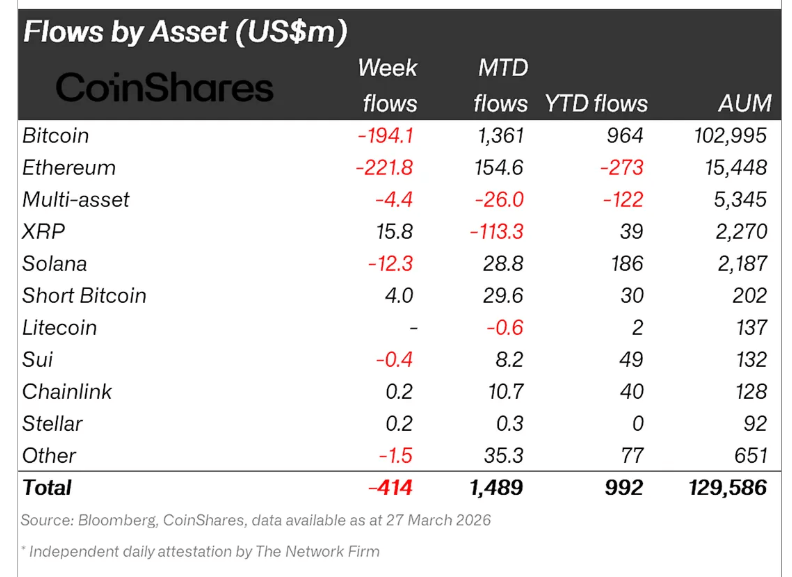
Investors withdrew $414 million from crypto funds last week, ending a five-week inflow streak. Spot Bitcoin ETFs saw $296 million in outflows, reversing earlier gains. Ether suffered the largest outflows at $222 million, pushing its year-to-date performance negative. Bitcoin remained positive for the year despite $194 million in outflows. XRP was an exception, attracting $16 million. The sell-off was driven by inflation concerns, shifting expectations for U.S. interest rate hikes, and rising Middle East tensions, causing a broad shift away from riskier assets. Total assets under management fell to near $130 billion, levels last seen in early February.

Spot Bitcoin ETFs snapped a four-week run of gains last week, posting $296 million in net outflows after pulling in more than $2.2 billion earlier in the month. The crypto reversal was swift — and it wasn’t limited to Bitcoin.

Ether Takes The Hardest Hit

Ether led all assets in outflows, shedding $222 million in a single week. That brought its year-to-date total into the red, with a net loss of $273 million — the worst performance among tracked assets.

Spot Ether ETFs also recorded $206 million in outflows for a second straight week, a sign that institutional demand for the second-largest cryptocurrency has been cooling steadily.

Bitcoin fared better in the long run. Despite $194 million leaving Bitcoin funds last week, the asset remains up $964 million in net inflows for the year.

A small group of investors even moved in the opposite direction — short-Bitcoin products drew $4 million in fresh capital, suggesting some are betting on more losses ahead.

Across the board, total assets under management in digital asset products dropped to close to $130 billion.
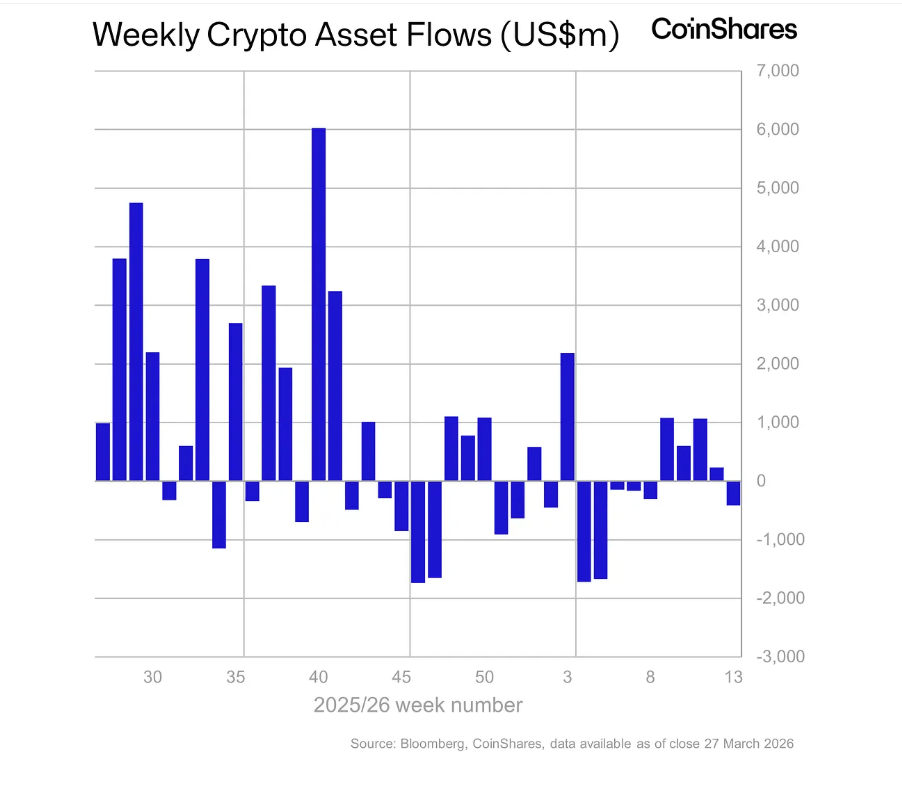
According to CoinShares head of research James Butterfill, that figure puts the market back at levels not seen since early February — broadly in line with where things stood in April 2025 during the first wave of US President Donald Trump’s tariffs.

Solana lost a little over $12 million over the same period. XRP was the exception. Reports from CoinShares show the token attracted close to $16 million in new capital, standing apart from the widespread exodus hitting nearly every other major asset.
What Spooked Investors

Three things rattled markets last week: inflation fears, shifting expectations around US interest rates, and rising tensions in the Middle East.

The most consequential of the three may be the rate outlook. Expectations heading into the June Federal Open Market Committee meeting moved away from potential cuts and toward possible hikes — a major shift that historically pushes investors away from riskier assets.

BTCUSD now trading at $67,744. Chart: TradingView

Digital assets tend to feel that pressure quickly. When borrowing costs look like they’re going up, money moves toward safer ground.

A Five-Week Streak Comes To An End

The $414 million in total outflows snapped what had been five consecutive weeks of inflows. Data from CoinShares shows the pullback reflected a broader shift toward risk-off behavior among investors, driven more by macroeconomic forces than anything specific to crypto markets.

Whether last week marks a turning point or a brief pause will likely depend on what signals come out of the Fed in the weeks ahead. For now, the money has moved — at least temporarily — to the sidelines.

Featured image from Getty Images, chart from TradingView

Criptos en tendencia

Preguntas relacionadas

QWhat was the total amount of net outflows from crypto funds last week, ending a five-week streak?

AThe total net outflows from crypto funds last week were $414 million, which ended a five-week streak of inflows.

QWhich cryptocurrency asset suffered the largest outflows and what was the amount?

AEther (ETH) suffered the largest outflows, shedding $222 million in a single week.

QAccording to the article, what were the three main factors that spooked investors and rattled the markets?

AThe three main factors were inflation fears, shifting expectations around US interest rates, and rising tensions in the Middle East.

QWhat was the notable exception to the widespread outflows, and how much capital did it attract?

AXRP was the notable exception; it attracted close to $16 million in new capital.

QWhat does the shift in expectations for the June Federal Open Market Committee meeting indicate, and how does it typically affect investor behavior?

AExpectations shifted away from potential interest rate cuts and toward possible hikes. This shift historically pushes investors away from riskier assets, as higher borrowing costs make safer investments more attractive.

Lecturas Relacionadas

CPU Makes a Comeback to the Table, A $170 Billion "Power Seizure" Drama Begins

A new era is dawning for the server CPU (Central Processing Unit), driven by the shift from AI model training to large-scale reasoning and the rise of Agentic AI. This article explores how the CPU is reclaiming a central role in the AI data center. For years, the focus has been on the GPU (Graphics Processing Unit) for AI training. However, as AI moves to the inference and Agent phase—where tasks involve complex, multi-step reasoning, tool calls, and data management—the workload balance is flipping. Studies show CPUs now handle over 70% of the workload in Agentic AI, up from 10-30% in training. This is because Agent tasks generate massive intermediate data (KV Cache) that exceeds GPU memory, forcing it to be offloaded to the CPU's larger, more scalable memory pools. This increased importance is translating into market changes. Major players are taking note: NVIDIA launched its first standalone CPU line, Vera, based on ARM architecture and optimized for Agent performance. AMD doubled its server CPU market forecast to over $1200 billion by 2030. Analyst reports project the total server CPU market could reach $1700 billion by 2030, with AI-driven demand being a primary driver. Furthermore, the classic ratio of CPUs to GPUs in AI servers is rapidly changing, converging from 1:8 toward 1:1 for Agent deployments. This surge in demand has led to a rare industry-wide price increase of 10-15% for server CPUs from Intel and AMD, breaking a decade-long trend of "more performance for the same price." Demand is bifurcating into high-core-count CPUs for in-rack GPU support and moderate-core CPUs for standalone Agent task orchestration. In China, this global trend presents an opportunity for domestic CPU manufacturers like Hygon (海光信息) and Huawei Kunpeng, who are bolstered by both growing AI infrastructure needs and national policies promoting technological self-reliance ("xin chuang"). The maturity of their software ecosystems is also accelerating, evidenced by faster adaptation to new AI models. In conclusion, the narrative is shifting from a GPU-centric view to one where CPU-GPU synergy is critical. The CPU is no longer a peripheral component but a performance-defining bottleneck and a key growth driver in the AI hardware stack, opening a massive new market estimated in the hundreds of billions of dollars.

marsbitHace 5 hora(s)

CPU Makes a Comeback to the Table, A $170 Billion "Power Seizure" Drama Begins

marsbitHace 5 hora(s)

TechFlow Intelligence: AMD AI Director Publicly Criticizes Claude Code for "Becoming Dumber and Lazier", Trump Claims Full Ceasefire in Hormuz But Strait Still Has 80 Unexploded Mines

TechFlow Intelligence Report: This daily digest covers key developments in AI, crypto, hardware, and geopolitics. In AI, SK Telecom faces US export control scrutiny over its partnership with Anthropic, while a Gemini user reports being misled in a scam scenario, sparking safety debates. China's Z.AI launches the GLM-5.2 model, rivaling Claude Opus without NVIDIA chips. In crypto, Bithumb lists ReProtocol, and Upbit delists KernelDAO. On the hardware front, MIT researchers build a custom OS to study chips, ASML denies US claims its advanced lithography machines are in China, and Amazon considers selling its in-house AI chips. Apple's future A21 Pro chip may use TSMC's latest N2P process. Major tech issues include 10,000 GitHub repositories distributing malware and Apple patching a critical eavesdropping flaw in Beats earbuds. US stocks rise, led by semiconductors, with Intel surging 10.6%, while SpaceX falls 3.5%. Geopolitically, despite a US-Iran deal, the Strait of Hormuz remains risky with ~80 uncleared mines, stalling 80M barrels of oil on standby tankers. Iran postpones Switzerland talks, and Trump calls the agreement an "unconditional surrender." The report highlights a contrast: temporary geopolitical calm versus the ongoing, fundamental restructuring of tech supply chains and chip independence.

marsbitHace 5 hora(s)

TechFlow Intelligence: AMD AI Director Publicly Criticizes Claude Code for "Becoming Dumber and Lazier", Trump Claims Full Ceasefire in Hormuz But Strait Still Has 80 Unexploded Mines

marsbitHace 5 hora(s)

Trading

Spot
Futuros

Artículos destacados

Cómo comprar WAR

¡Bienvenido a HTX.com! Hemos hecho que comprar WAR (WAR) sea simple y conveniente. Sigue nuestra guía paso a paso para iniciar tu viaje de criptos.Paso 1: crea tu cuenta HTXUtiliza tu correo electrónico o número de teléfono para registrarte y obtener una cuenta gratuita en HTX. Experimenta un proceso de registro sin complicaciones y desbloquea todas las funciones.Obtener mi cuentaPaso 2: ve a Comprar cripto y elige tu método de pagoTarjeta de crédito/débito: usa tu Visa o Mastercard para comprar WAR (WAR) al instante.Saldo: utiliza fondos del saldo de tu cuenta HTX para tradear sin problemas.Terceros: hemos agregado métodos de pago populares como Google Pay y Apple Pay para mejorar la comodidad.P2P: tradear directamente con otros usuarios en HTX.Over-the-Counter (OTC): ofrecemos servicios personalizados y tipos de cambio competitivos para los traders.Paso 3: guarda tu WAR (WAR)Después de comprar tu WAR (WAR), guárdalo en tu cuenta HTX. Alternativamente, puedes enviarlo a otro lugar mediante transferencia blockchain o utilizarlo para tradear otras criptomonedas.Paso 4: tradear WAR (WAR)Tradear fácilmente con WAR (WAR) en HTX's mercado spot. Simplemente accede a tu cuenta, selecciona tu par de trading, ejecuta tus trades y monitorea en tiempo real. Ofrecemos una experiencia fácil de usar tanto para principiantes como para traders experimentados.

192 Vistas totalesPublicado en 2024.12.11Actualizado en 2026.06.02

Cómo comprar WAR

Discusiones

Bienvenido a la comunidad de HTX. Aquí puedes mantenerte informado sobre los últimos desarrollos de la plataforma y acceder a análisis profesionales del mercado. A continuación se presentan las opiniones de los usuarios sobre el precio de WAR (WAR).

活动图片