Intraday Quantitative Sentiment Fluctuation Analysis Report — December 26, 2025

marsbitPublicado a 2025-12-26Actualizado a 2025-12-26

Resumen

BTC Market Sentiment Analysis Report — 2025.12.26 Over the past 24 hours, BTC market sentiment exhibited a V-shaped pattern, starting stable, then declining, before rebounding. Overall sentiment was negative, with the CED (Crypto Emotion Index) dropping from an initial 12.27 to a low of -15.14, with a slight recovery to -13.05 by the end of the session. Key情绪时段 (Emotional Phases): - Morning (09:45–12:00): High volatility in sentiment (CED 12.27 → 7.12) with narrow price fluctuations. - Afternoon to Evening (12:00–20:00): Sustained weakening of sentiment (CED 7.12 → -5.64), accompanied by a gradual price decline. - Night (20:00–04:00): Intense sentiment swings (CED -5.64 ↔ 4.28) alongside significant price oscillations. - Early Morning to Open (04:00–09:45): Sentiment plunged deeply (CED 1.86 → -13.05), resulting in a breakdown in price. Extreme Sentiment and Price Correlation: - Periods of extreme negative sentiment (CED < -10) showed a significantly higher probability of price declines, with an average drop of 0.12%. - Neutral sentiment ranges (|CED| ≤ 10) showed minimal directional bias, with a slight average increase of 0.03%. - Extreme sentiment phases often signal potential price reversals, particularly rebounds following intense negative sentiment. Summary and Conclusions: - Market sentiment remains deeply negative (CED = -13.05), reflecting severe lack of investor confidence. - Emotional momentum has noticeably weakened, suggesting a possible consolidation or botto...

Over the past 24 hours, the BTC market sentiment exhibited a V-shaped pattern of initial stability followed by a decline and then a rebound. The overall sentiment was negative, with the CED dropping continuously from an initial 12.27 to a low of -15.14, before slightly recovering to -13.05 by the end of the session.

Analysis of Extreme Sentiment Periods (|CED| > 10)
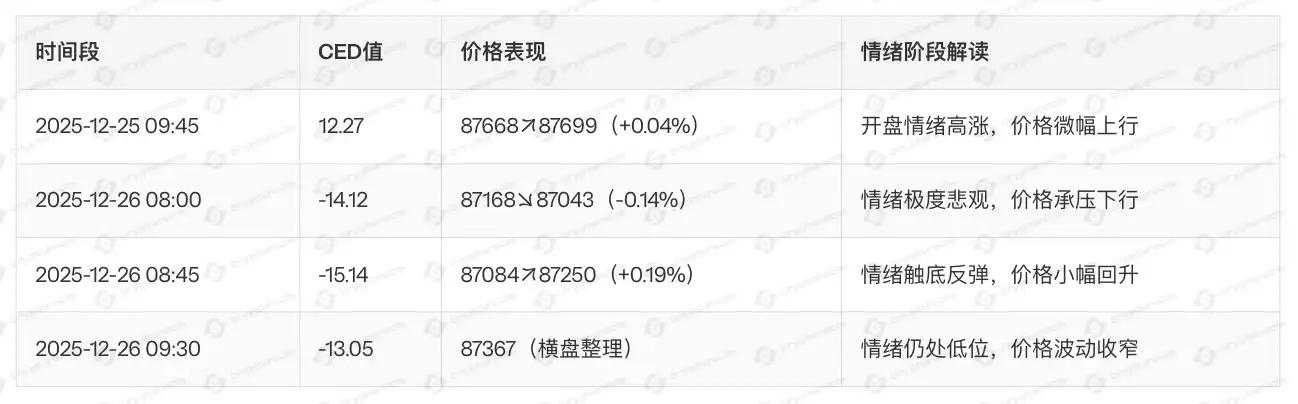
Intraday Sentiment Rhythm

  • Morning (09:45-12:00): High sentiment volatility (CED 12.27→7.12) with narrow price fluctuations
  • Afternoon to Evening (12:00-20:00): Sentiment continued to weaken (CED 7.12→-5.64) with a gradual price decline
  • Night (20:00-04:00): Intense sentiment fluctuations (CED -5.64↔4.28) accompanied by significant price volatility
  • Early Morning to Opening (04:00-09:45): Sentiment plunged deeply (CED 1.86→-13.05) with a breakout price drop

II. Relationship Between Extreme Sentiment Zones and Market Trends
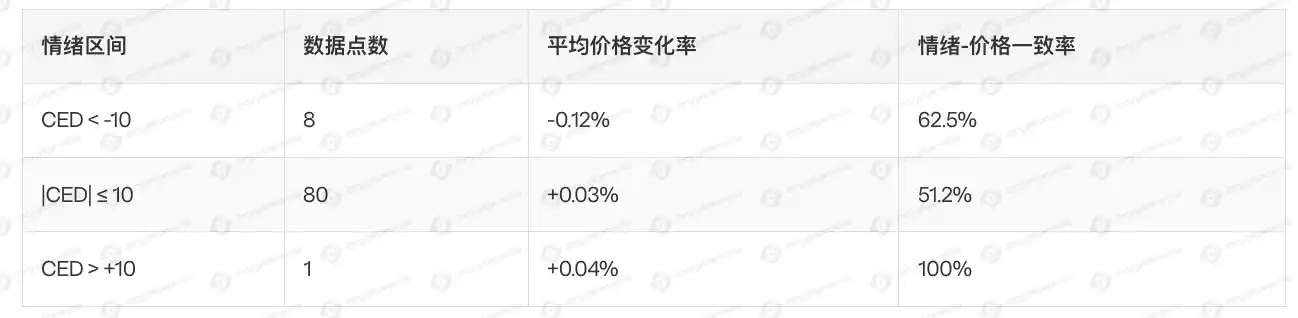
Trend Conclusions:

  • Extreme negative sentiment zones (CED<-10) show significantly higher probability of price decline, with an average drop of 0.12%
  • Neutral sentiment zones (|CED|≤10) show unclear price directionality, with a slight overall increase of 0.03%
  • Periods of extreme sentiment often indicate potential price reversal opportunities, particularly rebounds after extreme negative sentiment

III. Summary of Current Market Conditions
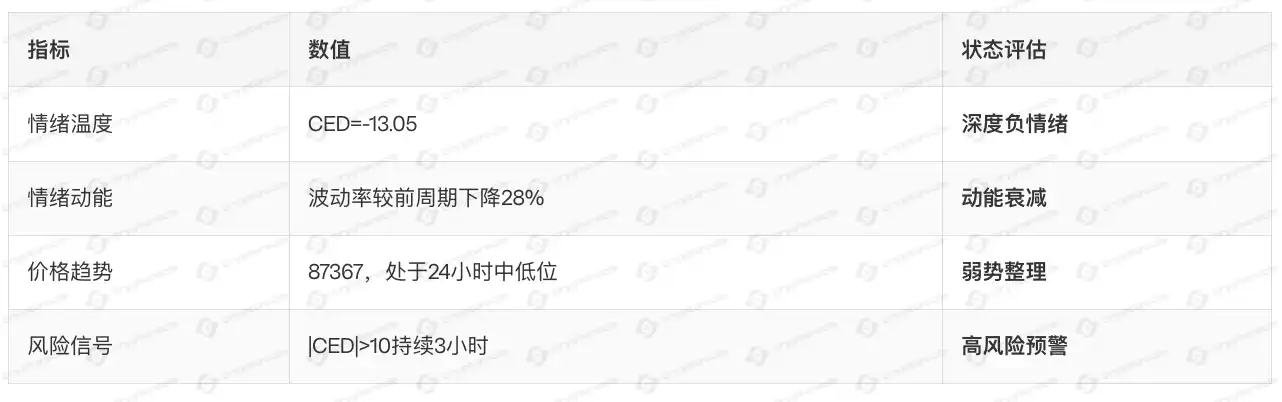
IV. Key Conclusions

  • Market sentiment is in a deeply negative zone (CED=-13.05), reflecting severely insufficient investor confidence
  • Sentiment momentum has noticeably weakened, suggesting a possible short-term consolidation and bottoming phase
  • Prices have formed short-term support in the 87000-87400 range; the strength of sentiment recovery needs monitoring
  • The prolonged duration of extreme negative sentiment warrants caution against further downside risks


Preguntas relacionadas

QWhat was the overall pattern of BTC market sentiment over the past 24 hours according to the report?

AThe BTC market sentiment showed a V-shaped pattern, starting stable, then declining, and finally rebounding. The overall trend was negative, with the CED dropping from an initial 12.27 to a low of -15.14, with a slight recovery to -13.05 by the end of the session.

QDuring which time period did the most significant emotional fluctuations and large price swings occur?

AThe most significant emotional fluctuations and large price swings occurred during the night session, from 20:00 to 04:00.

QWhat is the reported relationship between extreme negative sentiment (CED < -10) and price movement?

AThe report states that the extreme negative sentiment interval (CED < -10) has a significantly higher probability of price decline, with an average drop of 0.12%.

QWhat is the core conclusion regarding the current state of the market sentiment?

AThe core conclusion is that market sentiment is in a deep negative zone (CED = -13.05), reflecting severely insufficient investor confidence, and it may be entering a phase of volatile bottoming.

QWhat potential risk is highlighted due to the prolonged period of extreme negative sentiment?

AThe prolonged period of extreme negative sentiment highlights the risk of a further price breakdown.

Lecturas Relacionadas

The Crypto Scene Is Dead, Perpetual Swaps Are Eternal

The crypto industry is undergoing a fundamental shift. The era defined by minting novel, native digital assets (altcoins) is fading. These assets, lacking real-world cash flows or clear value, are losing relevance as attention and capital flow elsewhere. Two powerful external forces are reshaping the space. First, traditional assets like U.S. stocks, bonds, gold, and oil are being tokenized and traded on-chain. Second, the explosive growth of AI, with its tangible products, has overshadowed crypto's once-dominant "future narrative." This marks a critical pivot: crypto is transitioning from being a "factory for new assets" to becoming a "global conduit for existing assets." Its validated utility is not complex financial reinvention but efficient global settlement, transfer, and trading—the original promise of blockchain. Stablecoins like USDT and USDC exemplify this, offering faster dollar movement rather than replacing it. Consequently, native ecosystems like Ethereum face profound challenges. While still crucial infrastructure, ETH struggles to capture value as users interact with Layer 2s or trade traditional assets without needing to hold it. DeFi's grand narrative of rebuilding finance has narrowed to core needs like cheap transfers and deep liquidity. The true breakout innovation is the perpetual contract (Perp). It brilliantly bypasses the complexities of direct asset ownership (custody, compliance, dividends) by creating pure price exposure. Users can speculate on the price movement of *any* asset—NVIDIA, gold, oil—24/7, globally, and with leverage. This "price casino" model, while risky and ethically fraught, delivers unmatched liquidity and accessibility. Projects like Hyperliquid succeeded not by inventing new mechanics but by perfecting the timing and execution of this model. Key drivers included making on-chain Perps feel like centralized exchanges, post-FTX trust migration towards transparency, and rising demand to trade macro assets and equities round-the-clock. In conclusion, the crypto world's most enduring successes are the dollar (via stablecoins), Bitcoin, and trading. Its new frontier is not creating alternative assets but providing a seamless, perpetual trading layer—a new API—for the world's existing financial system. The age of native altcoins is over; the age of perpetual synthetic exposure has begun.

Odaily星球日报Hace 8 min(s)

The Crypto Scene Is Dead, Perpetual Swaps Are Eternal

Odaily星球日报Hace 8 min(s)

After Marvell's 32% Surge, the Chinese Chip Family Behind It Emerges

The stock price of Marvell Technology surged 32.5% on June 2nd, driven by NVIDIA CEO Jensen Huang highlighting its custom ASICs and optical interconnects as core to AI data center architecture. This event brought attention to the Chinese semiconductor family behind Marvell: the Dai siblings. The story centers on three siblings, all UC Berkeley graduates, whose three-decade entrepreneurial journey aligns with major semiconductor industry shifts. In 1995, youngest sister Dai Wei Li co-founded Marvell with her husband Sehat Sutardja and his brother, focusing on storage controllers. Eldest brother Dai Wei Min founded EDA company Ultima, later sold to Cadence, and later founded VeriSilicon (芯原) in China, becoming a leading semiconductor IP provider. Second brother Dai Wei Jin co-founded EDA firm Silicon Perspective (sold to Cadence) and GPU IP company Vivante, later acquired by VeriSilicon. The combined "Dai-Sutardja" family network extends beyond Marvell. Their ventures and investments form a comprehensive ecosystem for the post-Moore's Law, chiplet era. Key holdings include: Dream Big Semiconductor (AI SuperNICs, acquired by Arm), Alphawave (high-speed SerDes IP, acquired by Qualcomm), and Silicon Box (a chiplet advanced packaging foundry). VeriSilicon itself thrives on the AI ASIC and IP boom in China. Collectively, the family's AI infrastructure-related portfolio is estimated at over $22 billion. Their strategy represents a distinct path: building critical components for open standards and key manufacturing capacity in the chiplet era, rather than pursuing standalone AI chip dominance. While this path may not create the next NVIDIA, it has enabled repeated successful exits and sustained influence within the global semiconductor industry.

marsbitHace 1 hora(s)

After Marvell's 32% Surge, the Chinese Chip Family Behind It Emerges

marsbitHace 1 hora(s)

Microsoft is Afraid of Being Marginalized by AI Giants

Microsoft, once the defining force of the PC era, now faces a familiar challenge in the AI age: the risk of being relegated to a profitable but invisible infrastructure provider. This anxiety was laid bare at Build 2026, where CEO Satya Nadella unveiled a major strategic pivot. The catalyst was a quiet April agreement that dissolved Microsoft's exclusive licensing and cloud-hosting deal with OpenAI, its once-vital partner. This erased Microsoft's key AI moat. With OpenAI and Anthropic defining AI applications and gaining enterprise traction—even within Microsoft's own ranks—Nadella had to answer: without exclusivity, what is Microsoft's role? The answer was a suite of seven in-house AI models, a developer-focused AI workstation (Surface RTX Spark Dev Box), and, most crucially, the Agent 365 platform for enterprise AI governance. The models, notably targeting Anthropic's strengths in coding and enterprise, signal a defensive move. However, the broader strategy is to make the models themselves less decisive. Financially, Microsoft's AI revenue is strong, driven largely by Azure running others' models. Yet its user-facing products like Copilot show weak penetration and engagement. Microsoft earns infrastructure money but lacks direct user mindshare. Nadella's core fear is being "hollowed out." As OpenAI and Anthropic prepare for IPOs and gain financial independence, they may build their own infrastructure, threatening Azure's lucrative AI revenue stream. Microsoft's window is to entrench itself deeper: not as the model creator, but as the indispensable platform for securely deploying, managing, and governing all AI models within the enterprise through Agent 365. Build 2026 revealed Microsoft's bet: in the AI era, the ultimate power lies not in any single model, but in the enterprise "operating system" that controls them. Nadella is determined to ensure Microsoft is the driver of this new era, not just a passenger.

marsbitHace 1 hora(s)

Microsoft is Afraid of Being Marginalized by AI Giants

marsbitHace 1 hora(s)

Trading

Spot
Futuros

Artículos destacados

Cómo comprar BILL

¡Bienvenido a HTX.com! Hemos hecho que comprar Billions Network (BILL) sea simple y conveniente. Sigue nuestra guía paso a paso para iniciar tu viaje de criptos.Paso 1: crea tu cuenta HTXUtiliza tu correo electrónico o número de teléfono para registrarte y obtener una cuenta gratuita en HTX. Experimenta un proceso de registro sin complicaciones y desbloquea todas las funciones.Obtener mi cuentaPaso 2: ve a Comprar cripto y elige tu método de pagoTarjeta de crédito/débito: usa tu Visa o Mastercard para comprar Billions Network (BILL) al instante.Saldo: utiliza fondos del saldo de tu cuenta HTX para tradear sin problemas.Terceros: hemos agregado métodos de pago populares como Google Pay y Apple Pay para mejorar la comodidad.P2P: tradear directamente con otros usuarios en HTX.Over-the-Counter (OTC): ofrecemos servicios personalizados y tipos de cambio competitivos para los traders.Paso 3: guarda tu Billions Network (BILL)Después de comprar tu Billions Network (BILL), guárdalo en tu cuenta HTX. Alternativamente, puedes enviarlo a otro lugar mediante transferencia blockchain o utilizarlo para tradear otras criptomonedas.Paso 4: tradear Billions Network (BILL)Tradear fácilmente con Billions Network (BILL) en HTX's mercado spot. Simplemente accede a tu cuenta, selecciona tu par de trading, ejecuta tus trades y monitorea en tiempo real. Ofrecemos una experiencia fácil de usar tanto para principiantes como para traders experimentados.

169 Vistas totalesPublicado en 2026.05.07Actualizado en 2026.06.02

Cómo comprar BILL

Qué es ATWO

I. Introducción al ProyectoArena Two es una plataforma interactiva descentralizada que permite a los fanáticos jugar un papel activo y tokenizado en los resultados de eventos en tiempo real. A diferencia de los modelos de transmisión tradicionales que reducen a los fanáticos a espectadores pasivos, Arena Two aprovecha la tecnología blockchain para permitir que los fanáticos voten directamente en tiempo real e influyan en los resultados en el campo.II. Información del TokenNombre del token: ATWO (Arena Two)III. Enlaces RelacionadosSitio web: https://arenatwo.com/Exploradores: https://basescan.org/token/0x499D35eBE6cEe9B2Ac35Fd003fcBbeeB9CFc7B32Twitter: https://x.com/arenatwoXNota: La introducción del proyecto proviene de los materiales publicados o proporcionados por el equipo oficial del proyecto, que es solo para referencia y no constituye asesoramiento de inversión. HTX no se hace responsable de ninguna pérdida directa o indirecta resultante.

54 Vistas totalesPublicado en 2026.05.18Actualizado en 2026.06.02

Qué es ATWO

Cómo comprar ATWO

¡Bienvenido a HTX.com! Hemos hecho que comprar Arena Two (ATWO) sea simple y conveniente. Sigue nuestra guía paso a paso para iniciar tu viaje de criptos.Paso 1: crea tu cuenta HTXUtiliza tu correo electrónico o número de teléfono para registrarte y obtener una cuenta gratuita en HTX. Experimenta un proceso de registro sin complicaciones y desbloquea todas las funciones.Obtener mi cuentaPaso 2: ve a Comprar cripto y elige tu método de pagoTarjeta de crédito/débito: usa tu Visa o Mastercard para comprar Arena Two (ATWO) al instante.Saldo: utiliza fondos del saldo de tu cuenta HTX para tradear sin problemas.Terceros: hemos agregado métodos de pago populares como Google Pay y Apple Pay para mejorar la comodidad.P2P: tradear directamente con otros usuarios en HTX.Over-the-Counter (OTC): ofrecemos servicios personalizados y tipos de cambio competitivos para los traders.Paso 3: guarda tu Arena Two (ATWO)Después de comprar tu Arena Two (ATWO), guárdalo en tu cuenta HTX. Alternativamente, puedes enviarlo a otro lugar mediante transferencia blockchain o utilizarlo para tradear otras criptomonedas.Paso 4: tradear Arena Two (ATWO)Tradear fácilmente con Arena Two (ATWO) en HTX's mercado spot. Simplemente accede a tu cuenta, selecciona tu par de trading, ejecuta tus trades y monitorea en tiempo real. Ofrecemos una experiencia fácil de usar tanto para principiantes como para traders experimentados.

117 Vistas totalesPublicado en 2026.05.18Actualizado en 2026.06.02

Cómo comprar ATWO

Discusiones

Bienvenido a la comunidad de HTX. Aquí puedes mantenerte informado sobre los últimos desarrollos de la plataforma y acceder a análisis profesionales del mercado. A continuación se presentan las opiniones de los usuarios sobre el precio de A (A).

活动图片