Interview with Macro Master Raoul Pal: The Economic Singularity is Approaching, Don’t Get Off the Ride in the Next Four Years

链捕手Publicado a 2026-06-01Actualizado a 2026-06-01

Resumen

Interview with macro expert Raoul Pal discusses the approaching "economic singularity," where AI-driven growth outpaces traditional economic systems. He explains the unprecedented scale of the AI race between the US and China, arguing capital will continue flooding this sector as neither side can afford to stop. Pal sees this as a catalyst for cryptocurrency, as AI agents will operate on-chain, creating an "infinite TAM" for crypto networks. He views the recent crypto downturn as a normal bull market correction, advocating for a long-term "buy and hold" strategy over trying to time the market. Key investments include Layer 1 smart contract platforms like Ethereum, Solana, and Sui, which he believes will capture most value due to their foundational role. He also sees potential in privacy coins like Zcash and a future resurgence for high-end NFTs as digital trophy assets. Pal emphasizes that while AI stocks are hot, crypto offers superior asymmetric returns. He outlines a bullish case for 2026-2027 based on institutional adoption, pro-regulation, increased global liquidity, and crypto's current undervaluation relative to assets like the Nasdaq. His core advice: accumulate crypto assets during dips and hold for the long term, as the shift towards a digital, AI-agent-driven economy is inevitable.

Original Source:《When Shift Happens》

Original Compilation:Felix, PANews

Macro investor and Real Vision co-founder Raoul Pal once again appeared on the 《When Shift Happens》 podcast, delving into why the AI race is the largest capital event in human history, and why cryptocurrency holders are in an advantageous position. Raoul Pal explained the economic singularity, why traders always lose to long-term holders, and why he continued to buy during the recent pullback.

PANews has compiled the highlights of the interview.
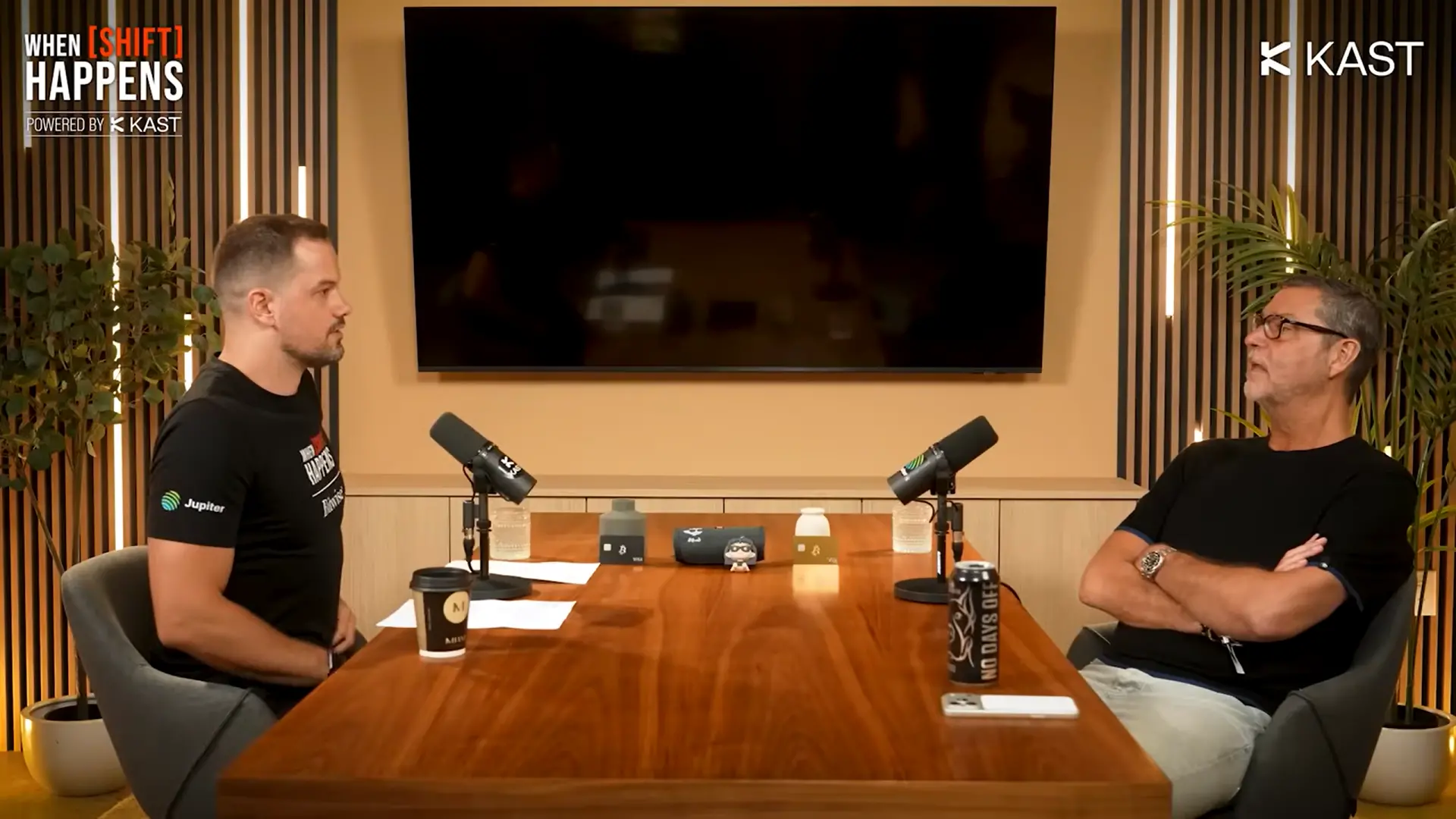
Host: You shared and commented on an interesting video a few weeks ago. It satirized the US stock market's constant rise, saying you just "buy the dip" to make money, borrow money to buy if you don't have any. It's not a pyramid scheme; it's the dip-buying plan. What's really going on with the stock market?

Raoul Pal: There are two main reasons. First, obviously, is liquidity—we are witnessing an expansion of liquidity. The other thing is, we are in the most extraordinary period in human history, and nothing else matters. All capital is flooding into artificial intelligence. This is the largest race ever. It's a race among nations, among companies. So, of course, it will suck every penny of capital because you can't slow it down.

Host: Tell me about this race.

Raoul Pal: In this world, no one will allow a single superpower to monopolize AGI (Artificial General Intelligence), so there must be two, and only the US and China can afford this race globally. Game theory suggests no nation will stop now because stopping means the other side gains an advantage. Even in a scenario like OpenAI going bankrupt and running out of funds, the US government would immediately auction its assets to companies like Microsoft, Google, etc., never allowing a single company to have a monopoly. This game is too big; no one will stop. It's a game of converting "units of energy into units of intelligence."

Host: Too big to fail. So, just "buy the dip" forever? Will it ever end?

Raoul Pal: I wrote in 《Global Macro Investor》 that it won't end unless it reaches the economic singularity. The economic singularity is when the system can no longer cope with the pace of technological development. You know the magic formula: population growth + productivity growth + debt growth. When you count AI and robots as population, our maximum population is currently 9 billion, but we could reach 18 billion, 100 billion, even a trillion intelligent agents. With 10 billion or 50 billion agents, the economic system simply cannot function as originally intended; it runs too fast.

Almost all past technology adoption followed Metcalfe's Law (PANews note: network value is proportional to the square of the number of connected users), showing logarithmic growth. But AI is the first observable case of "Reed's Law" in human history (PANews note: the value of a network scales not just with user count but exponentially due to group formation), which is exponential of exponential. It's estimated that by 2028, the annual text output by AI will exceed the total text output by humans from the Gutenberg printing press to the present.

Host: Anthropic's interview today also said their Q1 expected 10x growth but achieved 80x. That's incredible.

Raoul Pal: Yes, the economic singularity happens when you have economic agents (AI agents) capable of instant capital formation, which is what meme coins signify: instant capital creation and destruction. They can instantly build digital businesses, quickly capture markets, and exit when opportunities fade. In this economy, where is the role for large traditional corporations? Who are the workers? The system already isn't functioning normally. Because carbon-based life (human neurons) operates at 1 millisecond, but now we have electricity passing through sand (silicon, the second most common element on Earth) creating intelligence that is six orders of magnitude (a million times) faster than human neurons. It's insane.

Host: Given AI's exponential explosion, many in crypto want to switch to AI, thinking crypto is boring now, even fearing getting stuck. How do you view the investment choice between AI and crypto?

Raoul Pal: Even though the AI industry is extremely hot, I still believe that over the long cycle, cryptocurrency remains one of the investments with the optimal risk-reward. But it is indeed hard to compete with chip companies like Nvidia because they are the core part converting energy into intelligence. However, cryptocurrency has an "infinite TAM (Total Addressable Market)." Around October last year, we witnessed the birth of the agent economy (AI Agents). When these agents begin scaling massively, they will have their own wallets and conduct business on-chain. Previously, our estimate of the crypto market reaching $100 trillion was based on human users; now with unlimited AI agents, it completely changes the game. Moreover, the Fed will run the economy like in the Greenspan era, relying on productivity miracles to reduce debt-to-GDP, fiat currency depreciation won't stop, and the entire financial system is moving towards blockchain infrastructure, so you just need to front-run the institutions. The worst is over because global liquidity is accelerating.

Host: So for you, Bitcoin falling from recent peaks back to $60k isn't a bear market?

Raoul Pal: It's just an uncomfortable correction in a bull market. I've been in crypto since 2013. A 50% Bitcoin correction is normal, and other altcoins fall even harder, like Solana last cycle dropped 80% before skyrocketing. The difference is, the 2021 correction was very fast, a sharp drop followed by a quick recovery; this correction is more volatile, taking months, so people feel very painful. But look at it another way: the longer the consolidation, the longer and larger the potential bull market after the breakout.

Host: The problem is in 2021, the fall was fast, the rise was fast, but this market is choppy, time-consuming. Also, some well-performing companies (like stablecoins, RWA) don't have tokens; retail can't invest, making people feel the early fortune-making promise is broken.

Raoul Pal: I don't think that's true; product-market fit is king. Just because your altcoin hasn't risen doesn't mean the promise is broken; the market owes you nothing. People got used to the easy money days of previous years, but liquidity in 2024 is still somewhat suppressed; we haven't entered the real "banana zone" (referring to crazy upside). While ordinary people may not be able to buy equity in stablecoin companies, that's not the problem at all; you just need to hold the underlying Layer1 tokens. This is our "Universal Basic Equity." If a large part of the future economy is dominated by AI and agents, and they use crypto networks, we just need to hold Layer1 tokens to share in their success. We didn't have this opportunity in the internet era; now there's no excuse to miss it.

Host: What did you add to your portfolio during the recent dip?

Raoul Pal: I bought some Sui and a bit of Zcash. I didn't chase Zcash when it surged last year; I started buying during the pullback. In the store of value space, privacy has value. It's a very simple "left-curve" trade (intuitive): it's Bitcoin with privacy. The "right-curve" trade (thoughtful) considers it has quantum-resistant properties. While this may attract government bans, in the future, it provides a very important hedge attribute.

Host: Can you elaborate on why smart contract Layer1s will capture most of crypto's value over time?

Raoul Pal: Layer1s are investment-grade infrastructure layers. Just as the OS market eventually converged to three or four major players, Layer1s will also converge to 3-5 core chains. How to understand Layer1 value? If you unplug Ethereum today, the economic value destroyed is immense: all Layer2s, DeFi, NFTs, RWA would go to zero. ETH's current valuation might even be undervalued. Bitcoin has a single function; its goal is to capture a share of global savings. But the scalability of smart contract infrastructure is infinite.

Host: So which Layer1s will win?

Raoul Pal: ETH has the densest economic value and developer intellectual resources (security, Lindy Effect, etc.), like Microsoft—buying it won't be a big mistake. Solana has proven successful; it's more efficient, faster, cheaper. Sui is very early, but when the market fell 80%, ETH, Solana, and Sui were the only three tokens that maintained economic density. Sui's programmability within a single block, transaction throughput of thousands per second, and finality speed are on a completely different level. You can't evaluate blockchains with traditional "Discounted Cash Flow (DCF)" models because the network's purpose is to provide the cheapest, fastest service; valuing it by how much fee it generates is nonsense. The cheapest, fastest, most programmable chain will ultimately outperform.

Host: Some say DeFi has "died" after many hacks in the past few months. How could traditional finance put money on DeFi that's easily hacked?

Raoul Pal: But this only forces people to develop better products. Just like installing antivirus on computers, hacking is everywhere. Every bank internally has teams dealing with hacks and stolen funds ratios; they just don't publicize it. I predicted back in 2014 that the entire financial system's infrastructure would move to blockchain. Why? Because it's the most efficient way to output energy. The financial system will always migrate to the most profitable, most efficient track. And, DeFi is actually more suitable for machines (AI agents) than humans. Machines don't even need front-end websites; they can rebalance assets and trade instantly across multiple chains, using various stablecoins, with extremely low friction, in milliseconds. They will be the largest user group of DeFi, and we won't even notice these transactions.

Host: Do you think NFTs will gain huge value from the wealth effect mentioned above? My CryptoPunks and XCOPY aren't moving at all; I don't even want to look at them.

Raoul Pal: That's because NFT activity is a function of the crypto economy's prosperity. You have to wait until the overall crypto market reaches trillions of dollars. When ETH breaks above current prices to, say, $5000 or higher, you'll see a massive recovery in NFT activity. Think about it: we're experiencing the biggest turning point in human history: we will no longer be the top intelligence on the planet, and art is the carrier recording the culture of our era. When people make big money in this vast machine economy, they naturally buy "trophy assets" (PANews note: refers to those top-tier assets that, due to extreme scarcity, prime location, or major historical/cultural value, showcase the buyer's social status, bring high psychological satisfaction, and are often "priceless" in the market), just like tech moguls, real estate tycoons, and hedge fund billionaires buy art after getting rich.

Host: How do you plan to configure an NFT portfolio? Is only the top "holy grail" worth buying?

Raoul Pal: I'm actually preparing to launch an NFT fund. Many high-net-worth individuals, family offices, even OGs who made money in crypto but never bought digital art don't know how to buy. Our fund will have two parts: one invests in "holy grail" assets (like Alien Punks, XCOPY, Beeple, valued from hundreds of thousands to tens of millions), which already have proven social consensus. The other part invests in mid-tier but highly convex artists' works. For example, "Die with the most likes," who humorously, even crudely, documents the decline of the American middle class; or German artist Kim Asendorf, at the forefront of AI art. If these artists' works repriced from 20 ETH to 200 ETH (5-10x), and ETH itself may rise 10x in the future, you get an astonishing 100x dual return.

Don't worry about common NFTs because the whole industry is still small; everything will be repriced. Even if you buy a common Punk from the same series, it's a good trade. Additionally, our fund will engage in NFT collateralized lending, earning over 15% yield, reinvesting to support liquidity for the entire art ecosystem.

Host: Is Bitcoin a proxy for investing in AI?

Raoul Pal: You could say so, because AI promotes economic growth, and fiat depreciation from massive debt benefits Bitcoin's function as a digital store of value. However, Layer1 smart contract platforms are a better, more direct bet.

Host: You said everyone is too focused on cycles, while the big picture is so clear: unless you urgently need to, you should never sell.

Raoul Pal: Exactly. In an era with Agents, depreciating fiat, everything going on-chain, why would you sell? If we know the long-term direction of market cap, why sell? This is the pension plan for all humanity. The economic singularity arrives in about 4 years. You have 4 years now to hold as much of these assets as possible; they will carry you through the greatest uncertainty ahead.

Host: Can you prove with data that "buy and hold" beats those trying to time the market?

Raoul Pal: Absolutely. I've built models. If it reaches oversold territory 1-2 standard deviations below the lower bound of the logarithmic trend channel, you buy, then do nothing—the compounding is astonishing. If you try to sell at the top and buy back at the bottom, 99% of people can't do it; it's too difficult. People often chase the highs during rallies. I've been in this industry for 35 years; I don't know anyone who consistently makes big money through short-term trading. Those traders who make big money actually earn asset management fees.

It's proven that those who make the most money in crypto are the ones who "do nothing." Why are the most profitable accounts at major brokerages often "dead accounts (forgotten accounts)"? Retail tries to time highs and lows, not only fails but also expends enormous emotional and mental energy, getting angry or euphoric over daily price fluctuations—this is absolutely the most inefficient use of personal energy. If you have spare productive energy, go study AI, then hold onto your Bitcoin for dear life. If prices become overbought by two standard deviations, you can sell a bit to enjoy life; otherwise, shut up, buy the dip, and patiently hold.

Host: How do people keep faith when portfolios drop 60-80% and stay down for months?

Raoul Pal: I simply don't care. I live on my salary. If I have spare cash and the market is severely oversold, I keep buying. Because my core logic hasn't changed: tomorrow will be more digital than today.

Host: Now AI stocks are soaring; many charts are straight up. Won't this attract people away from boring crypto to buy AI?

Raoul Pal: Your duty is to be a mercenary for your own capital; go where the money is. But I believe crypto offers higher compound returns. Compared to Nasdaq, Bitcoin is currently at a severely oversold position relative to its long-term trend. This means, relative to Nasdaq, you should allocate more to crypto now.

Host: Finally, give us some optimistic hope for 2026-2027, to boost morale.

Raoul Pal: There's a lot of good news. First, banks are entering; stablecoins will explode in growth over the next two years. Regulatory-wise, the 《Clarity Act》 will be signed, allowing almost everyone to start building on blockchain. Macro-wise, the US government has trillions in interest to roll over and pay; they must keep printing, and global liquidity will increase. The business cycle remains strong; more people's income will be recycled into speculative assets. Most importantly, current crypto assets, relative to assets like Nasdaq, are at their cheapest point on the long-term logarithmic uptrend. We've also experienced the longest-lasting, lowest-reading "extreme fear" period historically (Fear & Greed Index below 10), and there's a high probability the Middle East war will be permanently resolved. This is a perfect storm of bullish combinations. I think the probability of this positive bullish outcome is 70%. The remaining 30% downside risk lies mainly in the Middle East war not being resolved, triggering inflation and liquidity tightening, but I haven't seen signs of that yet.


Criptos en tendencia

Preguntas relacionadas

QWhat is the 'economic singularity' as described by Raoul Pal, and why is it approaching?

AThe economic singularity, as described by Raoul Pal, is the point where the economic system can no longer cope with the speed of technological development. It's driven by the integration of AI and AI agents into the economy. These silicon-based 'agents' can operate and process information at speeds a million times faster than human (carbon-based) neurons. This results in near-instant capital formation and destruction (as seen with memecoins) and an exponential, self-reinforcing growth in AI output. He estimates this could overwhelm traditional economic structures within about four years, as the sheer number and speed of intelligent agents make the existing system inoperable.

QAccording to Raoul Pal, why is cryptocurrency still a superior investment compared to AI stocks, despite the AI boom?

ARaoul Pal argues that while AI stocks are booming, cryptocurrencies offer a superior risk-adjusted return over the long term. His key points are: 1) Unlimited Total Addressable Market (TAM): Crypto's potential market expands from billions of human users to potentially trillions of AI agents that will need digital wallets and on-chain services. 2) Direct Infrastructure Play: Holding core Layer-1 tokens (like ETH) is akin to holding 'universal basic equity' in the future digital economy, a chance missed during the internet era. 3) Relative Valuation: Bitcoin is currently at a severely oversold level relative to its long-term trend against the Nasdaq, making it a more attractive entry point for compounding returns.

QWhich Layer-1 blockchains does Raoul Pal believe will be the dominant winners, and what is his reasoning?

ARaoul Pal believes the Layer-1 landscape will consolidate to 3-5 core chains. He specifically highlights three that maintained 'economic density' even during severe market downturns: 1) Ethereum (ETH): Possesses the most concentrated economic value, developer resources, security, and Lindy effect, making it a safe, foundational bet. 2) Solana (SOL): Has proven to be successful, offering greater efficiency, speed, and lower cost. 3) Sui: Though early-stage, it operates at a different order of magnitude in terms of programmability per block, transaction speed, and finality speed. He argues the chains that are the cheapest, fastest, and most programmable will ultimately outperform.

QWhat is Raoul Pal's core advice on investment strategy for the coming years, and what data or logic does he use to support it?

ARaoul Pal's core advice is to 'buy and hold' and not to sell cryptocurrency assets unless absolutely necessary. He supports this with: 1) Long-Term Trend: The macro direction is clear towards more digitization, AI agent adoption, and fiat currency debasement. 2) Historical Performance: His models show that buying during periods of extreme oversold conditions (1-2 standard deviations below the logarithmic trend channel) and holding generates astounding compound returns. 3) Tracker Failure: He states that 99% of people fail at successfully timing the market (selling high and buying low), and the most profitable accounts are often inactive 'dead' accounts. He concludes that emotional energy spent on trading is inefficient and that holding through volatility is the most reliable path to significant wealth in crypto.

QWhat are the key bullish factors Raoul Pal lists for the cryptocurrency market looking toward 2026-2027?

ARaoul Pal lists several key bullish factors for 2026-2027: 1) Institutional Adoption: Banks are entering, and stablecoins are poised for explosive growth. 2) Regulatory Clarity: The potential signing of legislation like the 'Clarity Act' will enable broader development on blockchain. 3) Macroeconomic Liquidity: The U.S. government needs to finance trillions in debt, necessitating continued money printing and increasing global liquidity. 4) Strong Cycle & Sentiment Shift: A strong business cycle will recycle income into speculative assets, and the market has endured an historically long period of extreme fear, often a contrarian indicator. 5) Geopolitical Resolution: A potential permanent resolution to conflict in the Middle East could remove a major risk. He assigns a 70% probability to this positive outcome.

Lecturas Relacionadas

After Three Consecutive Quarters of Decline, Can the Crypto Market Find a Window for Stabilization in Q3?

The cryptocurrency market has just concluded its worst-performing quarter since 2022, with total capitalization dropping 12.6% to $2.1 trillion. All core metrics indicate capital is leaving the sector, not just rotating within it. Bitcoin fell 14.2% and Ethereum dropped 25.4% in Q2, breaking their previous correlation with US tech stocks. A key driver is the reversal in US spot Bitcoin ETF flows, which saw a net outflow of approximately $4.67 billion in Q2, including a record monthly outflow near $4.5 billion in June. While recent data suggests long-term holders are accumulating again, sustained ETF outflows mean continued selling pressure. Market focus is now singularly on the Federal Reserve. The upcoming July FOMC meeting is seen as the most critical event for Q3. A dovish signal could support Bitcoin reclaiming a $68,000-$84,000 range, while a hawkish stance might establish a new trading band around $50,000-$56,000. Additionally, regulatory uncertainty persists, with the progress of the crucial *CLARITY Act* stalling in the Senate, reducing its perceived 2026 passage probability to 40-45%. Despite the broad downturn, a few sectors showed growth. Prediction markets saw nominal volume surge 48.7% year-over-year to $113.8 billion, and tokenized collectibles transaction volume rose 143% quarterly to $1.4 billion. The Real-World Asset (RWA) tokenization sector also continued steady growth, now representing ~$28.1 billion in on-chain value. The market's foundation for an extreme crash appears limited, with Bitcoin price hovering near its 200-week moving average. However, the trading paradigm has shifted from narrative-driven speculation to decisions based on price action, policy developments, and interest rate expectations, making a broad sentiment-driven rally unlikely in the near term.

marsbitHace 1 hora(s)

After Three Consecutive Quarters of Decline, Can the Crypto Market Find a Window for Stabilization in Q3?

marsbitHace 1 hora(s)

BIT Trading Moment: BTC Still Suppressed by Weekly 200 EMA, Rejection May Restart Decline; Storage and Semiconductors that Surged Last Night Begin Falling in Evening Trading

**Crypto & Stock Market Wrap: Bitcoin Tests Resistance, Stocks Retreat After AI Surge** Bitcoin consolidates around $66,000, facing key resistance near $68,000—an area seen as a major psychological and technical hurdle where previous rallies have failed. Analysts note the cryptocurrency is caught between its 200-week moving average (~$63,333) and 200-week EMA (~$68,328). A clear break above $68k is needed to signal a stronger bullish trend, while a rejection could lead to a retest of $63k support. Market sentiment remains cautious, with low futures open interest pointing to a low-liquidity rebound rather than a full bull market. Bitcoin spot ETFs saw another $203 million inflow. US stock futures pointed lower after a strong Tuesday session led by a massive rebound in semiconductors and memory stocks. The rally was fueled by renewed optimism about AI-driven hardware demand, with Micron, SanDisk, and SK Hynix surging. However, those gains reversed in pre-market trading. Super Micro Computer (SMCI) soared over 20% after hours on strong guidance and a record backlog. Other standouts included Rocket Lab and nuclear energy plays Oklo and X-Energy. Rising oil prices (Brent above $91) and climbing Treasury yields (10-year near 4.64%), however, are reigniting inflation concerns and acting as a headwind for equities. In Asia, markets were mixed. South Korea's KOSPI pared early gains to close slightly higher as semiconductor stocks like SK Hynix gave back initial surges. Japan's Nikkei edged lower as the yen hit a fresh 38-year low against the dollar, raising fears of potential market intervention. Key events to watch include the Samsung Galaxy launch, AMD's AI event, and a slew of major tech earnings from Alphabet, Tesla, and IBM after the close on Wednesday, followed by the ECB meeting and Intel's earnings on Thursday.

marsbitHace 1 hora(s)

BIT Trading Moment: BTC Still Suppressed by Weekly 200 EMA, Rejection May Restart Decline; Storage and Semiconductors that Surged Last Night Begin Falling in Evening Trading

marsbitHace 1 hora(s)

Former CFTC Chairman, Circle President Tarbert: Preaching Long-Termism While Cashing Out $30 Million Himself

Former CFTC Chairman and Circle President Heath Tarbert has consistently advocated for a long-term vision in public, urging patience from investors as Circle’s stock price has fallen significantly from its peak. However, it has been revealed that since Circle’s IPO, Tarbert has continuously sold his CRCL shares through pre-arranged trading plans, cashing out approximately $30 million, without making any public market purchases. This contrast between his public messaging and personal actions has drawn criticism. Tarbert joined Circle in July 2023 as Chief Legal Officer, leveraging his regulatory experience to help guide the company through its IPO and expansion. Despite promoting stablecoins as long-term infrastructure, he established a 10b5-1 trading plan just before Circle went public, leading to substantial stock sales over the following year. In March 2026, he initiated another plan to sell more shares. His career trajectory highlights a pattern of moving between high-level regulatory roles and influential positions in the financial sector. After resigning as CFTC Chairman in early 2021, he joined Citadel Securities as Chief Legal Officer just 27 days later, during a period of intense regulatory scrutiny for the firm. He later joined Circle, aiding its efforts to navigate regulatory challenges for its public listing. While Tarbert's expertise in policy and compliance is valuable to companies like Circle, his actions—advocating long-term confidence while personally divesting—raise questions about the alignment between his public statements and his private financial decisions, leaving investors who followed his advice to bear the market risks.

marsbitHace 1 hora(s)

Former CFTC Chairman, Circle President Tarbert: Preaching Long-Termism While Cashing Out $30 Million Himself

marsbitHace 1 hora(s)

Gate Research Institute: The 'Wall Street-ization' Wave of Crypto Financial Products – Competition or Integration?

The article titled "Gate Research Institute: Are Crypto Financial Products Sparking a 'Wall Street' Wave—Competition or Convergence?" explores the evolving relationship between the crypto ecosystem and traditional finance (TradFi). The piece begins by reflecting on Bitcoin's original 2009 vision of decentralization, disintermediation, and moving away from banks. It then contrasts this with the 2024 landscape, where key crypto assets like Bitcoin are increasingly held through Wall Street products like ETFs issued by giants like BlackRock. The article questions whether this signifies that TradFi is systematically taking over the rights to issue, price, custody, and distribute crypto financial assets. The core argument is that this is not a zero-sum takeover but rather a bidirectional convergence where each side addresses the other's weaknesses. Crypto offers 24/7 global markets, programmable settlement, and open access but lacks compliant channels, institutional-grade custody, deep fiat liquidity, and mainstream distribution. TradFi possesses these but is constrained by legacy systems, limited operating hours, and slow settlement. Two primary convergence paths are highlighted: * **Path A (CEX to TradFi):** Exemplified by Gate, which has progressed from offering tokenized stocks and CFDs to providing direct, real stock trading (US, Hong Kong, South Korea) within its platform, using USDT. * **Path B (TradFi to Crypto):** Exemplified by Robinhood, which has integrated crypto trading, acquired exchanges like Bitstamp, and is moving traditional assets like stocks onto the blockchain via tokenization and its own Layer 2. Both paths are ultimately competing to become the next-generation, unified financial account—a "super account" where users can seamlessly trade cryptocurrencies, stocks, ETFs, RWA (Real World Assets), and tokenized treasury products in one interface. The growth of RWA and tokenized treasuries (e.g., BlackRock's BUIDL) is presented as the asset-layer fusion, providing stable, yield-bearing assets on-chain and acting as a bridge between the two worlds. In conclusion, the "Wall Street-ization" of crypto is framed as a mutual transformation. Decentralized ideals persist in the protocol layer, while at the application layer, a more efficient, global, and accessible unified capital market is emerging from this convergence. The future competition lies not between crypto exchanges and stockbrokers, but between platforms vying to offer the most comprehensive asset coverage, liquidity, and user experience within a single account.

marsbitHace 1 hora(s)

Gate Research Institute: The 'Wall Street-ization' Wave of Crypto Financial Products – Competition or Integration?

marsbitHace 1 hora(s)

Trading

Spot

Artículos destacados

Cómo comprar T

¡Bienvenido a HTX.com! Hemos hecho que comprar Threshold Network Token (T) sea simple y conveniente. Sigue nuestra guía paso a paso para iniciar tu viaje de criptos.Paso 1: crea tu cuenta HTXUtiliza tu correo electrónico o número de teléfono para registrarte y obtener una cuenta gratuita en HTX. Experimenta un proceso de registro sin complicaciones y desbloquea todas las funciones.Obtener mi cuentaPaso 2: ve a Comprar cripto y elige tu método de pagoTarjeta de crédito/débito: usa tu Visa o Mastercard para comprar Threshold Network Token (T) al instante.Saldo: utiliza fondos del saldo de tu cuenta HTX para tradear sin problemas.Terceros: hemos agregado métodos de pago populares como Google Pay y Apple Pay para mejorar la comodidad.P2P: tradear directamente con otros usuarios en HTX.Over-the-Counter (OTC): ofrecemos servicios personalizados y tipos de cambio competitivos para los traders.Paso 3: guarda tu Threshold Network Token (T)Después de comprar tu Threshold Network Token (T), guárdalo en tu cuenta HTX. Alternativamente, puedes enviarlo a otro lugar mediante transferencia blockchain o utilizarlo para tradear otras criptomonedas.Paso 4: tradear Threshold Network Token (T)Tradear fácilmente con Threshold Network Token (T) en HTX's mercado spot. Simplemente accede a tu cuenta, selecciona tu par de trading, ejecuta tus trades y monitorea en tiempo real. Ofrecemos una experiencia fácil de usar tanto para principiantes como para traders experimentados.

650 Vistas totalesPublicado en 2024.12.10Actualizado en 2026.06.02

Cómo comprar T

Discusiones

Bienvenido a la comunidad de HTX. Aquí puedes mantenerte informado sobre los últimos desarrollos de la plataforma y acceder a análisis profesionales del mercado. A continuación se presentan las opiniones de los usuarios sobre el precio de T (T).

活动图片












