Interpreting Polymarket's Major Updates Last Night: Expanded Fees, Self-Regulation, and New Incentives

Odaily星球日报Publicado a 2026-03-24Actualizado a 2026-03-24

Resumen

Polymarket, a prediction market platform, announced a series of major updates focused on self-regulation, fee expansion, and new incentive mechanisms. Key updates include enhanced market integrity rules explicitly prohibiting insider trading, market manipulation, and trading by entities capable of influencing event results. This aims to increase transparency and build regulatory trust. A new dynamic fee structure will be implemented starting March 30, 2026, expanding beyond Crypto and Sports to include Finance, Politics, Economics, Culture, and Weather. Fees peak when contract prices are near 50% probability. The platform also opened its referral program to all users with over $10k in trading volume, offering a 30% fee rebate for direct referrals and 10% for secondary ones. Additionally, a market maker rebate program was launched, redistributing a portion of taker fees to liquidity providers daily in USDC, with rebate rates varying by market. While the community anticipated a token airdrop, the announced updates are seen as long-term operational improvements, with overall positive sentiment.

Original | Odaily Planet Daily (@OdailyChina)

Author | Asher (@Asher_ 0210)

Last Saturday, Mustafa, a member of the Polymarket official team, posted on X platform that major news would be announced on Monday.
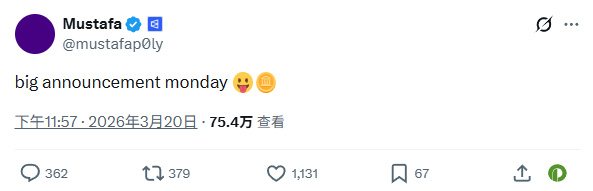
Activity of Polymarket official team member last weekend

As expected, Polymarket official released multiple major updates from last night to today. Next, Odaily Planet Daily will break them down for you one by one.

Updated Market Integrity Rules: Anti-Insider Trading, Anti-Manipulation

Last night, Polymarket announced updates to its market integrity rules for both its DeFi platform and its CFTC-regulated US exchange, further clarifying regulatory requirements regarding insider trading and market manipulation. Neal Kumar, Chief Legal Officer of Polymarket, stated: "Market prosperity relies on transparency. The refinement of these rules makes our expectations for all participants on both platforms clear and highlights the compliance infrastructure we have established. As Polymarket continues to grow, we will continue to solidify our foundation, ensuring our markets achieve their greatest strength—revealing the truth—through clear communication with users."

The new rules detail three types of prohibited behaviors, specifically including:

  • Trading using non-public information: If a participant possesses confidential information about the outcome or potential outcome of the subject event, and using this information would violate a pre-existing duty of trust or confidence owed to another person or entity, the participant must not trade any contracts.
  • Building positions based on illegal information sources: Participants must not trade using confidential information provided to them by others if the information was provided by someone who owes a pre-existing duty of trust or confidence to another, and the participant knows or has reason to know that the person providing the information would themselves be prohibited from using it for trading;
  • Entities with the ability to influence event outcomes participating in trading: If a participant has sufficient authority or influence to affect the outcome of the subject event, they must not participate in trading any contracts.

Simultaneously, the platform explicitly prohibits behaviors such as wash trading, matched orders, and price manipulation, and has launched a dedicated page to explain the rules and provide a channel for reporting anomalous behavior. Furthermore, Polymarket stated that its DeFi platform identifies risks through on-chain transparency mechanisms and a multi-layer monitoring system, while its US platform combines technical monitoring with collaboration from industry regulators to investigate and penalize violations.

This round of rule updates essentially redefines the market boundaries of Polymarket: which information can be traded, and which behaviors are directly excluded. Surrounding insider information, information sources, and the ability to influence event outcomes, the platform has turned previously ambiguous gray areas into clear "no-go" red lines, while simultaneously introducing monitoring and reporting mechanisms to bring trading behavior into a more traceable framework.

More importantly, this points to a change in the platform's positioning. Polymarket is shifting from the external perception of a "high-risk gambling arena" towards emphasizing information pricing and transparency as market infrastructure. By proactively strengthening compliance and rule expression, it aims to gain trust at the regulatory and public levels, laying the groundwork for subsequent broader expansion.

The Era of "Big Fees" Arrives: Fees Applied to All Except Geopolitical Events

According to the latest official Polymarket documentation, the platform will adjust its fee mechanism starting March 30, 2026. Building on the current Crypto and Sports categories, it will add multiple market categories such as Finance, Politics, Economics, Culture, Weather, etc., into the scope of taker fee charges.

The new fee rate is calculated using a dynamic formula directly related to price intervals. Overall, the new fee structure shows a distribution of "high in the middle, low at the ends": when the price is close to a 50% probability, the effective rate peaks, while in extreme intervals near 0% or 100%, the fee significantly decreases, potentially even being rounded down to 0 for very small trades.

Under the current fee system, the peak effective rate for Crypto markets is about 1.56%, and for Sports about 0.44%. In the new fee structure about to take effect, the differences between categories are further widened. For example, Crypto peaks at about 1.80%, Finance and Politics at about 1.00%, and Economics can reach 1.50%. Simultaneously, the corresponding maker rebate ratios for various categories are also set, e.g., Finance is as high as 50%, with most other categories around 25%.

The fee calculation is based on a unified formula, dynamically calculated by combining trade shares, price, and different market parameters. Fees are denominated in USDC but are charged in "share form" for buy orders and deducted in USDC for sell orders.
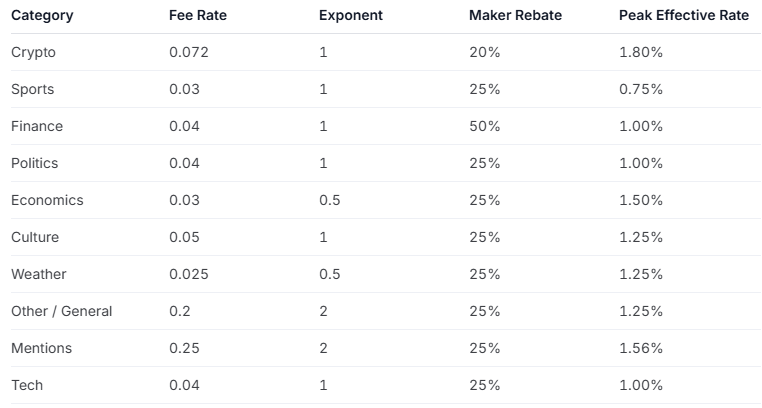
New fee charging standards for various markets

Not News Related to Financing or Token Airdrops, But Opening a Referral Program

This morning, Polymarket posted on X platform announcing that the referral program has been expanded from the internal testing phase to all traders with a trading volume exceeding $10, 000. Eligible users can receive rewards proportional to the trading volume of the new users they refer. Specific invitation details are as follows:

  • 30% fee rebate from direct referrals, 10% fee rebate from secondary referrals (rewards will be valid for the first 180 days after the user registers with Polymarket, this period may be subject to change without notice);
  • Fee rebate rewards are distributed daily (UTC);
  • Rewards are uncapped; the more your referred users trade on the platform, the more you earn.
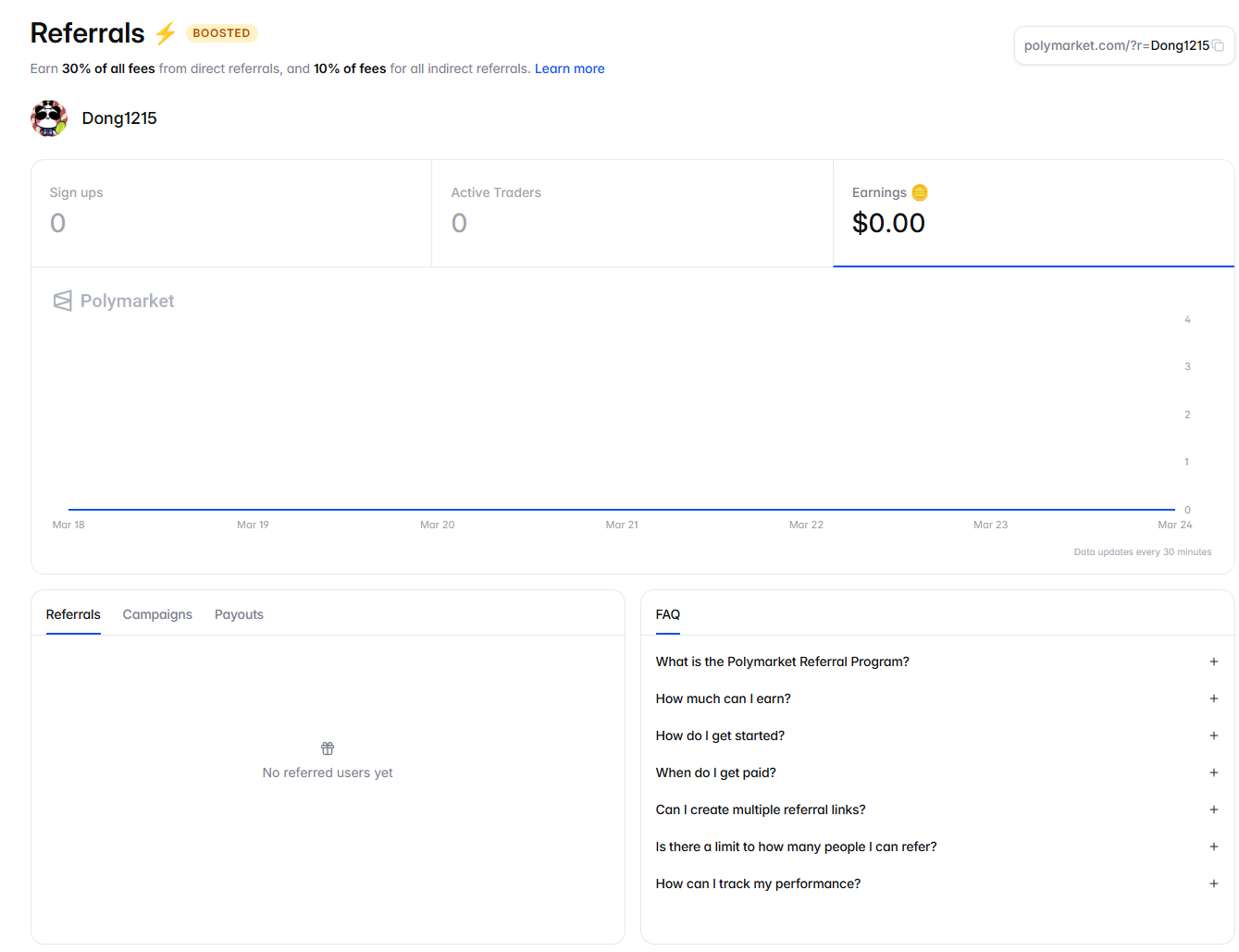
Polymarket invitation interface

Launch of Market Maker Rebate Program

In addition to opening the referral program, to incentivize continuous and competitive quoting, thereby providing a better trading experience for all traders, Polymarket has launched a market maker rebate program. Specifically, this mechanism redistributes a portion of the taker fees to liquidity providers (market makers), effectively redistributing trading costs among market participants.

Rebates are settled and distributed daily in USDC. Only successfully placed orders that are executed contribute to the allocation. The overall profit is not a fixed value but is calculated based on the proportion of liquidity contribution in the actual executed trades. The more trades executed and the higher the contribution, the corresponding rebate received is greater.

In terms of allocation logic, the system calculates the "fee equivalent value" for each executed trade, synthesizing the executed quantity, price, and fee parameters of different markets, and aggregates this within the same market. The final rebate is allocated according to each market maker's contribution share, meaning competition exists not only in whether the quote is executed but also in the price range of the quote and the fee contribution it brings. Overall, this rebate comes from the taker-paid fees, with varying rebate ratios across different markets, e.g., Crypto is 20%, Finance can be 50%, and most categories are around 25%.
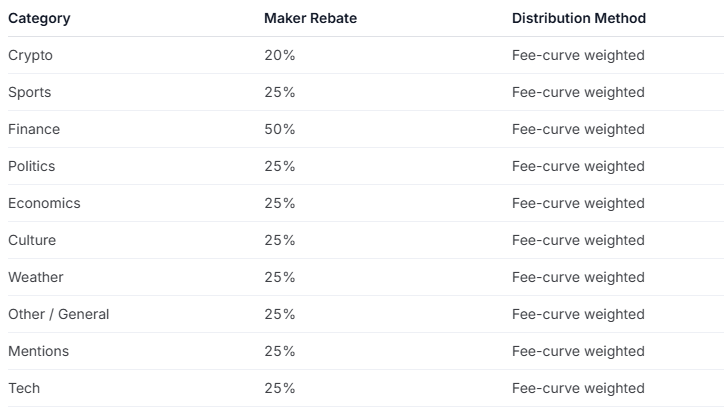
Rebate ratio situation across markets

No Information on Token Airdrops, But Overall Community Sentiment is Optimistic

Although the community previously anticipated that the "major news" might point to a token or airdrop, what ultimately materialized was a combination of updates to fees, rebates, and the referral system. Looking at the outcome, this mechanism leans more towards long-term incentive design rather than a one-time release of expectations. However, sentiment did not cool down because of this; instead, with clear, actionable paths for participation, the overall feedback from the trading community has been positive.

Many users already see the referral program as a "de facto airdrop entry," especially KOLs with their own traffic or community resources, who have noticeably increased their sharing efforts, with some even treating it as a long-term income stream; after the market maker rebate went live, feedback from the LP side was also direct, with more people reassessing their market making strategies, showing a clear increase in willingness to participate.

In contrast, arbitrage traders and those scanning for end-of-market opportunities are calmer. With the arrival of the new fee rules, some previously viable arbitrage spaces will be compressed, strategies need recalculation, and trading rhythms consequently tend to收敛 (converge, become more conservative), relying more on precise execution and cost control.

However, after Polymarket and Kalshi came under regulatory scrutiny, their valuations in the coming period will likely be worn down by policy tensions. (Related news:US lawmakers to propose bipartisan bill banning sports predictions on prediction markets like Polymarket)


Criptos en tendencia

Preguntas relacionadas

QWhat are the three main types of prohibited behaviors under Polymarket's updated market integrity rules?

AThe three main types of prohibited behaviors are: 1. Trading using non-public information that violates a pre-existing duty of trust. 2. Trading based on illegal information sources, if the participant knows the provider of the information was themselves prohibited from using it. 3. Participating in any contract if the participant has the authority or influence to affect the outcome of the event.

QWhen will Polymarket's new fee mechanism take effect, and what is the major change?

AThe new fee mechanism will take effect on March 30, 2026. The major change is the expansion of the taker fee to cover multiple new market categories beyond just Crypto and Sports, including Finance, Politics, Economics, Culture, and Weather.

QWhat is the purpose of Polymarket's newly launched Market Maker Rebate Program?

AThe purpose of the Market Maker Rebate Program is to incentivize continuous and competitive quoting by redistributing a portion of the taker fees back to the market makers who provide liquidity, thereby improving the overall trading experience for all participants.

QWho is eligible to participate in Polymarket's newly expanded Referral Program?

AThe Referral Program has been expanded to all traders with a trading volume exceeding $10,000.

QHow does the new dynamic fee structure work in terms of the relationship between price and the fee rate?

AThe new fee structure features a 'middle high, ends low' distribution. The effective fee rate peaks when the price is near a 50% probability and decreases significantly as the price approaches 0% or 100%, with very small trades potentially being rounded down to a fee of 0.

Lecturas Relacionadas

As Consensus Accelerates, What Are Young Investors Betting On?

Title: As Consensus Forms Faster, What Are Young Investors Betting On? In the rapid evolution of tech investment, a new generation of young investors is navigating a landscape where AI, robotics, commercial aerospace, and quantum computing are advancing simultaneously. Traditional investment logic based on financial models is giving way to a need for deep technical understanding and the ability to act before industry consensus forms. An analysis of trends from the "WAIC FUTURE TECH" list of young investment leaders reveals key shifts in focus. The first major trend is the movement of AI from the digital screen into the physical world. Investment is shifting from large language models and chatbots towards embodied AI, robotics, AI hardware, and edge computing. While demonstrations generate excitement, the real challenge lies in achieving scalable, reliable, and cost-effective delivery in complex real-world environments like factories and logistics. Success depends not just on algorithms but on the integration of sensors, actuators, and control systems. Second, the competitive focus for large models is moving beyond raw capability toward building an "intelligence flywheel." The goal is to create self-reinforcing systems where user interaction generates data, improving the model, which in turn enhances the user experience and attracts more engagement. Companies that successfully embed AI into workflows to create these closed-loop systems can build lasting value that isn't easily erased by the next model upgrade. Third, facing a potential bottleneck in high-quality human-generated data, investors are looking at new underlying technologies. Reinforcement learning and self-play, as demonstrated by AlphaGo Zero, offer paths for AI to generate its own experience. Scientific foundation models, which aim to build general AI capabilities for fields like life sciences and materials discovery, represent a non-consensus direction that could unlock new frontiers of knowledge and data. Finally, in deep-tech areas like quantum computing, commercial aerospace, and space-based infrastructure, patient capital is essential. These fields have long, uncertain development and validation cycles involving complex engineering, supply chains, and regulations. Investment here requires a long-term view, focusing on foundational team capabilities and the eventual emergence of market demand, even if commercial returns are distant. Collectively, these trends illustrate how young investors are adapting to a new era. They are learning to make earlier, technically-informed judgments, balance hype with real-world viability, and provide the patient capital needed to build the deep-tech foundations of the future.

marsbitHace 23 min(s)

As Consensus Accelerates, What Are Young Investors Betting On?

marsbitHace 23 min(s)

Can Japan Buy Growth with AI? Will the Bond Market Believe It?

Japan's cabinet has introduced the 2026 Basic Policy on Economic and Fiscal Management and Reform, shifting its primary fiscal target. The new framework moves away from the traditional annual primary balance goal and instead prioritizes a stable reduction of the debt-to-GDP ratio. This change is tied to a strategy of increased "responsible proactive fiscal" spending, aiming to boost long-term growth through investments in strategic sectors like AI, semiconductors, energy, and robotics. The government estimates total public and private investment in 62 key technologies could exceed 370 trillion yen by 2040. The market reaction has been mixed and cautious. While equity markets may respond to policy signals, bond markets are focused on fiscal credibility. Concerns center on whether the weakening of the clear primary balance anchor could lead to looser fiscal discipline. If investors doubt that these strategic investments will generate sufficient productivity gains, tax revenue, and nominal growth to outpace rising interest costs, they may demand higher yields on Japanese Government Bonds (JGBs). Recent volatility in the yen and JGB yields, with the 10-year yield briefly reaching 2.9%, reflects this skepticism. The success of this new framework hinges on two factors: whether Japan can achieve a nominal growth rate consistently higher than its long-term interest rates, and whether future budgets demonstrate disciplined control over bond issuance. The government's narrative is that strategic investment is essential to break Japan's cycle of low growth, aging, and labor shortages. However, the bond market will continuously assess the credibility of this plan, pricing the risk that it may represent fiscal expansion rather than a viable growth strategy.

marsbitHace 1 hora(s)

Can Japan Buy Growth with AI? Will the Bond Market Believe It?

marsbitHace 1 hora(s)

Misjudged A-Shares: Resilience, Expectations, and Confidence

China's A-share market recently faced selling pressure, especially in tech sectors, initially triggered by a global tech sell-off that began in South Korea. However, the article argues this is a case of "mistaken injury" and highlights the market's underlying resilience. This resilience stems from three main pillars: **1) Tech Sector Fundamentals:** Unlike Korea's market dominated by a few memory chip stocks, China's tech sector is diversified across computing, communications, electronics, and semiconductors, supported by dual narratives of global AI supply chains and domestic substitution. Core areas like optical modules and fiber optics continue to show strong earnings growth. **2) "National Team" Support:** State-backed institutions and large corporations have made significant market purchases and announced buybacks, providing liquidity and signaling confidence. This is seen as a stabilizing policy signal, often associated with market bottoms. **3) Broader Market Pillars:** Other major sectors are showing endogenous recovery momentum. Consumer stocks benefit from stabilizing CPI and signs of sector recovery (e.g., liquor price hikes). Cyclical sectors like aluminum have high earnings, potential price increases due to tight supply, and low valuations. The financial sector offers stable dividends and low valuations. The conclusion is that the sell-off was driven by external contagion, not a collapse in fundamentals. With strong policy support and recovering momentum across key sectors, the A-share market possesses the toughness to regain stability.

marsbitHace 1 hora(s)

Misjudged A-Shares: Resilience, Expectations, and Confidence

marsbitHace 1 hora(s)

Trading

Spot

Artículos destacados

Qué es $S$

Entendiendo SPERO: Una Visión General Completa Introducción a SPERO A medida que el panorama de la innovación continúa evolucionando, la aparición de tecnologías web3 y proyectos de criptomonedas juega un papel fundamental en la configuración del futuro digital. Un proyecto que ha atraído la atención en este campo dinámico es SPERO, denotado como SPERO,$$s$. Este artículo tiene como objetivo reunir y presentar información detallada sobre SPERO, para ayudar a entusiastas e inversores a comprender sus fundamentos, objetivos e innovaciones dentro de los dominios web3 y cripto. ¿Qué es SPERO,$$s$? SPERO,$$s$ es un proyecto único dentro del espacio cripto que busca aprovechar los principios de descentralización y tecnología blockchain para crear un ecosistema que promueva la participación, la utilidad y la inclusión financiera. El proyecto está diseñado para facilitar interacciones de igual a igual de nuevas maneras, proporcionando a los usuarios soluciones y servicios financieros innovadores. En su esencia, SPERO,$$s$ tiene como objetivo empoderar a los individuos al proporcionar herramientas y plataformas que mejoren la experiencia del usuario en el espacio de las criptomonedas. Esto incluye habilitar métodos de transacción más flexibles, fomentar iniciativas impulsadas por la comunidad y crear caminos para oportunidades financieras a través de aplicaciones descentralizadas (dApps). La visión subyacente de SPERO,$$s$ gira en torno a la inclusividad, buscando cerrar brechas dentro de las finanzas tradicionales mientras aprovecha los beneficios de la tecnología blockchain. ¿Quién es el Creador de SPERO,$$s$? La identidad del creador de SPERO,$$s$ sigue siendo algo oscura, ya que hay recursos públicos limitados que proporcionan información de fondo detallada sobre su(s) fundador(es). Esta falta de transparencia puede derivarse del compromiso del proyecto con la descentralización, una ética que muchos proyectos web3 comparten, priorizando las contribuciones colectivas sobre el reconocimiento individual. Al centrar las discusiones en torno a la comunidad y sus objetivos colectivos, SPERO,$$s$ encarna la esencia del empoderamiento sin señalar a individuos específicos. Como tal, comprender la ética y la misión de SPERO sigue siendo más importante que identificar a un creador singular. ¿Quiénes son los Inversores de SPERO,$$s$? SPERO,$$s$ cuenta con el apoyo de una diversa gama de inversores que van desde capitalistas de riesgo hasta inversores ángeles dedicados a fomentar la innovación en el sector cripto. El enfoque de estos inversores generalmente se alinea con la misión de SPERO, priorizando proyectos que prometen avances tecnológicos sociales, inclusión financiera y gobernanza descentralizada. Estas fundaciones de inversores suelen estar interesadas en proyectos que no solo ofrecen productos innovadores, sino que también contribuyen positivamente a la comunidad blockchain y sus ecosistemas. El respaldo de estos inversores refuerza a SPERO,$$s$ como un contendiente notable en el dominio de proyectos cripto que evoluciona rápidamente. ¿Cómo Funciona SPERO,$$s$? SPERO,$$s$ emplea un marco multifacético que lo distingue de los proyectos de criptomonedas convencionales. Aquí hay algunas de las características clave que subrayan su singularidad e innovación: Gobernanza Descentralizada: SPERO,$$s$ integra modelos de gobernanza descentralizada, empoderando a los usuarios para participar activamente en los procesos de toma de decisiones sobre el futuro del proyecto. Este enfoque fomenta un sentido de propiedad y responsabilidad entre los miembros de la comunidad. Utilidad del Token: SPERO,$$s$ utiliza su propio token de criptomoneda, diseñado para servir diversas funciones dentro del ecosistema. Estos tokens permiten transacciones, recompensas y la facilitación de servicios ofrecidos en la plataforma, mejorando la participación y la utilidad general. Arquitectura en Capas: La arquitectura técnica de SPERO,$$s$ apoya la modularidad y escalabilidad, permitiendo la integración fluida de características y aplicaciones adicionales a medida que el proyecto evoluciona. Esta adaptabilidad es fundamental para mantener la relevancia en el cambiante paisaje cripto. Participación de la Comunidad: El proyecto enfatiza iniciativas impulsadas por la comunidad, empleando mecanismos que incentivan la colaboración y la retroalimentación. Al nutrir una comunidad sólida, SPERO,$$s$ puede abordar mejor las necesidades de los usuarios y adaptarse a las tendencias del mercado. Enfoque en la Inclusión: Al ofrecer tarifas de transacción bajas e interfaces amigables para el usuario, SPERO,$$s$ busca atraer a una base de usuarios diversa, incluyendo a individuos que anteriormente pueden no haber participado en el espacio cripto. Este compromiso con la inclusión se alinea con su misión general de empoderamiento a través de la accesibilidad. Cronología de SPERO,$$s$ Entender la historia de un proyecto proporciona información crucial sobre su trayectoria de desarrollo y hitos. A continuación se presenta una cronología sugerida que mapea eventos significativos en la evolución de SPERO,$$s$: Fase de Conceptualización e Ideación: Las ideas iniciales que forman la base de SPERO,$$s$ fueron concebidas, alineándose estrechamente con los principios de descentralización y enfoque comunitario dentro de la industria blockchain. Lanzamiento del Whitepaper del Proyecto: Tras la fase conceptual, se lanzó un whitepaper completo que detalla la visión, los objetivos y la infraestructura tecnológica de SPERO,$$s$ para generar interés y retroalimentación de la comunidad. Construcción de Comunidad y Primeras Interacciones: Se realizaron esfuerzos de divulgación activa para construir una comunidad de primeros adoptantes y posibles inversores, facilitando discusiones en torno a los objetivos del proyecto y obteniendo apoyo. Evento de Generación de Tokens: SPERO,$$s$ llevó a cabo un evento de generación de tokens (TGE) para distribuir sus tokens nativos a los primeros seguidores y establecer liquidez inicial dentro del ecosistema. Lanzamiento de la dApp Inicial: La primera aplicación descentralizada (dApp) asociada con SPERO,$$s$ se puso en marcha, permitiendo a los usuarios interactuar con las funcionalidades centrales de la plataforma. Desarrollo Continuo y Alianzas: Actualizaciones y mejoras continuas a las ofertas del proyecto, incluyendo alianzas estratégicas con otros actores en el espacio blockchain, han moldeado a SPERO,$$s$ en un jugador competitivo y en evolución en el mercado cripto. Conclusión SPERO,$$s$ se erige como un testimonio del potencial de web3 y las criptomonedas para revolucionar los sistemas financieros y empoderar a los individuos. Con un compromiso con la gobernanza descentralizada, la participación comunitaria y funcionalidades diseñadas de manera innovadora, allana el camino hacia un paisaje financiero más inclusivo. Como con cualquier inversión en el espacio cripto que evoluciona rápidamente, se anima a los posibles inversores y usuarios a investigar a fondo y participar de manera reflexiva con los desarrollos en curso dentro de SPERO,$$s$. El proyecto muestra el espíritu innovador de la industria cripto, invitando a una mayor exploración de sus innumerables posibilidades. Mientras el viaje de SPERO,$$s$ aún se desarrolla, sus principios fundamentales pueden, de hecho, influir en el futuro de cómo interactuamos con la tecnología, las finanzas y entre nosotros en ecosistemas digitales interconectados.

150 Vistas totalesPublicado en 2024.12.17Actualizado en 2024.12.17

Qué es $S$

Qué es AGENT S

Agent S: El Futuro de la Interacción Autónoma en Web3 Introducción En el paisaje en constante evolución de Web3 y las criptomonedas, las innovaciones están redefiniendo constantemente cómo los individuos interactúan con las plataformas digitales. Uno de estos proyectos pioneros, Agent S, promete revolucionar la interacción humano-computadora a través de su marco agente abierto. Al allanar el camino para interacciones autónomas, Agent S busca simplificar tareas complejas, ofreciendo aplicaciones transformadoras en inteligencia artificial (IA). Esta exploración detallada profundizará en las complejidades del proyecto, sus características únicas y las implicaciones para el dominio de las criptomonedas. ¿Qué es Agent S? Agent S se presenta como un marco agente abierto innovador, diseñado específicamente para abordar tres desafíos fundamentales en la automatización de tareas informáticas: Adquisición de Conocimiento Específico del Dominio: El marco aprende inteligentemente de diversas fuentes de conocimiento externas y experiencias internas. Este enfoque dual le permite construir un rico repositorio de conocimiento específico del dominio, mejorando su rendimiento en la ejecución de tareas. Planificación a Largo Plazo de Tareas: Agent S emplea planificación jerárquica aumentada por la experiencia, un enfoque estratégico que facilita la descomposición y ejecución eficiente de tareas complejas. Esta característica mejora significativamente su capacidad para gestionar múltiples subtareas de manera eficiente y efectiva. Manejo de Interfaces Dinámicas y No Uniformes: El proyecto introduce la Interfaz Agente-Computadora (ACI), una solución innovadora que mejora la interacción entre agentes y usuarios. Utilizando Modelos de Lenguaje Multimodal de Gran Escala (MLLMs), Agent S puede navegar y manipular diversas interfaces gráficas de usuario sin problemas. A través de estas características pioneras, Agent S proporciona un marco robusto que aborda las complejidades involucradas en la automatización de la interacción humana con las máquinas, preparando el terreno para una multitud de aplicaciones en IA y más allá. ¿Quién es el Creador de Agent S? Si bien el concepto de Agent S es fundamentalmente innovador, la información específica sobre su creador sigue siendo elusiva. El creador es actualmente desconocido, lo que resalta ya sea la etapa incipiente del proyecto o la elección estratégica de mantener a los miembros fundadores en el anonimato. Independientemente de la anonimidad, el enfoque sigue siendo en las capacidades y el potencial del marco. ¿Quiénes son los Inversores de Agent S? Dado que Agent S es relativamente nuevo en el ecosistema criptográfico, la información detallada sobre sus inversores y patrocinadores financieros no está documentada explícitamente. La falta de información disponible públicamente sobre las bases de inversión u organizaciones que apoyan el proyecto plantea preguntas sobre su estructura de financiamiento y hoja de ruta de desarrollo. Comprender el respaldo es crucial para evaluar la sostenibilidad del proyecto y su posible impacto en el mercado. ¿Cómo Funciona Agent S? En el núcleo de Agent S se encuentra una tecnología de vanguardia que le permite funcionar de manera efectiva en diversos entornos. Su modelo operativo se basa en varias características clave: Interacción Humano-Computadora Similar a la Humana: El marco ofrece planificación avanzada de IA, esforzándose por hacer que las interacciones con las computadoras sean más intuitivas. Al imitar el comportamiento humano en la ejecución de tareas, promete elevar las experiencias de los usuarios. Memoria Narrativa: Empleada para aprovechar experiencias de alto nivel, Agent S utiliza memoria narrativa para hacer un seguimiento de las historias de tareas, mejorando así sus procesos de toma de decisiones. Memoria Episódica: Esta característica proporciona a los usuarios una guía paso a paso, permitiendo que el marco ofrezca apoyo contextual a medida que se desarrollan las tareas. Soporte para OpenACI: Con la capacidad de ejecutarse localmente, Agent S permite a los usuarios mantener el control sobre sus interacciones y flujos de trabajo, alineándose con la ética descentralizada de Web3. Fácil Integración con APIs Externas: Su versatilidad y compatibilidad con varias plataformas de IA aseguran que Agent S pueda encajar sin problemas en ecosistemas tecnológicos existentes, convirtiéndolo en una opción atractiva para desarrolladores y organizaciones. Estas funcionalidades contribuyen colectivamente a la posición única de Agent S dentro del espacio cripto, ya que automatiza tareas complejas y de múltiples pasos con una intervención humana mínima. A medida que el proyecto evoluciona, sus posibles aplicaciones en Web3 podrían redefinir cómo se desarrollan las interacciones digitales. Cronología de Agent S El desarrollo y los hitos de Agent S pueden encapsularse en una cronología que resalta sus eventos significativos: 27 de septiembre de 2024: El concepto de Agent S fue lanzado en un documento de investigación integral titulado “Un Marco Agente Abierto que Usa Computadoras Como un Humano”, mostrando las bases del proyecto. 10 de octubre de 2024: El documento de investigación fue puesto a disposición del público en arXiv, ofreciendo una exploración profunda del marco y su evaluación de rendimiento basada en el benchmark OSWorld. 12 de octubre de 2024: Se lanzó una presentación en video, proporcionando una visión visual de las capacidades y características de Agent S, involucrando aún más a posibles usuarios e inversores. Estos marcadores en la cronología no solo ilustran el progreso de Agent S, sino que también indican su compromiso con la transparencia y la participación comunitaria. Puntos Clave Sobre Agent S A medida que el marco Agent S continúa evolucionando, varios atributos clave destacan, subrayando su naturaleza innovadora y potencial: Marco Innovador: Diseñado para proporcionar un uso intuitivo de las computadoras similar a la interacción humana, Agent S aporta un enfoque novedoso a la automatización de tareas. Interacción Autónoma: La capacidad de interactuar de manera autónoma con las computadoras a través de GUI significa un salto hacia soluciones informáticas más inteligentes y eficientes. Automatización de Tareas Complejas: Con su metodología robusta, puede automatizar tareas complejas y de múltiples pasos, haciendo que los procesos sean más rápidos y menos propensos a errores. Mejora Continua: Los mecanismos de aprendizaje permiten a Agent S mejorar a partir de experiencias pasadas, mejorando continuamente su rendimiento y eficacia. Versatilidad: Su adaptabilidad en diferentes entornos operativos como OSWorld y WindowsAgentArena asegura que pueda servir a una amplia gama de aplicaciones. A medida que Agent S se posiciona en el paisaje de Web3 y criptomonedas, su potencial para mejorar las capacidades de interacción y automatizar procesos significa un avance significativo en las tecnologías de IA. A través de su marco innovador, Agent S ejemplifica el futuro de las interacciones digitales, prometiendo una experiencia más fluida y eficiente para los usuarios en diversas industrias. Conclusión Agent S representa un audaz avance en la unión de la IA y Web3, con la capacidad de redefinir cómo interactuamos con la tecnología. Aunque aún se encuentra en sus primeras etapas, las posibilidades para su aplicación son vastas y atractivas. A través de su marco integral que aborda desafíos críticos, Agent S busca llevar las interacciones autónomas al primer plano de la experiencia digital. A medida que nos adentramos más en los reinos de las criptomonedas y la descentralización, proyectos como Agent S sin duda desempeñarán un papel crucial en la configuración del futuro de la tecnología y la colaboración humano-computadora.

561 Vistas totalesPublicado en 2025.01.14Actualizado en 2025.01.14

Qué es AGENT S

Cómo comprar S

¡Bienvenido a HTX.com! Hemos hecho que comprar Sonic (S) sea simple y conveniente. Sigue nuestra guía paso a paso para iniciar tu viaje de criptos.Paso 1: crea tu cuenta HTXUtiliza tu correo electrónico o número de teléfono para registrarte y obtener una cuenta gratuita en HTX. Experimenta un proceso de registro sin complicaciones y desbloquea todas las funciones.Obtener mi cuentaPaso 2: ve a Comprar cripto y elige tu método de pagoTarjeta de crédito/débito: usa tu Visa o Mastercard para comprar Sonic (S) al instante.Saldo: utiliza fondos del saldo de tu cuenta HTX para tradear sin problemas.Terceros: hemos agregado métodos de pago populares como Google Pay y Apple Pay para mejorar la comodidad.P2P: tradear directamente con otros usuarios en HTX.Over-the-Counter (OTC): ofrecemos servicios personalizados y tipos de cambio competitivos para los traders.Paso 3: guarda tu Sonic (S)Después de comprar tu Sonic (S), guárdalo en tu cuenta HTX. Alternativamente, puedes enviarlo a otro lugar mediante transferencia blockchain o utilizarlo para tradear otras criptomonedas.Paso 4: tradear Sonic (S)Tradear fácilmente con Sonic (S) en HTX's mercado spot. Simplemente accede a tu cuenta, selecciona tu par de trading, ejecuta tus trades y monitorea en tiempo real. Ofrecemos una experiencia fácil de usar tanto para principiantes como para traders experimentados.

1.1k Vistas totalesPublicado en 2025.01.15Actualizado en 2026.06.02

Cómo comprar S

Discusiones

Bienvenido a la comunidad de HTX. Aquí puedes mantenerte informado sobre los últimos desarrollos de la plataforma y acceder a análisis profesionales del mercado. A continuación se presentan las opiniones de los usuarios sobre el precio de S (S).

活动图片













