Interop Roadmap "Acceleration": After Fusaka Upgrade, Ethereum Interoperability May Take a Key Leap

深潮Publicado a 2025-12-11Actualizado a 2025-12-11

Resumen

The Ethereum Fusaka upgrade, while primarily noted for expanding blob capacity and reducing L2 data costs, introduced the underappreciated EIP-7825—a critical enabler for Ethereum’s ZK and interoperability roadmap. EIP-7825 imposes a per-transaction gas limit (~16.78 million gas), preventing "mega-transactions" from blocking entire blocks. This change makes proof generation parallelizable, transforming it from a logic-bound challenge into a solvable computational problem. As a result, real-time ZK proofs become feasible, even for large blocks, paving the way for near-instant finality. This upgrade supports the development of L1 zkEVM, which can serve as a trust anchor for L2s, enabling secure, instant cross-chain communication without relying on optimistic challenge periods or centralized bridges. Furthermore, the shift from zkEVM to more efficient zkVM architectures is accelerated by EIP-7825, as zkVMs can leverage parallelization for faster, cheaper proof generation. Ultimately, these advancements are key to achieving seamless interoperability—not just for asset transfers, but for generalized cross-chain logic and communication—bringing Ethereum closer to a future where users experience a unified, chain-agnostic interface powered by real-time ZK verification.

Author: imToken

In previous articles of the Interop series, we discussed OIF (Intent Framework) and EIL (Interoperability Layer), which respectively address the standardization of cross-chain intents (making the entire network understand what you want to do) and the execution channel issue (enabling funds to move in a standardized manner).

However, achieving a perfect "single-chain experience" still faces the trade-off between speed and trust. After all, in the current interoperability experience, one must either endure slowness (such as Optimistic Rollup requiring a 7-day challenge period to confirm finality) or sacrifice decentralization (relying on the trust assumptions of multi-signature bridges).

To break this "impossible triangle," it is essential to have a foundational capability that spans the "Acceleration" and finalization (Finalisation) of Ethereum's interoperability roadmap—the "real-time proof" brought by ZK technology (extended reading: "Ethereum Interop Roadmap: How to Unlock the 'Last Mile' of Mass Adoption").

And in the recently activated Fusaka upgrade, the inconspicuous EIP-7825 has cleared the biggest engineering obstacle for this ultimate goal.

I. The Underestimated EIP-7825 Behind the Fusaka Upgrade

On December 4, the Ethereum Fusaka upgrade was officially activated on the mainnet. Unlike the fanfare of the Dencun upgrade, the market spotlight was mostly focused on Blob scaling and PeerDAS, with much discussion about the further reduction of L2 data costs.

But beyond this noise, there was actually an inconspicuous proposal, EIP-7825, which cleared the biggest obstacle for Ethereum to achieve L1 zkEVM and real-time proofs, and can even be said to be quietly paving the way for the ultimate goal of Interop.

In this Fusaka upgrade, the focus was almost entirely on scaling: Blob capacity expanded by 8 times, combined with PeerDAS random sampling verification, making the cost narrative of the DA (Data Availability) track a thing of the past.

Indeed, cheaper L2s are a good thing, but for Ethereum's long-term ZK roadmap, EIP-7825 is the real game-changer because it sets a Gas limit for a single transaction on Ethereum (about 16.78 million Gas).

As we all know, Ethereum's block Gas Limit has been increased to 60 million this year. But even as the upper limit continues to rise, theoretically, if someone is willing to pay an extremely high Gas Price, they could still send a super-complex "Mega-Transaction" that directly occupies the entire block's 60 million Gas capacity, thereby clogging the entire block.

This was allowed before, but EIP-7825 introduces a new restriction: no single transaction can consume more than 16.78 million Gas, regardless of the block size.

So why limit the size of a single transaction? Actually, this change has no impact on ordinary user transfers, but for ZK Provers (proof generators), it is a matter of life and death, and it is also closely related to how ZK systems generate proofs.

To give a simple example, before EIP-7825, if a block contained a "Mega-Transaction" consuming 60 million Gas, the ZK Prover had to run this extremely complex transaction sequentially—it couldn't be split or parallelized. This is like a single-lane highway where a giant truck is driving extremely slowly in front, and all the cars behind (other transactions) have to wait for it to pass.

This undoubtedly sentenced "real-time proof" to death—because the time to generate the proof becomes completely unpredictable, potentially taking dozens of minutes or even longer.

After EIP-7825, even if the block capacity expands to 100 million Gas in the future, since each transaction is forcibly limited to within 16.78 million Gas, each block is broken down into predictable, bounded, and parallelizable "small task units." This means that Ethereum's proof generation has changed from a tricky "logical puzzle" to a pure "money problem":

As long as enough parallel computing power can be invested, we can process these split small tasks simultaneously in an extremely short time, thereby generating ZK proofs for huge blocks.

As Michael, co-founder and CEO of Brevis, said, EIP-7825 is the most underestimated upgrade on the future path of ZK and Ethereum's 100x scaling. It turns "real-time proof" from "theoretically impossible" to "engineerable," as long as we can solve the computing power problem through parallel computing. Even a 200 million Gas block could achieve second-level proofs. This is not only a breakthrough in ZK technology but also the physical foundation for Ethereum's Interoperability Layer (EIL) to achieve second-level cross-chain settlement.
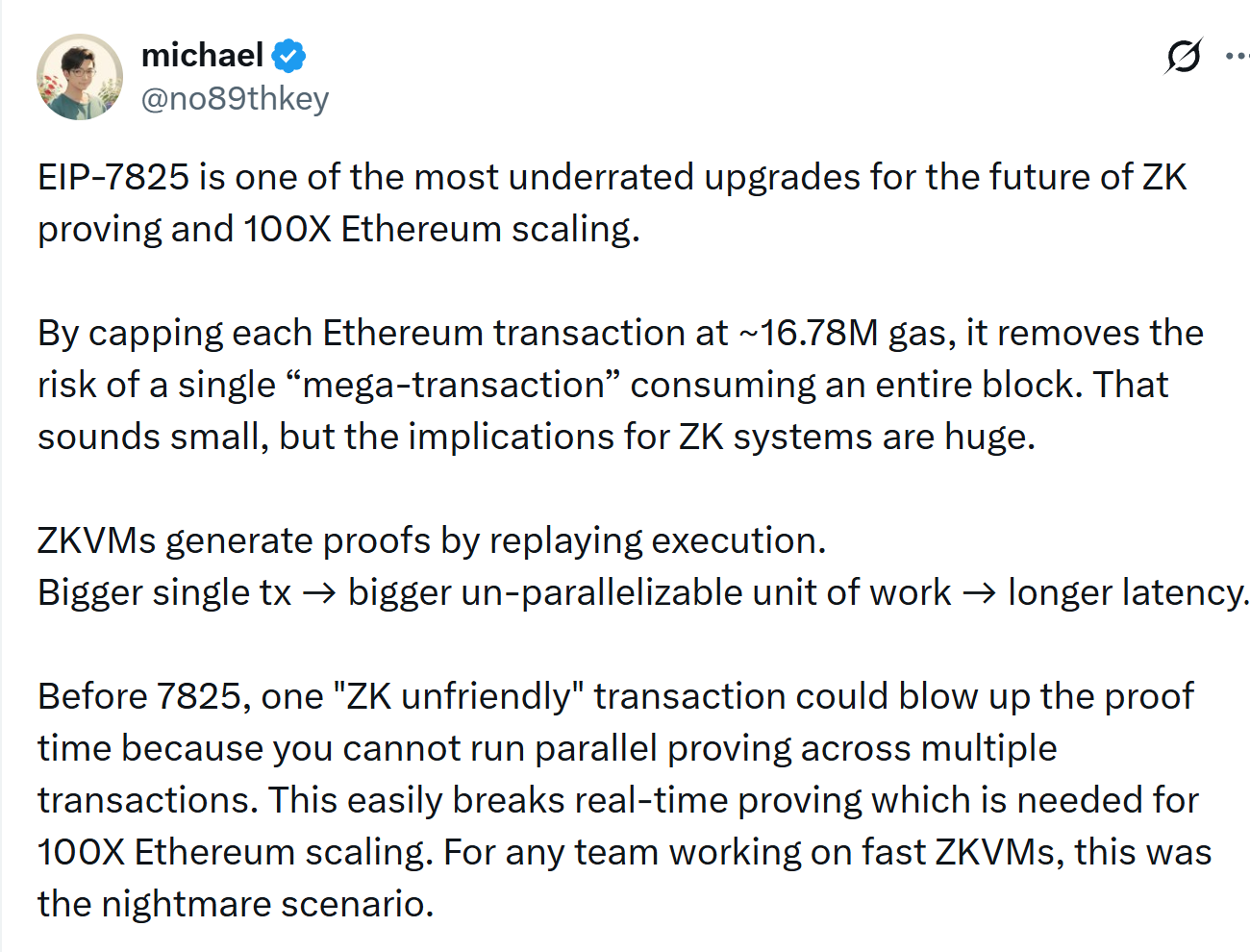
So this upgrade may not seem like the main event, but it is actually a huge breakthrough for the ZK roadmap and Ethereum's scaling future in 2026.

II. L1 zkEVM: The "Trust Anchor" for Ethereum Interoperability

However, although EIP-7825 paves the physical path (parallelizability) for real-time proofs by limiting the size of single transactions, this is only one side of the coin. The other side is how the Ethereum mainnet itself utilizes this capability?

This involves the most hardcore narrative in Ethereum's roadmap—L1 zkEVM.

For a long time, zkEVM has been regarded as the "holy grail" for scaling Ethereum, not only because it can solve performance bottlenecks but also because it redefines the trust mechanism of blockchain. Its core idea is to enable the Ethereum mainnet to generate and verify ZK proofs.

In other words, in the future, after each Ethereum block is executed, it can output a verifiable mathematical proof, allowing other nodes (especially light nodes and L2s) to confirm the correctness of the result without recalculating—if the ability to generate ZK proofs is directly written into the Ethereum protocol layer (L1), the proposer (Proposer) packs a block and generates a ZK proof, and the verifying nodes no longer need to rerun the transactions; they only need to verify this tiny mathematical proof.

What does this mean for interoperability?

In the context of Interop, the significance of L1 zkEVM far exceeds scaling itself. It can be said to be the "trust anchor" for all L2s. After all, if Ethereum L1 can generate proofs in real time, it means that all L2s can read L1's final state in real time and trustlessly. This will bring about two qualitative changes:

  • Eliminate the challenge period: The confirmation time between chains will be compressed from "7 days (OP mechanism)" to "seconds (ZK mechanism)";

  • Decentralized interconnection: Cross-chain will no longer require trust in third-party multi-signature bridges but will trust the mathematical truth of the Ethereum mainnet;

This is also the physical foundation we mentioned in the previous article for EIL (Interoperability Layer) to truly work—without L1's real-time finality, interoperability between L2s will never escape the shadow of "delay."

The goal is set (L1 zkEVM), and the physical limitations are removed (EIP-7825), but what about the specific implementation tools?

This leads to the subtle evolution happening in the ZK technology stack: from zkEVM to zkVM.

III. Fusaka & EIP-7825: The Interoperability Roadmap is Liberated

If EIP-7825 provides a "parallelizable hardware environment" for ZK by limiting the size of single transactions, then the evolution of the ZK technology stack is to find a "more efficient software architecture." This may sound like a tongue twister, but the difference is significant and represents two stages of ZK development (extended reading: "ZK Route 'Dawn Moment': Is Ethereum's Endgame Roadmap Accelerating Comprehensively?").

The first stage is naturally zkEVM, which can be regarded as the compatibility faction or the reformist faction.

The logic is to strive to imitate every instruction of the Ethereum EVM, allowing developers to deploy Solidity code directly, reducing migration costs and barriers.

In other words, the biggest advantage of zkEVM is its compatibility with existing Ethereum applications, greatly reducing the workload for Ethereum ecosystem developers. They can reuse most of the existing infrastructure and tools (including execution clients, block explorers, debugging tools, etc.).

However, precisely because of this, since the EVM was not designed with ZK-friendliness in mind, for the sake of compatibility, zkEVM's proof efficiency often has a ceiling, and the proof time is much slower, with a heavy historical burden.

zkVM, on the other hand, belongs to the radical revolutionary faction, directly building a virtual machine that is extremely friendly to ZK proofs (such as based on RISC-V or WASM) to speed up proof time and achieve better execution speed and performance.

But it also loses compatibility with many EVM features and the ability to use existing tools (such as low-level debuggers). However, a clear trend is that more and more L2 projects are shedding their burdens, optimizing proof speed and cost to the extreme, and exploring architectures based on zkVM.

So why is the Fusaka upgrade the unlocker?

After all, before EIP-7825, whether it was zkEVM or zkVM, once they encountered a Mega-Transaction on Ethereum, the proof generation time would skyrocket due to the inability to split tasks.

Now, EIP-7825 forcibly breaks down transactions into predictable small units. With a parallelizable environment, an efficient architecture like zkVM can exert its maximum power. Even complex Ethereum blocks, when placed in a zkVM and combined with parallel computing power, can achieve real-time proofs.

What does this mean for interoperability? The proliferation of zkVM combined with EIP-7825 means that the cost of generating proofs will drop significantly. When the cost of generating a cross-chain proof is low enough to be negligible and the speed is as fast as sending an email, traditional "cross-chain bridges" will completely disappear, replaced by underlying universal message protocols.

In Conclusion

As repeatedly mentioned in previous articles of the Interop series, the ultimate goal of Interop is not just asset "cross-chain," nor is it limited to the concept of "asset bridges" anymore. It is a set of system-level capabilities, including cross-chain data communication, cross-chain logic execution, cross-chain user experience, cross-chain security, and consensus.

From this perspective, Interop can be understood as the universal language between future Ethereum ecosystem protocols. Its significance lies not only in transmitting value but also in sharing logic. The role of ZK in this is to guarantee execution correctness and support real-time state verification, making cross-domain calls "dare to do, able to do." It can even be said that without real-time ZK, it is difficult to have truly usable Interop UX.

So when EIP-7825 was quietly activated in the Fusaka upgrade, and as L1 zkEVM gradually becomes a reality, we are getting closer to that endgame: execution, settlement, and proof are completely abstracted in the background, and users are completely unaware of the existence of chains throughout the process.

This is the Interop endgame we all look forward to in the future.

Criptos en tendencia

Preguntas relacionadas

QWhat is the significance of EIP-7825 in the Fusaka upgrade for Ethereum's interoperability?

AEIP-7825 introduces a per-transaction gas limit of approximately 16.78 million gas, which prevents 'mega-transactions' from blocking the entire block. This allows ZK provers to process transactions in parallel, making real-time proof generation for large blocks feasible and paving the way for instant cross-chain settlements in Ethereum's interoperability layer (EIL).

QHow does L1 zkEVM serve as a 'trust anchor' for Ethereum's interoperability?

AL1 zkEVM enables Ethereum mainnet to generate and verify ZK proofs for its own blocks. This allows L2s to read L1's finalized state in real-time without trust assumptions, eliminating challenge periods (e.g., reducing from 7 days to seconds) and enabling decentralized cross-chain interactions without relying on third-party bridges.

QWhat is the key difference between zkEVM and zkVM in the context of ZK technology evolution?

AzkEVM focuses on compatibility with Ethereum's EVM, allowing developers to reuse existing tools and infrastructure but often at the cost of slower proof generation due to EVM's ZK-unfriendly design. zkVM prioritizes proof efficiency and performance by building a ZK-friendly virtual machine (e.g., based on RISC-V or WASM), sacrificing some EVM compatibility for faster execution and lower costs.

QHow does EIP-7825 combined with zkVM architecture improve interoperability?

AEIP-7825 breaks down transactions into small, parallelizable units, while zkVM provides an efficient architecture for proof generation. Together, they drastically reduce the cost and time required to generate cross-chain proofs, making traditional bridges obsolete and enabling seamless, instant cross-chain communication at the protocol level.

QWhat is the ultimate goal of Interop (interoperability) in the Ethereum ecosystem according to the article?

AThe ultimate goal of Interop is not just cross-chain asset transfers but a comprehensive system-level capability that includes cross-chain data communication, logic execution, user experience, security, and consensus. It aims to create a universal language for Ethereum protocols, enabling value transfer and logic sharing with real-time state verification powered by ZK technology, all abstracted away from end-users for a seamless experience.

Lecturas Relacionadas

Will History Repeat Itself? Fidelity Lists Five Catalysts to End the Crypto Winter

Fidelity's new report suggests that the current crypto winter for Bitcoin may be nearing its end, identifying five potential catalysts that could drive a market turnaround based on historical patterns. First, Bitcoin's approximately four-year cycle, driven by its halving mechanism, historically marks peaks and troughs. The last bottom was in November 2022, potentially pointing to the next around November 2026, though cycle length can vary. Second, clearer regulation has often preceded past bull markets. The focus is now on the CLARITY Act, which aims to clarify US digital asset oversight between the SEC and CFTC. Its passage could unlock domestic activity currently held back by legal uncertainty. Third, Federal Reserve monetary policy plays a role. A shift to lower interest rates tends to correlate with rising crypto prices by reducing borrowing costs and boosting risk appetite, though markets may price this in well ahead of any official change. Fourth, the emergence of breakthrough applications can fuel investor interest. Current trends like real-world asset tokenization, AI-related crypto infrastructure, and stablecoins are being watched, but history shows the biggest catalysts are often unexpected. Fifth, a new wave of institutional adoption could be a trigger. While ongoing adoption in 2026 hasn't sparked a new bull run, a major unexpected move—like a significant purchase by a tech giant or adoption as a hedge in a global crisis—could create a powerful new narrative. Fidelity concludes that while the market is in a downturn, historical turning points have often resulted from a combination of such factors, and the next phase for Bitcoin may depend on which of these catalysts materializes first.

Foresight NewsHace 9 min(s)

Will History Repeat Itself? Fidelity Lists Five Catalysts to End the Crypto Winter

Foresight NewsHace 9 min(s)

US CFTC Launches Broad Investigation into Polymarket, Is the Prediction Market Party Coming to an End?

The U.S. Commodity Futures Trading Commission (CFTC) is conducting a broad investigation into the prediction market platform Polymarket, focusing on its business practices including social media promotions. This follows a bipartisan letter from U.S. senators urging the CFTC to probe alleged fraudulent marketing tactics used to promote gambling-like products. The action coincides with a period of explosive growth for the prediction market sector, driven by events like the World Cup, with platforms like Kalshi and Robinhood reporting record trading volumes and revenue. The investigation signals a potential end to the sector's unregulated expansion and may lead to clearer federal oversight, particularly regarding investor protection and distinguishing prediction markets from traditional sports betting. The CFTC's move has also intensified a jurisdictional conflict with multiple U.S. states (including Kentucky and New York), which have sued platforms like Polymarket and Kalshi, accusing them of operating illegal sports betting and threatening state gambling tax revenues. Furthermore, the CME Group has sued the CFTC, challenging its approval of certain prediction market products. The report also highlights the political and capital interests intertwined with the industry. Donald Trump Jr. holds advisory and investment roles in both Kalshi and Polymarket, and the Trump administration has previously emphasized federal regulatory authority over these markets. The CFTC's investigation into Polymarket is framed as a step towards formalizing the industry's regulatory landscape, moving it from a phase of "wild growth" towards a more structured future.

marsbitHace 2 hora(s)

US CFTC Launches Broad Investigation into Polymarket, Is the Prediction Market Party Coming to an End?

marsbitHace 2 hora(s)

U.S. CFTC Launches Extensive Investigation into Polymarket, Is the Prediction Market Frenzy Season Cooling Down?

The U.S. Commodity Futures Trading Commission (CFTC) has launched a broad investigation into the prediction market platform Polymarket, focusing on its business practices including social media activities. This follows a bipartisan letter from U.S. senators urging the CFTC to probe allegations of paid influencer false marketing and fraudulent promotion of gambling-like products to American users. The investigation comes as the prediction market sector experiences explosive growth, largely driven by the World Cup. Weekly trading volumes have hit record highs, exceeding $14.4 billion, with platforms like Kalshi and Robinhood's new venture seeing significant activity. Major firms like Meta are also showing interest in the space. This regulatory scrutiny signals a potential end to the sector's "wild growth" phase. The CFTC's move also highlights an escalating jurisdictional conflict between federal regulators and state authorities. Over a dozen states, including Kentucky and New York, have sued platforms like Polymarket and Kalshi, accusing them of operating illegal sports betting, which threatens state gambling tax revenues. The CFTC is countersuing to assert its exclusive federal jurisdiction over these "event contracts" as derivatives. Furthermore, the CFTC's approval of Kalshi's Bitcoin perpetual futures contract has sparked a lawsuit from traditional exchange CME, alleging regulatory overreach. The political and capital landscape is intricate, with Donald Trump Jr. holding advisory roles and investments in both Kalshi and Polymarket. This connects capital, political influence, and regulatory bodies, suggesting the current investigation may be a step toward formalizing the industry's rules rather than halting its progress.

Odaily星球日报Hace 2 hora(s)

U.S. CFTC Launches Extensive Investigation into Polymarket, Is the Prediction Market Frenzy Season Cooling Down?

Odaily星球日报Hace 2 hora(s)

Trading

Spot

Artículos destacados

Cómo comprar NASDAQ100

¡Bienvenido a HTX.com! Hemos hecho que comprar Nasdaq-100 Index (NASDAQ100) sea simple y conveniente. Sigue nuestra guía paso a paso para iniciar tu viaje de criptos.Paso 1: crea tu cuenta HTXUtiliza tu correo electrónico o número de teléfono para registrarte y obtener una cuenta gratuita en HTX. Experimenta un proceso de registro sin complicaciones y desbloquea todas las funciones.Obtener mi cuentaPaso 2: ve a Comprar cripto y elige tu método de pagoTarjeta de crédito/débito: usa tu Visa o Mastercard para comprar Nasdaq-100 Index (NASDAQ100) al instante.Saldo: utiliza fondos del saldo de tu cuenta HTX para tradear sin problemas.Terceros: hemos agregado métodos de pago populares como Google Pay y Apple Pay para mejorar la comodidad.P2P: tradear directamente con otros usuarios en HTX.Over-the-Counter (OTC): ofrecemos servicios personalizados y tipos de cambio competitivos para los traders.Paso 3: guarda tu Nasdaq-100 Index (NASDAQ100)Después de comprar tu Nasdaq-100 Index (NASDAQ100), guárdalo en tu cuenta HTX. Alternativamente, puedes enviarlo a otro lugar mediante transferencia blockchain o utilizarlo para tradear otras criptomonedas.Paso 4: tradear Nasdaq-100 Index (NASDAQ100)Tradear fácilmente con Nasdaq-100 Index (NASDAQ100) en HTX's mercado spot. Simplemente accede a tu cuenta, selecciona tu par de trading, ejecuta tus trades y monitorea en tiempo real. Ofrecemos una experiencia fácil de usar tanto para principiantes como para traders experimentados.

19 Vistas totalesPublicado en 2026.06.18Actualizado en 2026.06.18

Cómo comprar NASDAQ100

Qué es RE

I. Introducción al Proyecto1. ¿Qué es Re Protocol?Re Protocol es un protocolo de reaseguro descentralizado que conecta capital de stablecoin con mercados de reaseguro regulados en el mundo real. Los usuarios depositan stablecoins en el contrato inteligente de la Capa de Capital de Seguros (ICL). Los fondos depositados se utilizan para respaldar contratos de reaseguro totalmente colateralizados, y los depositantes ganan recompensas a cambio. El rendimiento se deriva de fuentes tanto en cadena como fuera de cadena, además de diferenciales específicos de tokens. El protocolo opera en múltiples cadenas, incluyendo Ethereum, Avalanche y Arbitrum.2. ¿Cómo funciona Re Protocol?Los usuarios depositan activos aprobados (como USDC, USDe, sUSDe) en contratos inteligentes de ICL para acuñar uno de dos tokens generadores de rendimiento. Los fondos se agregan diariamente en una bóveda de custodia de Fireblocks, mantenida bajo control de múltiples firmas, con saldos publicados diariamente a oráculos de Chainlink. Cuando los reaseguradores licenciados retiran fondos de acuerdo con una Nota de Superávit, una parte del capital se transfiere a cuentas fiduciarias de reaseguro §114 domiciliadas en EE. UU., sirviendo como colateral conforme para las pólizas del reasegurador. A medida que los contratos de reaseguro maduran y el equipo actuarial libera capital, la liquidez regresa al protocolo, apoyando los canjes de reUSD y acumulando rendimiento para ambos tokens.El protocolo ofrece dos tokens que corresponden a diferentes tramos en la estructura de capital:reUSD (Basis-Plus, Tramo Senior): El rendimiento es una tasa combinada (promedio ponderado de SOFR y tasa sUSDe de 7 días) más un diferencial de 250 puntos básicos. Ofrece mayor liquidez y apoya el canje instantáneo cuando hay capacidad disponible.reUSDe (Insurance Alpha, Tramo Junior): El rendimiento es la misma tasa combinada más un diferencial de 850 puntos básicos, a cambio de absorber pérdidas antes del tramo senior. Los canjes son trimestrales. reUSDe tiene un período mínimo de tenencia de al menos 40 días.Capa de Protección de Capital: El propio capital del reasegurador absorbe las pérdidas primero, seguido por reUSDe, siendo reUSD el tramo más senior protegido por las dos capas debajo de él.3. ¿Quién fundó Re Protocol?Karn Saroya, Co-Fundador y CEO, se graduó del MIT. Anteriormente fundó la plataforma de insurtech respaldada por capital de riesgo Cover (una correduría licenciada, que luego cesó operaciones) y antes fundó la aplicación de moda Stylekick (adquirida por Shopify en 2015). También trabajó anteriormente en consultoría de servicios financieros.Detalles de Financiamiento:Septiembre de 2022: Re completó una ronda de financiamiento Seed de $14 millones liderada por Tribe Capital (incubada a través de sus Tribe Crypto Labs), con participación de Framework Ventures, Morgan Creek Digital, Defy VC, Stratos, Exor, SiriusPoint y otros.Mayo de 2024: Completó una ronda de financiamiento de $7 millones liderada por Electric Capital.4. Tokenómica de Re ProtocolRE es el token de gobernanza de Re Protocol con un suministro total fijo de 1 mil millones de tokens, sin mecanismo inflacionario y sin plan de acuñación continua. El token se utiliza para gobernanza a través de un modelo de participación para votar, cubriendo acceso al mercado, presupuestos de incentivos, staking y delegación, comités, actualizaciones del protocolo y capital de resiliencia compartido.Distribución de tokens:Ecosistema (50%): Utilizado para recompensas de staking, participación en gobernanza, liquidez, integraciones, subvenciones, expansión de mercado y crecimiento del ecosistema. 159.6 millones de tokens están circulando en el TGE, con el resto sujeto a un vesting lineal durante 48 meses.Contribuyentes Clave (20%): Incluye a los contribuyentes clave y asesores que construyen el protocolo, sistemas de gobernanza, integraciones, marcos de riesgo e infraestructura de mercado; 12 meses de cliff más 36 meses de vesting lineal.Inversores (17%): Patrocinadores estratégicos; 12 meses de cliff más 36 meses de vesting lineal.Reserva de Desarrollo del Ecosistema (13%): Reserva a largo plazo para futuras contribuciones y contribuyentes.5. Cronología de Hitos ClaveSeptiembre de 2022: Re completó una ronda de financiamiento Seed de $14 millones, debutó públicamente y se posicionó como el primer protocolo de reaseguro impulsado por blockchain, construido inicialmente en Avalanche.Mayo de 2024: Completó una ronda de financiamiento de $7 millones liderada por Electric Capital.18 de junio de 2026: El token $RE se lanzó oficialmente.​II. Información del TokenNombre del token: RE(Re)III. Enlaces RelacionadosSitio web:https://re.xyz/Exploradores:https://etherscan.io/token/0x526526528f35ac738177003b8773b402b8df8143Twitter:https://twitter.com/reNota: La introducción del proyecto proviene de los materiales publicados o proporcionados por el equipo oficial del proyecto, que es solo para referencia y no constituye asesoramiento de inversión. HTX no se hace responsable de ninguna pérdida directa o indirecta resultante.

262 Vistas totalesPublicado en 2026.06.18Actualizado en 2026.06.29

Qué es RE

Cómo comprar RE

¡Bienvenido a HTX.com! Hemos hecho que comprar Re (RE) sea simple y conveniente. Sigue nuestra guía paso a paso para iniciar tu viaje de criptos.Paso 1: crea tu cuenta HTXUtiliza tu correo electrónico o número de teléfono para registrarte y obtener una cuenta gratuita en HTX. Experimenta un proceso de registro sin complicaciones y desbloquea todas las funciones.Obtener mi cuentaPaso 2: ve a Comprar cripto y elige tu método de pagoTarjeta de crédito/débito: usa tu Visa o Mastercard para comprar Re (RE) al instante.Saldo: utiliza fondos del saldo de tu cuenta HTX para tradear sin problemas.Terceros: hemos agregado métodos de pago populares como Google Pay y Apple Pay para mejorar la comodidad.P2P: tradear directamente con otros usuarios en HTX.Over-the-Counter (OTC): ofrecemos servicios personalizados y tipos de cambio competitivos para los traders.Paso 3: guarda tu Re (RE)Después de comprar tu Re (RE), guárdalo en tu cuenta HTX. Alternativamente, puedes enviarlo a otro lugar mediante transferencia blockchain o utilizarlo para tradear otras criptomonedas.Paso 4: tradear Re (RE)Tradear fácilmente con Re (RE) en HTX's mercado spot. Simplemente accede a tu cuenta, selecciona tu par de trading, ejecuta tus trades y monitorea en tiempo real. Ofrecemos una experiencia fácil de usar tanto para principiantes como para traders experimentados.

74 Vistas totalesPublicado en 2026.06.18Actualizado en 2026.06.29

Cómo comprar RE

Discusiones

Bienvenido a la comunidad de HTX. Aquí puedes mantenerte informado sobre los últimos desarrollos de la plataforma y acceder a análisis profesionales del mercado. A continuación se presentan las opiniones de los usuarios sobre el precio de A (A).

活动图片