Interop Roadmap "Acceleration": After Fusaka Upgrade, Ethereum Interoperability May Take a Key Leap

深潮Publicado a 2025-12-11Actualizado a 2025-12-11

Resumen

The Ethereum Fusaka upgrade, while primarily noted for expanding blob capacity and reducing L2 data costs, introduced the underappreciated EIP-7825—a critical enabler for Ethereum’s ZK and interoperability roadmap. EIP-7825 imposes a per-transaction gas limit (~16.78 million gas), preventing "mega-transactions" from blocking entire blocks. This change makes proof generation parallelizable, transforming it from a logic-bound challenge into a solvable computational problem. As a result, real-time ZK proofs become feasible, even for large blocks, paving the way for near-instant finality. This upgrade supports the development of L1 zkEVM, which can serve as a trust anchor for L2s, enabling secure, instant cross-chain communication without relying on optimistic challenge periods or centralized bridges. Furthermore, the shift from zkEVM to more efficient zkVM architectures is accelerated by EIP-7825, as zkVMs can leverage parallelization for faster, cheaper proof generation. Ultimately, these advancements are key to achieving seamless interoperability—not just for asset transfers, but for generalized cross-chain logic and communication—bringing Ethereum closer to a future where users experience a unified, chain-agnostic interface powered by real-time ZK verification.

Author: imToken

In previous articles of the Interop series, we discussed OIF (Intent Framework) and EIL (Interoperability Layer), which respectively address the standardization of cross-chain intents (making the entire network understand what you want to do) and the execution channel issue (enabling funds to move in a standardized manner).

However, achieving a perfect "single-chain experience" still faces the trade-off between speed and trust. After all, in the current interoperability experience, one must either endure slowness (such as Optimistic Rollup requiring a 7-day challenge period to confirm finality) or sacrifice decentralization (relying on the trust assumptions of multi-signature bridges).

To break this "impossible triangle," it is essential to have a foundational capability that spans the "Acceleration" and finalization (Finalisation) of Ethereum's interoperability roadmap—the "real-time proof" brought by ZK technology (extended reading: "Ethereum Interop Roadmap: How to Unlock the 'Last Mile' of Mass Adoption").

And in the recently activated Fusaka upgrade, the inconspicuous EIP-7825 has cleared the biggest engineering obstacle for this ultimate goal.

I. The Underestimated EIP-7825 Behind the Fusaka Upgrade

On December 4, the Ethereum Fusaka upgrade was officially activated on the mainnet. Unlike the fanfare of the Dencun upgrade, the market spotlight was mostly focused on Blob scaling and PeerDAS, with much discussion about the further reduction of L2 data costs.

But beyond this noise, there was actually an inconspicuous proposal, EIP-7825, which cleared the biggest obstacle for Ethereum to achieve L1 zkEVM and real-time proofs, and can even be said to be quietly paving the way for the ultimate goal of Interop.

In this Fusaka upgrade, the focus was almost entirely on scaling: Blob capacity expanded by 8 times, combined with PeerDAS random sampling verification, making the cost narrative of the DA (Data Availability) track a thing of the past.

Indeed, cheaper L2s are a good thing, but for Ethereum's long-term ZK roadmap, EIP-7825 is the real game-changer because it sets a Gas limit for a single transaction on Ethereum (about 16.78 million Gas).

As we all know, Ethereum's block Gas Limit has been increased to 60 million this year. But even as the upper limit continues to rise, theoretically, if someone is willing to pay an extremely high Gas Price, they could still send a super-complex "Mega-Transaction" that directly occupies the entire block's 60 million Gas capacity, thereby clogging the entire block.

This was allowed before, but EIP-7825 introduces a new restriction: no single transaction can consume more than 16.78 million Gas, regardless of the block size.

So why limit the size of a single transaction? Actually, this change has no impact on ordinary user transfers, but for ZK Provers (proof generators), it is a matter of life and death, and it is also closely related to how ZK systems generate proofs.

To give a simple example, before EIP-7825, if a block contained a "Mega-Transaction" consuming 60 million Gas, the ZK Prover had to run this extremely complex transaction sequentially—it couldn't be split or parallelized. This is like a single-lane highway where a giant truck is driving extremely slowly in front, and all the cars behind (other transactions) have to wait for it to pass.

This undoubtedly sentenced "real-time proof" to death—because the time to generate the proof becomes completely unpredictable, potentially taking dozens of minutes or even longer.

After EIP-7825, even if the block capacity expands to 100 million Gas in the future, since each transaction is forcibly limited to within 16.78 million Gas, each block is broken down into predictable, bounded, and parallelizable "small task units." This means that Ethereum's proof generation has changed from a tricky "logical puzzle" to a pure "money problem":

As long as enough parallel computing power can be invested, we can process these split small tasks simultaneously in an extremely short time, thereby generating ZK proofs for huge blocks.

As Michael, co-founder and CEO of Brevis, said, EIP-7825 is the most underestimated upgrade on the future path of ZK and Ethereum's 100x scaling. It turns "real-time proof" from "theoretically impossible" to "engineerable," as long as we can solve the computing power problem through parallel computing. Even a 200 million Gas block could achieve second-level proofs. This is not only a breakthrough in ZK technology but also the physical foundation for Ethereum's Interoperability Layer (EIL) to achieve second-level cross-chain settlement.
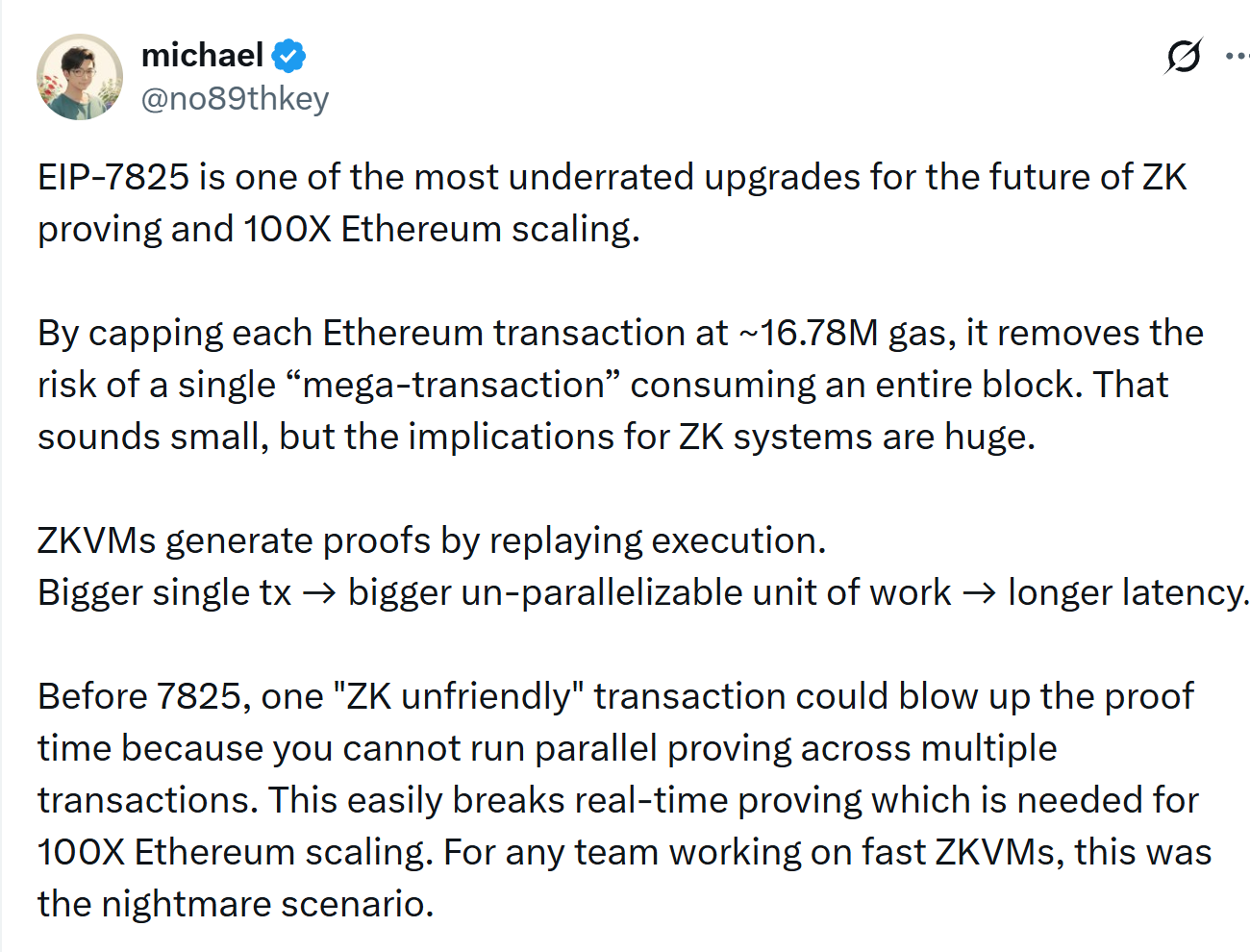
So this upgrade may not seem like the main event, but it is actually a huge breakthrough for the ZK roadmap and Ethereum's scaling future in 2026.

II. L1 zkEVM: The "Trust Anchor" for Ethereum Interoperability

However, although EIP-7825 paves the physical path (parallelizability) for real-time proofs by limiting the size of single transactions, this is only one side of the coin. The other side is how the Ethereum mainnet itself utilizes this capability?

This involves the most hardcore narrative in Ethereum's roadmap—L1 zkEVM.

For a long time, zkEVM has been regarded as the "holy grail" for scaling Ethereum, not only because it can solve performance bottlenecks but also because it redefines the trust mechanism of blockchain. Its core idea is to enable the Ethereum mainnet to generate and verify ZK proofs.

In other words, in the future, after each Ethereum block is executed, it can output a verifiable mathematical proof, allowing other nodes (especially light nodes and L2s) to confirm the correctness of the result without recalculating—if the ability to generate ZK proofs is directly written into the Ethereum protocol layer (L1), the proposer (Proposer) packs a block and generates a ZK proof, and the verifying nodes no longer need to rerun the transactions; they only need to verify this tiny mathematical proof.

What does this mean for interoperability?

In the context of Interop, the significance of L1 zkEVM far exceeds scaling itself. It can be said to be the "trust anchor" for all L2s. After all, if Ethereum L1 can generate proofs in real time, it means that all L2s can read L1's final state in real time and trustlessly. This will bring about two qualitative changes:

  • Eliminate the challenge period: The confirmation time between chains will be compressed from "7 days (OP mechanism)" to "seconds (ZK mechanism)";

  • Decentralized interconnection: Cross-chain will no longer require trust in third-party multi-signature bridges but will trust the mathematical truth of the Ethereum mainnet;

This is also the physical foundation we mentioned in the previous article for EIL (Interoperability Layer) to truly work—without L1's real-time finality, interoperability between L2s will never escape the shadow of "delay."

The goal is set (L1 zkEVM), and the physical limitations are removed (EIP-7825), but what about the specific implementation tools?

This leads to the subtle evolution happening in the ZK technology stack: from zkEVM to zkVM.

III. Fusaka & EIP-7825: The Interoperability Roadmap is Liberated

If EIP-7825 provides a "parallelizable hardware environment" for ZK by limiting the size of single transactions, then the evolution of the ZK technology stack is to find a "more efficient software architecture." This may sound like a tongue twister, but the difference is significant and represents two stages of ZK development (extended reading: "ZK Route 'Dawn Moment': Is Ethereum's Endgame Roadmap Accelerating Comprehensively?").

The first stage is naturally zkEVM, which can be regarded as the compatibility faction or the reformist faction.

The logic is to strive to imitate every instruction of the Ethereum EVM, allowing developers to deploy Solidity code directly, reducing migration costs and barriers.

In other words, the biggest advantage of zkEVM is its compatibility with existing Ethereum applications, greatly reducing the workload for Ethereum ecosystem developers. They can reuse most of the existing infrastructure and tools (including execution clients, block explorers, debugging tools, etc.).

However, precisely because of this, since the EVM was not designed with ZK-friendliness in mind, for the sake of compatibility, zkEVM's proof efficiency often has a ceiling, and the proof time is much slower, with a heavy historical burden.

zkVM, on the other hand, belongs to the radical revolutionary faction, directly building a virtual machine that is extremely friendly to ZK proofs (such as based on RISC-V or WASM) to speed up proof time and achieve better execution speed and performance.

But it also loses compatibility with many EVM features and the ability to use existing tools (such as low-level debuggers). However, a clear trend is that more and more L2 projects are shedding their burdens, optimizing proof speed and cost to the extreme, and exploring architectures based on zkVM.

So why is the Fusaka upgrade the unlocker?

After all, before EIP-7825, whether it was zkEVM or zkVM, once they encountered a Mega-Transaction on Ethereum, the proof generation time would skyrocket due to the inability to split tasks.

Now, EIP-7825 forcibly breaks down transactions into predictable small units. With a parallelizable environment, an efficient architecture like zkVM can exert its maximum power. Even complex Ethereum blocks, when placed in a zkVM and combined with parallel computing power, can achieve real-time proofs.

What does this mean for interoperability? The proliferation of zkVM combined with EIP-7825 means that the cost of generating proofs will drop significantly. When the cost of generating a cross-chain proof is low enough to be negligible and the speed is as fast as sending an email, traditional "cross-chain bridges" will completely disappear, replaced by underlying universal message protocols.

In Conclusion

As repeatedly mentioned in previous articles of the Interop series, the ultimate goal of Interop is not just asset "cross-chain," nor is it limited to the concept of "asset bridges" anymore. It is a set of system-level capabilities, including cross-chain data communication, cross-chain logic execution, cross-chain user experience, cross-chain security, and consensus.

From this perspective, Interop can be understood as the universal language between future Ethereum ecosystem protocols. Its significance lies not only in transmitting value but also in sharing logic. The role of ZK in this is to guarantee execution correctness and support real-time state verification, making cross-domain calls "dare to do, able to do." It can even be said that without real-time ZK, it is difficult to have truly usable Interop UX.

So when EIP-7825 was quietly activated in the Fusaka upgrade, and as L1 zkEVM gradually becomes a reality, we are getting closer to that endgame: execution, settlement, and proof are completely abstracted in the background, and users are completely unaware of the existence of chains throughout the process.

This is the Interop endgame we all look forward to in the future.

Preguntas relacionadas

QWhat is the significance of EIP-7825 in the Fusaka upgrade for Ethereum's interoperability?

AEIP-7825 introduces a per-transaction gas limit of approximately 16.78 million gas, which prevents 'mega-transactions' from blocking the entire block. This allows ZK provers to process transactions in parallel, making real-time proof generation for large blocks feasible and paving the way for instant cross-chain settlements in Ethereum's interoperability layer (EIL).

QHow does L1 zkEVM serve as a 'trust anchor' for Ethereum's interoperability?

AL1 zkEVM enables Ethereum mainnet to generate and verify ZK proofs for its own blocks. This allows L2s to read L1's finalized state in real-time without trust assumptions, eliminating challenge periods (e.g., reducing from 7 days to seconds) and enabling decentralized cross-chain interactions without relying on third-party bridges.

QWhat is the key difference between zkEVM and zkVM in the context of ZK technology evolution?

AzkEVM focuses on compatibility with Ethereum's EVM, allowing developers to reuse existing tools and infrastructure but often at the cost of slower proof generation due to EVM's ZK-unfriendly design. zkVM prioritizes proof efficiency and performance by building a ZK-friendly virtual machine (e.g., based on RISC-V or WASM), sacrificing some EVM compatibility for faster execution and lower costs.

QHow does EIP-7825 combined with zkVM architecture improve interoperability?

AEIP-7825 breaks down transactions into small, parallelizable units, while zkVM provides an efficient architecture for proof generation. Together, they drastically reduce the cost and time required to generate cross-chain proofs, making traditional bridges obsolete and enabling seamless, instant cross-chain communication at the protocol level.

QWhat is the ultimate goal of Interop (interoperability) in the Ethereum ecosystem according to the article?

AThe ultimate goal of Interop is not just cross-chain asset transfers but a comprehensive system-level capability that includes cross-chain data communication, logic execution, user experience, security, and consensus. It aims to create a universal language for Ethereum protocols, enabling value transfer and logic sharing with real-time state verification powered by ZK technology, all abstracted away from end-users for a seamless experience.

Lecturas Relacionadas

Fu Peng's First Public Speech in 2026: What Exactly Are Crypto Assets? Why Did I Join the Crypto Asset Industry?

Fu Peng, a renowned macroeconomist and now Chief Economist at New火 Group, delivered his first public speech of 2026 at the Hong Kong Web3 Festival. He explained his perspective on crypto assets and why he joined the industry, framing it within the context of macroeconomic trends and financial evolution. Fu emphasized that crypto assets are transitioning from an early, belief-driven phase to a mature, institutionally integrated asset class. He drew parallels to the 1970s-80s, when technological advances (like computing) revolutionized traditional finance, leading to the rise of FICC (Fixed Income, Currencies, and Commodities). Similarly, current advancements in AI, data, and blockchain are reshaping finance, with crypto assets becoming part of a new "FICC + C" (C for Crypto) framework. He noted that institutional capital, including traditional hedge funds, avoided early crypto due to its speculative nature but are now engaging as regulatory clarity emerges (e.g., stablecoin laws, CFTC classifying crypto as a commodity). Fu predicted that 2025-2026 marks a turning point where crypto becomes a standardized, financially viable asset for diversified portfolios, akin to commodities or derivatives in traditional finance. Fu defined Bitcoin not as "digital gold" in a simplistic sense but as a value-preserving, financially tradable asset. He highlighted that crypto's future lies in regulated, institutional adoption, moving away from retail-dominated trading. His entry into crypto signals this maturation, where traditional finance integrates crypto into mainstream asset management.

marsbitHace 4 min(s)

Fu Peng's First Public Speech in 2026: What Exactly Are Crypto Assets? Why Did I Join the Crypto Asset Industry?

marsbitHace 4 min(s)

Justin Sun Sues Trump Family: What $75 Million Bought Was Only a Blacklist

Justin Sun, founder of Tron, has filed a lawsuit in federal court against World Liberty Financial (WLF), alleging he was made the "primary target of a fraudulent scheme" after investing $75 million. Sun claims the investment secured him an advisor title and WLFI tokens, which were later frozen by WLF, causing "hundreds of millions in losses." The dispute began in late 2024 when Sun's investment helped revive WLF's struggling token sale, which ultimately raised $550 million. Shortly after, the SEC dropped its lawsuit against Sun following Donald Trump's inauguration. However, relations soured when Sun refused WLF's demands for additional funding. In August 2025, WLF added a "blacklist" function to its smart contract, allowing it to unilaterally freeze tokens. Sun's holdings, worth approximately $107 million, were frozen, and he was threatened with token destruction. The lawsuit highlights WLF's structure, which directs 75% of token sale profits to the Trump family, who had earned $1 billion by December 2025. WLF's CEO is Zach Witkoff, son of U.S. Middle East envoy Steve Witkoff. The project faces scrutiny for opaque operations, including a controversial loan arrangement on the Dolomite platform, co-founded by a WLF advisor. Despite Sun's history with the SEC, the case underscores centralization risks within DeFi, as WLF controls governance and holds powers to freeze assets arbitrarily. Sun's tokens remain frozen as legal proceedings begin.

marsbitHace 12 min(s)

Justin Sun Sues Trump Family: What $75 Million Bought Was Only a Blacklist

marsbitHace 12 min(s)

$500 to Buy OpenAI Stock: Silicon Valley's Most Respectable Liquidity Invitation

Silicon Valley's largest venture capital platform, AngelList, has launched a new fund called USVC, allowing U.S. retail investors to buy into high-profile AI companies like OpenAI, Anthropic, and xAI with a minimum investment of $500—no accredited investor status required. Promoted by AngelList co-founder Naval Ravikant, the fund is framed as an opportunity for ordinary people to access high-growth private tech investments traditionally reserved for VCs. However, critics argue it functions more like an exit vehicle for early insiders. USVC acquires shares not through primary rounds but largely via secondary transactions—purchasing stakes from early investors, VC funds, and employees looking to cash out at peak valuations. With companies like xAI heavily weighted in the portfolio, the fund effectively channels retail money into providing liquidity for insiders who entered at much lower valuations. The fund’s structure raises concerns: shares are illiquid, with no secondary market, and buybacks are limited and discretionary. The actual annual fee reaches 3.61%, far above the advertised 1% management fee. This model parallels the "low float, high fully diluted valuation" strategy seen in crypto, where early investors profit by selling to latecomers at inflated prices. The timing—alongside similar moves by platforms like Robinhood—suggests that Silicon Valley’s sudden interest in retail inclusion may be less about democratizing access and more about securing exits for insiders.

marsbitHace 42 min(s)

$500 to Buy OpenAI Stock: Silicon Valley's Most Respectable Liquidity Invitation

marsbitHace 42 min(s)

Trading

Spot
Futuros

Artículos destacados

Cómo comprar CFG

¡Bienvenido a HTX.com! Hemos hecho que comprar Centrifuge (CFG) sea simple y conveniente. Sigue nuestra guía paso a paso para iniciar tu viaje de criptos.Paso 1: crea tu cuenta HTXUtiliza tu correo electrónico o número de teléfono para registrarte y obtener una cuenta gratuita en HTX. Experimenta un proceso de registro sin complicaciones y desbloquea todas las funciones.Obtener mi cuentaPaso 2: ve a Comprar cripto y elige tu método de pagoTarjeta de crédito/débito: usa tu Visa o Mastercard para comprar Centrifuge (CFG) al instante.Saldo: utiliza fondos del saldo de tu cuenta HTX para tradear sin problemas.Terceros: hemos agregado métodos de pago populares como Google Pay y Apple Pay para mejorar la comodidad.P2P: tradear directamente con otros usuarios en HTX.Over-the-Counter (OTC): ofrecemos servicios personalizados y tipos de cambio competitivos para los traders.Paso 3: guarda tu Centrifuge (CFG)Después de comprar tu Centrifuge (CFG), guárdalo en tu cuenta HTX. Alternativamente, puedes enviarlo a otro lugar mediante transferencia blockchain o utilizarlo para tradear otras criptomonedas.Paso 4: tradear Centrifuge (CFG)Tradear fácilmente con Centrifuge (CFG) en HTX's mercado spot. Simplemente accede a tu cuenta, selecciona tu par de trading, ejecuta tus trades y monitorea en tiempo real. Ofrecemos una experiencia fácil de usar tanto para principiantes como para traders experimentados.

256 Vistas totalesPublicado en 2026.03.19Actualizado en 2026.03.19

Cómo comprar CFG

Qué es WL

I. Introducción al ProyectoWorldLand es una L2 o cadena lateral de Ethereum, diseñada como una solución de abajo hacia arriba para mejorar el ecosistema de Ethereum.II. Información del Token1) Información BásicaNombre del token: WL (WorldLand)III. Enlaces RelacionadosSitio web:https://worldland.foundation/Exploradores:https://bscscan.com/address/0x8aaB31fbc69C92fa53f600910Cf0f215531F8239Redes Sociales:https://x.com/WorldLand_space Nota: La introducción del proyecto proviene de los materiales publicados o proporcionados por el equipo oficial del proyecto, que es solo para referencia y no constituye asesoramiento de inversión. HTX no se hace responsable de ninguna pérdida directa o indirecta resultante.

132 Vistas totalesPublicado en 2026.03.28Actualizado en 2026.03.28

Qué es WL

Cómo comprar WL

¡Bienvenido a HTX.com! Hemos hecho que comprar WorldLand (WL) sea simple y conveniente. Sigue nuestra guía paso a paso para iniciar tu viaje de criptos.Paso 1: crea tu cuenta HTXUtiliza tu correo electrónico o número de teléfono para registrarte y obtener una cuenta gratuita en HTX. Experimenta un proceso de registro sin complicaciones y desbloquea todas las funciones.Obtener mi cuentaPaso 2: ve a Comprar cripto y elige tu método de pagoTarjeta de crédito/débito: usa tu Visa o Mastercard para comprar WorldLand (WL) al instante.Saldo: utiliza fondos del saldo de tu cuenta HTX para tradear sin problemas.Terceros: hemos agregado métodos de pago populares como Google Pay y Apple Pay para mejorar la comodidad.P2P: tradear directamente con otros usuarios en HTX.Over-the-Counter (OTC): ofrecemos servicios personalizados y tipos de cambio competitivos para los traders.Paso 3: guarda tu WorldLand (WL)Después de comprar tu WorldLand (WL), guárdalo en tu cuenta HTX. Alternativamente, puedes enviarlo a otro lugar mediante transferencia blockchain o utilizarlo para tradear otras criptomonedas.Paso 4: tradear WorldLand (WL)Tradear fácilmente con WorldLand (WL) en HTX's mercado spot. Simplemente accede a tu cuenta, selecciona tu par de trading, ejecuta tus trades y monitorea en tiempo real. Ofrecemos una experiencia fácil de usar tanto para principiantes como para traders experimentados.

222 Vistas totalesPublicado en 2026.03.28Actualizado en 2026.03.28

Cómo comprar WL

Discusiones

Bienvenido a la comunidad de HTX. Aquí puedes mantenerte informado sobre los últimos desarrollos de la plataforma y acceder a análisis profesionales del mercado. A continuación se presentan las opiniones de los usuarios sobre el precio de A (A).

活动图片