Interactive Tutorial | Total Prize Pool of $1 Million, Jupiter Launches Trading Card Collection Event

Odaily星球日报Publicado a 2025-12-15Actualizado a 2025-12-15

Resumen

Jupiter, a leading Solana-based DEX aggregator, has launched a new trading card collection event with a total prize pool of $1 million USDC. The event runs from December 11, 2025, to February 1, 2026. Users can earn cards by trading specific token pairs—including JUP, JUP/SOL, JUP/jupSOL, and others—using Jupiter’s Ultra Mode (market order) or Limit Order V2. Only trades of $10,000 or more in volume qualify for card rewards. Each card has different rarity levels and corresponding rewards: Common (87.399% chance, 1 USDC), Advanced (10%, 5 USDC), Rare (2.5%, 25 USDC), Mythic (0.1%, 100 USDC), and Legendary (0.001%, 10,000 USDC). Participants are advised to use the Jupiter wallet (browser extension or mobile app) and trade via jup.ag. Estimated cost per card is around $3–5. Users can also earn extra cards through referral links. Note that card opening must be done on the desktop version.

Original | Odaily Planet Daily (@OdailyChina)

Author | Asher (@Asher_ 0210)
Amid the boring market, a new "airdrop farming" opportunity has arrived.

On the evening of December 12, Jupiter announced on the X platform the launch of a trading card collection event with a total prize pool of 1 million USDC. Users can automatically obtain cards by trading specified trading pairs and meeting the corresponding trading volume; they can also get more cards by inviting friends. The cards have different rarities, and scratching them open can yield corresponding USDC rewards.

Below, Odaily Planet Daily will guide everyone through the details of Jupiter's trading card collection event and the participation guide.

Details of Jupiter's Trading Card Collection Event

Event Overview: Trade specified trading pairs on Jupiter (web or mobile) to automatically receive cards. Open the cards to share the rewards.

Total Event Prize Pool: 1 million USDC.

Event Time: December 11, 2025, 15:00 Beijing Time to February 1, 2026, 07:59.

Card Classification: Users automatically receive cards by trading eligible token pairs on Jupiter (web or mobile). Cards are divided into 5 levels. The specific card levels, probabilities, and corresponding rewards are:

  • Common Card: Draw probability 87.399%, reward 1 USDC;
  • Uncommon Card: Draw probability 10%, reward 5 USDC;
  • Rare Card: Draw probability 2.5%, reward 25 USDC;
  • Mythic Card: Draw probability 0.1%, reward 100 USDC;
  • Legendary Card: Draw probability 0.001%, reward 10000 USDC.

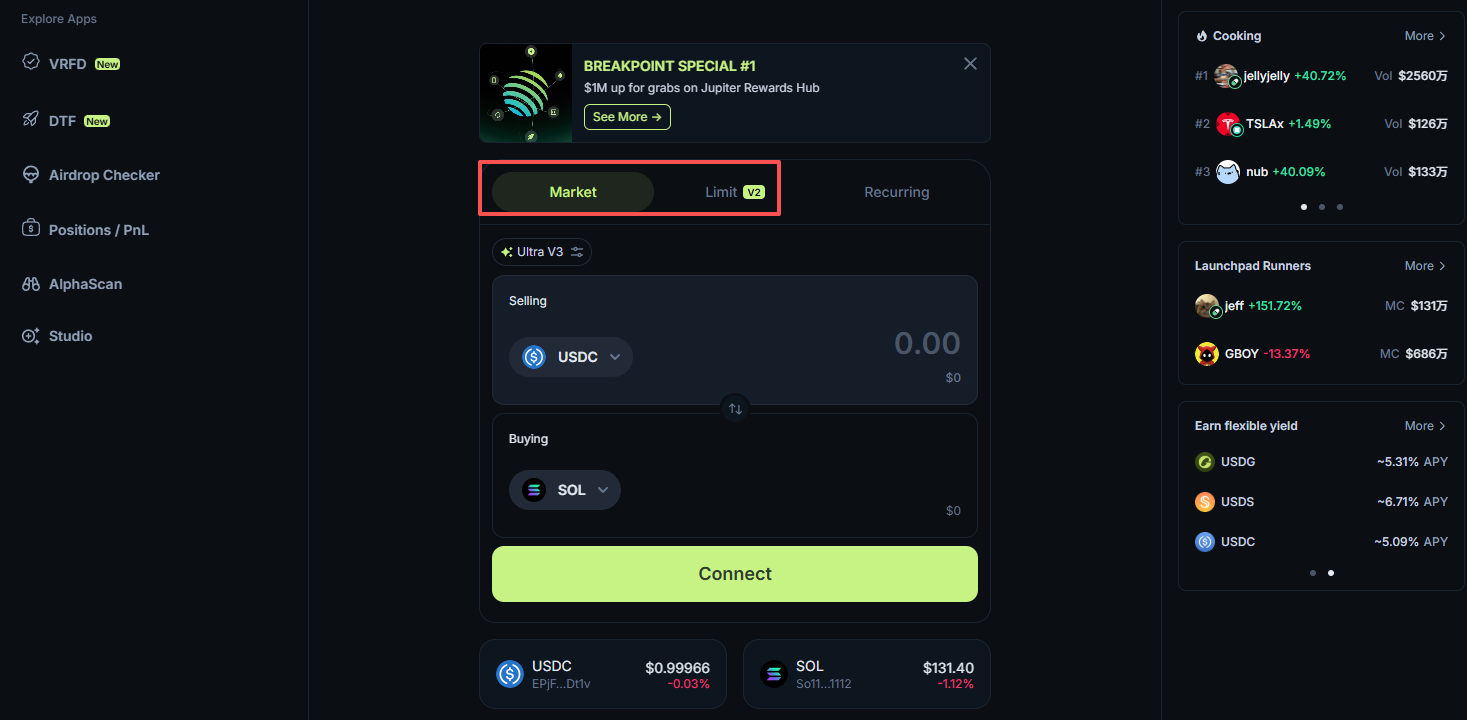
Eligible Trade Types: Only trades executed via Market (Ultra Mode) or Limit Order V2 mode are eligible (V1 and DAC DCA modes cannot participate).
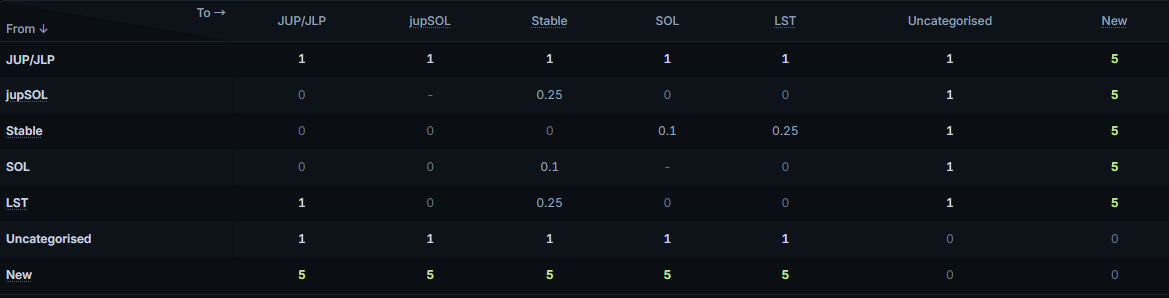
Eligible Trading Pairs: As shown in the table below, including JUP, JUP/SOL, JUP/jupSOL, JUP/Stable, JUP/LST, JUP/Uncategorised, JUP/New (refers to new coins listed on Jupiter within 24 hours). The numbers in the table indicate the number of cards obtained for every $10,000 in trading volume completed. For example, completing $10,000 worth of JUP to SOL trading volume yields 1 card.
Step-by-Step Participation Tutorial

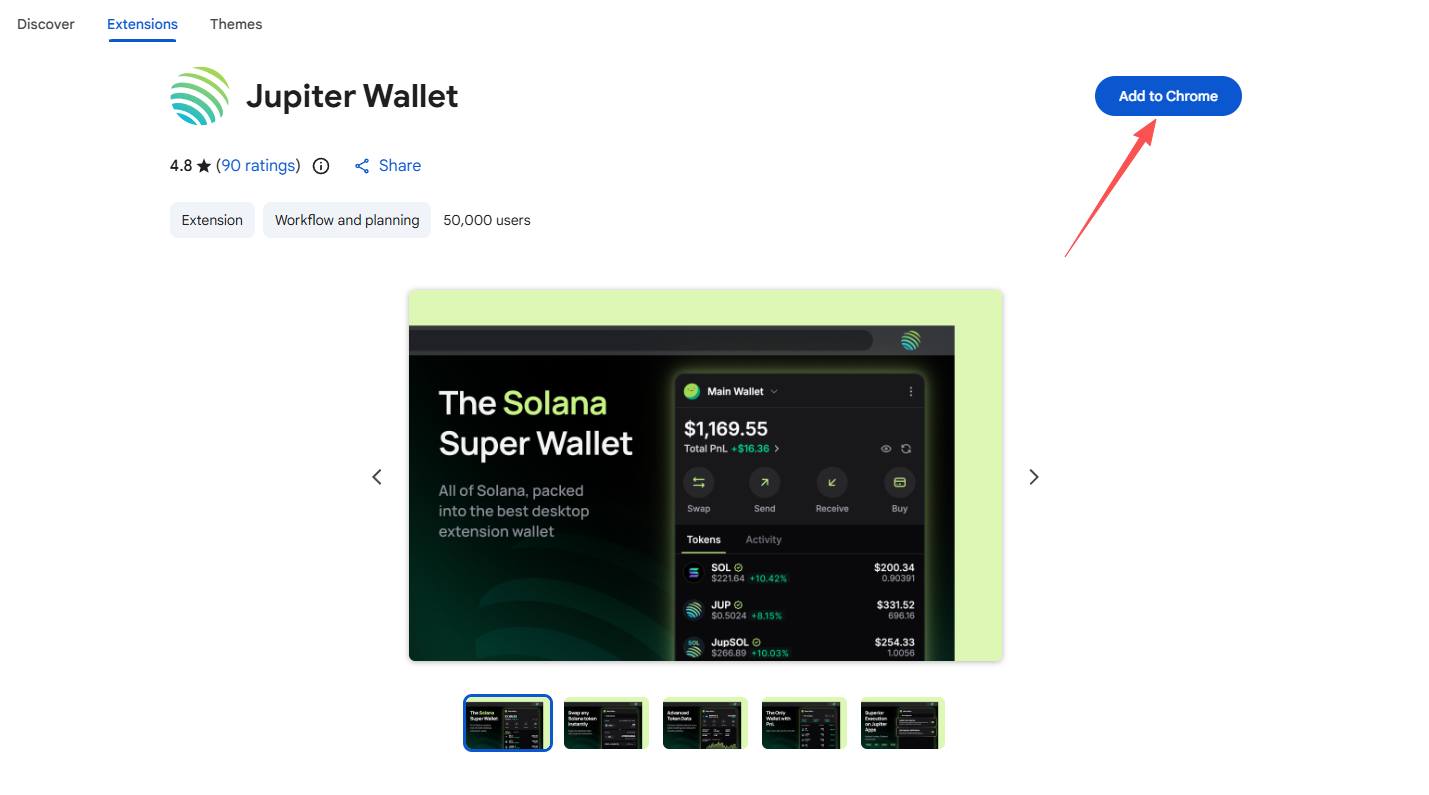
STEP 1. Download the Jupiter wallet from the Chrome Web Store (Link: https://chromewebstore.google.com/detail/jupiter-wallet/iledlaeogohbilgbfhmbgkgmpplbfboh), import an existing wallet address or create a new wallet address. It's worth noting that while participation is possible via mobile, claiming reward cards and opening them must be done on the desktop version.

STEP 2. Go to the trading website (Link: https://jup.ag/), generate trading volume to earn cards. Based on实测 data, it costs approximately $3 to $5 to obtain one card.
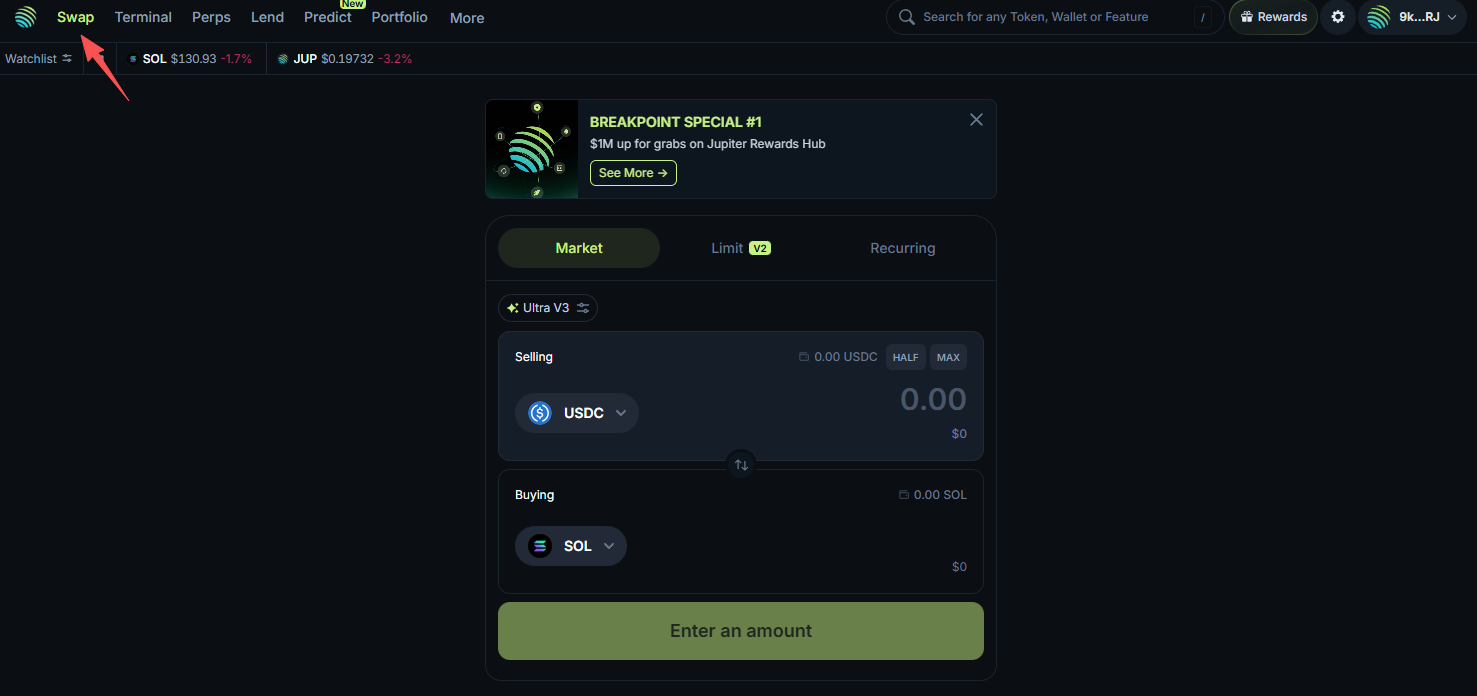
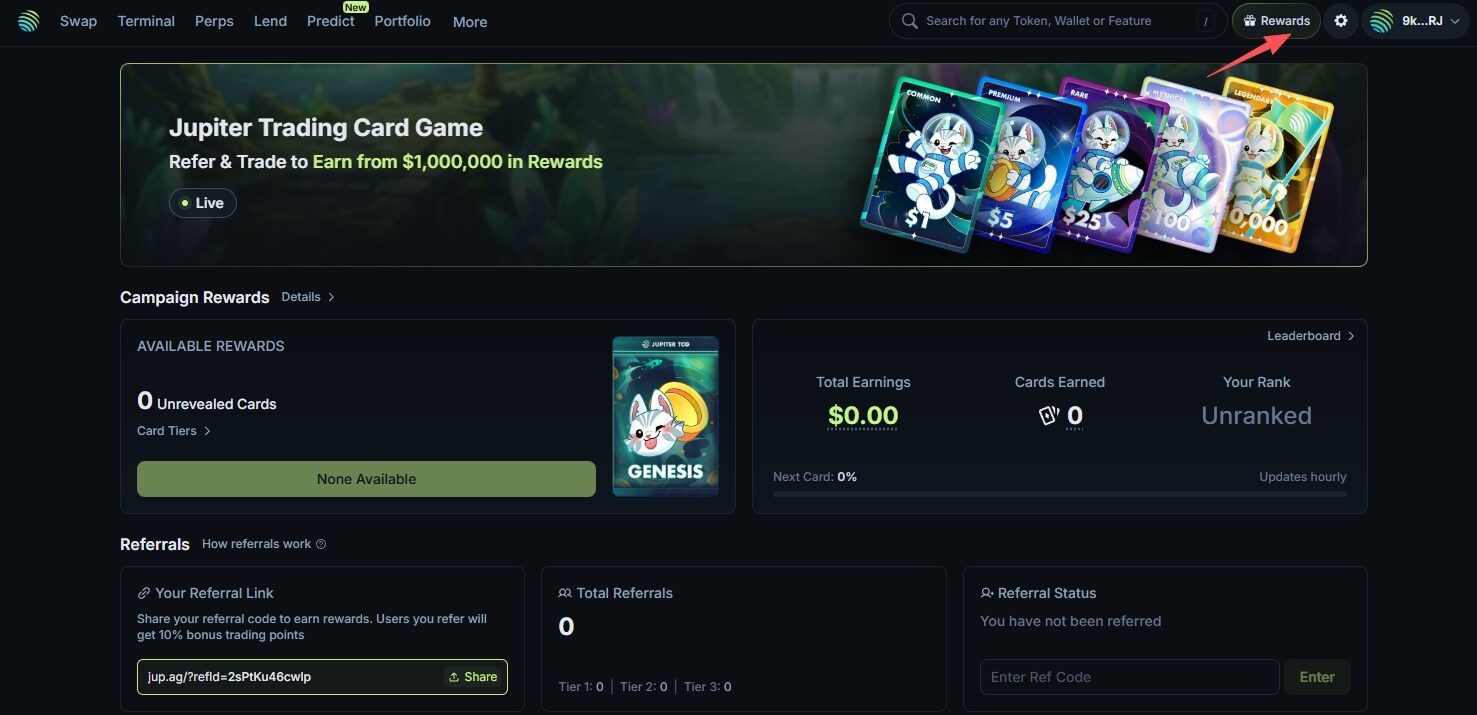
STEP 3. Click on "Rewards" to enter the rewards panel, generate a personal referral link to increase the number of cards. Additionally, this page also allows you to view the number of cards obtained.
Preguntas relacionadas

QWhat is the total prize pool for Jupiter's trading card collection event?

AThe total prize pool for Jupiter's trading card collection event is 1,000,000 USDC.

QWhat are the different rarities of cards and their corresponding rewards in the Jupiter event?

AThe card rarities and rewards are: Common (87.399% chance, 1 USDC), Advanced (10% chance, 5 USDC), Rare (2.5% chance, 25 USDC), Mythic (0.1% chance, 100 USDC), and Legendary (0.001% chance, 10,000 USDC).

QWhat trading modes are eligible for the Jupiter card collection event?

AOnly trades executed in the 'Ultra Mode' (market order) or 'Limit Order V2' mode are eligible. Trades using V1 or DAC DCA modes do not qualify.

QWhat is the estimated cost to earn one card in the Jupiter event according to the article?

AAccording to the article, the estimated cost to earn one card is approximately 3 to 5 US dollars.

QDuring what time period is the Jupiter trading card event active?

AThe event is active from 15:00 on December 11, 2025, to 07:59 on February 1, 2026 (Beijing Time).

Lecturas Relacionadas

"Agents' Last Exam", Claude Fable 5 Actually Loses to GPT 5.5

Surprisingly, in the newly released "Agents' Last Exam" (ALE) benchmark from UC Berkeley, GPT-5.5 has outperformed the recently launched and highly-regarded Claude Fable 5. ALE tests AI agents on their ability to perform real-world tasks across 55 professional domains—such as 3D modeling in Siemens NX, creating game scenes in Unreal Engine, and visual effects work in Adobe After Effects—by granting them full GUI and command-line access. In the core task completion rate ranking, GPT-5.5 configurations secured the top two spots (24.0% and 23.0%), while Claude Fable 5 with Claude Code came in third (22.0%). Notably, the highest pass rate was only 24%, and the most difficult "Last-Exam" tier saw most top models, including GPT-5.5 and Fable 5, scoring zero. The benchmark also revealed significant cost and efficiency gaps: Fable 5 spent over four times more money than GPT-5.5's most expensive configuration for a slightly lower score, and was much slower. ALE differs from previous knowledge-based benchmarks by evaluating practical "ability to do" rather than static knowledge retrieval. Its tasks are derived from real expert projects, automatically scored, and designed to prevent cheating through a rotating pool of private challenges. The results suggest that high performance on traditional benchmarks does not necessarily translate to proficiency in complex, open-ended real-world work. The study also notes that agents often fail by prematurely declaring tasks complete without proper verification, and that no single model excels uniformly across all diverse domains.

marsbitHace 3 min(s)

"Agents' Last Exam", Claude Fable 5 Actually Loses to GPT 5.5

marsbitHace 3 min(s)

Retail Ecology Dwindles, ZKsync Bets on Bank Pilots for a Breakthrough

Amidst declining retail activity, ZKsync is pivoting to target institutional banking as its primary growth strategy. The article explores this shift, contrasting it with the competitive "survival of the fittest" narrative by highlighting a cooperative model inspired by naturalist Peter Kropotkin. ZKsync is developing infrastructure like its private, permissioned Prividium suite for banks (e.g., Deutsche Bank's use case via Memento), enabling private transactions with public verifiability via zero-knowledge proofs. This appeals to institutions needing privacy, compliance, and Ethereum-based settlement security, unlike fully private chains (e.g., JPMorgan's Kinaxis) or consortium models (e.g., R3 Corda). However, this strategic focus has coincided with a steep decline in its public DeFi ecosystem, evidenced by plunging TVL and the departure of major protocols like Aave due to low fees. The network's future now hinges on banking adoption, with upcoming pilots like the Cari Network involving regional banks holding over $600 billion in deposits. A significant challenge is balancing this institutional focus with ZKsync's decentralized governance. Banks must operate on a network where rules and fees (denominated in the volatile ZK token) can be changed via community vote, and where a Security Council holds emergency control—a stark contrast to the predictable, contract-bound environments of traditional finance. The coming 18 months will test whether ZKsync can successfully onboard traditional banks onto a dynamically governed public chain or if institutions will ultimately revert to proprietary solutions.

Foresight NewsHace 45 min(s)

Retail Ecology Dwindles, ZKsync Bets on Bank Pilots for a Breakthrough

Foresight NewsHace 45 min(s)

The Recursive AI Anthropic Warned About: Tian Yuandong's New Company Has Just Taken the "First Step"

Anthropic recently highlighted the rapid progress toward "recursive self-improvement," where AI systems autonomously design and train their successors. In response, Recursive Superintelligence, a new company co-founded by former Meta researcher Tian Yuan Dong, has publicly demonstrated its first step toward automating AI research. The company released a system designed to autonomously execute the full AI research cycle: generating ideas, implementing code, running experiments, and learning from results. It validated this approach by achieving state-of-the-art results on three diverse benchmarks: 1. **NanoChat Autoresearch:** Optimizing a small language model's validation loss under a fixed 5-minute GPU budget, improving upon the community's best result. 2. **NanoGPT Speedrun:** Reducing the time to train a GPT model to a specific loss on 8 H100 GPUs from 79.7 seconds to 77.5 seconds, beating a highly optimized, human-driven community effort. 3. **SOL-ExecBench:** Improving the overall score on NVIDIA's suite of 235 GPU kernel optimization tasks by 18%, closing the gap to the hardware limit. The system discovered novel optimizations in this highly specialized domain without direct human expertise. Recursive's system operates as a general framework, capable of parallel exploration and cross-task knowledge transfer while incorporating safeguards against reward hacking. The company, backed by $650M in funding and a star-studded team including Richard Socher and Alexey Dosovitskiy, aims to create AI that recursively enhances its own research capabilities. This development represents an early but concrete move toward a new paradigm where AI accelerates its own advancement. It occurs alongside Anthropic's warnings about the need for industry coordination and potential pauses when recursive self-improvement thresholds are reached, highlighting the dual trajectory of rapid technical progress and growing calls for careful stewardship.

marsbitHace 52 min(s)

The Recursive AI Anthropic Warned About: Tian Yuandong's New Company Has Just Taken the "First Step"

marsbitHace 52 min(s)

Trading

Spot
Futuros

Artículos destacados

Cómo comprar T

¡Bienvenido a HTX.com! Hemos hecho que comprar Threshold Network Token (T) sea simple y conveniente. Sigue nuestra guía paso a paso para iniciar tu viaje de criptos.Paso 1: crea tu cuenta HTXUtiliza tu correo electrónico o número de teléfono para registrarte y obtener una cuenta gratuita en HTX. Experimenta un proceso de registro sin complicaciones y desbloquea todas las funciones.Obtener mi cuentaPaso 2: ve a Comprar cripto y elige tu método de pagoTarjeta de crédito/débito: usa tu Visa o Mastercard para comprar Threshold Network Token (T) al instante.Saldo: utiliza fondos del saldo de tu cuenta HTX para tradear sin problemas.Terceros: hemos agregado métodos de pago populares como Google Pay y Apple Pay para mejorar la comodidad.P2P: tradear directamente con otros usuarios en HTX.Over-the-Counter (OTC): ofrecemos servicios personalizados y tipos de cambio competitivos para los traders.Paso 3: guarda tu Threshold Network Token (T)Después de comprar tu Threshold Network Token (T), guárdalo en tu cuenta HTX. Alternativamente, puedes enviarlo a otro lugar mediante transferencia blockchain o utilizarlo para tradear otras criptomonedas.Paso 4: tradear Threshold Network Token (T)Tradear fácilmente con Threshold Network Token (T) en HTX's mercado spot. Simplemente accede a tu cuenta, selecciona tu par de trading, ejecuta tus trades y monitorea en tiempo real. Ofrecemos una experiencia fácil de usar tanto para principiantes como para traders experimentados.

607 Vistas totalesPublicado en 2024.12.10Actualizado en 2026.06.02

Cómo comprar T

Discusiones

Bienvenido a la comunidad de HTX. Aquí puedes mantenerte informado sobre los últimos desarrollos de la plataforma y acceder a análisis profesionales del mercado. A continuación se presentan las opiniones de los usuarios sobre el precio de T (T).

活动图片