Interactive Tutorial | Perle Labs, Which Raised $17.5 Million, Launches Season 1 Points Campaign

Odaily星球日报Publicado a 2026-01-22Actualizado a 2026-01-22

Resumen

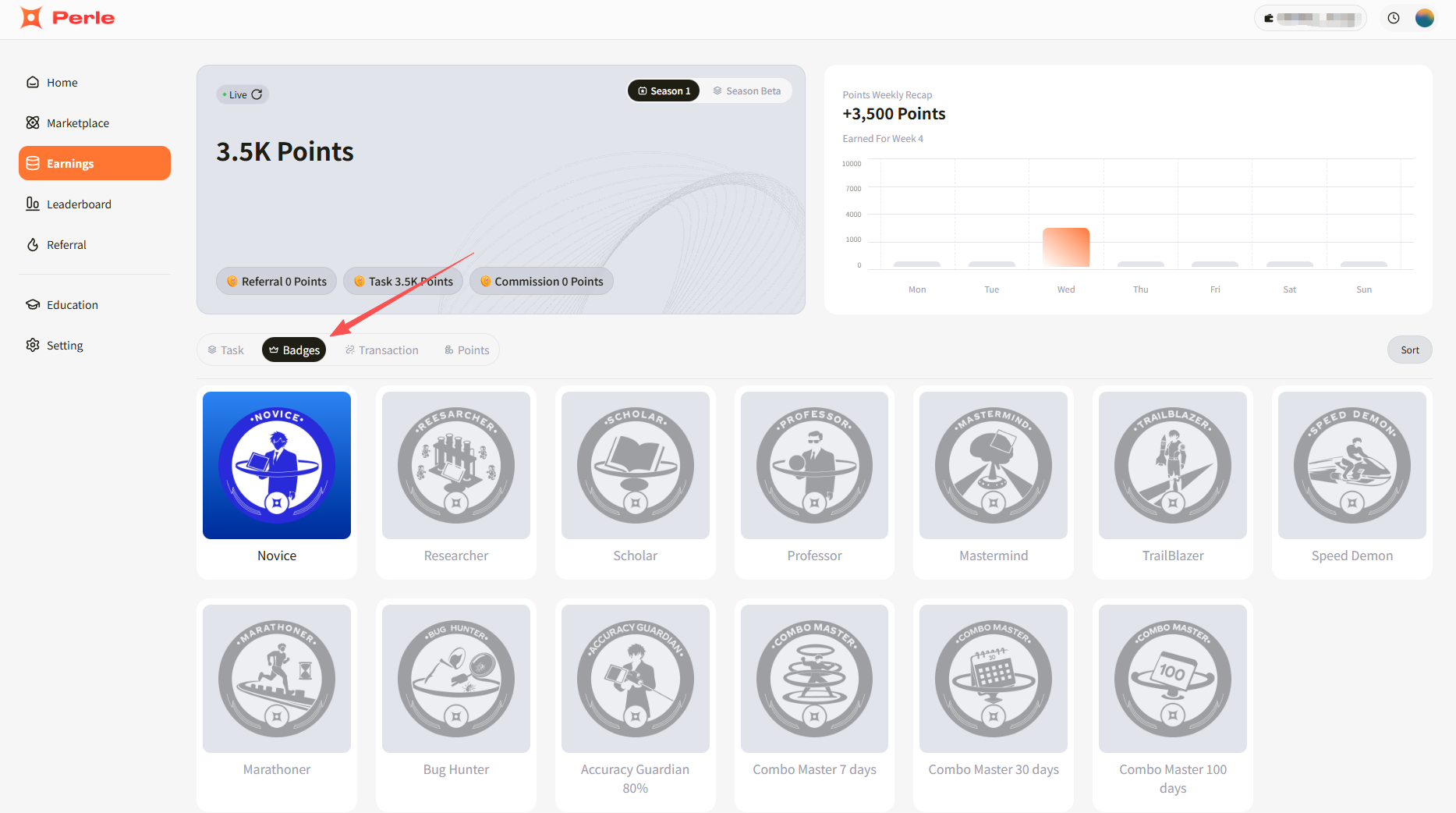
Perle Labs, an AI training data platform backed by $17.5 million in funding, has launched its Season 1 points campaign. The platform, which uses human experts to perform verifiable, on-chain data labeling on Solana, allows users to earn points by completing tasks. The interactive tasks, available on their app, include: a legal contract classification quest (1,000 points), social media account bindings (500 points), a product tagging quest from complaint emails (1,000 points), a meeting caption quest requiring audio recordings (1,000 points, pending manual review), and a medical specialty classification quest (1,000 points). Each task requires connecting a Solana wallet with some SOL for transaction fees. Users can also earn a 10% referral bonus from invited friends. Points and badges can be tracked in the "Earnings" section.

Original | Odaily Planet Daily (@OdailyChina)

Author | Asher (@Asher_ 0210)
On January 19, Perle Labs, an AI training data platform driven by human experts, announced on platform X that the beta version ended on January 6. The Season 1 campaign is now officially launched. Users can earn points by completing various tasks.

Below, Odaily Planet Daily will give you a quick overview of Perle Labs and a step-by-step guide to participating in the Season 1 campaign to earn points and potentially qualify for a future token airdrop.

Perle Labs: An AI Training Data Platform Driven by Human Experts

Project Introduction

Perle Labs is an AI training data platform driven by human experts, focused on providing high-quality datasets to support decentralized AI development. According to ROOTDATA, Perle Labs has raised a total of $17.5 million in funding to date.

On the Perle Labs platform, experts (such as doctors, financial analysts) perform data annotation. Each step is recorded on the Solana blockchain, making it tamper-proof and fully traceable. Clients (such as pharmaceutical companies, banks) can directly access this "certified" data via API.

Step-by-Step Interaction Tutorial

Interaction Link: https://app.perle.xyz/

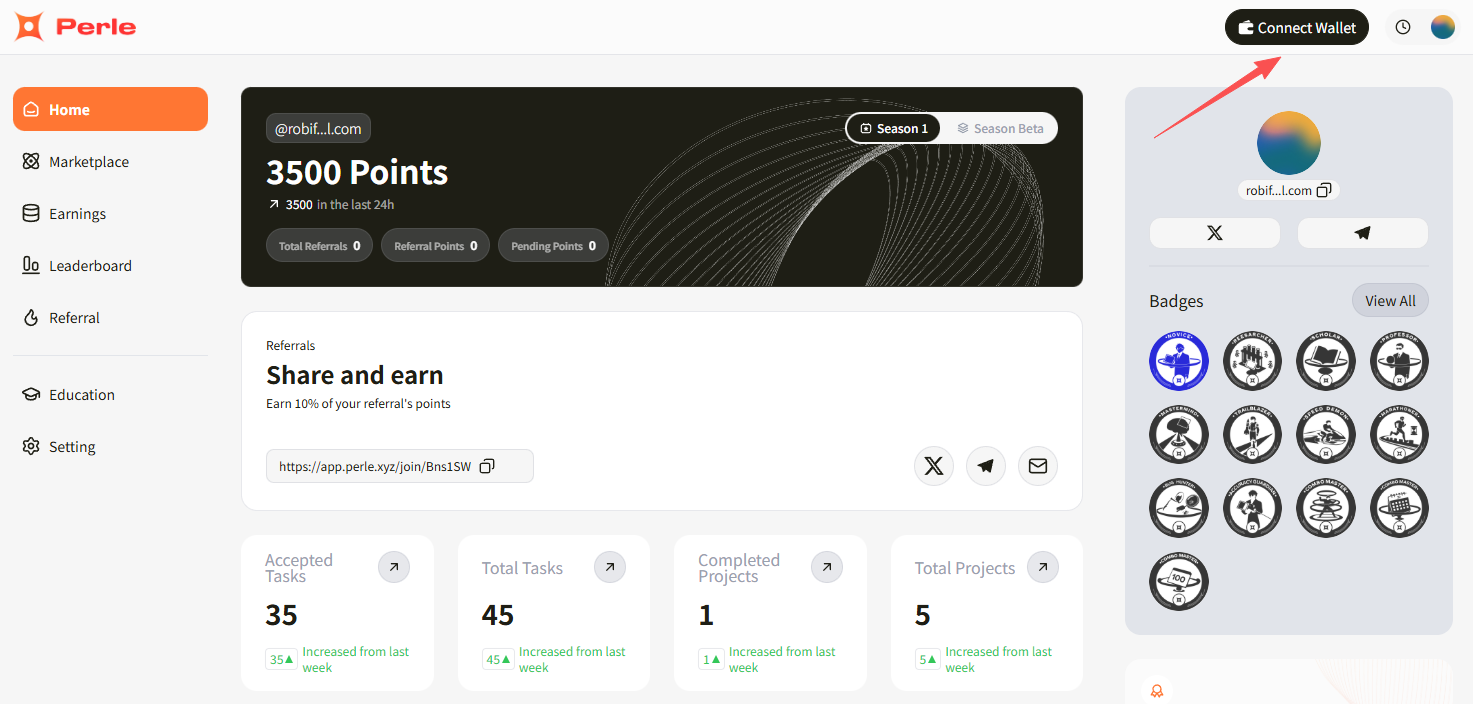
STEP 1. Click "Connect Wallet" to connect a wallet supporting the Solana network (you will get a personal referral link; inviting friends earns you 10% of the points they earn). Ensure the connected wallet has a small amount of SOL, as each task requires on-chain confirmation.
STEP 2. Click "Marketplace". There will be 5 tasks available to participate in.
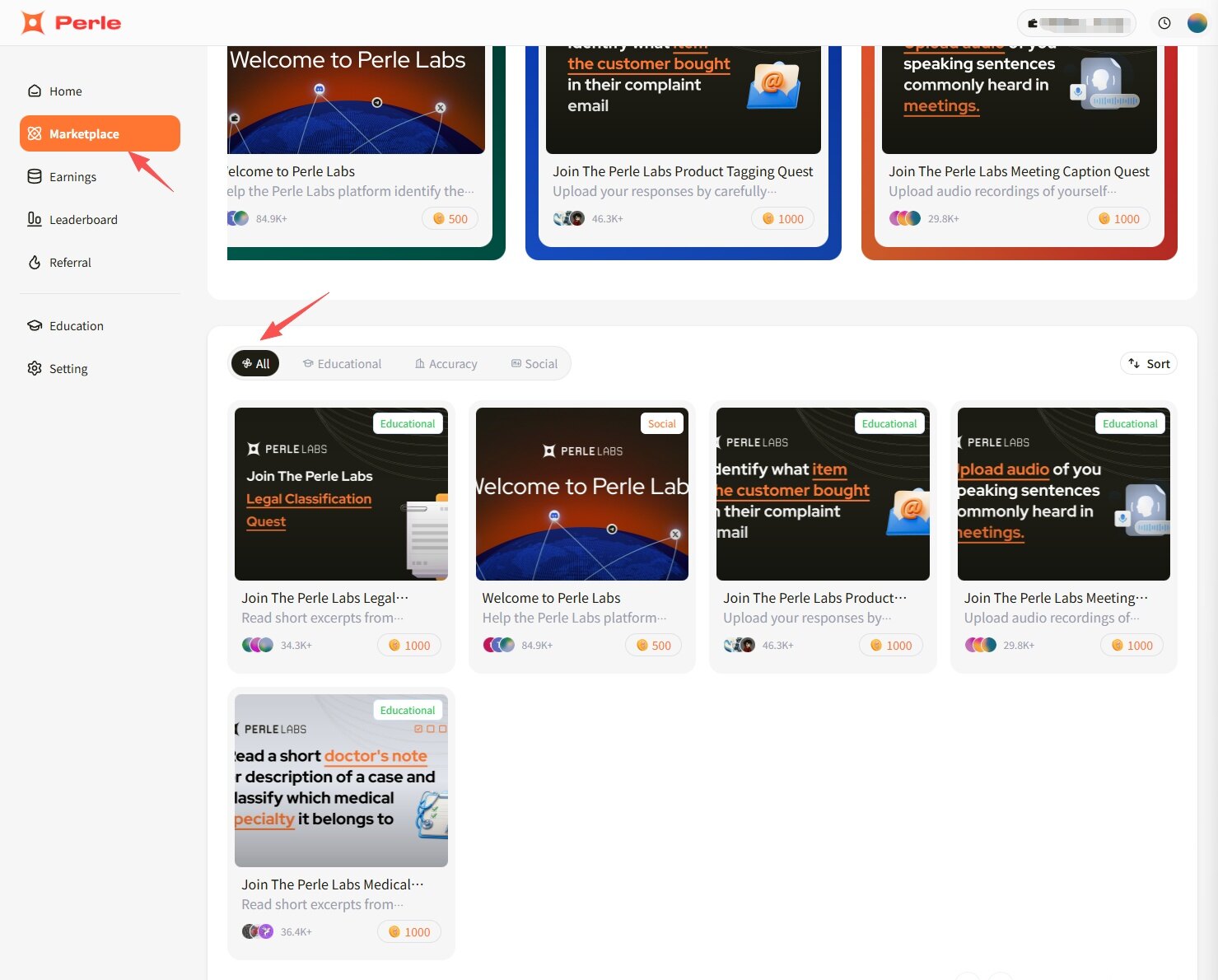
Except for the social binding task, for each other task, you need to fully watch the instructions to unlock it.
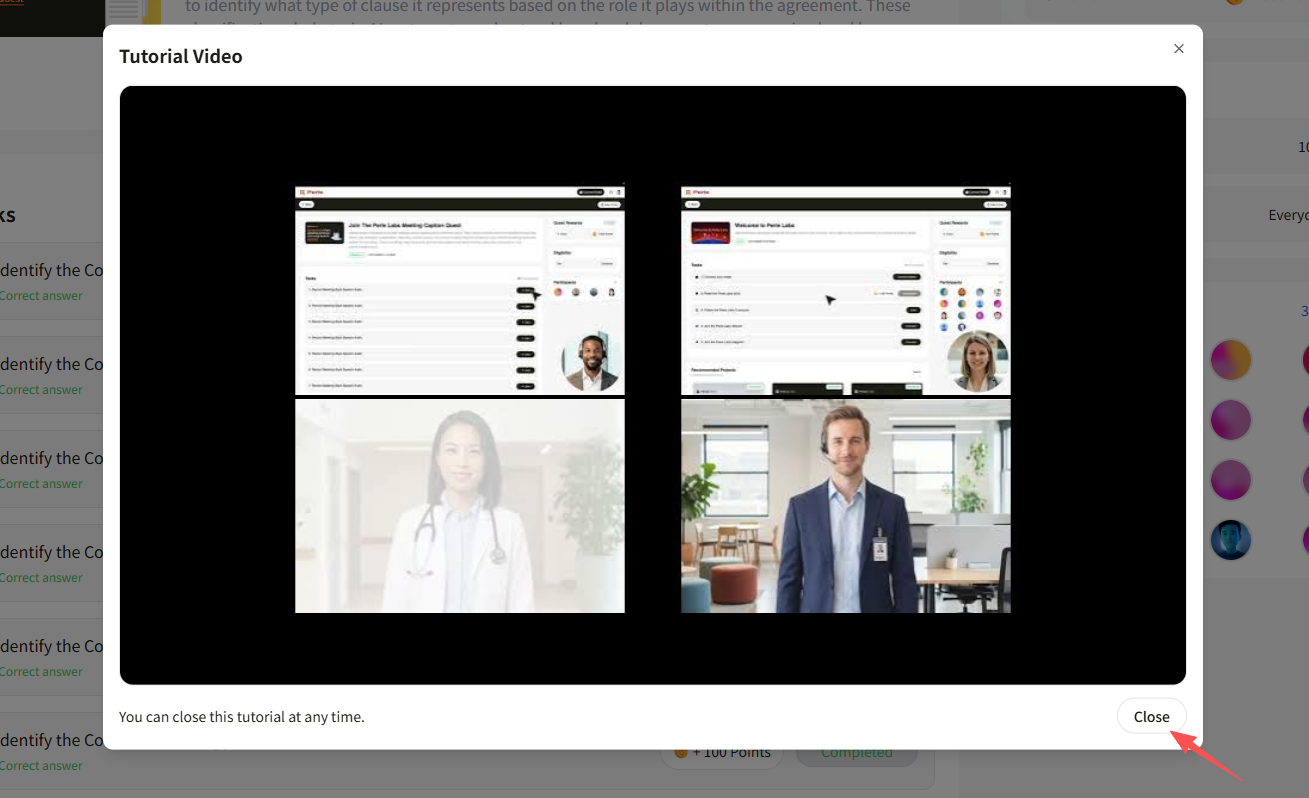
Task 1. Join The Perle Labs Legal Classification Quest: Read excerpts from legal contracts and select the corresponding clause (the questions are highly specialized; using AI tools for assistance is recommended). 10 questions, 100 points each, 1000 points total.
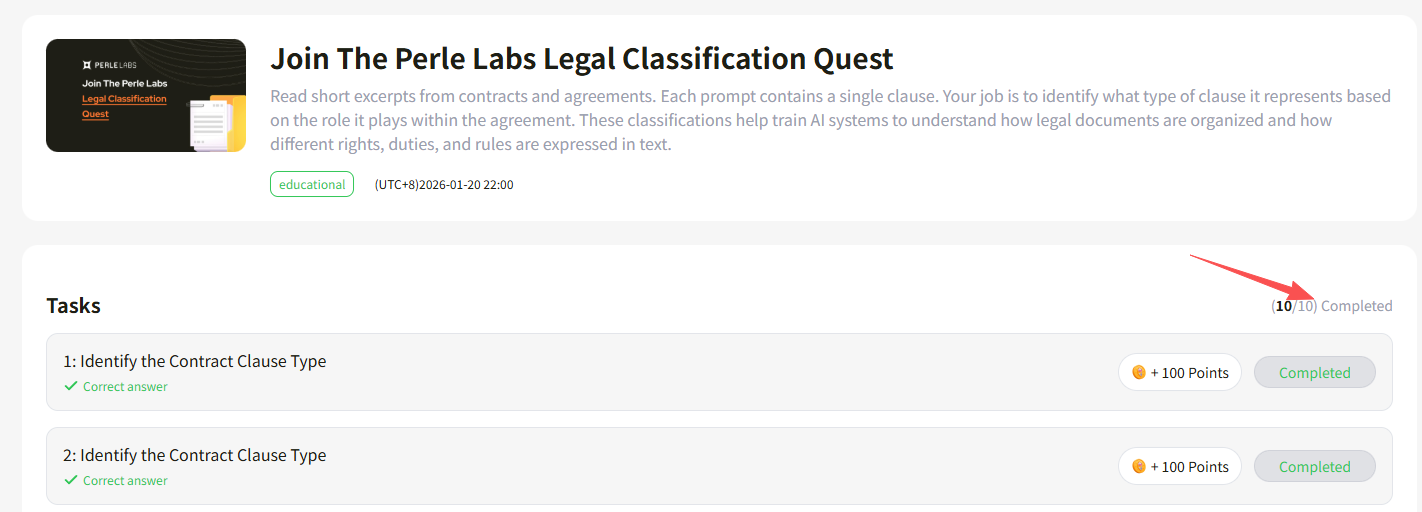
Task 2. Welcome to Perle Labs: Bind your personal X, Discord, Telegram, etc. 5 tasks total, 100 points each, 500 points total.
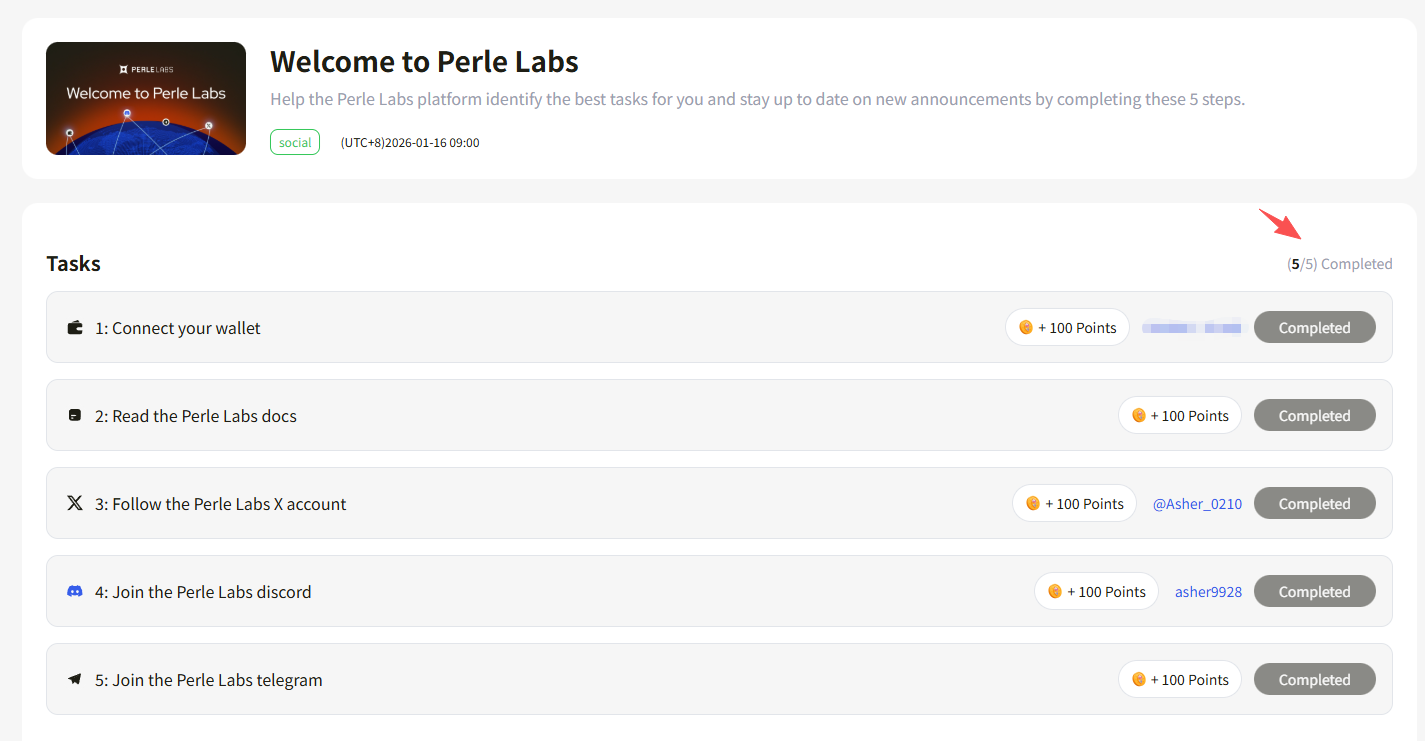
Task 3. Join The Perle Labs Product Tagging Quest: Find the mentioned product in complaint email messages. 10 questions, 100 points each, 1000 points total.
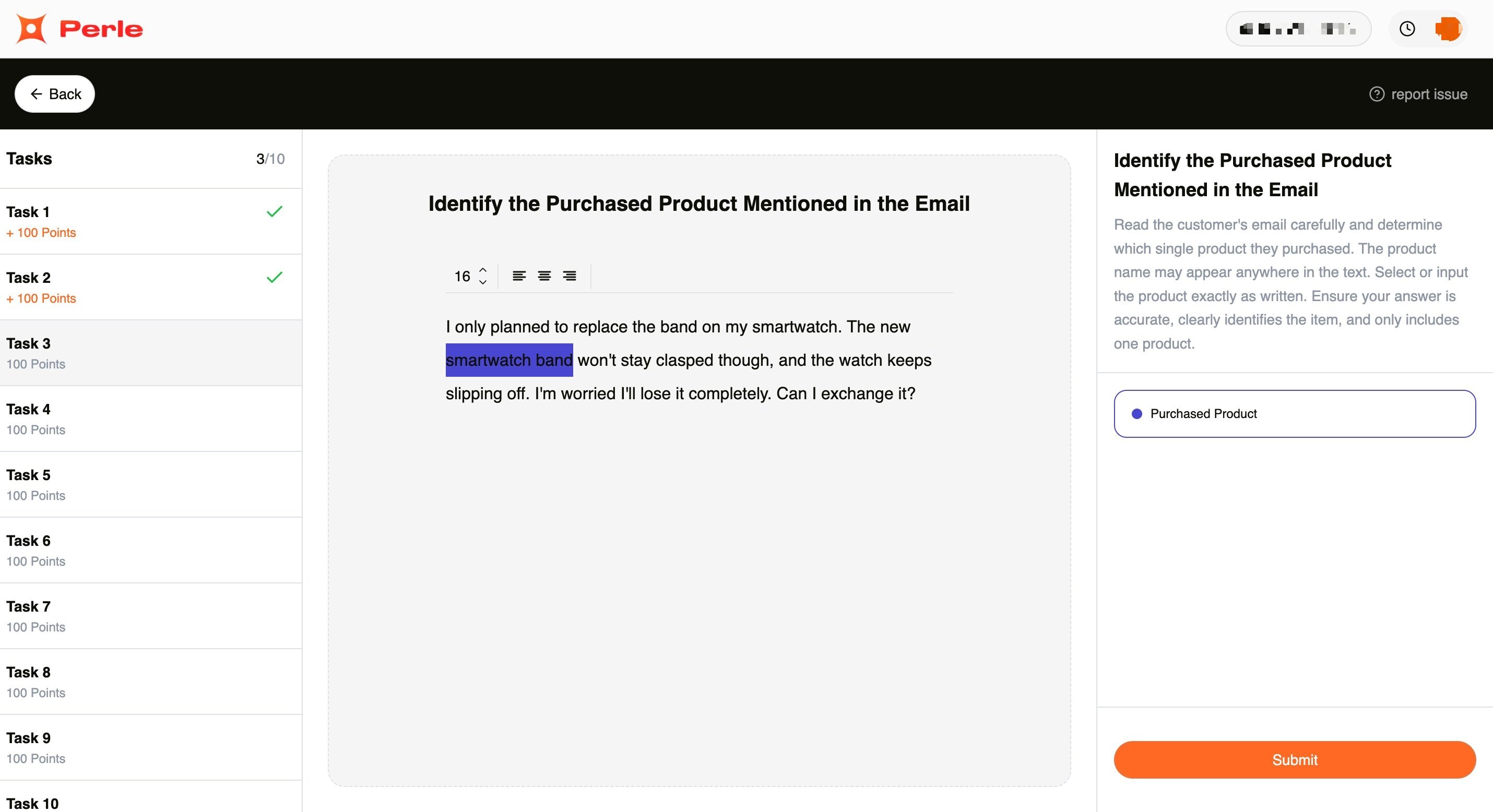
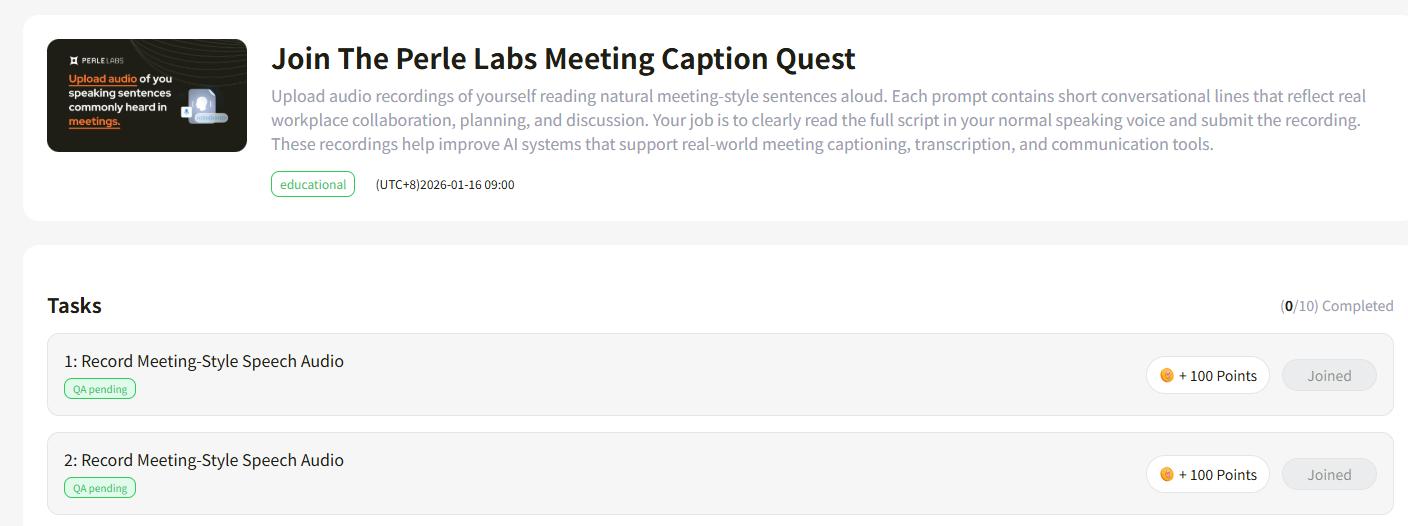
Task 4. Join The Perle Labs Meeting Caption Quest: Read sentences aloud (in English). 10 questions, 100 points each, 1000 points total. The audio part requires manual review and won't show as completed immediately; just submit the voice content on-chain.
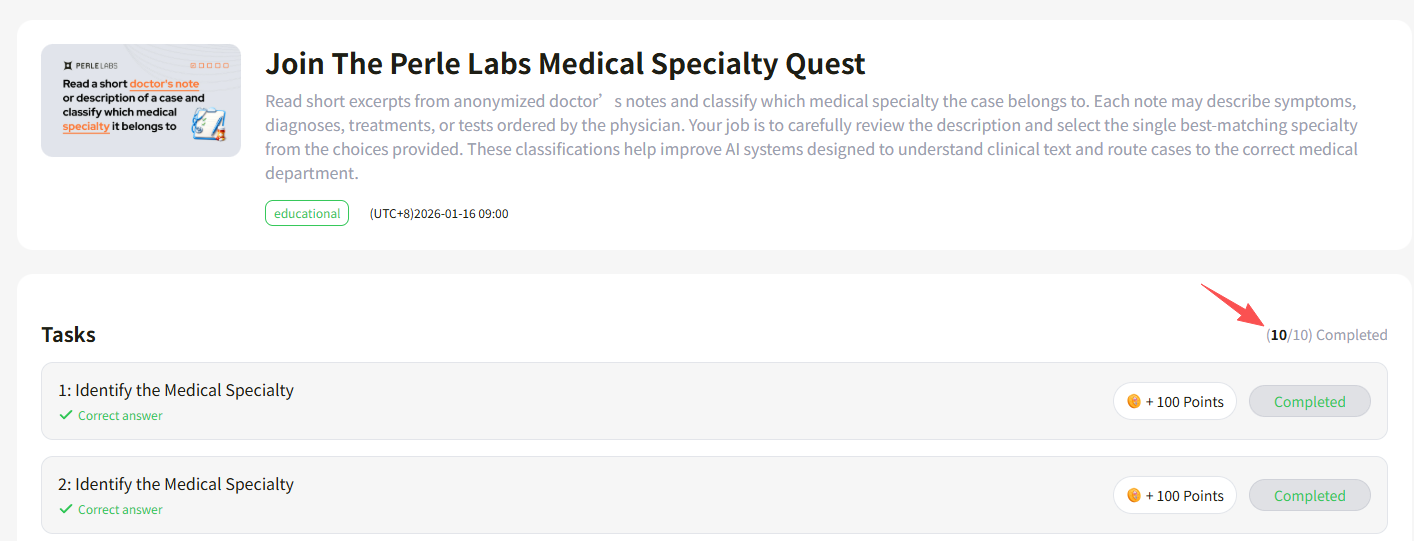
Task 5. Join The Perle Labs Medical Specialty Quest: Read the content of doctor's notes to determine the medical specialty of the case (the questions are highly specialized; using AI tools for assistance is recommended). 10 questions, 100 points each, 1000 points total.
STEP 3. Click "Earnings" to view your points and badge acquisition status.
Preguntas relacionadas

QWhat is Perle Labs and what is its primary focus?

APerle Labs is a human expert-driven AI training data platform that focuses on providing high-quality datasets to support decentralized AI development.

QHow much total funding has Perle Labs raised according to the article?

APerle Labs has raised a total of $17.5 million in funding.

QWhat is the purpose of the Season 1 campaign launched by Perle Labs?

AThe purpose of the Season 1 campaign is for users to complete various tasks to earn points, potentially for future token airdrops.

QWhich blockchain does Perle Labs use to record data annotation steps?

APerle Labs records every step of expert data annotation on the Solana blockchain.

QWhat are the five main quests available in the Marketplace for users to earn points?

AThe five main quests are: 1. Legal Classification Quest, 2. Social Account Binding, 3. Product Tagging Quest, 4. Meeting Caption Quest, and 5. Medical Specialty Quest.

Lecturas Relacionadas

Bernstein Analysis: Can the $142 Billion Long-Term Order Hold Up the Memory Cycle?

Bernstein revisits long-term agreements (LTAs) in the memory industry, highlighting new contracts with purchase commitments, minimum prices, and financial guarantees signed by Micron and SanDisk. These aim to provide an earnings floor for the coming years. Micron has 16 strategic customer agreements, with 14 representing approximately $100 billion in minimum revenue and about $22 billion in cash deposits/commitments. SanDisk has contracts for around $42 billion in minimum revenue and over $11 billion in guarantees. Combined, these ~$33 billion in guarantees make it more costly for major clients to walk away. However, Bernstein models that the potential revenue needing protection over 3-5 years is around $5.2 trillion. The existing guarantees thus cover only about 0.6% of that scale. While LTAs provide a cushion, they cannot fully shield profits in a severe downturn, as clients may still find it cheaper to breach contracts if spot prices fall deeply below floor prices. LTAs are most suitable for large, credit-worthy customers like U.S. cloud service providers with stable, high-volume AI infrastructure needs. Consumer segments (phones, PCs) and some Chinese clients are less likely to adopt them, leaving an estimated 30-50% of the DRAM/NAND market exposed to spot price volatility. AI demand (e.g., HBM for training, storage for inference) supports higher valuations and makes LTAs more attractive for locking in high-demand customers. Yet, Bernstein stresses that LTAs soften, but do not eliminate, the memory cycle. Their true test will come in the next downturn, revealing whether clients honor contracts and whether guarantees provide sufficient pain to maintain supplier discipline.

marsbitHace 19 min(s)

Bernstein Analysis: Can the $142 Billion Long-Term Order Hold Up the Memory Cycle?

marsbitHace 19 min(s)

Dialogue with Jia Hang | Looking Back at Two Decades of Chinese Payment Going Global

**Summary: A Conversation with Jia Hang on Two Decades of China's Payment Globalization** Jia Hang, a veteran with over twenty years in payments, reflects on China's attempts to build a global payment network through three key phases: UnionPay (card networks), Alipay+ (digital wallets), and now, stablecoins. His journey began at UnionPay International, aiming to establish China's card network abroad. While successful in following Chinese tourists ("where Chinese go, UnionPay goes"), it struggled to achieve true global scale. The core lesson: card networks like Visa/Mastercard's unassailable advantage isn't just technical standards, but their deeply entrenched **governance and profit-sharing models** that create powerful network effects. Competing as the "same species" is nearly impossible. At Ant Group, he led Alipay+, a strategy to bypass card networks by interconnecting local e-wallets worldwide. While innovative, it faced a similar ceiling. Mobile QR payments and card swipes were essentially **the same species competing for the same pie**, lacking a disruptive value proposition for users or a sustainable new incentive model to replace the card networks' established flywheel. Today, at Singapore's DCS, Jia focuses on stablecoin-based payments. He argues stablecoins represent a fundamental shift. They are not competing with Visa for consumer payments but challenging the **traditional banking and account system for value movement**. Products like "U Cards" (stablecoin-linked payment cards) are transitional, leveraging existing card networks for acceptance while building new rails. The real potential lies in stablecoins enabling seamless, low-cost global value transfer, potentially reorganizing the financial infrastructure around **accounts rather than cards**. Jia believes stablecoin adoption for local retail payments, cross-border transactions, and as high-yield savings vehicles is becoming irreversible. This could gradually reduce reliance on traditional fiat channels, especially in regions with weak currencies or capital controls. The quest for the "next global payment network" continues, now centered on whether stablecoins can successfully bridge Web2 and Web3, establish new governance, and create compelling user value beyond mere cost reduction.

marsbitHace 42 min(s)

Dialogue with Jia Hang | Looking Back at Two Decades of Chinese Payment Going Global

marsbitHace 42 min(s)

Circle's Stock Price Plunges 76%, Hong Kong Dollar Stablecoin Set to Launch Within Two Weeks

Circle's stock price has plunged approximately 76% from its 2023 peak, reflecting a major market revaluation. Despite this, Circle President Heath Tarbert emphasized the company's focus on long-term execution and its dominant position with USDC's $73 billion circulation across 34 blockchains. The competitive landscape is intensifying. A new consortium-backed stablecoin, Open USD, is attempting to challenge incumbents by sharing reserve yields with partners. More significantly, Visa's new stablecoin platform, initially supporting Open USD while also being compatible with USDC, could erode Circle's network effects. In response, Circle is expanding into real-world payments through partnerships like the one with Japan's JCB. Separately, Tether (USDT) faces a two-year compliance window under new U.S. regulations, requiring it to adjust its reserve composition away from assets like Bitcoin and loans towards cash and U.S. Treasuries. Meanwhile, in Hong Kong, Standard Chartered-backed fintech firm Dian Dian is poised to launch a licensed HKD-pegged stablecoin (HKDAP), moving the industry into a phase where the real test is integrating licensed stablecoins into actual payment flows and corporate treasury systems. The sharp decline in Circle's stock underscores a broader shift: the stablecoin market is moving from a winner-takes-all dynamic to a multi-player competitive arena where execution, compliance, and real-world utility are becoming paramount.

marsbitHace 42 min(s)

Circle's Stock Price Plunges 76%, Hong Kong Dollar Stablecoin Set to Launch Within Two Weeks

marsbitHace 42 min(s)

Trading

Spot
活动图片