Intelligent Computing Convergence: The Deep Integration Architecture, Paradigm Evolution, and Application Landscape of AI and Cryptocurrency Industries

marsbitPublicado a 2026-03-17Actualizado a 2026-03-17

Resumen

The deep integration of AI and cryptocurrency represents a fundamental paradigm shift, moving beyond mere technological convergence to reshape economic and computational infrastructures. By 2025, the crypto market cap surpassed $4 trillion, signaling its maturation, while AI evolved from centralized models toward decentralized, transparent “open intelligence.” Key architectural innovations include decentralized physical infrastructure networks (DePINs) like Render and Akash, which aggregate global idle GPU resources, and platforms like Ritual that embed AI models into blockchain execution environments. Verification mechanisms such as ZKML and TEE ensure computational integrity and privacy. Bittensor introduces a token-incentivized marketplace for machine intelligence, using its Yuma consensus to reward high-performing models dynamically. AI agents have transitioned from tools to autonomous on-chain entities, capable of managing finances and executing DeFi strategies via protocols like x402 and Olas. Privacy advancements through FHE (e.g., Zama), ZKML, and TEE enable confidential on-chain computations, critical for high-stakes applications. AI also enhances security via automated smart contract auditing and real-time threat prevention systems. This fusion drives enterprise efficiency through cost reduction and secure data processing, while empowering individuals via intent-based agents and data monetization. The future points to “intelligent ledgers” where AI and block...

Authored by: GO2MARS WEB3 Research

Symbiosis of Algorithm and Ledger: A Major Shift in Global Technological Paradigm

In the third decade of the 21st century, the convergence of artificial intelligence (AI) and cryptocurrency (Crypto) is no longer merely the combination of two buzzwords, but a profound revolution in technological paradigms. As the global cryptocurrency market capitalization officially surpassed the $4 trillion mark in 2025, the industry has completed its transition from an experimental niche market to an essential component of the modern economy.

One of the core drivers of this transformation is the deep convergence between AI as an extremely powerful decision-making and processing layer, and blockchain as a transparent, immutable execution and settlement layer. This combination is addressing the respective pain points of both: AI is at a critical juncture of transitioning from monopolization by centralized giants to a decentralized, transparent era of "Open Intelligence"; meanwhile, the crypto industry, after the gradual maturation of its infrastructure, urgently needs AI to solve problems such as complex on-chain interactions, fragile security, and insufficient application utility.
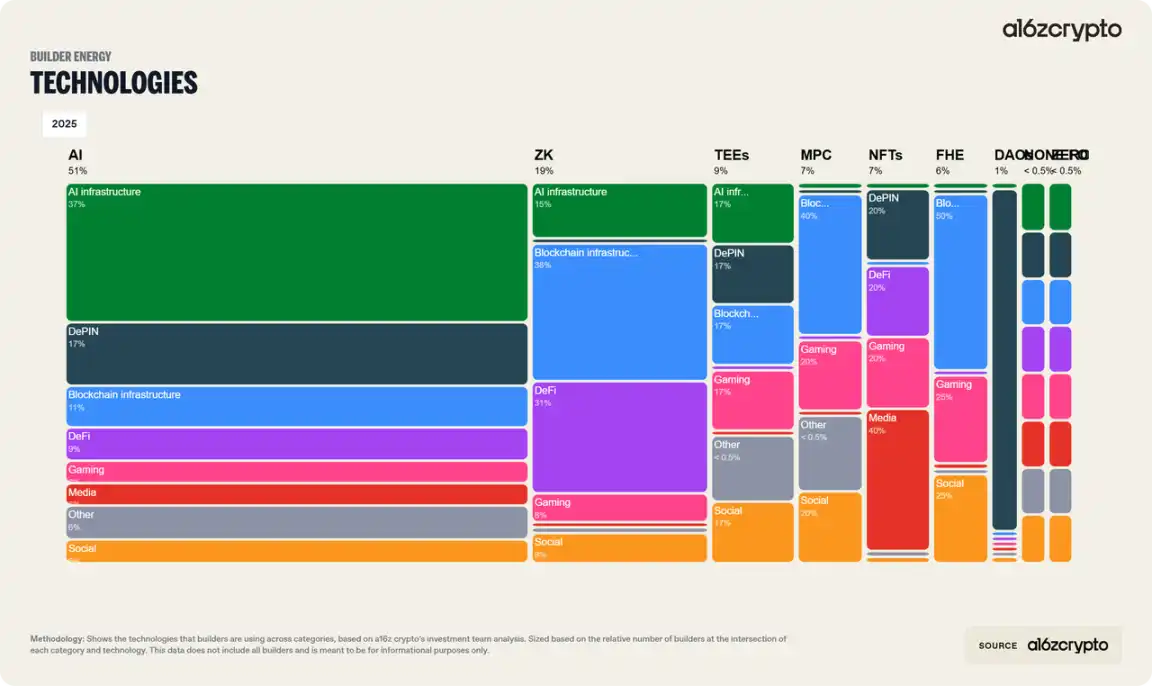
From the perspective of capital flow, the strategic divergence among top-tier venture capital firms also confirms this trend. a16z Crypto completed its fifth fundraising round of $2 billion in 2025, firmly positioning the intersection of AI and Crypto as its long-term strategic core, believing blockchain is the necessary infrastructure to prevent AI censorship and control.

Meanwhile, institutions like Paradigm are attempting to capture cross-industry dividends from technological convergence by expanding their investment boundaries to robotics and generalized AI. According to OECD data, by 2025, venture capital in the global AI sector accounted for 51% of total global investments, while within the Web3 space, the proportion of funding for AI-related projects is also steadily rising, reflecting the market's high recognition of the "decentralized intelligence" narrative.

1. Infrastructure Restructuring: Decentralized Computing Power and Computational Integrity

There is a natural contradiction between AI's insatiable appetite for Graphics Processing Units (GPUs) and the fragility of the current global supply chain. Between 2024 and 2025, GPU shortages became the norm, providing fertile ground for the explosion of Decentralized Physical Infrastructure Networks (DePIN).

1.1 Dual Evolution of Decentralized Computing Markets

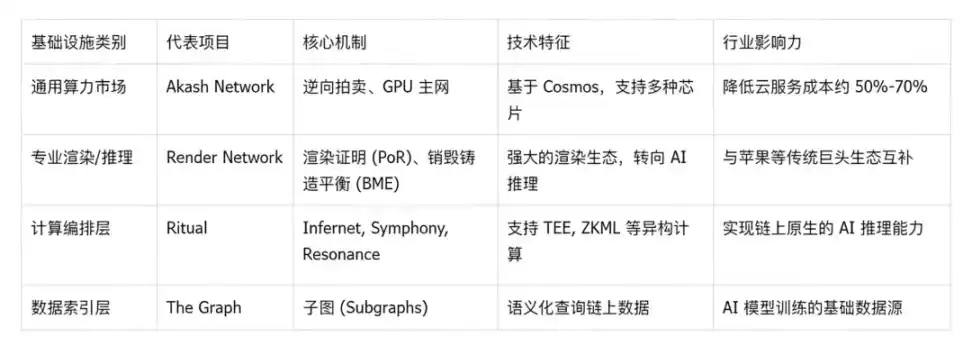
Current decentralized computing platforms are mainly divided into two camps. The first is represented by Render Network (RNDR) and Akash Network (AKT), which aggregate idle GPU computing power from around the world by building decentralized two-sided markets. Render Network has become a benchmark for distributed GPU rendering, not only reducing the cost of 3D creation but also supporting AI inference tasks through blockchain coordination functions, enabling creators to access high-performance computing power at lower prices. Akash, after 2023, achieved a leap forward with its GPU mainnet (Akash ML), allowing developers to rent high-spec chips for large-scale model training and inference.

The second category is represented by new computational orchestration layers like Ritual. Ritual's uniqueness lies in not trying to directly replace existing cloud services, but rather acting as an open, modular sovereign execution layer that embeds AI models directly into the blockchain's execution environment. Its Infernet product allows smart contracts to seamlessly call AI inference results, solving the long-standing technical bottleneck that "on-chain applications cannot natively run AI".
1.2 Computational Integrity and Breakthroughs in Verification Technology

In decentralized networks, verifying "whether computation has been executed correctly" is a core challenge. The technological progress in 2025 has mainly focused on the integrated application of Zero-Knowledge Machine Learning (ZKML) and Trusted Execution Environments (TEE).

The Ritual architecture, through its proof-system agnostic design, allows nodes to choose between TEE code execution or ZK proofs based on task requirements. This flexibility ensures that every inference result generated by an AI model is traceable, auditable, and guaranteed integrity, even in highly decentralized environments.

2. Democratization of Intelligence: The Rise of Bittensor and Commoditized Markets

The emergence of Bittensor (TAO) marks the entry of the AI and Crypto combination into a new stage of "marketization of machine intelligence." Unlike traditional single computing power platforms, Bittensor aims to create an incentive mechanism that allows various machine learning models worldwide to connect, learn from each other, and compete for rewards.

2.1 Yuma Consensus: From Linguistics to Consensus Algorithm

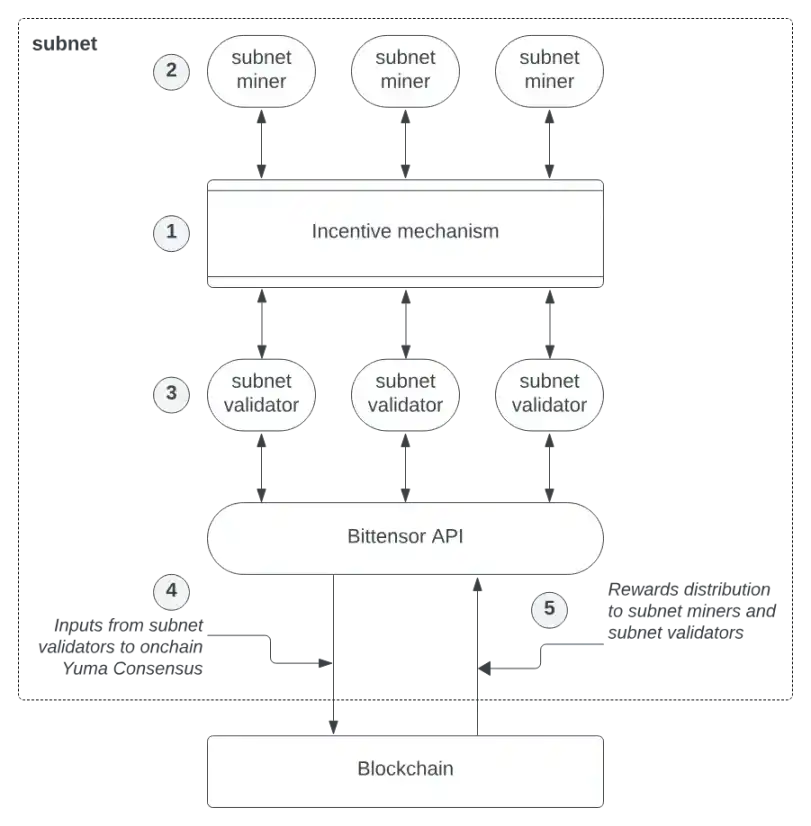
The core of Bittensor is the Yuma Consensus (YC), a subjective utility consensus mechanism inspired by Gricean pragmatics.

YC's operational logic assumes: an efficient cooperator tends to output true, relevant, and information-rich answers, as this is the optimal strategy for obtaining the highest reward in the incentive landscape. Technically, YC calculates token emissions through validators' weighted evaluation of miners' performance. Its core logic for allocating emission shares can be represented by the following LaTeX formula:
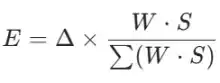
Where E is the emission reward, Δ is the daily total supply increment, W is the matrix of validator evaluation weights, and S is the corresponding staking weight. To prevent malicious collusion or bias, YC introduces a Clipping mechanism, which cuts weight settings that exceed the consensus baseline, ensuring the system's robustness.

2.2 Subnet Economy and the Dynamic TAO Paradigm

By 2025, Bittensor has evolved into a multi-layered architecture. The underlying layer is the Subtensor ledger managed by the Opentensor Foundation, while the upper layer consists of dozens of vertically specialized subnets (Subnets), focusing on specific tasks such as text generation, audio prediction, image recognition, etc.
The introduced "Dynamic TAO" mechanism creates independent value reserve pools for each subnet through an Automated Market Maker (AMM), with its price determined by the ratio of TAO to Alpha tokens:
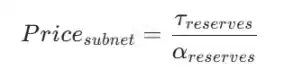
This mechanism enables automatic resource allocation: subnets with high demand and high-quality output will attract more staking, thereby receiving a higher proportion of daily TAO emissions. This competitive market structure is aptly compared to an "Olympic Games of Intelligence," naturally selecting out inefficient models.

3. The Rise of the Agent Economy: AI Agents as First-Class Citizens in Web3

In the 2024-2025 cycle, AI Agents are undergoing a fundamental transformation from "auxiliary tools" to "native on-chain entities." This evolution is reflected not only in the increasing complexity of the technical architecture but also in the fundamental expansion of their roles and permissions within the decentralized finance (DeFi) ecosystem.

Below is an in-depth analysis of this trend:

3.1 Agent Architecture: Closed Loop from Data to Execution

Current on-chain AI agents are no longer simple scripts but mature systems built on three complex logical layers:

Data Input Layer: Agents fetch real-time on-chain data such as liquidity pools, trading volume through blockchain nodes or APIs (like Ethers.js), and incorporate off-chain information like social media sentiment and centralized exchange prices through oracles (like Chainlink).

AI/ML Decision Layer (AI/ML Layer): Agents utilize Long Short-Term Memory networks (LSTM) to analyze price trends, or use Reinforcement Learning to continuously iterate optimal strategies in complex market games. The integration of Large Language Models (LLMs) also empowers agents to understand vague human intentions.

Blockchain Interaction Layer: This is the key to achieving "financial autonomy." Agents can now manage non-custodial wallets, automatically calculate optimal Gas fees, handle nonces, and even integrate MEV protection tools (e.g., Jito Labs) to prevent front-running in transactions.

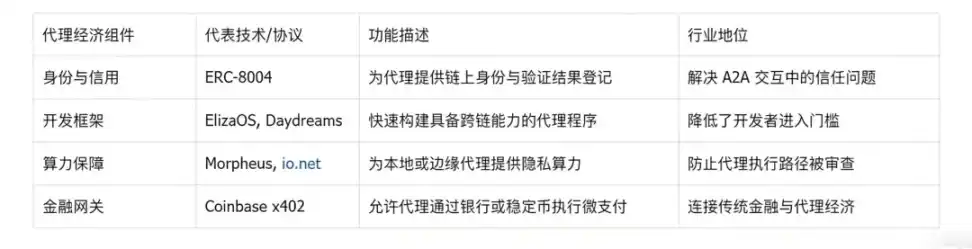
3.2 Financial Rails and Agent-to-Agent Transactions

a16z's 2025 report particularly emphasized the financial backbone of AI agents—protocols like x402 and similar micro-payment standards. These standards allow agents to pay API fees or purchase services from other agents without human intervention. For example, the Olas (formerly Autonolas) ecosystem already processes over 2 million automated transactions between agents monthly, covering tasks from DeFi swaps to content creation.
This trend is tangibly reflected in market data. In terms of growth rate, the AI agent market is on the verge of an explosion. According to research data from MarketsandMarkets, the global AI agent market is expected to grow from $7.84 billion in 2025 to $52.62 billion in 2030, with a compound annual growth rate (CAGR) of 46.3%. Furthermore, Grand View Research provides a similar long-term forecast, estimating the market size to reach $50.31 billion by 2030.

Meanwhile, standard tools at the development layer are also taking shape. The ElizaOS framework, strongly promoted by a16z, has become the infrastructure for the AI agent space, comparable to "Next.js" in front-end development. It allows developers to easily deploy AI agents with full financial capabilities on mainstream social platforms like X, Discord, and Telegram. As of early 2025, the total market capitalization of Web3 projects built on this framework has exceeded $20 billion.

4. Privacy Computing and Confidentiality: The Game of FHE, TEE, and ZKML

Privacy is one of the most challenging issues in the convergence of AI and Crypto. When enterprises run AI strategies on public chains, they neither want to leak private data nor disclose their core model parameters. Currently, the industry has formed three main technical paths: Fully Homomorphic Encryption (FHE), Trusted Execution Environment (TEE), and Zero-Knowledge Machine Learning (ZKML).

4.1 Zama and the Industrialization Journey of FHE

Zama, as a leading unicorn in this field, has made its fhEVM the standard for achieving "full-process encrypted computation." FHE allows computers to perform mathematical operations on data without decrypting it, and the results after decryption are identical to those from plaintext operations.

By 2025, Zama's technology stack has achieved significant performance leaps: for a 20-layer Convolutional Neural Network (CNN), computation speed increased by 21 times, and for a 50-layer CNN, it increased by 14 times. This progress makes "privacy stablecoins" (where transaction amounts are encrypted externally but the protocol can still verify legitimacy) and "sealed-bid auctions" possible on mainstream chains like Ethereum.

4.2 Verification Efficiency of ZKML and Integration with LLM

Zero-Knowledge Machine Learning (ZKML) focuses on "verification" rather than "computation." It allows one party to prove that it correctly ran a complex neural network model without exposing the input data or model weights. The latest zkLLM protocol can already perform end-to-end inference verification for a 13 billion parameter model, reducing proof generation time to within 15 minutes, with a proof size of only 200 KB. This technology is crucial for high-value financial audits and medical diagnostics.

4.3 Synergy between TEE and GPU: The Power of Hopper H100

Compared to FHE and ZKML, TEE (Trusted Execution Environment) offers execution speeds close to native performance. NVIDIA's H100 GPU introduces confidential computing capabilities, isolating memory through hardware-level firewalls, with inference overhead typically below 7%. Protocols like Ritual are heavily adopting GPU-based TEE to support AI agent applications requiring low latency and high throughput.

Privacy computing technology has officially moved from the idealistic conception of the laboratory into a new era of "production-level industrialization." Fully Homomorphic Encryption (FHE), Zero-Knowledge Machine Learning (ZKML), and Trusted Execution Environment (TEE) are no longer isolated technical tracks but together constitute a "modular confidentiality stack" for decentralized artificial intelligence.

This fusion is completely rewriting the underlying logic of Web3 and leads to the following three core conclusions:

FHE is the "HTTPS" underlying standard for Web3: As unicorns like Zama improve computational performance dozens of times, FHE is achieving a qualitative change from "everything public" to "encrypted by default." It solves the privacy challenge of on-chain state processing, enabling privacy stablecoins and fully MEV-resistant trading systems to move from theory to large-scale compliant applications.

ZKML is the mathematical endpoint for algorithmic accountability: The "ZKML singularity" arriving in the second half of 2025 marks a dramatic decrease in verification costs. By compressing the inference proof of a 13 billion parameter (13B) model to within 15 minutes, ZKML provides "mathematical-level consistency" guarantees for high-value financial audits and credit ratings, ensuring AI is no longer an untrustworthy black box.

TEE is the performance foundation of the agent economy: Compared to software solutions, TEE based on hardware like NVIDIA H100 offers near-native execution speeds with overhead below 7%. It is currently the only economically viable solution to support hundreds of millions of AI Agents making 24/7 real-time decisions, ensuring that agents securely hold private keys and execute complex strategies within hardware-level firewalls.
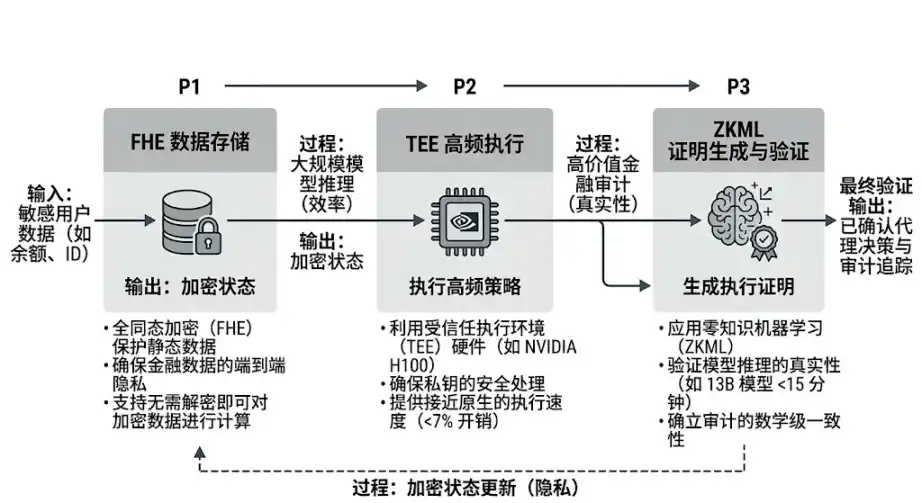
The future technological trend is not the victory of a single path, but the comprehensive popularization of "Hybrid Confidential Computing." In a complete AI business flow: use TEE for large-scale, high-frequency model inference to ensure efficiency; use ZKML at key nodes to generate execution proofs to ensure authenticity; and let FHE handle the encryption of sensitive financial states (such as account balances and private IDs).

This "trinity" fusion is reshaping the crypto industry from a "public transparent ledger" to a "sovereign privacy-enabled intelligent system," truly ushering in the era of an automated agent economy worth trillions of dollars.

5. Industry Security and Automated Auditing: AI as Web3's "Immune System"

The cryptocurrency industry has long been plagued by huge losses caused by smart contract vulnerabilities. The introduction of AI is changing this passive defense situation, shifting it from expensive manual audits to real-time AI monitoring.

5.1 Innovation in Static and Dynamic Audit Tools

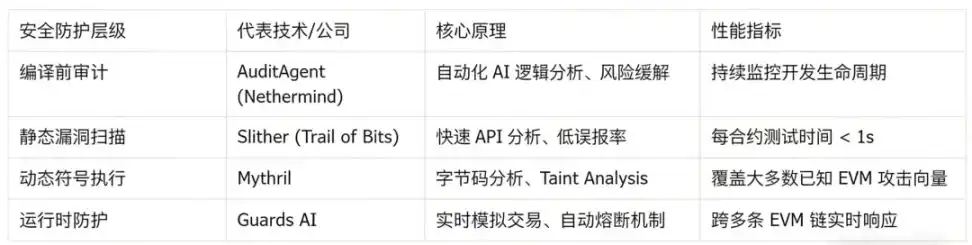
Tools like Slither and Mythril have deeply integrated machine learning models by 2025, capable of scanning Solidity contracts for reentrancy attacks, suicidal functions, or Gas consumption abnormalities in sub-second speeds. Furthermore, fuzzing tools like Foundry and Echidna use AI to generate extreme input data to probe deeply hidden logical vulnerabilities.

5.2 Real-time Threat Prevention Systems

In addition to pre-deployment audits, real-time defense has also made significant progress. Systems like Guardrail's Guards AI and CUBE3.AI can monitor all pending transactions (Mempool) across chains. Upon detecting malicious attack signals (such as governance attacks or oracle manipulation), they can automatically trigger contract pauses or intercept malicious transactions. This "active immunity" significantly reduces the risk of DeFi protocol hacks.
Practical Roadmap for Leveraging AI to Develop Crypto

In the future digital landscape, the convergence of AI and Crypto is no longer a technological experiment but a deep revolution concerning "productivity efficiency" and "wealth distribution rights." This combination not only gives AI an independently controlled "wallet" but also gives Crypto an autonomously thinking "brain," jointly opening the era of an autonomous agent economy worth trillions of dollars.

The following is the core benefits and practical map of this convergence at the enterprise and individual levels:

1. Enterprise Level: From "Cost Reduction and Efficiency Increase" to "Business Boundary Expansion"

For enterprises, the combination of AI and Crypto primarily solves the structural contradiction between high computing power costs, fragile system security, and data privacy protection.

Drastic reduction in infrastructure costs (DePIN effect): Leveraging distributed computing power networks (like Akash or Render), enterprises are no longer trapped by expensive NVIDIA H100 cluster procurement. Actual measurement data shows that renting global idle GPUs can reduce costs by 39% to 86% compared to traditional cloud service providers. This "computing freedom" allows startups to afford fine-tuning and training of ultra-large-scale models.

Automation and cost reduction of security barriers: Traditional contract audit cycles are long and expensive. Now, by deploying AI security agents like AuditAgent, driven by neural networks, enterprises can achieve "sentry monitoring" throughout the entire development lifecycle. They can identify logical vulnerabilities like reentrancy attacks the moment code is submitted and can automatically trigger contract circuit breakers at the mempool level the instant a hacker's command is issued, protecting protocol assets from loss.

"Encrypted Computing" for core business secrets: With Fully Homomorphic Encryption (FHE) and networks like Nillion's "Blind Compute," enterprises can run AI strategies on public chains without disclosing core model parameters and private customer data. This not only establishes data sovereignty but also allows financial and medical data, previously restricted by compliance risks, to enter the decentralized collaboration network.

2. Individual Level: From "Financial Blind Spots" to "Intelligent Sovereign Economy"

For individual users, the fusion of AI and Crypto means the complete disappearance of technical barriers and the opening of new income channels.

Intent-oriented "Private Banker": Future users will no longer need to understand what Gas fees or cross-chain bridges are. AI agents built on frameworks like ElizaOS will achieve "radical abstraction"—you just need to say: "Help me deposit this $1000 in the place with the highest interest and safest," and the AI will autonomously monitor APY across the network and automatically close positions during risk fluctuations. Ordinary people can thus enjoy asset management at the level of top hedge funds.

Assetization of personal data (Data Yield Farming): Your digital footprint is no longer taken for free by giants. Through platforms like Synesis One, users can participate in "Train2Earn," providing labeled data for AI training and directly obtaining token rewards. You can even earn passive dividends every time an AI calls a specific knowledge entry by holding a Kanon NFT, truly realizing "data as an asset."

Ultimate protection of privacy and identity: Using Worldcoin or cryptographic identity protocols, you can prove you are human and not an AI, while using privacy computing networks to protect sensitive information like your personal schedule and home address from being leaked to AI service providers. This "blind interaction" mode ensures that while you benefit from AI convenience, you still hold the highest right of interpretation over your digital sovereignty.

This two-way architectural evolution is handing "trust" to the blockchain and "efficiency" to AI. It is not only reconstructing the moats of enterprises but also building a ladder for every ordinary person to access the intelligent sovereign economy.

Evolution Prediction: Towards a New Era of "Intelligent Ledger"

In summary, how can AI and Crypto combine better? The answer lies in shifting from "simple tool stacking" to "deep architectural coupling."

First, blockchain must evolve into a platform capable of supporting large-scale computation. Efforts by protocols like Ritual and Starknet are making ZKML as simple as calling a standard library. Second, AI agents must become legitimate entities in economic life. With the proliferation of identity standards like ERC-8004, we will see an "intelligent network" composed of hundreds of millions of agents, engaging in 24/7 resource gaming and value exchange on-chain.

Finally, this fusion will reshape human financial sovereignty. Privacy payments realized through FHE, fair creator distribution achieved through provenance protocols, and algorithmic democratization realized through markets like Bittensor, together constitute a blueprint for a fairer, more efficient, and decentralized future digital economy.

In this technological marathon, the crypto industry provides not just capital, but a philosophical framework about "transparency" and "trust"; while AI provides the "brain" that makes these frameworks operate. As 2026 approaches, this convergence will not be limited to technical circles but will reach billions of ordinary users globally through more intuitive AI interaction interfaces.

Preguntas relacionadas

QWhat are the two main types of decentralized computing platforms mentioned in the article, and what are their key characteristics?

AThe two main types are: 1) Decentralized bilateral markets like Render Network (RNDR) and Akash Network (AKT), which aggregate idle global GPU power to provide cost-effective computing for tasks like rendering and AI inference. 2) New computational orchestration layers like Ritual, which act as an open, modular sovereign execution layer that embeds AI models directly into a blockchain's execution environment, allowing smart contracts to natively call AI inference results.

QHow does Bittensor's Yuma consensus mechanism work to incentivize and validate machine learning models?

ABittensor's Yuma consensus (YC) is a subjective utility consensus mechanism inspired by Gricean pragmatics. It operates on the logic that an efficient collaborator is incentivized to output truthful, relevant, and informative answers to gain the highest rewards. Validators evaluate the performance of miners (ML models), and token emissions are calculated based on a matrix of these validator-assigned weights and corresponding staking weights. A clipping mechanism is used to cut weights that exceed a consensus benchmark, ensuring system robustness against collusion or bias.

QWhat are the three primary technical paths for ensuring privacy in AI and Crypto applications, as discussed in the article?

AThe three primary technical paths for privacy are: 1) Fully Homomorphic Encryption (FHE), exemplified by Zama's fhEVM, which allows computation on encrypted data. 2) Zero-Knowledge Machine Learning (ZKML), which focuses on verifying that a complex neural network model was run correctly without revealing input data or model weights. 3) Trusted Execution Environments (TEE), such as those utilizing NVIDIA's H100 GPU, which provide hardware-level memory isolation for high-speed, confidential computation with low overhead.

QAccording to the article, how is AI transforming security and auditing in the Web3 space?

AAI is transforming Web3 security by moving from expensive manual audits to real-time AI monitoring. Tools like Slither and Mythril now integrate machine learning models to scan smart contracts for vulnerabilities at sub-second speeds. Furthermore, real-time threat prevention systems like Guardrail's Guards AI and CUBE3.AI monitor the mempool across chains, automatically intercepting malicious transactions or triggering contract pauses upon detecting attack signals, such as governance attacks or oracle manipulation, thus providing a proactive 'immune system' for DeFi protocols.

QWhat is the predicted future trend for the architecture of decentralized AI, particularly concerning privacy technologies?

AThe predicted future trend is not the victory of a single path but the comprehensive adoption of 'Hybrid Confidential Computing.' In a complete AI workflow, TEE would be used for large-scale, high-frequency model inference to ensure efficiency; critical nodes would use ZKML to generate execution proofs for verifiability; and sensitive financial states (like account balances) would be handled by FHE for encrypted storage. This 'trinity' fusion is reshaping the crypto industry from a 'transparent ledger' into a 'sovereign privacy intelligent system' capable of powering a multi-trillion-dollar automated agent economy.

Lecturas Relacionadas

North Korean Hackers Loot $500 Million in a Single Month, Becoming the Top Threat to Crypto Security

North Korean hackers, particularly the notorious Lazarus Group and its subgroup TraderTraitor, have stolen over $500 million from cryptocurrency DeFi platforms in less than three weeks, bringing their total theft for the year to over $700 million. Recent major attacks on Drift Protocol and KelpDAO, resulting in losses of approximately $286 million and $290 million respectively, highlight a strategic shift: instead of targeting core smart contracts, attackers are now exploiting vulnerabilities in peripheral infrastructure. For instance, the KelpDAO attack involved compromising downstream RPC infrastructure used by LayerZero's decentralized validation network (DVN), allowing manipulation without breaching core cryptography. This sophisticated approach mirrors advanced corporate cyber-espionage. Additionally, North Korea has systematically infiltrated the global crypto workforce, with an estimated 100 operatives using fake identities to gain employment at blockchain companies, enabling long-term access to sensitive systems and facilitating large-scale thefts. According to Chainalysis, North Korean-linked hackers stole a record $2 billion in 2025, accounting for 60% of all global crypto theft that year. Their total historical crypto theft has reached $6.75 billion. Post-theft, they employ specialized money laundering methods, heavily relying on Chinese OTC brokers and cross-chain mixing services rather than standard decentralized exchanges. Security experts, while acknowledging the increased sophistication, emphasize that many attacks still exploit fundamental weaknesses like poor access controls and centralized operational risks. Strengthening private key management, limiting privileged access, and enhancing coordination among exchanges, analysts, and law enforcement immediately after an attack are critical to improving defense and fund recovery chances. The industry's challenge now extends beyond secure smart contracts to safeguarding operational security at the infrastructure level.

marsbitHace 57 min(s)

North Korean Hackers Loot $500 Million in a Single Month, Becoming the Top Threat to Crypto Security

marsbitHace 57 min(s)

Circle CEO's Seoul Visit: No Korean Won Stablecoin Issuance, But Met All Major Korean Banks

Circle CEO Jeremy Allaire's recent activities in Seoul indicate a strategic shift for the company, moving away from issuing a Korean won-backed stablecoin and instead focusing on embedding itself as a key infrastructure provider within Korea’s financial and crypto ecosystem. Despite Korea accounting for nearly 30% of global crypto trading volume—with a market characterized by high retail participation and altcoin dominance—Circle has chosen not to compete for the role of stablecoin issuer. Instead, Allaire met with major Korean banks (including Shinhan, KB, and Woori), financial groups, leading exchanges (Upbit, Bithumb, Coinone), and tech firms like Kakao. This approach reflects a broader industry transition: the core of stablecoin competition is shifting from issuance rights to systemic positioning. With Korean regulators still debating whether banks or tech companies should issue stablecoins, Circle is avoiding regulatory uncertainty by strengthening its role as a service and technology partner. The company is deepening integration with trading platforms, building connections, and promoting stablecoin infrastructure. This positions Circle to benefit regardless of which entity eventually issues a won stablecoin. Allaire also noted the potential for a Chinese yuan stablecoin in the next 3–5 years, underscoring a regional trend of stablecoins becoming more regulated and integrated with traditional finance. Ultimately, Circle’s strategy highlights that future influence in the stablecoin market will belong not necessarily to the issuers, but to the foundational infrastructure layers that enable cross-system transactions.

marsbitHace 1 hora(s)

Circle CEO's Seoul Visit: No Korean Won Stablecoin Issuance, But Met All Major Korean Banks

marsbitHace 1 hora(s)

SpaceX Ties Up with Cursor: A High-Stakes AI Gambit of 'Lock First, Acquire Later'

SpaceX has secured an option to acquire AI programming company Cursor for $60 billion, with an alternative clause requiring a $10 billion collaboration fee if the acquisition does not proceed. This structure is not merely a potential acquisition but a strategic move to control core access points in the AI era. The deal is designed as a flexible, dual-path arrangement, allowing SpaceX to either fully acquire Cursor or maintain a binding partnership through high-cost collaboration. This "option-style" approach minimizes immediate regulatory and integration risks while ensuring long-term alignment between the two companies. At its core, the transaction exchanges critical AI-era resources: SpaceX provides its Colossus supercomputing cluster—one of the world’s most powerful AI training infrastructures—while Cursor contributes its AI-native developer environment and strong product adoption. This synergy connects compute power, models, and application layers, forming a closed-loop AI capability stack. Cursor, founded in 2022, has achieved rapid growth with over $1 billion in annual revenue and widespread enterprise adoption. Its value lies in transforming software development through AI agents capable of coding, debugging, and system design—positioning it as a gateway to future software production. For SpaceX, this move is part of a broader strategy to evolve from a aerospace company into an AI infrastructure empire, integrating xAI, supercomputing, and chip manufacturing. Controlling Cursor fills a gap in its developer tooling layer, strengthening its AI narrative ahead of a potential IPO. The deal reflects a shift in AI competition from model superiority to ecosystem and entry-point control. With programming tools as a key battleground, securing developer loyalty becomes crucial for dominating the software production landscape. Risks include questions around Cursor’s valuation, technical integration challenges, and potential regulatory scrutiny. Nevertheless, the deal underscores a strategic bet: controlling both compute and software development access may redefine power dynamics in the AI-driven future.

marsbitHace 2 hora(s)

SpaceX Ties Up with Cursor: A High-Stakes AI Gambit of 'Lock First, Acquire Later'

marsbitHace 2 hora(s)

Trading

Spot
Futuros

Artículos destacados

Qué es GROK AI

Grok AI: Revolucionando la Tecnología Conversacional en la Era Web3 Introducción En el paisaje de rápida evolución de la inteligencia artificial, Grok AI se destaca como un proyecto notable que une los dominios de la tecnología avanzada y la interacción del usuario. Desarrollado por xAI, una empresa liderada por el renombrado empresario Elon Musk, Grok AI busca redefinir la forma en que interactuamos con la inteligencia artificial. A medida que el movimiento Web3 continúa floreciendo, Grok AI tiene como objetivo aprovechar el poder de la IA conversacional para responder consultas complejas, proporcionando a los usuarios una experiencia que no solo es informativa, sino también entretenida. ¿Qué es Grok AI? Grok AI es un sofisticado chatbot de IA conversacional diseñado para interactuar dinámicamente con los usuarios. A diferencia de muchos sistemas de IA tradicionales, Grok AI abraza una gama más amplia de consultas, incluyendo aquellas que normalmente se consideran inapropiadas o fuera de las respuestas estándar. Los objetivos centrales del proyecto incluyen: Razonamiento Confiable: Grok AI enfatiza el razonamiento de sentido común para proporcionar respuestas lógicas basadas en la comprensión contextual. Supervisión Escalable: La integración de asistencia de herramientas asegura que las interacciones de los usuarios sean monitoreadas y optimizadas para la calidad. Verificación Formal: La seguridad es primordial; Grok AI incorpora métodos de verificación formal para mejorar la confiabilidad de sus resultados. Comprensión de Largo Contexto: El modelo de IA sobresale en retener y recordar un extenso historial de conversaciones, facilitando discusiones significativas y contextualizadas. Robustez Adversarial: Al enfocarse en mejorar sus defensas contra entradas manipuladas o maliciosas, Grok AI busca mantener la integridad de las interacciones de los usuarios. En esencia, Grok AI no es solo un dispositivo de recuperación de información; es un compañero conversacional inmersivo que fomenta un diálogo dinámico. Creador de Grok AI La mente detrás de Grok AI no es otra que Elon Musk, una persona sinónimo de innovación en varios campos, incluyendo la automoción, los viajes espaciales y la tecnología. Bajo el paraguas de xAI, una empresa enfocada en avanzar la tecnología de IA de maneras beneficiosas, la visión de Musk busca remodelar la comprensión de las interacciones de IA. El liderazgo y la ética fundacional están profundamente influenciados por el compromiso de Musk de empujar los límites tecnológicos. Inversores de Grok AI Si bien los detalles específicos sobre los inversores que respaldan a Grok AI son limitados, se reconoce públicamente que xAI, el incubador del proyecto, está fundado y apoyado principalmente por el propio Elon Musk. Las empresas y participaciones anteriores de Musk proporcionan un respaldo robusto, fortaleciendo aún más la credibilidad y el potencial de crecimiento de Grok AI. Sin embargo, hasta ahora, la información sobre fundaciones de inversión adicionales u organizaciones que apoyan a Grok AI no está fácilmente accesible, marcando un área para una posible exploración futura. ¿Cómo Funciona Grok AI? La mecánica operativa de Grok AI es tan innovadora como su marco conceptual. El proyecto integra varias tecnologías de vanguardia que facilitan sus funcionalidades únicas: Infraestructura Robusta: Grok AI está construido utilizando Kubernetes para la orquestación de contenedores, Rust para rendimiento y seguridad, y JAX para computación numérica de alto rendimiento. Este trío asegura que el chatbot opere de manera eficiente, escale efectivamente y sirva a los usuarios de manera oportuna. Acceso a Conocimiento en Tiempo Real: Una de las características distintivas de Grok AI es su capacidad para acceder a datos en tiempo real a través de la plataforma X—anteriormente conocida como Twitter. Esta capacidad otorga a la IA acceso a la información más reciente, permitiéndole proporcionar respuestas y recomendaciones oportunas que otros modelos de IA podrían pasar por alto. Dos Modos de Interacción: Grok AI ofrece a los usuarios una elección entre “Modo Divertido” y “Modo Regular”. El Modo Divertido permite un estilo de interacción más lúdico y humorístico, mientras que el Modo Regular se centra en ofrecer respuestas precisas y exactas. Esta versatilidad asegura una experiencia personalizada que se adapta a diversas preferencias de los usuarios. En esencia, Grok AI une rendimiento con compromiso, creando una experiencia que es tanto enriquecedora como entretenida. Cronología de Grok AI El viaje de Grok AI está marcado por hitos cruciales que reflejan sus etapas de desarrollo y despliegue: Desarrollo Inicial: La fase fundamental de Grok AI tuvo lugar durante aproximadamente dos meses, durante los cuales se realizó el entrenamiento inicial y el ajuste del modelo. Lanzamiento Beta de Grok-2: En un avance significativo, se anunció la beta de Grok-2. Este lanzamiento introdujo dos versiones del chatbot—Grok-2 y Grok-2 mini—cada una equipada con capacidades para chatear, programar y razonar. Acceso Público: Tras su desarrollo beta, Grok AI se volvió disponible para los usuarios de la plataforma X. Aquellos con cuentas verificadas por un número de teléfono y activas durante al menos siete días pueden acceder a una versión limitada, haciendo que la tecnología esté disponible para un público más amplio. Esta cronología encapsula el crecimiento sistemático de Grok AI desde su inicio hasta el compromiso público, enfatizando su compromiso con la mejora continua y la interacción del usuario. Características Clave de Grok AI Grok AI abarca varias características clave que contribuyen a su identidad innovadora: Integración de Conocimiento en Tiempo Real: El acceso a información actual y relevante diferencia a Grok AI de muchos modelos estáticos, permitiendo una experiencia de usuario atractiva y precisa. Estilos de Interacción Versátiles: Al ofrecer modos de interacción distintos, Grok AI se adapta a diversas preferencias de los usuarios, invitando a la creatividad y la personalización en la conversación con la IA. Avanzada Infraestructura Tecnológica: La utilización de Kubernetes, Rust y JAX proporciona al proyecto un marco sólido para asegurar confiabilidad y rendimiento óptimo. Consideración de Discurso Ético: La inclusión de una función generadora de imágenes muestra el espíritu innovador del proyecto. Sin embargo, también plantea consideraciones éticas en torno a los derechos de autor y la representación respetuosa de figuras reconocibles—una discusión en curso dentro de la comunidad de IA. Conclusión Como una entidad pionera en el ámbito de la IA conversacional, Grok AI encapsula el potencial de experiencias transformadoras para los usuarios en la era digital. Desarrollado por xAI y guiado por el enfoque visionario de Elon Musk, Grok AI integra conocimiento en tiempo real con capacidades avanzadas de interacción. Busca empujar los límites de lo que la inteligencia artificial puede lograr mientras mantiene un enfoque en consideraciones éticas y la seguridad del usuario. Grok AI no solo encarna el avance tecnológico, sino que también representa un nuevo paradigma de conversación en el paisaje Web3, prometiendo involucrar a los usuarios con tanto conocimiento hábil como interacción lúdica. A medida que el proyecto continúa evolucionando, se erige como un testimonio de lo que la intersección de la tecnología, la creatividad y la interacción similar a la humana puede lograr.

263 Vistas totalesPublicado en 2024.12.26Actualizado en 2024.12.26

Qué es GROK AI

Qué es ERC AI

Euruka Tech: Una Visión General de $erc ai y sus Ambiciones en Web3 Introducción En el paisaje en rápida evolución de la tecnología blockchain y las aplicaciones descentralizadas, nuevos proyectos emergen con frecuencia, cada uno con objetivos y metodologías únicas. Uno de estos proyectos es Euruka Tech, que opera en el amplio dominio de las criptomonedas y Web3. El enfoque principal de Euruka Tech, particularmente su token $erc ai, es presentar soluciones innovadoras diseñadas para aprovechar las crecientes capacidades de la tecnología descentralizada. Este artículo tiene como objetivo proporcionar una visión general completa de Euruka Tech, una exploración de sus objetivos, funcionalidad, la identidad de su creador, posibles inversores y su importancia dentro del contexto más amplio de Web3. ¿Qué es Euruka Tech, $erc ai? Euruka Tech se caracteriza como un proyecto que aprovecha las herramientas y funcionalidades ofrecidas por el entorno Web3, centrándose en integrar inteligencia artificial dentro de sus operaciones. Aunque los detalles específicos sobre el marco del proyecto son algo elusivos, está diseñado para mejorar la participación del usuario y automatizar procesos en el espacio cripto. El proyecto tiene como objetivo crear un ecosistema descentralizado que no solo facilite transacciones, sino que también incorpore funcionalidades predictivas a través de inteligencia artificial, de ahí la designación de su token, $erc ai. El objetivo es proporcionar una plataforma intuitiva que facilite interacciones más inteligentes y un procesamiento eficiente de transacciones dentro de la creciente esfera de Web3. ¿Quién es el Creador de Euruka Tech, $erc ai? En la actualidad, la información sobre el creador o el equipo fundador detrás de Euruka Tech permanece no especificada y algo opaca. Esta ausencia de datos genera preocupaciones, ya que el conocimiento del trasfondo del equipo es a menudo esencial para establecer credibilidad dentro del sector blockchain. Por lo tanto, hemos categorizado esta información como desconocida hasta que se disponga de detalles concretos en el dominio público. ¿Quiénes son los Inversores de Euruka Tech, $erc ai? De manera similar, la identificación de inversores u organizaciones de respaldo para el proyecto Euruka Tech no se proporciona fácilmente a través de la investigación disponible. Un aspecto que es crucial para los posibles interesados o usuarios que consideren involucrarse con Euruka Tech es la garantía que proviene de asociaciones financieras establecidas o respaldo de firmas de inversión de renombre. Sin divulgaciones sobre afiliaciones de inversión, es difícil sacar conclusiones completas sobre la seguridad financiera o la longevidad del proyecto. De acuerdo con la información encontrada, esta sección también se encuentra en estado de desconocido. ¿Cómo Funciona Euruka Tech, $erc ai? A pesar de la falta de especificaciones técnicas detalladas para Euruka Tech, es esencial considerar sus ambiciones innovadoras. El proyecto busca aprovechar el poder computacional de la inteligencia artificial para automatizar y mejorar la experiencia del usuario dentro del entorno de las criptomonedas. Al integrar IA con tecnología blockchain, Euruka Tech tiene como objetivo proporcionar características como operaciones automatizadas, evaluaciones de riesgo e interfaces de usuario personalizadas. La esencia innovadora de Euruka Tech radica en su objetivo de crear una conexión fluida entre los usuarios y las vastas posibilidades que presentan las redes descentralizadas. A través de la utilización de algoritmos de aprendizaje automático e IA, busca minimizar los desafíos de los usuarios primerizos y optimizar las experiencias transaccionales dentro del marco de Web3. Esta simbiosis entre IA y blockchain subraya la importancia del token $erc ai, que actúa como un puente entre las interfaces de usuario tradicionales y las capacidades avanzadas de las tecnologías descentralizadas. Cronología de Euruka Tech, $erc ai Desafortunadamente, como resultado de la información limitada disponible sobre Euruka Tech, no podemos presentar una cronología detallada de los principales desarrollos o hitos en el viaje del proyecto. Esta cronología, típicamente invaluable para trazar la evolución de un proyecto y entender su trayectoria de crecimiento, no está actualmente disponible. A medida que la información sobre eventos notables, asociaciones o adiciones funcionales se haga evidente, las actualizaciones seguramente mejorarán la visibilidad de Euruka Tech en la esfera cripto. Aclaración sobre Otros Proyectos “Eureka” Es importante señalar que múltiples proyectos y empresas comparten una nomenclatura similar con “Eureka”. La investigación ha identificado iniciativas como un agente de IA de NVIDIA Research, que se centra en enseñar a los robots tareas complejas utilizando métodos generativos, así como Eureka Labs y Eureka AI, que mejoran la experiencia del usuario en educación y análisis de servicio al cliente, respectivamente. Sin embargo, estos proyectos son distintos de Euruka Tech y no deben confundirse con sus objetivos o funcionalidades. Conclusión Euruka Tech, junto con su token $erc ai, representa un jugador prometedor pero actualmente oscuro dentro del paisaje de Web3. Si bien los detalles sobre su creador e inversores permanecen no revelados, la ambición central de combinar inteligencia artificial con tecnología blockchain se presenta como un punto focal de interés. Los enfoques únicos del proyecto para fomentar la participación del usuario a través de la automatización avanzada podrían destacarlo a medida que el ecosistema Web3 progresa. A medida que el mercado cripto continúa evolucionando, los interesados deben mantener un ojo atento a los avances en torno a Euruka Tech, ya que el desarrollo de innovaciones documentadas, asociaciones o una hoja de ruta definida podría presentar oportunidades significativas en el futuro cercano. Tal como está, esperamos más información sustancial que podría revelar el potencial de Euruka Tech y su posición en el competitivo paisaje cripto.

256 Vistas totalesPublicado en 2025.01.02Actualizado en 2025.01.02

Qué es ERC AI

Qué es DUOLINGO AI

DUOLINGO AI: Integrando el Aprendizaje de Idiomas con Web3 e Innovación en IA En una era donde la tecnología redefine la educación, la integración de la inteligencia artificial (IA) y las redes blockchain anuncia una nueva frontera para el aprendizaje de idiomas. Entra DUOLINGO AI y su criptomoneda asociada, $DUOLINGO AI. Este proyecto aspira a fusionar la capacidad educativa de las principales plataformas de aprendizaje de idiomas con los beneficios de la tecnología descentralizada Web3. Este artículo profundiza en los aspectos clave de DUOLINGO AI, explorando sus objetivos, marco tecnológico, desarrollo histórico y potencial futuro, mientras mantiene claridad entre el recurso educativo original y esta iniciativa independiente de criptomoneda. Visión General de DUOLINGO AI En su esencia, DUOLINGO AI busca establecer un entorno descentralizado donde los aprendices puedan ganar recompensas criptográficas por alcanzar hitos educativos en la competencia lingüística. Al aplicar contratos inteligentes, el proyecto tiene como objetivo automatizar los procesos de verificación de habilidades y asignación de tokens, adhiriéndose a los principios de Web3 que enfatizan la transparencia y la propiedad del usuario. El modelo se aparta de los enfoques tradicionales para la adquisición de idiomas al apoyarse en gran medida en una estructura de gobernanza impulsada por la comunidad, permitiendo a los poseedores de tokens sugerir mejoras al contenido del curso y a las distribuciones de recompensas. Algunos de los objetivos notables de DUOLINGO AI incluyen: Aprendizaje Gamificado: El proyecto integra logros en blockchain y tokens no fungibles (NFTs) para representar niveles de competencia lingüística, fomentando la motivación a través de recompensas digitales atractivas. Creación de Contenido Descentralizada: Abre avenidas para que educadores y entusiastas de los idiomas contribuyan con sus cursos, facilitando un modelo de reparto de ingresos que beneficia a todos los contribuyentes. Personalización Impulsada por IA: Al emplear modelos avanzados de aprendizaje automático, DUOLINGO AI personaliza las lecciones para adaptarse al progreso de aprendizaje individual, similar a las características adaptativas que se encuentran en plataformas establecidas. Creadores del Proyecto y Gobernanza A partir de abril de 2025, el equipo detrás de $DUOLINGO AI permanece seudónimo, una práctica frecuente en el paisaje descentralizado de criptomonedas. Esta anonimidad está destinada a promover el crecimiento colectivo y la participación de los interesados en lugar de centrarse en desarrolladores individuales. El contrato inteligente desplegado en la blockchain de Solana anota la dirección de la billetera del desarrollador, lo que significa el compromiso con la transparencia en las transacciones a pesar de que la identidad de los creadores sea desconocida. Según su hoja de ruta, DUOLINGO AI aspira a evolucionar hacia una Organización Autónoma Descentralizada (DAO). Esta estructura de gobernanza permite a los poseedores de tokens votar sobre cuestiones críticas como implementaciones de características y asignaciones del tesoro. Este modelo se alinea con la ética del empoderamiento comunitario que se encuentra en diversas aplicaciones descentralizadas, enfatizando la importancia de la toma de decisiones colectiva. Inversores y Asociaciones Estratégicas Actualmente, no hay inversores institucionales o capitalistas de riesgo identificables públicamente vinculados a $DUOLINGO AI. En cambio, la liquidez del proyecto proviene principalmente de intercambios descentralizados (DEXs), marcando un contraste marcado con las estrategias de financiamiento de las empresas de tecnología educativa tradicionales. Este modelo de base indica un enfoque impulsado por la comunidad, reflejando el compromiso del proyecto con la descentralización. En su libro blanco, DUOLINGO AI menciona la formación de colaboraciones con “plataformas de educación blockchain” no especificadas, destinadas a enriquecer su oferta de cursos. Si bien aún no se han divulgado asociaciones específicas, estos esfuerzos colaborativos sugieren una estrategia para fusionar la innovación blockchain con iniciativas educativas, ampliando el acceso y la participación de los usuarios a través de diversas avenidas de aprendizaje. Arquitectura Tecnológica Integración de IA DUOLINGO AI incorpora dos componentes principales impulsados por IA para mejorar su oferta educativa: Motor de Aprendizaje Adaptativo: Este sofisticado motor aprende de las interacciones de los usuarios, similar a los modelos propietarios de las principales plataformas educativas. Ajusta dinámicamente la dificultad de las lecciones para abordar desafíos específicos de los aprendices, reforzando áreas débiles a través de ejercicios dirigidos. Agentes Conversacionales: Al emplear chatbots impulsados por GPT-4, DUOLINGO AI proporciona una plataforma para que los usuarios participen en conversaciones simuladas, fomentando una experiencia de aprendizaje de idiomas más interactiva y práctica. Infraestructura Blockchain Construido sobre la blockchain de Solana, $DUOLINGO AI utiliza un marco tecnológico integral que incluye: Contratos Inteligentes de Verificación de Habilidades: Esta característica otorga automáticamente tokens a los usuarios que superan con éxito las pruebas de competencia, reforzando la estructura de incentivos para resultados de aprendizaje genuinos. Insignias NFT: Estos tokens digitales significan varios hitos que los aprendices logran, como completar una sección de su curso o dominar habilidades específicas, permitiéndoles intercambiar o mostrar sus logros digitalmente. Gobernanza DAO: Los miembros de la comunidad con tokens pueden participar en la gobernanza votando sobre propuestas clave, facilitando una cultura participativa que fomenta la innovación en las ofertas de cursos y características de la plataforma. Línea de Tiempo Histórica 2022–2023: Conceptualización Los cimientos de DUOLINGO AI comienzan con la creación de un libro blanco, destacando la sinergia entre los avances en IA en el aprendizaje de idiomas y el potencial descentralizado de la tecnología blockchain. 2024: Lanzamiento Beta Un lanzamiento beta limitado introduce ofertas en idiomas populares, recompensando a los primeros usuarios con incentivos en tokens como parte de la estrategia de participación comunitaria del proyecto. 2025: Transición a DAO En abril, se produce un lanzamiento completo de la red principal con la circulación de tokens, lo que provoca discusiones comunitarias sobre posibles expansiones a idiomas asiáticos y otros desarrollos de cursos. Desafíos y Direcciones Futuras Obstáculos Técnicos A pesar de sus ambiciosos objetivos, DUOLINGO AI enfrenta desafíos significativos. La escalabilidad sigue siendo una preocupación constante, particularmente en equilibrar los costos asociados con el procesamiento de IA y mantener una red descentralizada y receptiva. Además, garantizar la creación y moderación de contenido de calidad en medio de una oferta descentralizada plantea complejidades en el mantenimiento de estándares educativos. Oportunidades Estratégicas Mirando hacia adelante, DUOLINGO AI tiene el potencial de aprovechar asociaciones de micro-certificación con instituciones académicas, proporcionando validaciones verificadas en blockchain de habilidades lingüísticas. Además, la expansión entre cadenas podría permitir que el proyecto acceda a bases de usuarios más amplias y a ecosistemas blockchain adicionales, mejorando su interoperabilidad y alcance. Conclusión DUOLINGO AI representa una fusión innovadora de inteligencia artificial y tecnología blockchain, presentando una alternativa centrada en la comunidad a los sistemas tradicionales de aprendizaje de idiomas. Si bien su desarrollo seudónimo y su modelo económico emergente traen ciertos riesgos, el compromiso del proyecto con el aprendizaje gamificado, la educación personalizada y la gobernanza descentralizada ilumina un camino hacia adelante para la tecnología educativa en el ámbito de Web3. A medida que la IA continúa avanzando y el ecosistema blockchain evoluciona, iniciativas como DUOLINGO AI podrían redefinir cómo los usuarios se involucran con la educación lingüística, empoderando comunidades y recompensando la participación a través de mecanismos de aprendizaje innovadores.

251 Vistas totalesPublicado en 2025.04.11Actualizado en 2025.04.11

Qué es DUOLINGO AI

Discusiones

Bienvenido a la comunidad de HTX. Aquí puedes mantenerte informado sobre los últimos desarrollos de la plataforma y acceder a análisis profesionales del mercado. A continuación se presentan las opiniones de los usuarios sobre el precio de AI (AI).

活动图片