Insider Trading Might Be the Most Valuable Part of Prediction Markets

比推Publicado a 2026-01-07Actualizado a 2026-01-07

Resumen

An anonymous account on the decentralized prediction market Polymarket achieved a 1,242% return by accurately predicting the arrest of Venezuelan leader Maduro before mainstream media reported the event. This triggered debates over potential insider trading and led U.S. Representative Ritchie Torres to propose the "2026 Financial Prediction Market Public Integrity Act," aiming to regulate such activities in crypto prediction platforms. The incident raised questions about whether prediction markets should prioritize fairness or accuracy. While traditional finance prohibits insider trading to protect retail participants, prediction markets may inherently rely on information asymmetry to produce more accurate forecasts. The core value of these markets lies in truth discovery—aggregating fragmented information into predictive signals—even if it allows informed participants to profit. The proposed legislation faces challenges in enforcement within decentralized environments and may conflict with the fundamental mechanism of prediction markets. Rather than enforcing absolute fairness, which could reduce market efficiency, the article argues that prediction markets should be viewed as tools for revealing truth through transparent, on-chain information flow, even when it involves informational advantages.

Author: Chloe, ChainCatcher

Original Title: Insider Trading Might Be the Most Valuable Part of Prediction Markets


Recently, Venezuelan leader Maduro was arrested. Before mainstream media released the news, a Polymarket account established in late December had quietly exited with a 1242% return. This incident prompted U.S. Representative Ritchie Torres to propose the "2026 Financial Prediction Market Public Integrity Act," attempting to introduce traditional financial "insider trading" regulations into the crypto market.

This article will use the Maduro incident as a core case study to delve into the controversial issue of "insider trading" in prediction markets, re-examining whether we need an absolutely fair casino or a precise truth engine in decentralized prediction platforms.

Polymarket's "Prophet" Moment: Accurately Predicting Maduro's Downfall

In January 2026, Venezuelan leader Maduro was confirmed to be arrested. While global mainstream media were still verifying sources, data on the decentralized prediction market Polymarket had already provided the answer.

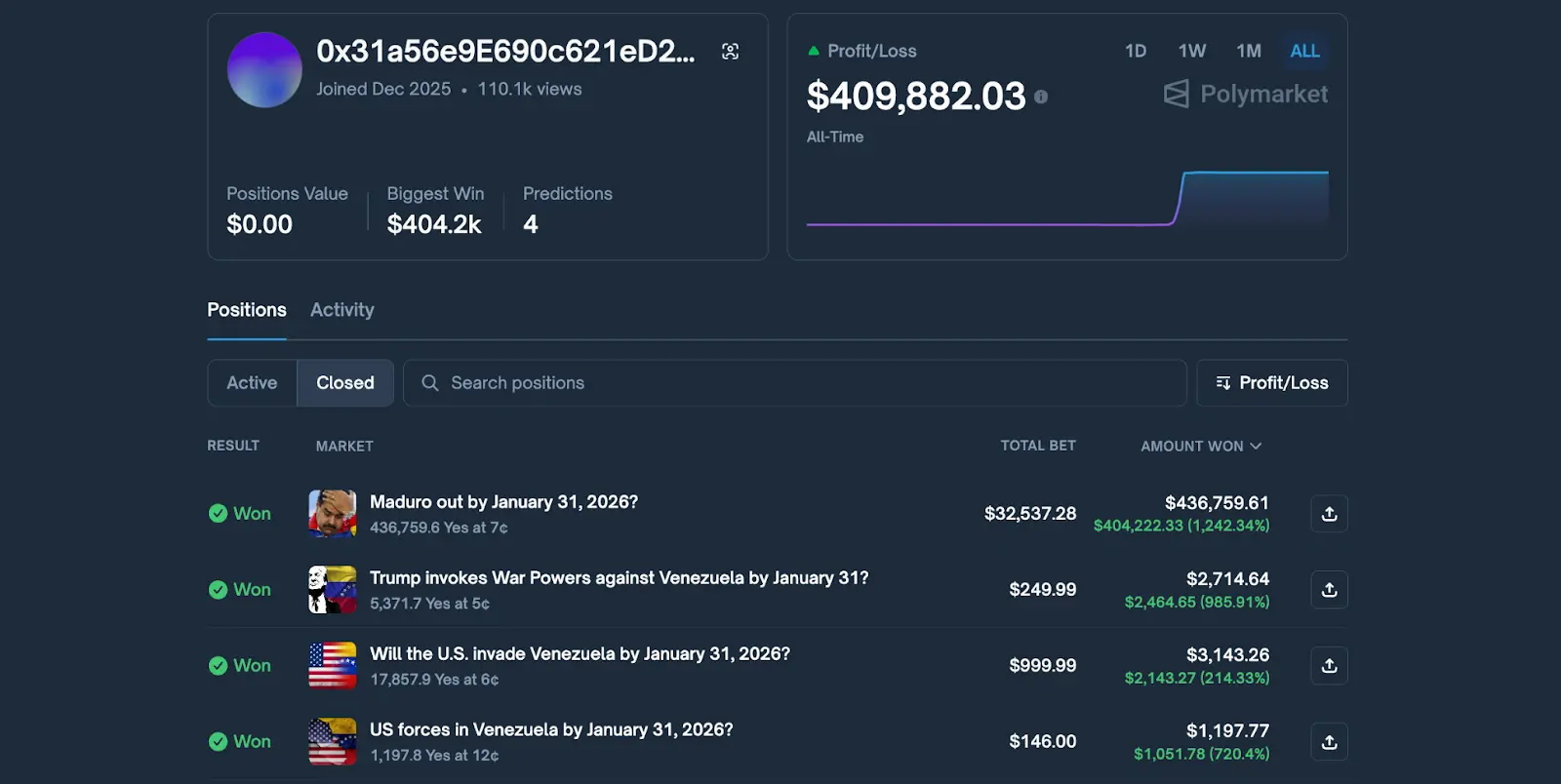
A new account created on Polymarket in late December 2025 seemed to have a god's-eye view, accurately predicting the event. The account made four predictions, all related to whether the U.S. would intervene in Venezuela, with the largest being a bet of $32,537 that "Maduro will step down before January 31." At the time, the market's expected probability for such an extreme event was only in the single digits, and the account swept up contracts at an extremely low price of 7 cents.

As news of Trump confirming military action emerged early Saturday, these contracts instantly surged to near the settlement price of $1. The account profited over $400,000 in less than 24 hours, with a yield of 1242%. This was not ordinary speculation but a precise sniper shot.
Mysterious Prophet or Insider Trading?

This god-like巨额获利 quickly became a focus in the community. As discussions heated up, accusations of insider trading followed:

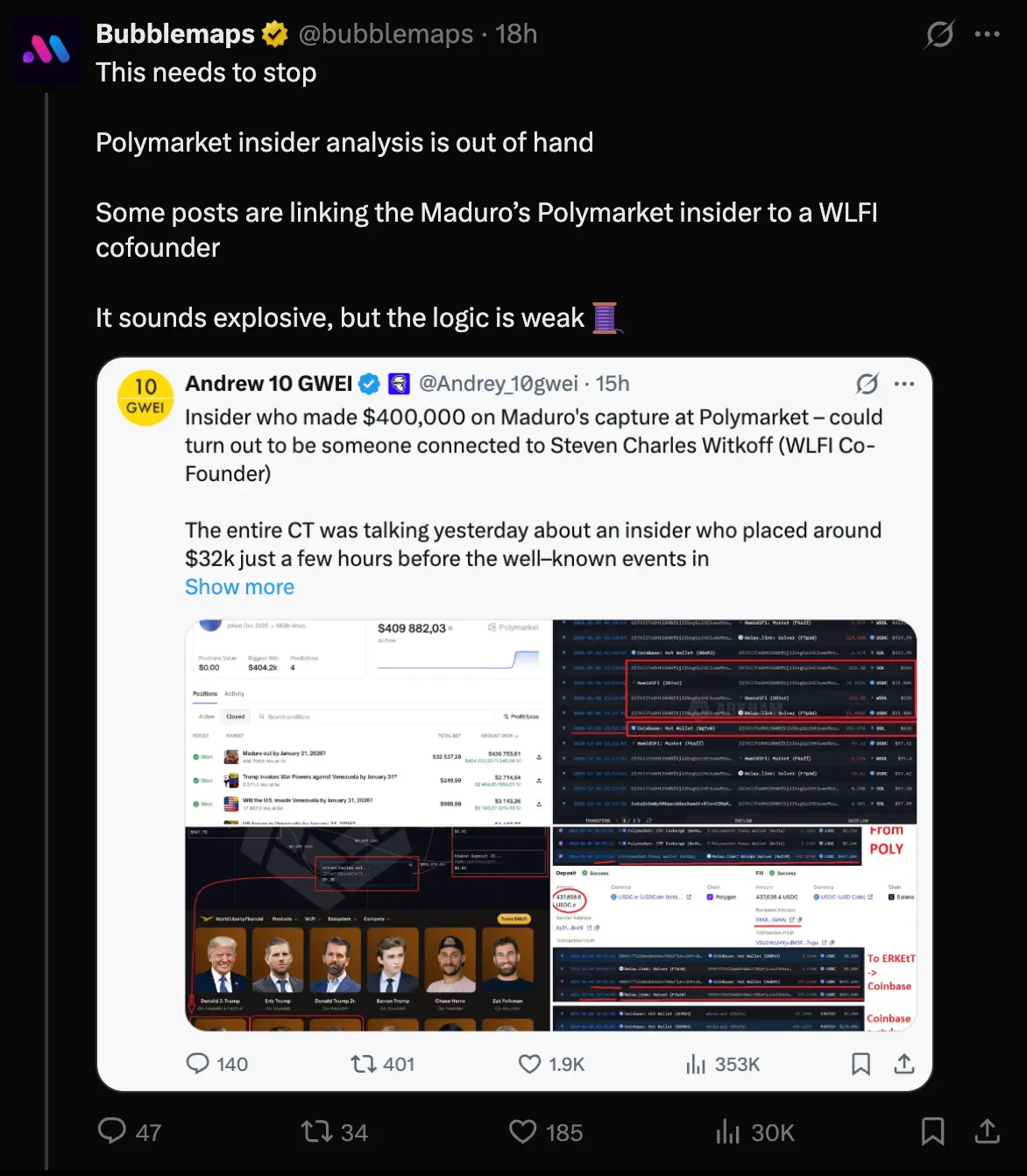
On-chain analyst Andrew 10 GWEI pointed out that the account's fund path showed extremely high similarity: 252.39 SOL withdrawn from Coinbase on January 1 closely matched 252.91 SOL deposited by another wallet the previous day in both amount and time (23 hours apart),疑似通过交易所进行中转断链. More controversially, the associated wallet registered domains like StCharles.sol and had large transactions with an address疑似 belonging to World Liberty Finance (WLFI) co-founder Steven Charles Witkoff. Given WLFI's close ties to the Trump family, this strongly raised suspicions: Was this insider trading using White House internal information?

On-chain analysis platform BubbleMaps later offered a different perspective. They argued that the "time and amount similarity" inference was too superficial, noting at least 20 wallets on-chain fit this pattern, and Andrew's argument lacked direct on-chain fund movement evidence, so there was no reliable proof linking the Polymarket account to the WLFI co-founder.
Representative Proposes Integrity Act: Aiming to Regulate Prediction Market Insider Trading

The incident also led U.S. Representative Ritchie Torres to propose the "2026 Financial Prediction Market Public Integrity Act." The core of the bill is to prohibit federally elected officials, politically appointed officials, and executive branch employees from trading in prediction markets related to government policies using "material non-public information" obtained through their official positions.

However, this bill faces a dual challenge in reality. First is the lengthy and uncertain legislative process; in the complex power dynamics of U.S. politics, such bills often undergo lengthy hearings and interest negotiations, ultimately容易沦为 political statements with little substantive impact.

Second is the enforcement blind spot in a decentralized environment. On-chain fund flows can easily be obscured through various privacy protocols or complex transfer mechanisms. Although the bill symbolizes the formal intrusion of traditional financial values into prediction markets, attempting to protect retail investors from information harvesting and maintain fair participation rights, we must consider: Will directly applying this regulatory logic to decentralized prediction markets create conflicts due to differing core values,甚至导致 prediction markets失灵?

The Core Value of Prediction Markets and the Paradox of Insider Trading

Returning to first principles, what is the purpose of prediction markets? Is it to give everyone a fair chance to profit, or to obtain the most accurate prediction results?

Traditional finance prohibits insider trading to protect retail investors' confidence and prevent capital markets from becoming cash machines for the powerful. But in prediction markets, the core value might be "truth discovery."

Prediction markets are machines that aggregate fragmented information into price signals. If a market about "whether Maduro will step down" prohibits informed participants, then the market's price will always reflect "laypeople's guesses" rather than "true probability," causing the prediction market to lose accuracy.

In the Maduro incident,假设 the profiteer was not an insider but a top information analysis expert. He might have pieced together the likelihood of military action by tracking abnormal radio signals at the Venezuela border, private jet movements, or even the U.S. Department of Defense's public procurement lists, after model inference. This behavior might be highly controversial in traditional regulation, but in the logic of prediction markets, it is an extremely valuable "information pricing behavior."

One mission of prediction markets is to break information monopolies. While各方 are interpreting ambiguous, lagging government diplomatic rhetoric, price fluctuations on prediction markets are already sending early warnings of the truth to the world. Therefore, rather than calling this insider trading, it is more apt to see it as a博弈 that rewards hidden information surfacing through trading, thereby providing real-time risk guidance for the public.

Prediction Markets Are Tools Born for Pursuing Truth, Not Fair Trading Venues

The emergence of the "2026 Financial Prediction Market Public Integrity Act" may reflect regulators' cognitive bias towards decentralized prediction platforms. If we pursue a "completely fair" prediction market, we will ultimately get a "completely ineffective" prediction market.

The Maduro incident深刻揭示了 the true value of prediction markets: It allows hidden truths to be transformed into on-chain signals visible to all through the traces of fund flow. Blockchain transparency breaks the black box; even if we cannot immediately identify the幕后推手, when mysterious accounts heavily build positions and probabilities fluctuate剧烈, the market is actually sending signals. This attracts smart money to quickly follow, rapidly leveling the originally unequal information gap, thereby transforming "insider information" into "public probability."

Prediction markets are not stock markets; they are essentially radars of collective human intelligence. To keep this radar precise, it is necessary to allow the friction cost brought by information arbitrage to a certain extent. Therefore, rather than trying to block signals with bans, should we not instead consider positioning prediction markets as tools born for pursuing truth, rather than fair trading venues?


Twitter:https://twitter.com/BitpushNewsCN

Bitpush TG Group:https://t.me/BitPushCommunity

Bitpush TG Subscription: https://t.me/bitpush

Original Link:https://www.bitpush.news/articles/7600733

Preguntas relacionadas

QWhat was the core event that sparked the debate around insider trading in prediction markets, as discussed in the article?

AThe core event was the arrest of Venezuelan leader Maduro, which was accurately predicted by a Polymarket account that achieved a 1242% return before mainstream media reported the news.

QWhat legislative response did the Maduro prediction incident trigger in the United States?

AIt prompted U.S. Representative Ritchie Torres to propose the 'Financial Prediction Market Public Integrity Act of 2026', aiming to regulate insider trading in crypto prediction markets by prohibiting federal officials from using material non-public information.

QAccording to the article, what is the fundamental purpose of prediction markets: fairness or accuracy?

AThe article argues that the core purpose of prediction markets is accuracy and 'truth discovery', as they are designed to aggregate fragmented information into price signals that reflect real-world probabilities, rather than ensuring fair profit opportunities for all participants.

QHow does the article differentiate between traditional financial markets and prediction markets regarding insider trading?

ATraditional financial markets ban insider trading to protect retail investors and maintain confidence, while prediction markets may benefit from informed trading because it helps produce more accurate predictions, turning hidden information into public signals.

QWhat technological challenge does the article highlight for enforcing insider trading regulations in decentralized prediction markets?

AThe article points out the enforcement blind spot in decentralized environments, where chain fund flows can easily be obscured through privacy protocols or complex transfer mechanisms, making it difficult to track and regulate insider trading.

Lecturas Relacionadas

Single-Day Plunge of 30%, Arthur Hayes Suddenly Liquidates: Why Did ZEC Get Exploded by Security Issues?

On June 5th, Zcash founder Zooko Wilcox disclosed a critical soundness vulnerability in the project's latest Orchard privacy pool. This flaw, found in the elliptic curve multiplication constraints, could allow an attacker to create unlimited counterfeit ZEC within the shielded pool, with transactions appearing valid. The vulnerability was discovered in late May by security researcher Taylor Hornby, who utilized Anthropic's new Opus 4.8 AI model for a targeted audit. The Zcash ecosystem had already performed an emergency network upgrade to patch the issue. However, the detailed disclosure triggered severe market panic, causing ZEC's price to plummet over 30% in a single day. Notably, prominent investor Arthur Hayes announced he had sold his entire ZEC position following the news. The incident starkly challenges the "technological trust" narrative central to privacy coins. Despite years of top-tier cryptographic audits, the bug persisted until uncovered with advanced AI-assisted research. This highlights the growing gap between theoretical perfection and practical implementation in privacy technology. The event serves as a industry-wide warning: in an AI-driven security landscape, the assumption that "undiscovered equals safe" is obsolete. It underscores the urgent need for continuous, proactive security practices combining AI audits, formal verification, and rapid response mechanisms.

foresightnews_apiHace 1 hora(s)

Single-Day Plunge of 30%, Arthur Hayes Suddenly Liquidates: Why Did ZEC Get Exploded by Security Issues?

foresightnews_apiHace 1 hora(s)

Breaking the Curse of DeFi Cascading Liquidations, Vitalik Proposes a New Solution

**Vitalik Buterin Proposes New DeFi Design to Eliminate Forced Liquidations** Ethereum co-founder Vitalik Buterin has published a proposal for a new decentralized finance (DeFi) architecture aimed at removing the automatic liquidation mechanisms prevalent in current lending protocols. The core idea involves creating synthetic assets using options as building blocks, fundamentally avoiding the抵押借贷结构 that triggers forced sell-offs. The proposal responds to a recurring flaw in DeFi: during sharp market downturns, mass自动清算 of under-collateralized positions can exacerbate price declines, creating systemic selling pressure and market instability, as evidenced by recent crypto market volatility. Buterin's model would split an asset like 1 ETH into two option-like derivatives, P and N, pegged to a price index with a set strike price and expiration. At expiry, an oracle determines the settlement price to allocate the underlying ETH between P and N holders. This design eliminates the "cliff" of instant liquidation. Instead, a position's value would gradually drift from its target peg if not actively rebalanced by the user, transferring the rebalancing decision from the protocol to the user or automated tools. A key advantage is the reduced reliance on high-frequency, real-time oracle price feeds, which are vulnerable to manipulation and errors in current systems. The delayed settlement in the options model allows for more robust, fault-tolerant oracle designs. However, significant challenges remain for practical adoption. High transaction costs (slippage) from frequent rebalancing on automated market makers (AMMs) could erode user funds. The model may not be suitable for stablecoins requiring a strict 1:1 dollar peg, as it inherently allows for value drift. Success would depend on developing new liquidity provisioning models and deep markets for these synthetic assets. The proposal represents a fundamental rethinking of DeFi risk management, challenging the industry to explore alternatives to被动集中平仓 rather than merely optimizing existing liquidation processes. It remains a theoretical framework awaiting implementation and testing by development teams.

foresightnews_apiHace 1 hora(s)

Breaking the Curse of DeFi Cascading Liquidations, Vitalik Proposes a New Solution

foresightnews_apiHace 1 hora(s)

Bitcoin's Decline Marks the Transformation of Crypto

Title: The Decline of Bitcoin Marks the Transformation of Crypto While Bitcoin's price recently fell below $70,000, down approximately 45% from its peak, the broader crypto industry is not following it into decline. Instead, crypto is maturing and evolving beyond its dependence on Bitcoin's price movements. Two of Bitcoin's core functions are being usurped. First, AI has captured its role as the primary speculative asset. AI, with its tangible revenue, explosive demand, and massive capital inflows ($700-830 billion in 2024), is siphoning off the speculative "hot money" that once drove Bitcoin. It also contributes to a sustained high-interest-rate environment, further tightening liquidity for assets like Bitcoin. Second, dollar-pegged stablecoins like USDC and USDT have replaced Bitcoin as the crypto market's foundational currency and primary on/off-ramp. Most trading pairs and on-chain transactions are now settled in stablecoins, severing the historical link where all capital inflows had to pass through Bitcoin first. This decoupling allows projects to thrive based on their own fundamentals rather than Bitcoin's price. Examples include Hyperliquid, an on-chain derivatives exchange with annual revenues of $8-13 billion, and prediction market platform Polymarket, valued at $200 billion with $3.65 billion in annual fees. These projects are evaluated on traditional metrics like revenue and user growth. New opportunities are emerging, particularly around privacy. Privacy coins like Zcash (ZEC) are seeing surging demand, while infrastructure like NEAR enables private, cross-chain asset transfers without requiring users to hold a specific token—privacy becomes a universal service layer. In this new paradigm, stablecoins are the universal cash, various project tokens represent equity, and privacy-enabled cross-chain coordination layers (like NEAR) act as the critical infrastructure connecting a fragmented, multi-chain ecosystem. Bitcoin is now just one asset among many. The era where the entire crypto market moved in lockstep with Bitcoin is over. The industry's health should now be judged by project fundamentals—real revenue, active users, and tokenomics that capture value—and the development of the underlying infrastructure enabling a mature, dollar-denominated crypto economy.

foresightnews_apiHace 1 hora(s)

Bitcoin's Decline Marks the Transformation of Crypto

foresightnews_apiHace 1 hora(s)

Lightspark CEO: In Ten Years, Bitcoin Will Be as Invisible as TCP/IP, Yet Power Trillions in Daily Transactions

A decade from now, Bitcoin will function like TCP/IP — invisible yet foundational, supporting trillions in daily transactions globally, according to Lightspark CEO David Marcus. In this future, a coffee shop in Lagos receives instant payment, a manufacturer in São Paulo settles an invoice with a supplier in Ho Chi Minh City, and a freelancer in Bangalore gets paid weekly from an Austin startup — all via Bitcoin's settlement layer, with none of the parties consciously interacting with it. This vision parallels the adoption of open protocols: first driven by necessity where existing systems fail, then scaling rapidly as tools mature and economic benefits become clear. The structural shift begins with wallets. Modern non-custodial wallets, like Spark, allow users to hold dollars, local currency, and Bitcoin in a single address, seamlessly switching between them. This eliminates friction and revolutionizes global custody, moving significant deposits to user-controlled keys not by ideology, but by superior utility. As a result, Bitcoin becomes the default savings layer for billions, as its fixed supply and appreciating value make it a rational choice for savers holding it alongside stablecoins in their everyday wallets. Businesses follow a similar path, from small companies in emerging markets to multinational corporations, holding Bitcoin alongside operational stablecoins. The latest trend is direct Bitcoin transactions for commerce. When both parties hold Bitcoin, transacting in it becomes the simplest option — no conversions, no intermediary currency. This starts in niche areas like high-value B2B settlements but grows as infrastructure makes sending Bitcoin as easy as stablecoins. An accelerating force is AI agents. By 2036, AI agents conducting commerce on behalf of individuals and firms will increasingly choose Bitcoin for settlement. Optimizing for speed, finality, and minimal counterparty risk across jurisdictions, they find Bitcoin's global, neutral, and programmable network ideal for netting and settling obligations. Thus, Bitcoin is becoming the native currency for machine commerce, just as it has become a native savings asset for humans. The global monetary system is being rebuilt from the protocol layer: open infrastructure, default self-custody, Bitcoin settling everything underneath, with stablecoins as the interface. Most users won't think about Bitcoin when they transact — and they won't need to.

foresightnews_apiHace 1 hora(s)

Lightspark CEO: In Ten Years, Bitcoin Will Be as Invisible as TCP/IP, Yet Power Trillions in Daily Transactions

foresightnews_apiHace 1 hora(s)

Trading

Spot
Futuros
活动图片